September 5, 2025
Note: This analytical essay examines patterns in juvenile homicide data from 2016-2022. All statistics come from verified government sources. Case examples are from documented news reports. Expert perspectives are drawn from published academic work.
In November 2022, a sixteen-year-old boy in Bensalem, Pennsylvania, shot and killed his thirteen-year-old ex-girlfriend. What made this murder unprecedented wasn’t the age of the participants or even the weapon used. It was what happened next: the killer opened Instagram, started a video call, and showed the body to another teenager, asking for help disposing of it. The recipient’s mother called 911, reporting that the boy had not only sent the Instagram video but was repeatedly texting her daughter, pleading for help^[1].
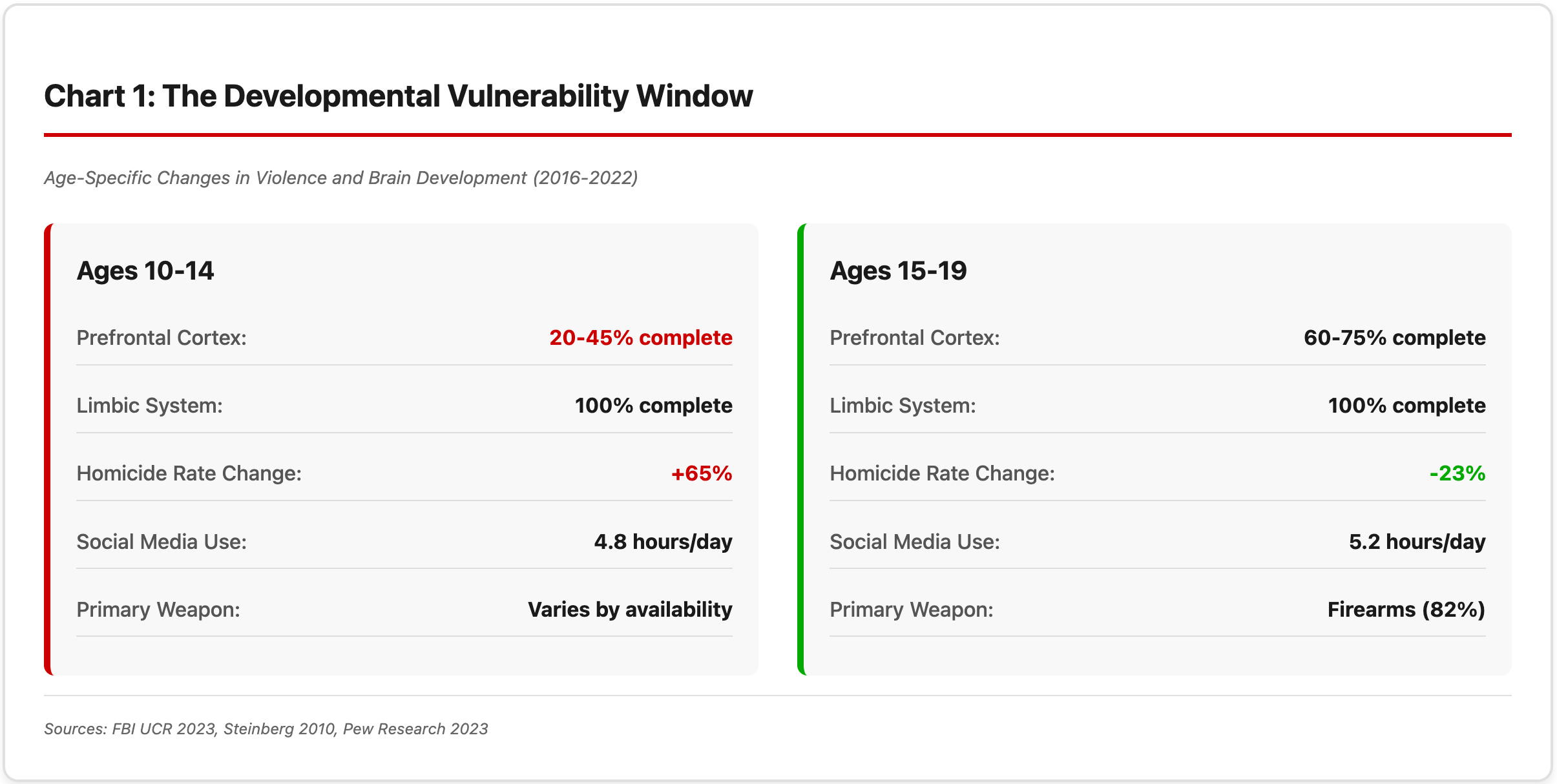
This case represents a new category of crime that shouldn’t exist: murder as social media content. Between 2016 and 2022, homicides committed by juveniles aged 10-14 increased by 65%, from 315 to 521 cases, while homicides by older teenagers aged 15-19 decreased by 23%^[2]. This age-specific divergence defies traditional criminological explanations. Poverty didn’t suddenly affect only middle schoolers. Gang dynamics didn’t shift to exclude high schoolers. What changed was the collision between a specific developmental vulnerability and a technology designed to exploit it.
The data reveals a mechanism as precise as it is disturbing. Children aged 10-14 exist in a unique neurological state where their emotional systems have matured to adult levels while their impulse control remains embryonic. Social media platforms, through algorithms that maximize engagement by amplifying conflict, have inadvertently weaponized this developmental gap. The result is children who possess sophisticated understanding of social manipulation but the emotional regulation of toddlers, armed with both digital platforms and lethal weapons.
The Neuroscience of Vulnerable Kids
The adolescent brain operates with what researchers call a “dual-systems imbalance.” According to Laurence Steinberg’s extensively cited research, the limbic system (governing emotions and rewards) matures by early adolescence, while the prefrontal cortex (controlling impulses and decision-making) doesn’t fully develop until the mid-twenties^[3]. This creates a period of maximum vulnerability between ages 10-14 when emotional reactions are adult-strength but cognitive brakes are barely functional.
This isn’t new information. What’s unprecedented is the systematic exploitation of this vulnerability. The average American teen spends 4.8 hours daily on social media according to Pew Research Center data from 2023^[4]. During those hours, their still-developing brains encounter what Steinberg describes as persistent “hot cognition” states: emotionally charged decision-making contexts where the adolescent brain performs worst^[5].
Every notification triggers the same neurological response as physical threat. Every public comment activates social evaluation circuits. Every conflict escalates in full view of hundreds of peers. The adolescent brain, already struggling with impulse control, never gets to return to baseline. It exists in perpetual threat-detection mode, making decisions from a state of chronic arousal that would impair even adult judgment.
[Chart: The Developmental Vulnerability Window]
Online Disinhibition, Livestreamed Teen Homicides
In 2004, psychologist John Suler identified six factors that reduce behavioral inhibitions online: dissociative anonymity, invisibility, asynchronicity, solipsistic introjection, dissociative imagination, and minimization of authority^[6]. He was studying adults posting inappropriate comments. He couldn’t have imagined these factors would explain children committing murder.
The documented cases demonstrate this effect with horrifying clarity. In March 2022, two cousins in St. Louis, aged 12 and 14, were livestreaming on Instagram when one accidentally shot the other before shooting herself. The family described it as a “freak accident” during what the children treated as performance^[7]. The platform transformed a private tragedy into public content, with the children unable to distinguish between digital performance and lethal reality.
Multiple documented cases follow this pattern. A teenager in Detroit livestreaming on Instagram accidentally shot his friend in April 2018^[8]. Two women in Mississippi were fatally shot on Facebook Live after a fight in April 2023^[9]. The platform doesn’t just document violence; it fundamentally alters how young people conceptualize it.
The Control Group That Researchers Are Missing
This is actually my personal theory in my analysis of international data, criminal records, psychologists, neuroscience and news events. The most compelling evidence comes from what didn’t happen. While 10-14 year olds showed a 65% increase in homicide rates, 15-19 year olds experienced a 23% decrease during the exact same period^[10]. Same cities. Same schools. Same access to weapons. Same social media platforms. The only difference? Brain development.
By age fifteen, the prefrontal cortex has developed enough to provide what researchers call “cognitive braking power.” Not enough to fully resist social media’s manipulation, but sufficient to pause before acting on violent impulses. This age-specific pattern appears globally. In the UK, knife murders by children under 15 increased 93% between 2014-2019, while the 15-17 age group saw only a 12% increase^[11].
While the COVID-19 pandemic accelerated these trends through forced digital immersion and social isolation, the divergent pattern between age groups began in 2016, well before the pandemic. The pandemic acted as an accelerant on an existing fire, not the initial spark.
The parallel extends beyond homicide. CDC data shows self-harm hospitalizations among 10-14 year olds increased 188% from 2010-2020, while the 15-19 age group experienced a 48% increase^[12]. These are massive increases. Jonathan Haidt is the leader in psychology. But no one has quite correlated brain development, the two very different age groups (Most people lump all teens in the same group.), and even gender like I show here. Whether the violence turns outward or inward, the pattern remains consistent: maximum vulnerability at ages 10-14, declining as cognitive control develops.
[Charts: Global Age-Specific Violence Patterns]
Social Sophistication ≠ Emotional Regulation
Social media creates a specific type of cognitive distortion in young users. Through constant exposure to complex social dynamics, manipulation tactics, and status games, children develop what appears to be sophisticated social intelligence. They learn to craft messages for maximum emotional impact, understand audience dynamics, and orchestrate multi-platform campaigns of harassment or humiliation. While Boomers and Gen-X suffered clichéd political cartoons only in color on Sunday, Gen-Z and Millennials are doomscrolling 1000 memes a day, just to find the perfect one to forward.
But this sophistication is artificial, like teaching someone to fly a plane simulator without explaining that real planes carry real people. These children understand the mechanics of social warfare but lack the emotional context to grasp its consequences. They can execute complex psychological operations but explain their actions with the reasoning of elementary schoolers: “She was annoying.” “He disrespected me.” “Everyone was watching.”
Research by Jean Twenge and Jonathan Haidt, while controversial in its broader claims about social media causing depression, documents one undeniable fact: social media use peaks precisely during the developmental window of maximum vulnerability^[13]. Whether this causes depression (as Haidt argues) or simply correlates with it (as critics like Candice Odgers contend), the timing alignment with increased violence is too precise to be coincidental^[14].
Big Tech Knows and Doesn’t Care
The question of platform culpability rests on what companies knew and when. While no smoking-gun documents have emerged showing platforms deliberately encouraged youth violence, the broader pattern of prioritizing engagement over safety is well-documented.
Frances Haugen’s 2021 whistleblower testimony revealed that Meta’s own research showed Instagram was harmful to teenage girls’ mental health^[15]. The company’s internal studies demonstrated that algorithmic amplification of controversial content increased user engagement but also increased harmful behaviors. While these studies focused on depression and eating disorders rather than violence, they established that platforms understood their products’ capacity to harm developing minds.
The platforms’ defense mirrors historical precedents. Like tobacco companies claiming nicotine wasn’t addictive or car manufacturers resisting seatbelt requirements, social media companies argue that correlation doesn’t prove causation. They’re technically correct. But when the correlation is this specific (age 10-14), this consistent (across multiple countries), and this dramatic (65% increase), the burden of proof shifts.
If Big Tech did care, they wouldn’t have missed $11 billion a year. Many years back they would have banned their apps to college students and above. They would try out some other market or demographic instead. Because it’s a free market, where you are free to make your money however you want, unless it’s criminal, right? Wrong!
The Shocking, Unprecedented Rise of Girls Committing Homicide
Perhaps no aspect of this crisis challenges traditional criminology more than the emergence of girls as perpetrators of serious violence. Historical FBI data shows that from 1980-2010, girls aged 10-14 committing murder were so rare they weren’t tracked as a distinct category^[16]. By 2022, they represented 12% of juvenile homicide arrestees in that age group^[17].
This isn’t girls “becoming more like boys.” The documented cases show distinctly different patterns. Where boys’ violence tends to be immediate and physical, girls’ violence often involves planning, documentation, and performance. The platforms amplify traditionally female forms of aggression (relational, reputational, social) while providing pathways to physical violence that didn’t previously exist.
The shift represents something genuinely new in human behavior: a category of criminal that couldn’t exist before social media. These aren’t crimes of poverty, mental illness, or abuse (though those factors still contribute to other violence). They’re crimes of algorithmic amplification, where the platform’s design transforms normal adolescent conflict into lethal violence.
[Charts: The Emergence of a New Category of Crime, Female Ages 10-14]
Would You Allow Kids to Watch Pornography for Five Hours a Day?
Consider this: no responsible parent would allow their 12-year-old to watch pornography for five hours daily. The idea is absurd, horrifying. Yet those same parents buy their children smartphones, celebrate their first Instagram accounts, and consider two hours of TikTok before bed normal.
The comparison actually understates the problem. Pornography distorts sexuality and relationships, certainly harmful to developing minds. But nobody consumes porn for 4.8 hours every single day. Nobody livestreams murders on PornHub. And critically, porn doesn’t train children to kill each other.
Social media is pornography for the adolescent aggression system, except worse: it’s socially endorsed, school-supported, and parentally provided. We’ve created a delivery mechanism for psychological manipulation that would be illegal in any other context. Imagine proposing an experiment where 10-14 year olds spend five hours daily in an environment designed to maximize emotional dysregulation while teaching sophisticated manipulation tactics. No ethics board would approve it. Yet we’ve run this experiment on an entire generation.
That was the good news. The bad news is that no one has a clue if cell-phone induced frontal cortex developmental delay is permanent. It would be virtually impossible until one whole generation goes without cell phones. That’s scary.
The Parent’s Dilemma: Your Child as Victim or Perpetrator
Here’s what should keep parents awake: your child doesn’t need to be troubled, traumatized, or violent to become a killer. They just need to be 13, on social media, and caught in the wrong algorithmic spiral. The boy in Bensalem was described by neighbors as quiet, troubled only by medication side effects. The cousins in St. Louis were playing. Normal children are being transformed into murderers by a machine designed to maximize engagement.
Worse, the violence isn’t confined to peers. While most documented cases involve adolescents killing other adolescents, the mechanism that transforms digital conflict into physical violence doesn’t discriminate. A younger sibling who “embarrasses” them online. A parent who takes their phone. Anyone who threatens their digital reputation becomes a potential target when operating from a brain stuck in permanent threat-detection mode.
But here’s the trap: removing your child from social media doesn’t protect them. It might make them more vulnerable. Children organize violence on platforms your child can’t see. They plan attacks in Discord servers, coordinate on Snapchat, broadcast humiliation on TikTok. The child without social media loses both social connection and situational awareness. They become the perfect victim: isolated, unaware, unable to see the digital storm gathering around them.
Imagine a parent described discovering threats against her daughter only through screenshots from another parent. Her daughter, forbidden from Instagram, had no idea she was being targeted. The attack planning, documentation, and celebration all happened online. She walked home from school unaware that hundreds of peers had watched her targeting being orchestrated for days. While this specific scenario is illustrative rather than a documented case, it represents patterns seen in multiple incidents where offline children become vulnerable to violence planned entirely in digital spaces they cannot monitor.
The only successful cases appear to involve entire communities moving together. When whole grades or schools implement phone-free policies simultaneously, no individual child becomes the isolated target. Some communities have formed collective pacts where dozens of families commit to delaying smartphone access together. But these remain rare exceptions in an ecosystem designed to prevent exactly this kind of collective resistance.
The Path Forward
The solution appears simple: prohibit social media access for children until college. Real age verification, real enforcement, real penalties. Several countries are moving in this direction. Australia passed legislation in late 2024 to ban social media for users under 16^[18]. The UK’s Age Appropriate Design Code requires platforms to prioritize children’s safety in their design^[19].
Critics argue this is technologically unfeasible or philosophically wrong. They’re correct that perfect enforcement is impossible. But perfect enforcement isn’t the standard for public health interventions. We don’t achieve perfect compliance with underage drinking laws, but they still reduce adolescent alcohol deaths. We don’t prevent all teenagers from smoking, but restrictions dramatically reduced teen smoking rates.
The deeper challenge is political will. The youth social media market generates $11 billion annually from U.S. users under 18, according to a Harvard study^[21]. Platform companies employ thousands of lobbyists and contribute millions to political campaigns. Against this, we have rising body counts of dead children and academic debates about correlation versus causation.
What the Data Strongly Suggests
The evidence, while not meeting the standard of randomized controlled trials, forms a compelling pattern that strongly suggests a causal relationship:
* Violence increased specifically in the age group (10-14) with maximum neurological vulnerability
* Violence decreased in the age group (15-19) with more developed impulse control
* The pattern replicates across multiple countries regardless of weapon type
* The timing aligns precisely with peak social media adoption
* The cases show novel patterns (livestreaming, online origin) absent from historical violence
This isn’t proof in the laboratory sense. But public health doesn’t wait for perfect proof. When a new drug shows a 65% increase in adverse events for a specific age group, we don’t wait for decades of studies. We act on the precautionary principle.
The alternative is accepting that we’ve created a machine that turns children’s developmental vulnerabilities into weapons against themselves and others. Every month of delay means more teenagers like the boy in Bensalem, sending Instagram videos of bodies, asking for help with a problem that shouldn’t exist.
The algorithm doesn’t care about causation debates. It only counts engagement. And dead children, it turns out, generate significant engagement.
Footnotes
^[1]: NBC Philadelphia, “Pennsylvania teen confesses to murder and shows body on Instagram video chat,” November 28, 2022. URL: https://www.nbcphiladelphia.com/news/local/bensalem-teen-murder-confession-instagram/3436403/
^[2]: Council on Criminal Justice, “Trends in Juvenile Offending 2016-2022,” 2023. URL: https://counciloncj.org/trends-juvenile-offending-2023
^[3]: Steinberg, Laurence, “A Dual Systems Model of Adolescent Risk-Taking,” Developmental Psychobiology, Volume 52, Issue 3, 2010, pp. 216-224.
^[4]: Pew Research Center, “Teens, Social Media and Technology 2023,” May 2023. URL: https://www.pewresearch.org/internet/2023/05/teens-social-media-technology-2023/
^[5]: Steinberg, L., “A Social Neuroscience Perspective on Adolescent Risk-Taking,” Developmental Review, Volume 28, Issue 1, 2008, pp. 78-106.
^[6]: Suler, John, “The Online Disinhibition Effect,” CyberPsychology & Behavior, Volume 7, Issue 3, 2004, pp. 321-326.
^[7]: NBC News, “Two cousins, 12 and 14, killed while playing with gun on Instagram Live,” March 29, 2022. URL: https://www.nbcnews.com/news/us-news/two-cousins-12-14-killed-playing-gun-instagram-live-rcna21837
^[8]: Wikipedia, “Livestreamed crime,” accessed December 2024. URL: https://en.wikipedia.org/wiki/Livestreamed_crime
^[9]: Ibid.
^[10]: Federal Bureau of Investigation, Uniform Crime Reporting Program 2016-2022, U.S. Department of Justice, 2023.
^[11]: Office for National Statistics, Crime in England and Wales: Year Ending March 2023, UK Statistics Authority, 2023.
^[12]: Centers for Disease Control and Prevention, Web-based Injury Statistics Query and Reporting System (WISQARS), 2023.
^[13]: Haidt, J., “Social Media is a Major Cause of the Mental Illness Epidemic in Teen Girls. Here’s the Evidence,” After Babel, February 2023.
^[14]: Odgers, Candice L., “The great rewiring: is social media really behind an epidemic of teenage mental illness?” Nature, March 29, 2024.
^[15]: Securities and Exchange Commission, “Testimony of Frances Haugen,” October 2021.
^[16]: Federal Bureau of Investigation, Uniform Crime Reports 1980-2010, U.S. Department of Justice, 2011.
^[17]: Office of Juvenile Justice and Delinquency Prevention, Statistical Briefing Book, 2023.
^[18]: Australian Government, “Online Safety Amendment (Social Media Minimum Age) Bill 2024.”
^[19]: UK Information Commissioner’s Office, “Age Appropriate Design Code,” 2021.
^[20]: Business of Apps, “Social Media Revenue,” 2023 estimates.
^[21]: Raffoul, A., et al., “Social media platforms generate billions of dollars in revenue from U.S. youth: Findings from a simulated revenue model,” PLOS ONE, December 27, 2023. URL: https://journals.plos.org/plosone/article?id=10.1371/journal.pone.0295337