March 13, 2026
Bloomberg charges $35/month for market coverage. The Financial Times charges $42. The Economist charges $17. Original analysis by Tatsu with 40+ footnotes: $8/month.
Share this preview with others who should see this.
On the evening of March 12, NBC News published a sentence that will matter more than any missile fired that day. Senior US military officials privately told reporters:
"The idea that air strikes could easily wipe out decades of Iranian investment in asymmetric warfare was a miscalculation."[1]
I wrote this on March 9:
"The story isn't Russia. The story is China. And nobody in the prestige press is telling it. I can argue that with this Chinese tech, Iran is winning the war and the US is losing, before they even run out of interceptors very soon and the suicidal option of boots on the ground goes on the table."[2]
I wrote this on March 10:
"Each Shahed costs roughly $20,000 to $50,000; each Patriot intercept runs $3 to $6 million. Sustained saturation campaigns don't need to penetrate defenses to win. They need to exhaust them."[3]
Robert Pape, who has advised every White House since 2001 and built the curriculum that trains the Air Force for exactly this kind of war, told Diary of a CEO on March 12 that the entire campaign was a three-stage escalation trap: air strikes succeed tactically, politicians declare victory, and then the ground invasion nobody planned for becomes inevitable. He gives it 75% odds.[4]
None of this is hindsight. The interceptor depletion math was published before it became classified briefing material. The Chinese precision strike architecture was documented before Hezbollah used it to penetrate Iron Dome. The escalation framework was laid out before the Pentagon started leaking to NBC that the plan was flawed. The generals are now building the evidentiary record for "we told them so." The problem is that some of us told them first.
Everything that happened on Days 12 and 13 proves the thesis.
What this article covers:
* Hezbollah penetrated Iron Dome on Day 13 using the same Chinese BeiDou precision guidance I documented on March 9. Nobody in the mainstream press has connected this.
* Over 1,000 Patriot interceptors expended. CSIS estimated 3-5 weeks to critical depletion. We are on Day 13. Hezbollah's second front doubles the drain rate.
* Iraq shut down all oil ports. Iran has taken ~20 million barrels/day off the global market. The IEA dumped 400 million barrels, the largest emergency release in history. Brent crossed $100 anyway.
* The Pentagon confirmed a US Tomahawk struck a girls' school on Day 1 using outdated intelligence. 168 children, 14 teachers. WashPo reports an AI-generated target list may have been involved.
* Iran's invisible Supreme Leader rejected ceasefire. Iran's elected president offered three conditions. The rift between civilian and military authority in Tehran is now visible.
* A man in Michigan who lost four family members to Israeli airstrikes attacked a synagogue. The war has produced its first domestic blowback attack.
* Robert Pape gives 75% odds of ground deployment. The 82nd Airborne's training is still cancelled. The campaign was sequenced backwards, and the Pentagon is beginning to admit it.
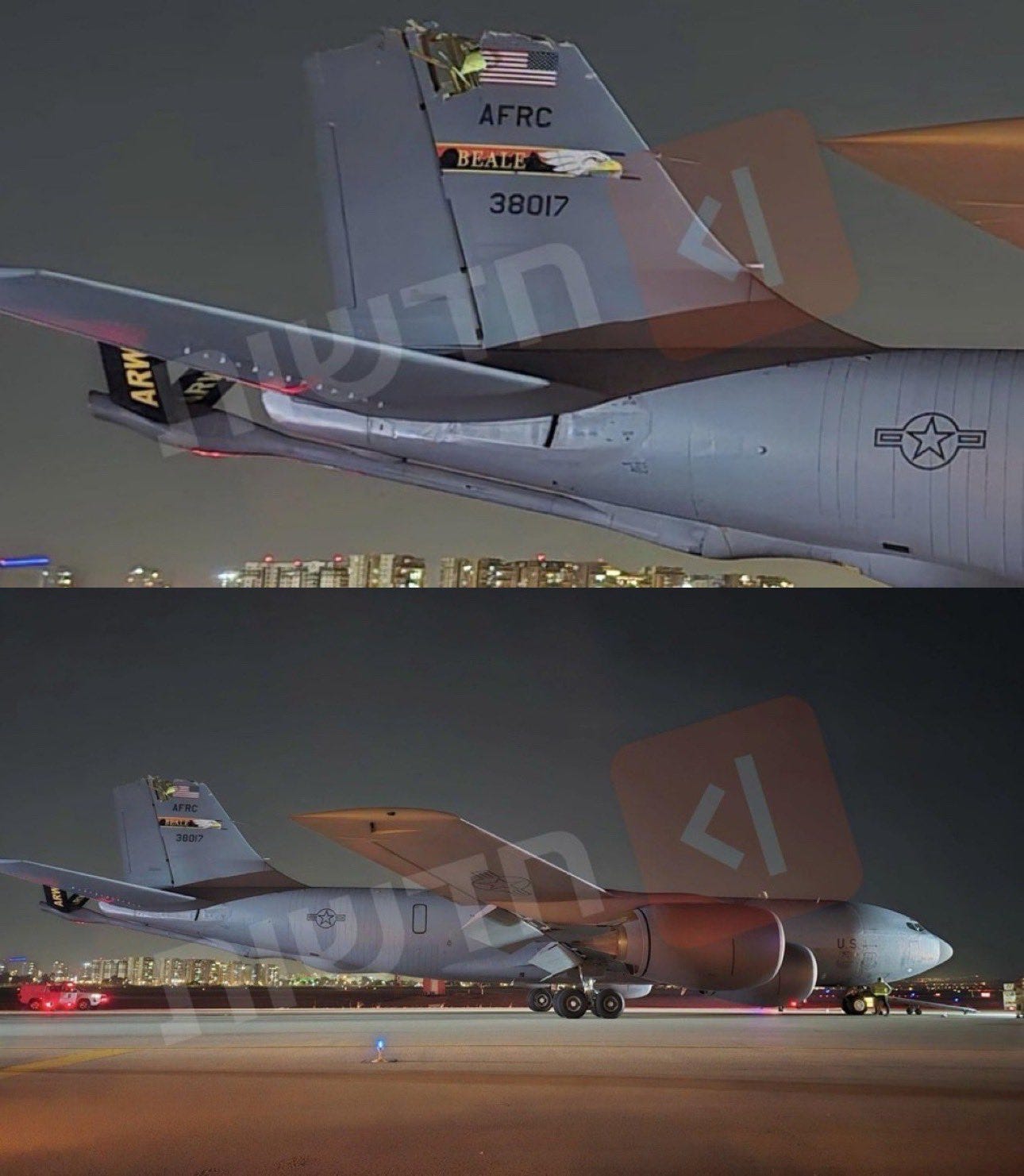
CENTCOM denies hostile fire on the other KC-135 that crashed and killed four servicemen in Iraq, but likely Iranian SAM hit it, went out of control, took the vertical stabilizer off this KC-135 Refueler, lost its wing, crashed. Meanwhile this one limped back to Ben Gurion airport. CBS reported hostile fire, but the Pentagon ordered the reporter to remove the tweet.
Full investigation below. $8/month for analysis that's ahead of the Pentagon.
Hezbollah Has Precision Strike Capability
On Day 13, Hezbollah launched approximately 200 rockets and 20 drones at northern Israel, its largest barrage since the war began, timed to coincide with Iranian ballistic missile strikes on Tel Aviv and Haifa. This was not a gesture of solidarity. It was a coordinated, integrated multi-axis attack designed to overwhelm Israeli air defenses from two directions simultaneously.[5]
It worked. The New York Post, citing Israeli military sources, reported that Hezbollah rockets "penetrated" the Iron Dome system. Of 100 rockets fired in one wave, some got through.[6] A rocket from Lebanon struck Netanya, approximately 30 kilometers north of Tel Aviv, the deepest Hezbollah strike into Israeli territory during this war. Iranian missiles made direct impacts in Karmiel (facing "little to no interception attempts" per OSINT footage) and the Arab town of Zarzir, west of Nazareth, where at least 30 people were injured.
This is where the BeiDou kill chain article becomes operational.[2] The question nobody in the prestige press asked after Iron Dome was penetrated is the one I answered three days earlier: why are these rockets suddenly accurate?
The answer is the same Chinese satellite navigation system that transformed Iranian ballistic missiles from 99% intercepted in April 2024 to THAAD radars destroyed in the Jordanian desert in March 2026. BeiDou's Precise Point Positioning service delivers centimeter-level accuracy to authorized military users, and it is not subject to the same GPS spoofing that degrades Western-guided munitions.[7] Iran has access to this system through a bilateral defense agreement signed in Beijing in 2015. Hezbollah has access to it through Iran. The precision upgrade that turned Iranian missiles into radar-killers is the same upgrade that is now turning Hezbollah rockets into Iron Dome penetrators.
The Washington Post ran "Russia is helping Iran" as the frame. Russia's intelligence contribution is real but largely redundant with what Chinese commercial satellite imagery was already publishing on social media for free. The actual transformation, the system that converted inaccurate rockets into precision weapons capable of hitting specific buildings in Karmiel, traces to Beijing. Defense Secretary Hegseth said China is "not really a factor." On Day 13, Chinese-enabled precision strikes penetrated the most celebrated missile defense system in the world.
Israel's response was immediate and escalatory. The IDF destroyed 10 Hezbollah command posts in Beirut's southern suburbs, Defense Minister Katz warned Lebanon he would "take territory," and the IDF Chief of Staff declared the burden of "pacifying" the south falls on Israel.[8] Since March 2, Israeli strikes on Lebanon have killed at least 687 people, including 98 children, and displaced more than 800,000.
The multi-front architecture is not expanding by accident. It is expanding by design, and the design runs through the same Chinese satellite system that Pete Hegseth says is "not really a factor."
The Interceptor Hourglass
Here is the math I published on March 10, before the Pentagon briefed it to Congress.[3]
Over 1,000 PAC-3 Patriot interceptors have been expended against 2,100+ Iranian drones and 700+ ballistic missiles. Bloomberg reports this is depleting global Patriot stockpiles, directly affecting Ukraine's air defense capability.[9] Each PAC-3 round costs $3 to $6 million. Each Shahed drone costs $20,000 to $50,000. Iran does not need to penetrate the shield. It needs to empty it.
CSIS estimated 3 to 5 weeks from conflict start before critical interceptor depletion. We are now on Day 13. The clock I described in the Bahrain article is not theoretical anymore. It is the central fact of the war.
Hezbollah's second front compounds the problem exponentially. Every Israeli interceptor fired at a Hezbollah rocket is one not available for Iranian ballistic missiles. Every Iron Dome battery repositioned to the northern border is one not covering Tel Aviv. Hezbollah is performing the exact function it was designed for: a strategic second front that drains the same finite interceptor pool from a different direction.
Perhaps one of the US goals should have been to break the axles between Iran, Hezbollah, the Houthis, and other aligned parties, but one supposes, "Well that's Israel's problem".
And the cost-exchange ratio is catastrophic on both fronts. The Pentagon briefed Congress that the first six days of Operation Epic Fury cost $11.3 billion, significantly higher than the earlier $900 million per day estimate.[10] At the updated burn rate of approximately $1.88 billion per day, the 13-day cost approaches $24.4 billion. Officials told NBC a supplemental funding request is coming, possibly exceeding $50 billion. Iran's IRGC announced its "41st wave" of attacks on Day 13. The IRGC claims it can sustain six months at this pace. The interceptor math says the coalition cannot sustain six weeks.
Mearsheimer's argument, that the US attack on Iran has worsened Ukraine's battlefield situation by diverting munitions and attention, is no longer theoretical. It is measurable. Every Patriot round fired at a Shahed over Bahrain is one that does not exist over Kharkiv. The Iran war is not just depleting American missile defense. It is depleting the global stockpile that underpins the entire Western security architecture.
Iraq Goes Dark
While Hezbollah was draining interceptors from the north, Iran opened a new front in the south. Two fuel tankers, the Marshall Islands-flagged Safesea Vishnu and the Malta-flagged Zefyros, were struck in Iraqi territorial waters near Basra. At least one crew member was killed. Separately, the IRGC claimed it hit the US-owned Safe Sia in the northern Persian Gulf after it "failed to comply with warnings," and published strike footage.[11]
Iraq's response was immediate: it suspended all oil terminal operations. Every port, every loading facility, offline.
Iraq exports approximately 3.3 million barrels per day, making it OPEC's second-largest producer. Combined with the continued Hormuz disruption, Iran has now taken roughly 20 million barrels per day off the global market. That is not a disruption. That is a structural break in global energy supply. Iran demonstrated in a single morning that it can reach oil infrastructure in Iraq, Oman, Saudi Arabia, and the UAE simultaneously.
Three more commercial vessels were hit on Day 12 in the Strait itself: the Thailand-flagged Mayuree Naree (fire, crew evacuating, three members still missing), the Japan-flagged One Majesty, and the Marshall Islands-flagged Star Gwyneth. Total ships attacked since the war began: at least 22.[12]
The US Navy is still refusing "near-daily requests" from the shipping industry for military escorts, telling shippers the risk is "too high" and it does not have enough vessels to escort while running combat operations.[13] Trump's convoy promise remains vapor. The Navy cannot fight the war and protect the trade routes the war is destroying.
One detail from Day 13 tells you where this is heading. A Liberia-flagged tanker, the Shenlong, carrying 135,335 metric tonnes of Saudi crude, arrived safely at Mumbai after transiting the Strait of Hormuz. India's Foreign Minister Jaishankar negotiated safe passage directly with Iran's FM Araghchi. Iran subsequently allowed Indian-flagged tankers to pass.[14] A BRICS-mediated arrangement. Iran is not blocking global oil. It is redirecting it. The strait is closed to the West, open to strategic partners. This is what asymmetric warfare looks like when it works, and it is exactly what the Pentagon just admitted it failed to anticipate.
Band-Aids and Arterial Spray in Markets
On Day 12, the IEA's 32 member countries unanimously approved the largest coordinated drawdown of strategic petroleum reserves in the agency's 51-year history: 400 million barrels, with the United States contributing 172 million from the Strategic Petroleum Reserve.[15] This is after Trump roundly denounced Biden for doing the same thing in his term.
The market's response was the verdict. Brent crude closed at $100.46 per barrel, up 9.2%, the first close above $100 since August 2022. NBC called it the "largest supply disruption in the history of the global oil market."[16] The record emergency release did not prevent $100 oil. It happened the same day.
The Strait normally handles roughly 20 million barrels per day. Four hundred million barrels replaces 20 days of lost flow, but the IEA's own logistics estimate is 60 to 90 days before meaningful volumes reach refineries. The US SPR drops to roughly 223 million barrels after this release, the lowest since 1984. The reserve that was designed for a 90-day emergency now covers 35 days. If Hormuz remains closed beyond that (Iran says it will), the United States will have spent its strategic cushion with no second move.
The Dow fell 739 points, dropping below 47,000 for the first time in 2026. Goldman Sachs fell 4.47%. JPMorgan warned of a 10% correction. Yardeni Research raised the probability of a "market meltdown" to 35%. Citi evacuated its Dubai headquarters.[17]
Iran's state media offered a number: $200 per barrel if the war continues.
Minab School Admission by US
The Pentagon's preliminary assessment confirmed what Bellingcat and BBC Verify had already documented independently. A US Tomahawk cruise missile struck the Shajareh Tayyiba girls' school in Minab, Iran on February 28, Day 1 of the war. One hundred and sixty-eight children and fourteen teachers were killed.[18]
The strike used outdated DIA intelligence that identified the school as part of an adjacent IRGC base. The school had been physically separated from the facility by a wall built between 2013 and 2016. The intelligence assessment predated the separation. Human Rights Watch called for the strike to be investigated as a war crime.[19] On March 13, the Washington Post reported that an AI-generated target list may have been involved in the strike selection. Democrats are demanding Pentagon testimony from Hegseth and Rubio.[20]
"This is what happens when you launch a war without Congressional authorization." -- Senator Murphy
The school strike is the kind of event that shifts political gravity. The confirmation that it was a US weapon using verifiably outdated intelligence removes any deniability. This will be the image in every anti-war protest, every Congressional hearing, every international legal proceeding for years.
Khamenei Ghost Statement and the Pezeshkian Rift
On Day 13, Iranian state media broadcast what it called Mojtaba Khamenei's first public statement as Supreme Leader. A Press TV anchor read written text over a still photograph. The new Supreme Leader, 14 days into a war and six days after his installation, did not appear. He did not speak.[21]
OSINT channels citing Iranian MFA sources reported that Mojtaba was wounded in the strikes that killed his father: fractured foot, bruised eye, stable condition but "cannot show his face in public." CNN described the speech as "purported." Iran International noted it "did little to dispel rumours" about his condition.[22]
But here is what matters for the war's trajectory: the ghost statement rejected ceasefire and called for Hormuz to stay closed. On the same day, President Pezeshkian outlined three conditions for a ceasefire (recognition of nuclear rights, reparations, security guarantees), the first shift from total rejection to conditional engagement.[23] The elected president wants to negotiate. The Supreme Leader's office wants to escalate. The rift between civilian and military authority in Tehran is now visible.
This connects directly to Pape's framework. In stage 2 of the escalation trap, the air campaign produces tactical success but strategic failure, and the political leadership faces a choice between accepting that failure and escalating to stage 3.[4] Both sides are now in stage 2. Both sides have leaders saying contradictory things. Both sides are watching the interceptor clock run down. And Pape puts the odds of stage 3 (ground forces) at 75%. The question I laid out in the Grapefruit Problem article remains unanswered: if the endgame was always to secure Iran's enriched uranium, then ground forces needed to go in first, with air support. Instead, the United States did the opposite, and now 25 kilograms of weapons-grade uranium (a volume smaller than a grapefruit) is somewhere in 1.6 million square kilometers of mountain, desert, and tunnel networks.[24]
The campaign was sequenced backwards. The Pentagon is beginning to admit it. And the 82nd Airborne is still sitting on its hands at Fort Liberty with its training cancelled.
The War Hits USA
On March 12, the war arrived on American soil.
At Temple Israel, a Reform synagogue in West Bloomfield Township, Michigan, Ayman Mohamad Ghazali, a 41-year-old naturalized US citizen born in Lebanon who worked at a restaurant in Dearborn Heights, rammed a vehicle through the front doors and opened fire. Approximately 140 people, including children, were inside. Synagogue security guards killed Ghazali before he could reach them.[25]
The motive was confirmed within hours. Ghazali had lost two brothers and two of their children in an Israeli airstrike on his family's village in Lebanon roughly 10 days earlier. Michigan's Attorney General identified a clear "nexus" between the Iran war and the attack. The FBI deployed over 100 agents.
This is blowback in its purest form: a naturalized citizen radicalized not by ideology but by personal loss from a war the United States is supporting. If Israeli strikes on Lebanon continue producing civilian casualties at the current rate (687 killed, 98 children in 10 days), the probability of additional attacks by people in Ghazali's position does not decrease. It compounds.
A KC-135 Stratotanker crashed in western Iraq the same day, the fourth manned aircraft lost in 13 days. CENTCOM says "not hostile fire." The IRGC claims a shootdown. A CBS correspondent tweeted the surviving aircraft "was under hostile fire" and then deleted it.[26] Reporters do not delete sourced reporting because it was accurate. They delete it because someone with authority told them to.
Generals, My Consulting Is Available
Return to the NBC sentence.
"The idea that air strikes could easily wipe out decades of Iranian investment in asymmetric warfare was a miscalculation."
This is not a revelation. It is a confession. And it is a confession that arrives two weeks late, after the interceptor stockpile has been drawn down by over 1,000 rounds, after the largest emergency oil release in history failed to hold prices below $100, after 168 children were killed with outdated intelligence, after Hezbollah opened a second front using Chinese satellite navigation to penetrate the most celebrated air defense system in the world.
The three pieces of analysis I published before this admission laid out the exact mechanics of the failure:
The kill chain runs through Beijing, not Moscow.[2] BeiDou Precise Point Positioning gives Iran centimeter-level guidance that GPS spoofing cannot degrade. Every precision strike that hits a THAAD radar, a Fifth Fleet installation, or a building in Karmiel runs on this system. Hezbollah's Iron Dome penetration on Day 13 is the same technology. The prestige press is still writing about Russian intelligence. The actual capability transformation is Chinese.
The interceptor math is a death spiral.[3] Each Patriot round costs 60 to 300 times what the drone it kills cost to build. Iran does not need to overwhelm the shield in a single salvo. It needs to run it dry over weeks. CSIS estimated 3 to 5 weeks to critical depletion. We are on Day 13. Hezbollah's second front doubles the drain rate from a direction the original war plan did not account for. The math does not care about declarations of victory.
The escalation trap follows a pattern that has repeated across every American air campaign since Korea.[4] Smart bombs succeed tactically. Politicians declare mission accomplished. And then the ground deployment that nobody planned for becomes inevitable because the air campaign created problems only ground forces can solve. Pape puts it at 75%. The 82nd Airborne's cancelled training exercise is the observable indicator. The grapefruit of missing uranium is the unresolved trigger.
The Pentagon's leak to NBC is not the beginning of accountability. It is the beginning of blame distribution. The generals are positioning themselves for the post-war narrative: the plan was flawed, we said so internally, the politicians overruled us. This is the institutional machinery of "we told them so" being assembled in real time.
But here is what the leak does not say, and what someone should: the analysis was available. The interceptor math was published. The precision strike architecture was documented. The escalation framework was laid out. The sequencing failure was explained. All of it was written before it became classified briefing material, and all of it was available to anyone willing to read outside the consensus.
The Pentagon just admitted the war's foundational premise was wrong. The question now is whether anyone in a position of authority will act on that admission before the interceptors run out, before the oil reserves are spent, and before stage 3 begins.
Robert Pape says 75%. The 82nd Airborne says training cancelled. The Pentagon says miscalculation.
We said it first.
$8/month for analysis that's ahead of the Pentagon's own briefings. Bloomberg charges $35.
Notes
[1] "Senior US officials acknowledge Iran miscalculation." NBC News, March 12, 2026. Officials stated the "ability to disrupt energy flows and trade routes remains intact despite widespread air strikes."
[2] "The Kill Chain Nobody's Talking About: How China Built Iran's Precision Strike Capability." Tatsu Ikeda, March 9, 2026. Documents the BeiDou satellite navigation system's role in transforming Iranian missile accuracy from 99% intercepted (April 2024) to THAAD radars destroyed (March 2026).
[3] "The First Iran Domino: From Bahrain to Your Grocery Bill." Tatsu Ikeda, March 10, 2026. Interceptor cost-exchange analysis: $20,000-$50,000 per Shahed vs. $3-6 million per Patriot intercept.
[4] "The Iranian Grapefruit Problem." Tatsu Ikeda, March 25, 2026 (scheduled). Documents Pape's three-stage escalation framework, the 82nd Airborne readiness indicator, and the campaign sequencing failure. Pape gives 75% odds of ground deployment.
[5] "Iran launches wave of heavy multi-warhead missiles at Israel." Al Jazeera, March 11, 2026. IRGC 37th wave: Kheibar Shekan, Ghadr, Khorramshahr, and Kheibar heavy missiles targeting Be'er Ya'akov over a sustained three-hour barrage.
[6] "Hezbollah rockets penetrate Iron Dome." New York Post, March 12, 2026. Citing Israeli military sources, multiple rockets from a 100-round salvo breached the system. Netanya struck, deepest Hezbollah penetration of the war.
[7] "BeiDou Navigation Satellite System." China Satellite Navigation Office. BeiDou's Precise Point Positioning (PPP) service delivers centimeter-level accuracy to authorized military users on a separate signal from civilian GPS-equivalent service.
[8] "Israeli strikes on Lebanon kill 687 since March 2." France 24, March 12, 2026. Includes 98 children. Over 800,000 displaced. IDF Chief of Staff declared Israel bears the burden of "pacifying" southern Lebanon.
[9] "US munitions consumption depleting global Patriot stockpiles." Bloomberg, March 11, 2026. Over 1,000 PAC-3 interceptors expended against 2,100+ drones and 700+ ballistic missiles, directly affecting Ukraine's air defense capability.
[10] "First 6 days of Iran war cost $11.3 billion, Pentagon tells senators." NBC News, March 12, 2026. Significantly higher than the earlier $900 million/day estimate from Senator Thune.
[11] "Two tankers attacked in Iraqi waters, oil ports suspended." Bloomberg, March 12, 2026. Iraq exports 3.3 million barrels per day, OPEC's second-largest producer.
[12] "Three cargo ships struck off Iran's coast, including one in Strait of Hormuz." CNBC, March 11, 2026. IRGC claimed responsibility for striking the Mayuree Naree and Express Room.
[13] "US military 'not ready' to escort oil ships through Hormuz." Al Jazeera, March 12, 2026. Reuters: "One or two vessels can be overwhelmed by a swarm."
[14] "Iran ships oil to China through Strait of Hormuz even as war chokes the waterway." CNBC, March 11, 2026. 11+ million barrels shipped to China since the war began. India's FM Jaishankar separately negotiated safe passage.
[15] "IEA agrees to release record 400 million barrels of oil." CNBC, March 11, 2026. US contributing 172 million barrels from SPR. Delivery: 60 to 90 days.
[16] "Oil soars 10% as 'largest supply disruption' in history worsens." NBC News, March 12, 2026. Brent closed at $100.46, first above $100 since August 2022.
[17] "Stock market news for March 12, 2026." CNBC, March 12, 2026. Dow fell 739 points. Goldman Sachs down 4.47%. JPMorgan warned of 10% correction.
[18] "Pentagon confirms US Tomahawk struck Minab school." CNN, March 11, 2026. Bellingcat and BBC Verify independently confirmed the munition. 168 children, 14 teachers killed.
[19] "Investigate Iran school attack as a war crime." Human Rights Watch, March 7, 2026. DIA intelligence predated 2013-2016 separation wall construction.
[20] "AI-generated target list may have been used in school strike." Washington Post, March 11, 2026. Democrats demanding Pentagon testimony from Hegseth and Rubio.
[21] "Iran says its new leader made his 1st address, vowing to keep Strait of Hormuz closed." NPR, March 12, 2026. Statement read by Press TV anchor. Khamenei did not appear or speak.
[22] "Analysis: Mojtaba Khamenei's first purported statement." CNN, March 12, 2026. "Not delivered or read by Khamenei himself." Iran International: "did little to dispel rumours."
[23] "Iran's president sets terms to end the war: Is an off-ramp in sight?" Al Jazeera, March 12, 2026. First shift from total rejection to conditional engagement.
[24] "The Iranian Grapefruit Problem." Tatsu Ikeda, March 25, 2026 (scheduled). 25 kg of weapons-grade uranium occupies a volume smaller than a grapefruit. Iran dispersed its stockpile across 1.6 million square kilometers after Midnight Hammer gave them ten months of warning.
[25] "Suspect in Temple Israel synagogue attack identified." CNN, March 12, 2026. Ghazali lost two brothers and two of their children in an Israeli airstrike on Lebanon. Michigan AG: clear "nexus" with the Iran war.
[26] "KC-135 tanker crashes in Iraq during Operation Epic Fury." Breaking Defense, March 12, 2026. Fourth manned aircraft lost. CENTCOM: "not hostile fire." IRGC claimed shootdown. CBS correspondent deleted hostile fire tweet.