This post is public. Share it with anyone who should see this.
January 19, 2026
"It's okay dude. I'm not mad at you." — Renee Good's last words, seconds before an ICE agent shot her dead
I don't do American politics.
I write about the harsh reality of geopolitics: Iran, Venezuela, Ukraine, the stuff that actually moves markets and shapes the world order. American domestic politics is tribal theater, and I avoid it.
But this one got under my skin, like Blackwater in Iraq in 2007. I involuntarily dropped the newspaper to the floor, it was so shocking. And it's my first op-ed ever, so bear with me.
Get analysis like this delivered to your inbox.
Renee Good died on January 7, 2026. An ICE agent shot her in Minneapolis as she sat in her car, filming an immigration raid. The right called it justified. She was an agitator. She got what she deserved. FAFO.
Ashli Babbitt died on January 6, 2021. A Capitol Police officer shot her as she climbed through a broken window during the riot. The left called it justified. She was an insurrectionist. She got what she deserved.
Five years apart, almost to the day. Same pattern. Different victims. Opposite tribes cheering.
Here's what both shootings have in common:
* Federal agent kills unarmed citizen
* Video exists
* No prosecution
* One side sees a martyr
* Other side sees a terrorist who had it coming
* Officer walks free
* Family sues, settles (Good family will do the same as I will prove)
* Life goes on
The only variable is which half of the country is outraged and which half is celebrating.
When Babbitt was shot, conservatives screamed murder. Liberals said she fucked around and found out. When Good was shot, liberals screamed murder. Conservatives said she FAFO'ed.
The consistent position, that the government shouldn't execute citizens without trial, is held by almost nobody.
This isn't left versus right. It's barbarism with extra steps.
Look at how fast the narratives formed.
Within two hours of Good's death, the Trump administration called her a "domestic terrorist" who "weaponized her vehicle." DHS Secretary Noem called her a "deranged lunatic." Vice President Vance offered his defense:
"The reason this woman is dead is because she tried to ram somebody with her car. You think maybe he's a little bit sensitive about somebody ramming him?"
Video analysis by ABC, the Star Tribune, and Bellingcat shows Good turning her steering wheel away from the agent more than a second before he opened fire. The agent, Jonathan Ross, filmed the shooting with his left hand while firing with his right. He never dropped his phone.
Seconds later, she was dead.
But it doesn't matter. The narrative was set. She was a threat. She deserved it.
When Babbitt was shot, the same dynamic played out in reverse. Conservatives saw an unarmed woman murdered by an agent of the Pelosi regime. Liberals saw a violent insurrectionist stopped before she could reach members of Congress.
The DOJ declined to prosecute. The officer, Michael Byrd, later gave interviews explaining why he had no choice:
"I know that day I saved countless lives. I know members of Congress, as well as my fellow officers and staff, were in jeopardy and in serious danger."
Sounds trigger-happy to me. So that's what trials are for. We never get one.
The state doesn't care about your politics. It cares about compliance.
Pelosi's Capitol Police shot Babbitt. Trump's ICE shot Good. Different administrations. Different victims. Same outcome: dead citizen, no accountability.
The tribal framing is a distraction. The real story is simpler: federal agents can kill you, and nothing will happen to them. The only question is whether your death will be celebrated by the red team or the blue team.
Both women made choices that put them in front of armed federal agents. Babbitt climbed through a window into a secured area. Good stopped her car in the middle of an ICE operation to film and talk back to agents.
I'm not blaming them. I'm describing physics.
When someone who wants to confront meets someone who wants to shoot, the outcome is predictable. Your righteousness won't stop bullets. Your iPhone won't protect you. It will just provide evidence for a trial that will never happen.
The agent who shot Good had been dragged 100 yards by a car six months earlier. He had 33 stitches. Was he traumatized, or was he primed? Was he scared, or was he waiting for permission?
The agent who shot Babbitt was protecting members of Congress from a mob that had already breached the building. Was he doing his job, or did he have other options?
I don't know. Neither do you. That's what trials are for.
We don't have trials. We have Twitter debates about which corpse deserved it.
Both women were in relationships with women.
Renee Good lived with her partner Becca. They weren't legally married, though Becca called her "my wife." Before meeting Becca, Renee was a stay-at-home mom, a dental assistant, a "devoted Christian" who took youth mission trips. Her ex-husband told the Associated Press she had never attended a protest in her life. "She was not an activist."
Then she met Becca. Within a year, she was blocking ICE vehicles and filming federal agents.
Ashli Babbitt lived with her husband Aaron and their girlfriend Kayla Joyce in San Diego. A throuple. Before 2016, Babbitt was a registered Libertarian who voted for Obama and thought he "did great things." By 2020, she was posting QAnon hashtags 50 times a day, retweeting Lin Wood and Michael Flynn, flying a giant Q flag in her front yard.
Her live-in girlfriend later told reporters she "didn't follow her on Twitter and didn't know about her fierce belief in QAnon conspiracy theories." The radicalization happened in a parallel digital world her own household couldn't see.
Two women. Both radicalized. One by a partner, one by an algorithm.
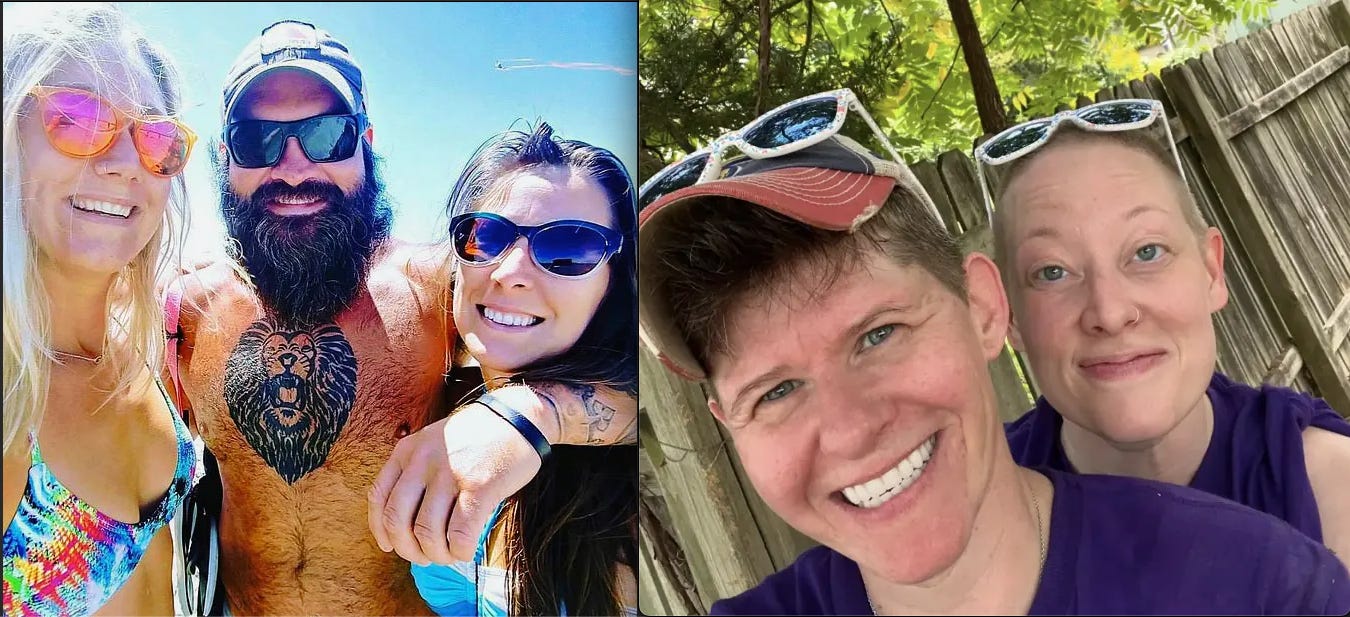
[CAPTION: Ashli Babbit with husband and girlfriend, Renee Good with girlfriend]
Becca Good was outside the car that day, taunting ICE agents: "You wanna come at us?" and "Go get yourself some lunch, big boy." After Renee was shot, Becca said on video: "I made her come down here. It's my fault."
The algorithm that fed Babbitt's rage has no such confession. But the effect was the same: a woman who might have lived a quiet life was instead fed a steady diet of grievance until she climbed through a window into gunfire.
The radicalizers walk free. The radicalized are dead.
And the people left behind? Becca Good has no legal claim to Renee's six-year-old son. The boy's father, an Air Force veteran, died in 2023. Now his mother is dead too. He's an orphan. His grandfather is seeking custody.
Aaron Babbitt collected $5 million in settlement money. He's moved on.
In a civilized country, both shooters would face a jury. The evidence would be presented. A verdict would be reached. Due process would apply to the dead as well as the living.
In America, federal agents are judge, jury, and executioner. The family sues. The government settles with taxpayer money. The officer gets reassigned or retires with pension. The country argues about whether the victim was a hero or a villain.
Then we do it again.
The pattern isn't new. Rodney King, beaten on video by LAPD in 1991, cops acquitted, Los Angeles burned. Abner Louima, a Haitian immigrant sodomized with a broken broomstick by NYPD officers in a Brooklyn precinct bathroom in 1997, his intestines ruptured, while the cops told him: "This is Giuliani time." George Floyd, knee on neck for nine minutes, "I can't breathe," the whole world watching.
The names change. The politics of the victims change. The outcome doesn't.
What's different about Babbitt and Good is how perfectly they mirror each other, five years apart. Same cause of death: federal agent, single confrontation, video evidence, no prosecution. Opposite political valence.
If you mourned one and mocked the other, you're not principled. You're tribal.
If you think one shooting was justified and the other was murder, ask yourself: would you feel the same way if the victim had the opposite politics?
The government has the monopoly on violence. That's the definition of a state. The question is whether that violence is accountable.
In America, at the federal level, it isn't. There's a legal architecture that makes federal agents virtually untouchable. It dates back to 1890. It's called Supremacy Clause immunity. And it's why Jonathan Ross will never see the inside of a Minnesota courtroom.
That's Part 2.
Notes
Part 1 of a 3-part series on federal impunity and state violence in America.