CLASSIFICATION: Professional Analysis - Institutional ClientsPREPARED: 2025-12-08 | COVERAGE: 30 days | WORD COUNT: 10,174REPORT TYPE: Strategic Outlook
This is the first of my Monthly Outlooks on Geopolitical Risk Assessment. It is a comprehensive global strategy report for the month for institutions. I am working on weekly and daily reports, stay tuned. While December and possibly January 2026 will be free, going forward this will be a premium report only available to a new tier of subscriber base. Pricing to be announced soon. Please share with your investor colleagues, family offices, and other institutions needing global risk assessment and strategy, and comment below on what you want to see here!
Phase 1: Analytical Framework
Major Strategic Shifts Identified
* US-Russia Bilateral Negotiations - Trump administration has established direct channel with Moscow, deliberately excluding European allies from Ukraine settlement discussions
* Russian Territorial Consolidation - Capture of Pokrovsk and advances in Zaporizhzhia represent strategic gains ahead of potential ceasefire
* European Coalition Fracturing - Italy’s aid delay and Belgium’s asset freeze resistance signal eroding Western unity
* Russian Drone Warfare Supremacy - 10:1 drone ratio advantage fundamentally alters battlefield dynamics
* Middle East Ceasefire Fragility - Israel-Hezbollah agreement faces 10,000+ documented violations
* Syria Power Transition - Turkey displacing Iran as primary external influence under Jolani government
* European Defense Surge - NATO allies accelerating toward 5% GDP target by 2035
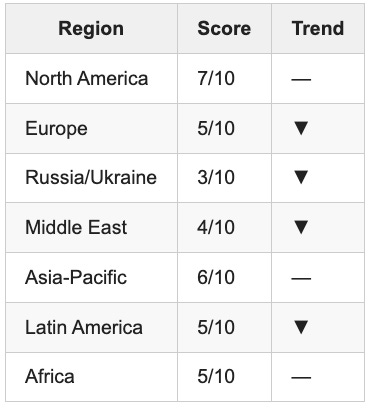
Regional Stability Rankings
Region Score Trend North America 7/10 — Europe 5/10 ▼ Russia/Ukraine 3/10 ▼ Middle East 4/10 ▼ Asia-Pacific 6/10 — Latin America 5/10 ▼ Africa 5/10 —
Risk Event Categories
* Settlement framework collapse leading to escalation
* European defense coalition fragmentation
* Middle East ceasefire breakdown
* Energy infrastructure targeting
* Sovereign debt contagion from asset seizures
Market Implication Themes
* Defense sector bifurcation (European surge vs. US plateau)
* Energy volatility from sanctions relief uncertainty
* Eastern European sovereign spreads compression/expansion
* Currency effects from geopolitical risk repricing
Phase 2: Executive Summary
Bottom Line
December 2025 marks a potential watershed in post-Cold War European security architecture. Three concurrent developments have converged to create conditions unprecedented since February 2022: the Trump administration has established a direct bilateral negotiation channel with Moscow deliberately excluding European institutional participation; Russian forces have consolidated major territorial gains across eastern Ukraine including Pokrovsk; and the European military support coalition has begun publicly fracturing with Italy delaying 2026 aid authorization.
The probability of a negotiated settlement framework emerging within 90 days now stands at 65-70%. However, this assessment carries significant uncertainty given Russia’s continued maximalist demands and the absence of Ukrainian representation in recent bilateral discussions.
Overall Risk Posture: ELEVATED - Multiple concurrent destabilizing factors across Europe, Middle East, and great power competition require heightened portfolio risk management.
Key Strategic Signals
1. US-Russia Direct Channel Established (Confidence: 85%)President Trump’s special envoy Steve Witkoff and son-in-law Jared Kushner conducted a five-hour meeting with Putin on December 2, presenting four documents outlining Washington’s settlement framework.[^1] While Putin’s adviser Yuri Ushakov characterized discussions as “constructive and substantive,” he confirmed “compromises have not yet been found.”[^2] The deliberate exclusion of European allies from these talks represents a fundamental shift in transatlantic security coordination with implications for NATO cohesion and European defense autonomy.
2. Russian Territorial Gains Accelerate (Confidence: 75%)Russia claims capture of Pokrovsk, a critical logistics hub in Donetsk Oblast with pre-war population of 60,000.[^3] The Institute for the Study of War noted insufficient evidence to confirm complete control as of December 1, characterizing the timing of Russia’s announcement—on the eve of Witkoff’s Moscow visit—as “intentional signaling” within Russia’s “ongoing cognitive warfare effort.”[^4] Ukrainian forces report continued fighting in northern Pokrovsk along the railway line. Strategic significance: Pokrovsk represents the last major holdout before Kramatorsk and Sloviansk.
3. European Coalition Publicly Fracturing (Confidence: 80%)Italy postponed approval of its 2026 military aid decree amid coalition tensions between Prime Minister Meloni and Deputy PM Salvini, who openly questions continued support.[^5] Belgium’s Prime Minister Bart De Wever blocked a €140 billion EU loan to Ukraine using frozen Russian assets, warning that confiscation “could bankrupt Belgium” and that Moscow has threatened he will “feel this forever.”[^6] These fractures emerge precisely as US commitment wavers.
4. Russian Drone Supremacy Achieved (Confidence: 90%)The Wall Street Journal reports Russia’s drone-to-Ukraine ratio has reached approximately 10:1 in the Pokrovsk sector—a complete reversal from earlier in the conflict when Ukraine held clear advantage.[^7] Russian fiber-optic-guided drones from the Rubikon unit now strike logistics targets 30+ kilometers behind front lines. Ukrainian logistics and drone units are suffering greater casualties than infantry. This represents what WSJ calls “the most important shift in the war” for 2025.
5. Middle East Ceasefire Deteriorating (Confidence: 85%)UNIFIL has documented over 10,000 Israeli violations of the November 2024 Lebanon ceasefire.[^8] Lebanese authorities report 657 air strikes and 330+ fatalities since the agreement took effect. Israel’s assassination of Hezbollah military commander Haytham Ali Tabatabai in Beirut in late November has triggered revenge vows. A de facto Israeli buffer zone inside Lebanon contradicts withdrawal requirements.
Risk Posture Assessment
Current risk levels are ELEVATED compared to the prior period, driven by the convergence of three destabilizing dynamics: active great power negotiations with uncertain outcomes, accelerating battlefield changes that could alter negotiating positions, and fracturing Western institutional cohesion. The 30-day window through January 2026 carries particularly high uncertainty as multiple settlement attempts, EU summits, and potential military operations coincide. Key risk driver: the disconnect between US bilateral diplomacy and European security interests creates potential for uncoordinated responses.
Phase 3: Strategic Shifts - Deep Analysis
1. US-Russia Bilateral Settlement Track
Confidence: 70% | Impact: High | Timeframe: 30-90 days
Current Status
The Trump administration has fundamentally altered the diplomatic architecture surrounding Ukraine by establishing a direct bilateral channel with Moscow that deliberately excludes European allies. On December 2, special envoy Steve Witkoff and Jared Kushner conducted five hours of talks with Putin in the Kremlin, presenting four documents outlining Washington’s settlement framework.[^1] This follows at least six direct US-Russia engagements since September—the most sustained high-level diplomatic contact since 2021.
Putin characterized the discussions as “necessary” and “useful” but acknowledged “difficult work” with some proposals deemed unacceptable.[^2] The Kremlin received not only the initial 28-point plan but additional documents, suggesting iterative negotiation. Secretary of State Marco Rubio stated “some progress” had been made but “we’re still not close enough.”
European officials, receiving Trump’s framework second-hand, labeled it “very bad” and characterized provisions as “points for satisfying Putin.”[^9] The Wall Street Journal reports Europe is scrambling to develop a counter-proposal within days—a reactive posture that underscor…