This article took real research: nuclear geology, military logistics doctrine, airborne division operational history, declassified weapons assessments, and a framework from the professor who has advised every White House since 2001. It is designed to take you from "boots on the ground" (the cable news soundbite you keep hearing) to a detailed, ahead-of-real-time analysis of what a ground operation in Iran actually looks like, why it was set up to fail before it started, and what comes after. Bloomberg charges $35 a month for market coverage. The Financial Times charges $42. This is $8 a month, $80 a year. Pennies per article for analysis that is ahead of the news cycle, not behind it.
Share this preview with others who should see this.
On March 6, the U.S. Army cancelled a headquarters training exercise for the 82nd Airborne Division.[1] The command element was ordered to remain at Fort Liberty, North Carolina, instead of continuing to a planned rotation in Louisiana. The Pentagon said no deployment orders had been issued. They also refused to take ground troops off the table.
The 82nd Airborne is the Global Response Force: the only division in the U.S. Army that maintains a brigade combat team ready to deploy anywhere on Earth within 18 hours.[2] You do not cancel a training exercise to keep them "ready" unless readiness means something specific. On March 12, Robert Pape, a University of Chicago professor who has advised every White House since 2001 and spent three decades building the curriculum that trains the Air Force for exactly this kind of war, told Diary of a CEO that he gives 75% odds the United States will send ground forces into Iran.[3] His reason is simple: we still do not know where the enriched uranium is, and we have run out of things to bomb.
Everyone is debating whether stage 3 happens. Nobody is explaining what it looks like when it does, or why everything America has done in Iran so far made it nearly impossible to succeed.
Full investigation below. $8/month for analysis that's ahead of the news cycle.
The Wrong Order
Here is the argument you will not hear on cable news: the entire campaign was sequenced backwards.
If the endgame was always to secure Iran's enriched uranium (the only outcome that actually resolves the nuclear question), then ground forces needed to go in first, with air support. Instead, the United States did the opposite. Operation Midnight Hammer hit the nuclear facilities in June 2025. Operation Epic Fury targeted the regime in February 2026. Both operations gave Iran exactly what it needed: time and incentive to scatter its most dangerous material across 1.6 million square kilometers of mountain, desert, and tunnel networks.
Midnight Hammer sent seven B-2 Spirit stealth bombers from Whiteman Air Force Base carrying fourteen GBU-57 Massive Ordnance Penetrators.[4] Twelve of them were dropped on Fordow alone, targeting two primary ventilation shafts in a "drilling" methodology: the first weapon removes the heavy concrete defensive caps, and the subsequent five enter the open shaft at over 1,000 feet per second.[4] The facility was assessed as "functionally destroyed," meaning the centrifuges and support infrastructure were likely pulverized. But here is the problem that should have been obvious from the start. Satellite imagery showed trucks moving material out of Fordow two days before the strikes.[3] As Pape observed on the podcast: "I don't think they're moving out the popcorn."
Epic Fury launched eight months later, killing the Supreme Leader along with 20 to 30 other senior leaders. By then, Iran had dispersed its stockpile of 60% enriched uranium (enough for sixteen nuclear devices) across a country the size of Alaska.[5] The air campaigns did not prepare the battlefield for a ground operation. They sabotaged it. They turned a difficult problem (securing known facilities with concentrated material) into an impossible one (searching an entire nation for objects that can be moved in civilian trucks).
It is Where's Waldo, but with nukes.
And the sequencing failure goes deeper than logistics. The Supreme Leader whom Epic Fury killed, Ayatollah Khamenei, had issued two fatwas (religious edicts) against nuclear weapons.[3] Two. Those edicts died with him. His son, the new Supreme Leader, has issued no fatwa. He ran the Basij, the regime's internal security apparatus that specialized in suppressing protesters.[3] He is, by every account, significantly more aggressive than his father. The United States killed the one leader who had religious guardrails against weaponization and replaced him with someone who has every incentive to build the bomb. After all, we are already killing them. What exactly is their incentive not to?
Pape calls this the escalation trap.[6] I would call it something simpler: we bombed the buildings, gave Iran ten months to move everything that mattered, killed the moderate, promoted the hardliner, and are now contemplating sending a light infantry brigade to find with rifles what 30,000-pound bombs could not destroy. The campaign was not just poorly sequenced. It was designed, step by step, to guarantee its own failure.
Eighty Meters of Limestone
To understand why ground forces are even being discussed, you have to understand what the bombs did and did not accomplish at Fordow.
The Fordow Fuel Enrichment Plant sits at 34.88°N 50.99°E, roughly 30 kilometers north of the holy city of Qom, buried 80 to 90 meters beneath a mountain in the Zagros range.[7] This is not ordinary rock. The overburden is dense limestone and dolostone, carbonate formations with compressive strength estimated at 1.5 to 2 times that of standard reinforced concrete.[8] The mountain does not merely cover the facility. It functions as structural armor, absorbing and dispersing shockwaves from sequential detonations. Compare this to Natanz, which sits on alluvial sediments (unconsolidated sands and gravels) and is significantly more vulnerable to compression collapse.[8]
The GBU-57 Massive Ordnance Penetrator is a 30,000-pound weapon, the largest conventional bomb in the American arsenal. Twelve of them hit Fordow's ventilation shafts using the drilling methodology described above.[4] Battle damage assessments indicated the facility was functionally destroyed, but the underground chambers themselves may not have fully collapsed.[4] That distinction matters enormously for what comes next.
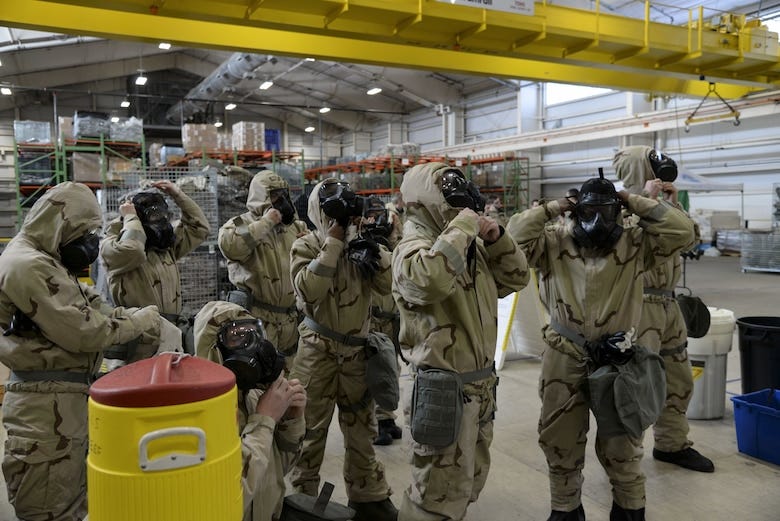
Searching those chambers would mean sending CBRN (Chemical, Biological, Radiological, Nuclear) specialist teams into a mountain that is structurally compromised by seismic shock.[9] The destruction of centrifuges fed with uranium hexafluoride gas released uranyl fluoride and hydrogen fluoride into the tunnel system, the latter being a highly corrosive acid that attacks tissue on contact.[10] Personnel would operate in full MOPP (Mission Oriented Protective Posture) gear: gas masks, chemical-resistant suits, and heavy gloves that severely degrade physical performance, communication, and visibility.[9] They would navigate dark, partially collapsed limestone corridors while scanning rubble for radioactive material.
This is what "securing Fordow" actually means. Not paratroopers standing on a hilltop. Hazmat teams crawling through a poisoned mountain, inch by inch, scanning every kilogram of debris for alpha and beta radiation signatures that are blocked by a few millimeters of metal or a few centimeters of air.[11] There is no shortcut. There is no drone that does this. There is no sensor you can fly over the mountain. You need human hands, within arm's reach of the material, in the dark, in a gas mask, in a building that might finish collapsing on top of you.
The Grapefruit
Even that nightmare scenario assumes the material is still at Fordow. It almost certainly is not.
As of early 2026, Iran possessed roughly 409 to 460 kilograms of uranium enriched to 60%, a stockpile that could be refined to weapons-grade (90%) in seven to ten days.[5] The amount of weapons…