March 29, 2026
In the final week of February 2026, in a conference room in Geneva, Iranian Foreign Minister Abbas Araghchi presented the American delegation with an offer: a multi-year pause on uranium enrichment and enhanced IAEA oversight of Iran's nuclear facilities. It was not everything the United States wanted. It was not zero enrichment. But it was a framework that career nonproliferation diplomats recognized as a serious basis for negotiation, more substantial than anything Iran had offered since the 2015 JCPOA.[1]
The American delegation was led by Steve Witkoff, a billionaire real estate developer with no background in nuclear policy, and Jared Kushner, the president's son-in-law. During the sessions, Witkoff invited Araghchi to tour the USS Abraham Lincoln. The Iranian Foreign Minister declined. Observers described the gesture as "idiosyncratic and dismissive of the gravity of the nuclear file." The third member of the American team was Michael Anton, a national security hawk with no specialized background in nonproliferation. His presence signaled what career diplomats already suspected: the decision to strike had been made before the talks began.[2]
The Americans gave a tell to the Iranians from day one.
Omani Foreign Minister Sayyid Badr bin Hamad Al Busaidi told reporters that "substantial progress" had been made during the February 26 session. President Trump expressed "deep dissatisfaction" with the pace of the talks. Four days later, on the morning of February 28, nearly 900 precision strikes hit Iran in twelve hours. Supreme Leader Khamenei was killed in the opening minutes. Operation Epic Fury had begun.[3]
Twenty-nine days later, nobody can stop the war.
Bloomberg: $35/month. Financial Times: $42/month. The Economist: $17/month. Original analysis by Tatsu with 40+ footnotes: $8/month.
Share this preview with others.
Inside this investigation:
* The Geneva failure: What Iran actually offered, who the US sent to negotiate, and why career diplomats say the war was pre-committed before the talks concluded
* The Montage President: NBC's revelation that Trump receives curated video highlight reels instead of comprehensive intelligence, and how four contradictory statements in 48 hours trace to four different briefing decks
* Days 26-29: Houthis actively join the war (two chokepoints now closed), KC-135 tankers destroyed at Prince Sultan, BAPCO refinery burning in Bahrain, Marines under fire in Kuwait, IDF Chief warns of military "collapse," Spain expelled from the alliance, third strike on a nuclear power plant
* The man who could have negotiated peace was killed on Day 17: Ali Larijani, the one pragmatist in the Iranian system, eliminated by an Israeli strike on March 17. The last off-ramp, destroyed.
What follows is a Day 26-29 operational update integrated with the pre-war diplomatic context that explains why this war started and why it now has no exit. Built from OSINT reports across 355+ channels, primary research on the Geneva negotiations, and sourced reporting from the Arms Control Association, The Guardian, PBS, and the Washington Post. A paid subscription is $8/month.
$8/month. The montage doesn't show you this.
The Geneva Offer Nobody Read
The failure in Geneva was not a failure of diplomacy. It was a failure of staffing.
The Arms Control Association published a detailed assessment in March 2026 concluding that "U.S. negotiators were ill-prepared for serious nuclear negotiations with Iran." The assessment identified three structural problems with the American delegation.[4]
First, the delegation had no one with technical expertise in nuclear nonproliferation. Witkoff's background was Manhattan real estate. Kushner's was Middle East deal-making focused on the Abraham Accords and Gulf normalization. Anton's was national security commentary. None of them could evaluate the technical significance of what Araghchi was offering, which involved specific enrichment thresholds, centrifuge configurations, and inspection protocols that require years of specialized knowledge to parse.[5]
Second, the American position was maximalist by design. The White House demanded total cessation of all enrichment and complete dismantlement of nuclear facilities. This was not a negotiating position. It was a demand designed to be rejected, because acceptance would have removed the justification for the military operation that was already being staged. C-17 cargo flights from Fort Liberty and Fort Stewart had been tracked since mid-February. The 82nd Airborne was on alert. The decision architecture was military, not diplomatic.[6]
Third, the delegation's behavior signaled contempt rather than engagement. The Guardian's post-mortem, published March 18 under the headline "How ignorance, misunderstanding and obfuscation ended Iran nuclear talks," documented the aircraft carrier tour invitation as emblematic of an approach that treated the talks as a performance rather than a negotiation. Witkoff was not there to negotiate. He was there to be seen negotiating, so that when the talks "failed," the administration could point to diplomacy as having been exhausted.[7]
The Iranian offer, reconstructed from Omani diplomatic sources and the Arms Control Association analysis, included:
* Continued enrichment for reactor fuel only, with no accumulation of weapons-grade material
* Enhanced IAEA oversight beyond current safeguards, including broader access to undeclared sites
* A multi-year compliance framework with benchmarks and verification mechanisms
This was not the JCPOA. In some respects it was less favorable (Iran retained enrichment rights). In other respects it was more favorable (broader inspection access than the 2015 deal provided). It was, by any professional assessment, a basis for negotiation that could have produced a framework within weeks.[8]
Instead, four days later, 900 strikes hit Iran in twelve hours. The man sitting across the table from Witkoff, Foreign Minister Araghchi, survived. The Supreme Leader did not. And 170 civilians at a girls' school near Bandar Abbas, adjacent to an IRGC naval base, did not either.[9]
President Visual Montage Trump
To understand why the Geneva offer was never comprehended by Trump, you need to understand how the president processes information.
NBC News reported that President Trump receives wartime intelligence briefings in the form of edited video compilations. These "montage briefings" consist of curated footage showing successful military strikes, intercepted enemy communications, and satellite imagery of destroyed targets. They are visual, dramatic, and selectively positive. They are not comprehensive assessments of the war's trajectory, the diplomatic landscape, or the strategic risks of escalation.[10]
This practice dates to Trump's first term, when intelligence officials discovered that the president retained information from visual presentations far more effectively than from written briefs or oral summaries. The Presidential Daily Briefing (PDB), traditionally a dense written document supplemented by in-person analysis from senior intelligence officials, was adapted to Trump's preference for images and video. By 2026, this adaptation had calcified into a system where the president's understanding of the war is shaped by what amounts to a highlight reel.[11]
The consequences are visible in the public record. Between March 20 and March 23, Trump made four statements about the war that are mutually contradictory:
March 20: "We are getting very close to meeting our objectives as we consider winding down our great military efforts in the Middle East with respect to Iran."
March 21-22: Issues a 48-hour ultimatum threatening to "hit and obliterate" Iran's power plants if the Strait of Hormuz is not reopened.
March 23, morning: Announces a 5-day pause, claiming "They called. I didn't call. They called. They want to make a deal."
March 23, afternoon: Claims agreements have been reached on "almost all points."[12]
These are not the statements of a leader executing a coherent strategy. They are the statements of a leader reacting to whatever information landed on his desk most recently. "Winding down" followed a montage showing destroyed Iranian infrastructure. The 48-hour ultimatum followed a briefing on Hormuz closure and oil prices. The "pause" followed a report (possibly from Omani intermediaries) suggesting Iranian willingness to talk. The "almost all points" claim followed a curated summary of diplomatic back-channel activity that omitted the fact that Iran's Parliament Speaker had called it "fake news" on X hours earlier.[13]
The montage briefing culture did not cause the war. The Geneva failure was a staffing and intent problem, not an intelligence problem. But the montage culture is why the war cannot be managed coherently once started. A president who receives curated highlights cannot calibrate escalation, cannot assess risk accurately, and cannot distinguish between tactical success (we destroyed a target) and strategic failure (the war is expanding beyond our ability to control it). The montage shows the bomb hitting the building. It does not show the KC-135 tankers burning at Prince Sultan.
Day 26: The Logistics Start Breaking
On March 25, the war entered a new phase that the montages are unlikely to have captured.
Delta Force, the 75th Rangers, and SEAL Team 6 deployed to theater, joining the 82nd Airborne and two Marine Expeditionary Units already in position. The buildup continued to accelerate even as Trump was publicly discussing "winding down." But the more significant development was structural: the air campaign's logistics backbone began to crack.[14]
The air campaign that devastated Iran in the first twelve hours depended on three categories of enabler aircraft that are invisible to the public but essential to operations: KC-135 tankers (which refuel fighters and bombers mid-flight), E-3 AWACS (which provide airborne command and control), and C-17/C-130 transports (which sustain the force). Without tankers, fighters cannot reach targets deep inside Iran and return. Without AWACS, the air picture degrades and targeting becomes less precise. Without transports, ammunition and spare parts do not arrive.[15]
Iran had been studying these dependencies. And on Day 28, it exploited them.
Day 28: Prince Sultan Air Base Burns
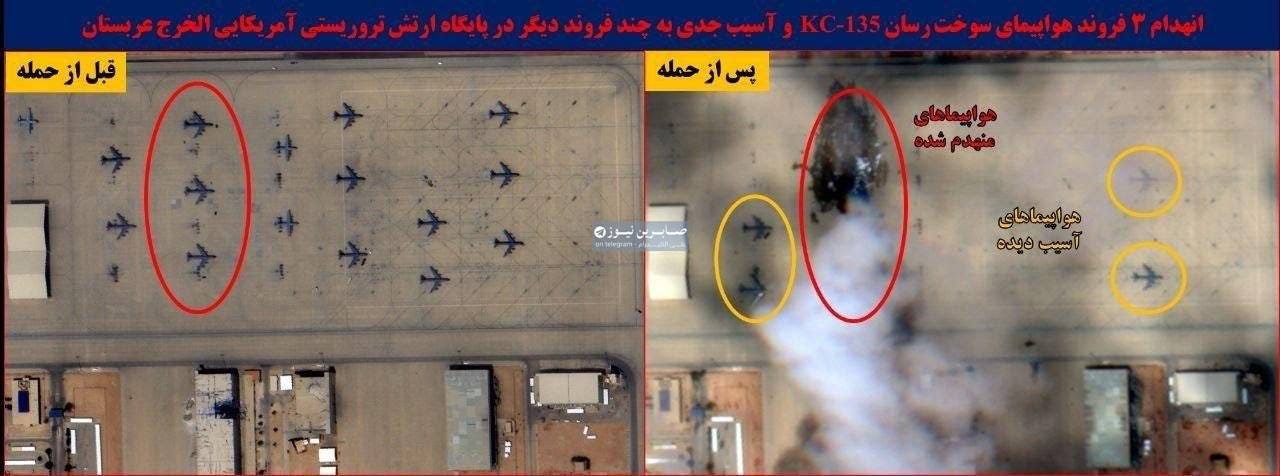
On March 27, Iranian missiles and drones struck Prince Sultan Air Base in Saudi Arabia in a coordinated attack that targeted not fighters or bombers but the enabler aircraft parked on the tarmac.
Satellite imagery confirmed the destruction of at least three KC-135 Stratotanker refueling aircraft. Reports indicated possible damage to one or two E-3 Sentry AWACS aircraft. Twenty-nine U.S. service members were wounded, fifteen in the single combined attack, five of them seriously. An F-16 was forced into a "hard landing" at a regional base, likely after sustaining damage from Iranian air defenses. Army Sergeant Benjamin N. Pennington, wounded in a previous attack on Prince Sultan earlier in March, died of his injuries.[16]
Iran did not try to shoot down American fighters. It burned the gas stations.
This is asymmetric warfare applied to logistics rather than combat. Every KC-135 destroyed reduces the number of fighter sorties that can reach Iranian targets. Every AWACS damaged degrades the coalition's ability to coordinate those sorties. The cost asymmetry is devastating: an Iranian Shahed drone costs approximately $20,000. A KC-135 costs $40 million and takes years to replace. The ratio is 2,000 to 1.[17]
The montage probably showed successful American strikes on Iranian missile facilities. It probably did not show the tankers burning at Prince Sultan. That is the difference between a highlight reel and an intelligence assessment.
It also suggests that the Gulf bases are out of interceptors, as I predicted from day one.
Day 29: The War Doubles with The Houthis
On March 21, in a story no one reported except myself, the Houthis formally declared war against the US.
On the morning of March 28, the war fundamentally changed character.
The Houthis joined the fight.
Ansarallah, the Houthi movement in Yemen, launched ballistic missiles toward Israel, with reported impacts in southern Israel including Beit Shemesh and a possible direct hit on a synagogue in central Israel. Houthi spokesman Yahya Saree issued a formal statement declaring that Yemen had entered the war on Iran's side and issued an ultimatum: if any alliance uses the Red Sea against Iran, the Houthis will "directly intervene."[18]
This transforms the geometry of the conflict. The war is no longer about one chokepoint. It is about two. The Strait of Hormuz carries 20% of the world's oil. The Bab al-Mandeb strait at the southern entrance to the Red Sea carries 12% of global trade. Both are now contested simultaneously. There is no modern precedent for the simultaneous closure or contested control of two of the world's five critical maritime chokepoints.[19]
The Houthi entry also stretches US and Israeli air defenses to a breaking point. Israel's Iron Dome, David's Sling, and Arrow systems are already depleted from four weeks of Iranian missile and drone attacks. Adding a southern axis from Yemen means interceptors must now cover a 360-degree threat environment rather than a primarily northern/eastern one. The interceptor math, already catastrophic (800 Patriot PAC-3 missiles consumed in five days, annual production approximately 500), becomes unsustainable.[20]
Day 29: Iran Punishes The Gulf States
While the Houthis opened the southern front, Iran systematically dismantled Gulf state infrastructure.
Bahrain: The BAPCO oil refinery in Riffa, processing 267,000 barrels per day and the oldest refinery in the Gulf, was set on fire by Iranian missiles. The Alba aluminum plant, one of the world's largest smelters, was struck. Sheikh Isa Air Base, which hosts US forces, was hit again.[21]
Kuwait: Iranian drones struck Kuwait International Airport, destroying radar systems used by US forces. IRGC drones and missiles hit US Marines on Bubiyan Island in northern Kuwait, with IRGC spokesman claiming "many American casualties" and vowing "this attack will continue every day."[22]
Iran's nuclear facilities: US and Israeli forces struck the Bushehr Nuclear Power Plant for the third time in ten days. IAEA Director General Rafael Grossi warned that any strike that damages the operating reactor could cause a "major radiological incident" with consequences far beyond Iran's borders. He called this the "reddest line" of nuclear safety. The strikes continued anyway.[23]
This is not a military campaign. This is mutual infrastructure destruction. Israel struck Iran's two largest steel manufacturing facilities (billions in losses). Iran struck Bahrain's oil refinery and aluminum plant. Israel struck Bushehr. Iran struck BAPCO and Dimona nuclear power plant in Israel. The pattern is explicit: every attack on Iranian economic infrastructure will be answered with an attack on Gulf state economic infrastructure. The Gulf states are being punished for hosting the forces that are attacking Iran.[24]
The IDF Is Out of Soldiers
On March 26, IDF Chief of Staff Lieutenant General Eyal Zamir delivered an unprecedented warning to the Israeli security cabinet. He raised "ten red flags" indicating a looming military collapse due to manpower shortages.
The numbers: the IDF faces an immediate deficit of 15,000 troops, including 8,000 combat soldiers. Reservists are on their sixth and seventh rotations since tensions escalated in 2023. The army is simultaneously fighting on four fronts: Iran, Lebanon (where Hezbollah launched 55 attacks in a single day, a new record), the West Bank, and Gaza. It cannot sustain operations on all four.[25]
The political dimension makes the crisis intractable. Approximately 80,000 ultra-Orthodox men are eligible for military service but exempted under coalition agreements that keep Netanyahu in power. Zamir is demanding new conscription legislation. Passing it would collapse Netanyahu's coalition. Not passing it risks military "collapse" (Zamir's word, not mine).[26]
Opposition leader Yair Lapid characterized the situation as sending an "under-manned and over-stretched" force into a multi-front war without an exit strategy. He is correct. Israel's military capability is now hostage to a domestic political arrangement that prioritizes coalition survival over national security. The IDF's technological superiority is real, but technology does not hold territory. People do, and there are not enough of them.[27]
The situation is so bad, Israel is contemplating a new conscription policy, a military draft.
American Alliances Are Blowing Up Left and Right
The war is breaking alliances faster than it is breaking enemies.
Spain: After Spain refused to allow US forces to use the Rota and Moron de la Frontera bases for strikes on Iran, President Trump "terminated all relations" with Madrid and threatened a full trade embargo worth $47 billion in annual goods trade. France voiced support for Spain's position, citing the UN Charter and international law.[28]
The G7: Secretary of State Marco Rubio told G7 foreign ministers that the conflict would last "another two to four weeks," the first official admission that the war has exceeded its planned timeline. EU foreign policy chief Kaja Kallas reportedly "tormented" Rubio over why Washington started the war in the first place. This is the Suez dynamic in reverse: in 1956, America pulled the rug on its allies' war. In 2026, America's allies are pulling the rug on America's.[29]
The Gulf states: Reports indicate that Saudi Arabia, UAE, Kuwait, and Bahrain are "losing patience" with the US as their infrastructure burns. Gulf nations that hosted US bases as a deterrent against Iran are now being attacked by Iran because they host US bases. The security arrangement that defined the Persian Gulf for three decades is collapsing in real time.[30]
Meanwhile, Europe remains the hidden logistics backbone of the war. Ramstein Air Base in Germany directs drone operations. RAF Fairford in the UK loads B-1b Lancer bombers. Souda Bay in Crete repairs damaged naval vessels. These governments publicly say "not our war" while enabling it from their territory. If one European parliament forces a base access vote, the logistics chain collapses. Spain already broke. France is wavering. Germany has not been tested yet.[31]
Israel Killed the Man Who Could Have Stopped the War
On March 17, an Israeli strike killed Ali Larijani.
Larijani was the former Speaker of the Iranian Parliament, a former Secretary of the Supreme National Security Council, and the closest thing Iran had to a pragmatic interlocutor who could negotiate with the West. He had served as nuclear negotiator, understood the technical dimensions of the enrichment file, and had relationships with European diplomats built over decades.[32]
He was the man who could have brokered a ceasefire. He was killed on Day 17, along with whatever remained of the diplomatic off-ramp.
With Khamenei dead, Larijani dead, and Mojtaba Khamenei (the new Supreme Leader) operating under the influence of IRGC hardliners who view any negotiation as capitulation, there is no one left on the Iranian side with both the authority and the inclination to negotiate. On the American side, the president watches highlight reels and the negotiating team consists of a real estate developer and a son-in-law. On the Israeli side, the prime minister cannot conscript the soldiers he needs without losing power.[33]
"Trump has no choice but to cave in to most of Iran's demands."
That is John Mearsheimer, speaking this week. The most prominent realist scholar in the world is telling anyone who will listen that the structural logic of this war leads to American capitulation. And the structural logic of the White House ensures that nobody there is listening, because the montage does not include clips of University of Chicago professors explaining why you have already lost.[34]
Twenty-Nine Days
This war has cost, as of March 19, at least $18 billion. It has killed a Supreme Leader, an unknown number of Iranian civilians (the internet blackout prevents accurate counting), American service members (Sergeant Pennington and others), and an unknown number of others across the Gulf. It has closed two maritime chokepoints, set Bahrain's largest refinery on fire, destroyed radar systems in Kuwait, struck a nuclear power plant three times, armed 600,000 Basij militia with MANPADS, brought the Houthis into the war, fractured NATO, exhausted Israeli manpower, burned the tanker aircraft that sustain the air campaign, and produced four contradictory presidential statements in 48 hours.[35]
It started because a real estate developer invited a foreign minister to tour an aircraft carrier instead of reading his nuclear offer. It continues because a president watches montages instead of intelligence assessments. It cannot stop because everyone who could negotiate an end is dead, alienated, or watching highlight reels.
Iran offered an enrichment pause. The United States sent someone who did not know what that meant. Twenty-nine days later, the Strait of Hormuz is a toll road, the Bab al-Mandeb is contested, Bahrain is burning, and the IDF Chief of Staff is warning his own government that the military is about to collapse.
This is what happens when the people making the decisions are not reading the footnotes. My footnotes. Have I cleared the fog of war for you? Then sign up for paid subscription, I’m literally doing Hegseth’s and all of Trump’s advisors’ jobs!
Subscribe and support real journalists. $8/month.
Notes
[1] "U.S. Negotiators Were Ill-Prepared for Serious Nuclear Negotiations with Iran." Arms Control Association, March 11, 2026. Assessment of the February 2026 Geneva negotiations including the Iranian enrichment pause offer and enhanced IAEA oversight proposal.
[2] "How ignorance, misunderstanding and obfuscation ended Iran nuclear talks." The Guardian, March 18, 2026. Post-mortem of the Geneva talks including Witkoff's aircraft carrier invitation, Michael Anton's inclusion, and the maximalist US demands.
[3] "2026 Iran War." Britannica, accessed March 28, 2026. Timeline of Operation Epic Fury including the February 28 opening strikes, Khamenei assassination, and 900 targets hit in twelve hours.
[4] "U.S. Negotiators Were Ill-Prepared." Arms Control Association. Three structural failures identified: no technical expertise, maximalist demands, and performative diplomacy.
[5] "Not so diplomatic: Witkoff, Kushner, and Trump's march to war in Iran." Responsible Statecraft, March 2026. Analysis of the American delegation's backgrounds and the mismatch between their expertise and the nuclear file's complexity.
[6] "US and Iran hold another round of indirect nuclear talks as American forces mass in Mideast." OPB/AP, February 26, 2026. Concurrent military staging during the Geneva diplomatic sessions.
[7] "How ignorance, misunderstanding and obfuscation ended Iran nuclear talks." The Guardian. The aircraft carrier tour invitation as emblematic of an approach that treated negotiations as performance.
[8] "U.S. Negotiators Were Ill-Prepared." Arms Control Association. Reconstruction of the Iranian offer from Omani diplomatic sources: enrichment for reactor fuel only, enhanced IAEA access, multi-year compliance framework.
[9] "2026 Iran War." Britannica. The Bandar Abbas girls' school incident: 170 civilian casualties from a strike targeting an adjacent IRGC naval base.
[10] NBC News reporting on "montage briefings," March 2026. Trump receives wartime intelligence as edited video highlight reels of successful strikes rather than comprehensive written or oral intelligence assessments.
[11] NBC News. Practice dates to Trump's first term (2017-2021) when intelligence officials adapted the Presidential Daily Briefing format to Trump's preference for visual information.
[12] "'We'll just keep bombing': Trump issues stark warning if Iran deal fails." LiveMint, March 2026. Trump's contradictory statements mapped across March 20-23. "Trump: Iran deal close; US speaking to regime's 'most respected' leader." Times of Israel.
[13] "'Fake news': Iranian Speaker says Trump's talk claims aimed at manipulating oil markets." Times of India, March 23, 2026. Ghalibaf's X post contradicting Trump's "almost all points" claim within hours.
[14] Intelligence capture, March 25, 2026 (Day 26). Delta Force, 75th Rangers, SEAL Team 6 deployment to theater confirmed across multiple OSINT channels.
[15] "U.S. Considering Deployment of 82nd Airborne Division to the Middle East." The Aviationist, March 24, 2026. Force structure analysis including enabler aircraft dependencies (tankers, AWACS, transports).
[16] "U.S. troops wounded, planes damaged in Iranian strike on Saudi air base, official says." PBS NewsHour, March 28, 2026. Prince Sultan Air Base attack: 3+ KC-135s destroyed, possible AWACS damage, 29 wounded, F-16 hard landing. "US Forces at Saudi Air Base Suffer Iranian Attack." Air & Space Forces Magazine. "At least 10 U.S. troops wounded." Washington Post. Sgt. Pennington death confirmed.
[17] Cost asymmetry analysis. KC-135 Stratotanker unit cost approximately $40 million (USAF). Shahed-136 drone estimated cost $20,000-$50,000 (multiple sources). Ratio 800:1 to 2,000:1 depending on drone variant.
[18] Intelligence capture, March 28, 2026 (Day 29). Houthi ballistic missiles toward Israel, impacts reported in Beit Shemesh, Yahya Saree official statement. Confirmed across GeoPWatch, War Monitor, Straits Times, Kobeissi Letter.
[19] "How Much of the World's Shipping & Oil Goes Through the Strait of Hormuz?" Speed Commerce, 2026. Hormuz: 20% of global oil. Bab al-Mandeb: 12% of global trade. No historical precedent for simultaneous contested control of two major chokepoints.
[20] Interceptor depletion analysis from "Operation Epic Fury: Pentagon or Pentabust?" Tatsu Ikeda, March 18, 2026. 800 Patriot PAC-3 missiles consumed in five days versus approximately 500 annual production capacity.
[21] Intelligence capture, March 28, 2026. BAPCO refinery fire (267,000 bpd), Alba aluminum plant struck, Sheikh Isa Air Base hit. Confirmed by Slavyangrad and Geopolitics Prime (combined 31,668 engagement).
[22] Intelligence capture, March 28, 2026. Kuwait International Airport radar destroyed by Iranian drones. IRGC strikes on US Marines at Bubiyan Island, Kuwait. Geopolitics Prime (25,485 views).
[23] "No damage detected after Bushehr Nuclear Power Plant in Iran attack: IAEA." ANI News, March 28, 2026. Third strike on Bushehr in ten days. "IAEA warns of radiological risk after strikes near Iran's Bushehr nuclear plant." Xinhua. Grossi's "reddest line" warning.
[24] "Yediot Ahronot reports IDF attacked two largest steel manufactories in Iran." Jerusalem Post, March 28, 2026. Tit-for-tat industrial targeting pattern: Israeli strikes on Iranian steel answered by Iranian strikes on Bahrain's BAPCO and Alba.
[25] "Israeli army chief warns of 'collapse' as war intensifies." Newsbook, March 2026. Zamir's "ten red flags," 15,000 troop deficit (8,000 combat), reservists on 6th-7th rotations.
[26] "Israeli army chief warns of 'collapse.'" Newsbook. 80,000 ultra-Orthodox eligible but unserved, conscription legislation blocked by coalition politics.
[27] "Israeli army chief warns of 'collapse.'" Newsbook. Lapid's characterization of the government sending "under-manned and over-stretched" forces into multi-front war without exit strategy.
[28] "Trump 'terminates all relations' with Spain over refusal to provide bases for strikes on Iran." Babel, March 2026. "Trump threatens to cut off trade with Spain over Iran, defense spending." Fox Business. $47 billion annual trade at risk. France voices support for Spain.
[29] "Rubio tells allies Iran war will continue 2-4 more weeks." Axios, March 2026. First official admission of extended timeline contradicting Trump's "winding down" statements. Kallas-Rubio clash at G7 over war's justification.
[30] "Gulf Arab States Under Pressure As Iranian Attacks Grind On." The War Zone, March 2026. Gulf nations reconsidering hosting of US forces as their own infrastructure becomes targets.
[31] Intelligence captures, March 25-27, 2026. European base access chain: Ramstein (drone operations), RAF Fairford (B-1 loading), Souda Bay (naval repair). Spain refused access, operations relocated. European parliaments have not yet forced base access votes.
[32] "2026 Iran War." Wikipedia, accessed March 28, 2026. Ali Larijani killed March 17, 2026. Former Parliament Speaker, former SNSC Secretary, nuclear negotiator, described as "potential bridge for diplomatic re-engagement."
[33] "Escalation in the Middle East: Tracking 'Operation Epic Fury' Across Military and Cyber Domains." Flashpoint, March 2026. Mojtaba Khamenei succession, regime fragmentation, IRGC decentralized command structure post-decapitation.
[34] Mearsheimer quoted in Geopolitics Prime (19,665 views, March 28, 2026): "Trump has no choice but to cave in to most of Iran's demands."
[35] War cost of $18 billion as of March 19 from "2026 Iran war." Wikipedia. Basij armed with MANPADS (Misagh-3, Chinese QW-18 copies) from intelligence capture, March 27, 2026.