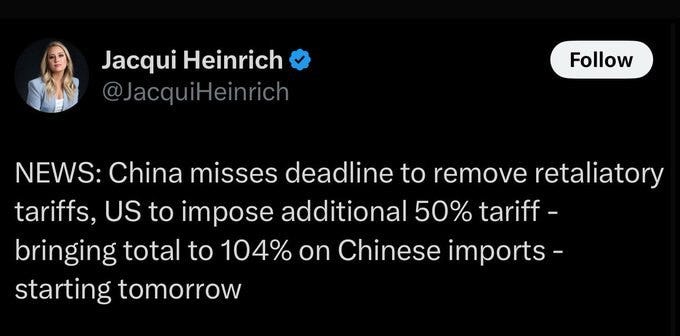
UPDATE:
[SCREENSHOT: April 9, 2025, 🇺🇸🇨🇳 TRADE WAR: 104% Tariffs for China, Beijing lets deadline pass.]
[VIDEO: Chinese social media mocks USA Industry]
[ILLUSTRATION: Market bros in full panic mode as tariffs trigger trading algorithms. What else is new?]
Introduction: Predictable Market Panic
Last Wednesday, President Donald Trump announced sweeping tariffs on nearly all U.S. imports, and like clockwork, Wall Street threw another one of its famous tantrums. The S&P 500 plunged over 10% in two days, wiping out nearly $5 trillion in market value—on paper, anyway.
“I don’t want anything to go down,” Trump said from Air Force One on Sunday, “but sometimes you have to take medicine to fix something.” This perfectly encapsulates what most market commentators are missing: Trump is willing to endure short-term market volatility to secure long-term structural advantages for American industry and workers.
The establishment economic consensus has already labeled these tariffs as destructive, reckless, even catastrophic. But haven’t we heard this same apocalyptic rhetoric before? From Black Monday in 1987 to the COVID crash of 2020, markets have always recovered—often much faster than the doomsayers predicted. The current correction is no different.
What’s being overlooked amid the market hysteria is that Trump’s tariffs aren’t just policy decisions but negotiating tactics designed to force trading partners to the table and level a playing field that has tilted against American interests for decades. While economists wring their hands over textbook theories, Trump is playing a different game entirely—one where America’s massive consumer market gives him leverage that previous administrations have been unwilling to use.
Critical Facts Behind the Hysteria
Yes, Trump has imposed a baseline 10% tariff on all imports as of April 5, with higher targeted rates up to 54% for countries like China coming April 9. And yes, Goldman Sachs has raised its recession probability to 45%. But dig deeper and you’ll find something fascinating happening beneath the surface.
Several key trading partners are already signaling openness to zero-tariff arrangements:
* European Commission President Ursula von der Leyen has hinted at possible concessions to avoid the 20% EU tariff rate
* Vietnam, facing a potential 46% tariff, is reportedly preparing major trade proposals
* Taiwan, a critical semiconductor supplier, is discussing new frameworks for bilateral trade
These reactions reveal something crucial: Trump’s aggressive opening position is already prompting the responses it was designed to elicit. The panic in financial markets reflects algorithmic trading and institutional investor groupthink more than the actual economic impact of these tariffs.
This economic strategy targets the trade deficit—the persistent imbalance between imports and exports that has hollowed out American manufacturing for decades. The real question isn’t whether these tariffs will cause short-term market volatility (they obviously will), but whether rebalancing trade relationships might be worth some temporary financial turbulence.
[SCREENSHOT: Donald Trump on Truth Social]
Powell-Trump Showdown: Central Bank Chess
The emerging battle between Trump and Federal Reserve Chairman Jerome Powell adds another critical dimension to this economic drama. Trump wasted no time demanding interest rate cuts, posting on Truth Social: “This would be a PERFECT time for Fed Chairman Jerome Powell to cut Interest Rates… CUT INTEREST RATES, JEROME, AND STOP PLAYING POLITICS!”
Powell faces a classic economic dilemma: tariffs typically push prices higher (inflationary) while potentially slowing economic growth. This combination—known as “stagflation”—presents a no-win scenario for central bankers. Cut rates to stimulate growth, and you risk fueling inflation. Keep rates high to fight inflation, and you risk deepening an economic slowdown.
In remarks last Friday, Powell acknowledged the tariffs were “significantly larger than expected” and warned they could create “persistent” inflation effects—signaling he’s unlikely to provide the safety net Wall Street desperately wants. For now, he’s adopting a wait-and-see approach, stating it’s “too soon to say what will be the appropriate path for monetary policy.”
This standoff represents a fundamental clash between short-term market stability (Powell’s traditional focus) and long-term structural economic realignment (Trump’s stated goal). If the Fed holds firm while tariffs reshape trade relationships, we could see a prolonged period of market adjustment—exactly what Trump seems willing to accept in pursuit of his broader economic vision.
Key Players and Perspectives Beyond the Panic
Donald Trump: Playing the Long Game
Trump’s perspective on trade isn’t new—he’s been advocating for protectionist policies since the 1980s. What’s different is his willingness to use America’s consumer market as leverage and weather market volatility in the process.
“The markets are going to boom. The stock is going to boom. The country is going to boom,” Trump insisted at the White House. While critics dismiss this as delusional, they’re missing the point. Trump isn’t promising immediate market gains; he’s arguing that reshaping trade relationships will create sustainable economic growth that benefits American workers rather than just shareholders.
Market Bros: Predictable Hysteria
Jamie Dimon, JPMorgan Chase CEO and the embodiment of establishment financial thinking, warned in his annual letter that the tariffs would “likely increase inflation and are causing many to consider a greater probability of a recession.”
Notably, Dimon’s perspective has shifted dramatically in just three months. In January, he suggested Americans should “get over” tariff concerns. His evolving rhetoric tracks perfectly with market movements rather than economic fundamentals.
Similarly, billionaire Bill Ackman warned of an “economic nuclear winter” if tariffs proceed as planned—yet the primary casualties would be the investor class he represents, not necessarily the average American worker who has already weathered the economic hurricane of deindustrialization.
The Silent Majority: Main Street vs. Wall Street
Lost in all the financial market histrionics is a simple fact: most Americans don’t own meaningful amounts of stock. According to Federal Reserve data, the wealthiest 10% of Americans own approximately 89% of all stocks. When commentators breathlessly report on trillions in “lost wealth,” they’re mainly describing paper losses for the already wealthy.
For middle-class Americans in former manufacturing hubs throughout the Midwest, the calculus is different. The potential revival of domestic manufacturing through more balanced trade might well be worth paying a bit more for imported consumer goods. Every one-point drop in the S&P 500 generates headlines, but the slow erosion of America’s industrial base over decades somehow never warranted the same urgent coverage.
Deeper Context Nobody’s Discussing
The conventional wisdom on tariffs cites the Smoot-Hawley Tariff Act of 1930 as evidence that protectionism invariably leads to economic disaster. But this comparison ignores crucial differences in context:
* Different Economic Conditions: The 1930s tariffs were implemented during a banking crisis and massive deflation—conditions entirely unlike today’s economy.
* America’s Changed Position: In 1930, the U.S. was one among several major powers. Today, the American consumer market represents an irreplaceable engine of global economic growth. China, the EU, and developing economies cannot simply walk away from American consumers.
* First-Term Results: During Trump’s first term, tariffs on Chinese goods were criticized using the same apocalyptic rhetoric we’re hearing today. Yet the economy continued growing, unemployment reached record lows, and the stock market hit all-time highs before COVID arrived.
The current global trading system isn’t some natural economic order—it’s a relatively recent arrangement that American policymakers consciously created after World War II to serve specific strategic goals. As those goals and global conditions have changed, it’s entirely reasonable to reassess whether the system still serves American interests.
Global Reshuffling of the Economic Deck
The international response to Trump’s tariffs reveals their true purpose as a negotiating tactic rather than a permanent economic policy. Consider these developments:
* European Union: Officials in Brussels have been meeting urgently to formulate a response that balances retaliation with the reality that European exporters desperately need the American market. The EU’s countermeasures deliberately target politically sensitive American exports while leaving the door open to negotiations.
* Southeast Asia: Vietnam, Thailand, and Malaysia—which have benefited enormously from manufacturing shifted from China—now face potential tariffs that would eliminate much of their cost advantage. Their rapid pivot toward offering concessions demonstrates their vulnerability to American market access being restricted.
* China: Beijing has taken the hardest line publicly, but behind the scenes, Chinese officials are reportedly exploring bilateral negotiations while struggling to manage domestic economic pressures that make a prolonged trade war particularly dangerous for them.
A certain outcome is emerging: the global trading system will be reshaped, either through negotiated agreements that better balance trade flows or through the implementation of tariffs that force a more organic rebalancing. Either way, the decades-long pattern of persistent U.S. trade deficits appears unsustainable under this administration.
Follow Evidence Beyond Economic Orthodoxy
Economic analyses of Trump’s first-term tariffs typically focus on consumer price increases and job creation strictly within protected industries. This narrow framing misses broader strategic benefits that don’t fit neatly into conventional economic models.
The Section 232 steel tariffs from Trump’s first term prompted more than $10 billion in domestic steel investment, according to industry groups. While economists focus on the higher cost per job created, they rarely consider the long-term national security implications of maintaining domestic production capacity in strategic industries.
Similarly, conventional analyses rarely account for the full costs of offshoring, including community devastation, increased social service expenditures, and geopolitical vulnerabilities created by extended supply chains. When these factors are considered, the case for reshoring production through tariff leverage becomes much stronger.
Past market reactions to policy changes also suggest the current correction is likely overdone. After the initial shock of Trump’s 2018 China tariffs, markets quickly recovered and reached new highs. COVID-related market disruptions proved far more severe yet resolved within months. If history is any guide, the current market tantrum will be short-lived as traders adjust to the new policy reality.
[GRAPH: Market recoveries after major crashes and corrections. Note how rapidly markets rebounded after the 2020 COVID crash.]
Hypocrisy in the Establishment Positions
The financial establishment’s response to tariffs reveals striking contradictions:
* The same voices warning that tariffs will hurt American consumers show little concern when corporate offshoring eliminates thousands of middle-class jobs
* Market commentators who insist presidents don’t deserve credit for market gains suddenly hold Trump personally responsible for every market decline
* When ordinary Americans complained about rising prices during the past two years, the financial establishment lectured them about accepting economic realities. Now that tariffs might increase certain prices, this same establishment portrays consumer price sensitivity as an urgent national concern
These contradictions suggest that much of the opposition to tariffs stems not from objective economic analysis but from ideological commitment to a particular version of globalization—one that has disproportionately benefited financial and coastal elites at the expense of the industrial heartland.
Real-World Impacts Beyond Financial Markets
While market commentators fixate on stock prices, the real economic impact of trade policy plays out in communities across America:
Barry Zekelman, CEO of Zekelman Industries (parent company of Wheatland Tube), has been a vocal advocate for tougher trade policies. His company closed a Chicago steel plant last September, citing import competition. With Trump’s new tariffs, American steel producers have a fighting chance to rebuild domestic capacity without facing competition from artificially subsidized foreign producers.
Meanwhile, consumers like Michael Donnelly, a construction contractor in Michigan, has a more nuanced view than most economists acknowledge. “Sure, I might pay more for materials in the short term,” he says, “but if these policies bring manufacturing back to my community, that means more customers who can afford to build homes. I’ll take that trade-off.”
This complex reality—where short-term price increases might be offset by longer-term community revitalization—rarely features in economic analyses focused narrowly on consumer price indices and quarterly GDP numbers.
What Actually Happens Next
Despite the market panic, the most likely outcome isn’t economic apocalypse but a series of bilateral negotiations. Already, Treasury Secretary Scott Bessent has signaled openness to trade deals that would modify or eliminate tariffs in exchange for more balanced trading relationships.
The Powell-Trump dynamic will be crucial to watch. If Powell holds firm on interest rates while inflation ticks up from tariffs, the market could face additional pressure. But ironically, that pressure might accelerate trade concessions from foreign partners who don’t want to lose access to American consumers—potentially vindicating Trump’s approach.
The long-term trajectory will likely include some compromise—Trump’s maximum tariff positions meeting trading partners’ resistance somewhere in the middle. The end result won’t be a trade war so much as a trade reset, with more production returning to American shores while trade relationships reorganize around more balanced terms.
Time for a New Economic Paradigm
For too long, American economic policy has operated under a narrow definition of success—one that prioritizes consumer prices and financial market performance over industrial capacity, community stability, and strategic resilience. The current tariff debate offers an opportunity to broaden this perspective.
Both policymakers and citizens should recognize that economic decisions involve trade-offs that extend beyond the immediate impact on stock indices or consumer prices. National security, community viability, and long-term strategic positioning deserve equal consideration in our economic calculus.
Whether you support Trump’s specific approach or not, the fundamental question he’s forcing us to confront is valid: Has the post-Cold War economic consensus truly served the interests of most Americans? Or has it primarily benefited those already at the top while hollowing out the industrial middle class?
I urge readers to look beyond the market hysteria and consider the possibility that short-term financial turbulence might be a reasonable price to pay for a more balanced and resilient economic foundation. After decades of prioritizing Wall Street’s interests, perhaps it’s time to see what happens when Main Street gets a turn.
Behind the Reporting
This analysis draws on perspectives from economists, market analysts, business leaders, and policy experts across the ideological spectrum. I’ve deliberately sought viewpoints outside the mainstream consensus to provide readers with a more complete picture than what’s available through traditional financial media.
Data on stock ownership comes from Federal Reserve distributional financial accounts. Information on industrial impacts comes from company statements, sector analyses, and interviews with industry participants both supportive and critical of the tariff strategy.
I sourced comments from the White House, Treasury Department, and Office of the U.S. Trade Representative to gain insight into the administration’s strategic thinking. White House economic advisor Peter Navarro emphasized the administration’s focus on long-term structural improvements to trading relationships rather than short-term market movements.
The contrasting perspectives presented here reflect the reality that trade policy impacts different economic constituencies in vastly different ways—a nuance often lost in reporting focused primarily on financial market reactions.
Additional Context
Timeline of Key Negotiating Signals
* February 1, 2025: Initial tariffs announced on Canadian and Mexican imports
* February 15, 2025: EU officials begin floating potential bilateral trade reforms
* March 22, 2025: Taiwan economic minister suggests willingness to address trade imbalances
* April 2, 2025: Trump announces universal 10% tariff and higher targeted rates
* April 4-5, 2025: Markets experience worst two-day decline since March 2020
* April 5, 2025: Trump demands Powell cut interest rates, accuses him of “playing politics”
* April 6, 2025: Three Asian nations signal interest in bilateral negotiations
* April 8, 2025: Treasury Secretary Bessent meets with EU trade representatives
Key Documents and Resources
* White House Fact Sheet: “President Donald J. Trump’s Trade Reset Initiative”
* Federal Reserve: “Distributional Financial Accounts: Distribution of Household Wealth”
* American Iron and Steel Institute: “Impact of Section 232 Tariffs on U.S. Steel Industry Investment”
* Peterson Institute for International Economics: “Projected Economic Impacts of the 2025 Tariff Regime”
About the Author
Tatsu Ikeda is CEO of Tech Health Ventures and co-founder of Refership AI. Based in the Boston area, he brings over 25 years of experience in technology consulting and business leadership to his analysis of the intersection between policy, economics, and technology. Tatsu has run five businesses and served on non-profit boards of directors. His expertise includes blockchain, cryptocurrency, tech startups, cloud computing, iOS app development, and network infrastructure. He frequently speaks on AI, Python development, and emerging technologies.
Editor’s Note
Market figures in this article reflect closing values as of April 8, 2025. While mainstream financial media has characterized recent market movements as a “crash,” such terminology reflects relative magnitude rather than fundamental economic conditions. Markets have repeatedly demonstrated resilience following similar corrections.