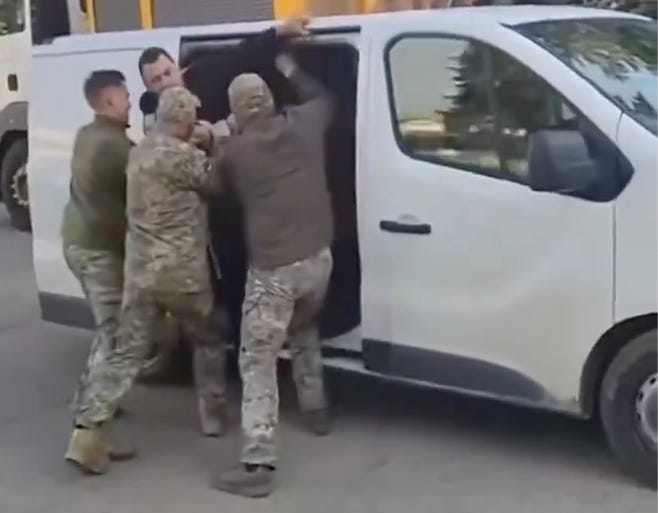
From the trunk of a car speeding past a military checkpoint to years-long self-imposed house arrest, Ukrainian men are going to extraordinary lengths to avoid military service. As the conflict enters its fourth year, a shadow society has emerged across Ukraine, where men of fighting age navigate a parallel existence marked by constant fear of conscription.
“I’ve probably been in isolation for more than two years, I can’t go outside to go outside, I can’t even go out into the entrance,” writes Oleg, a Ukrainian who describes his life as one of perpetual confinement. “I’m tired of this war, I’m tired of being in isolation for more than two years. I want freedom, I want to walk outside.”
This phenomenon represents more than individual cases of draft evasion. It reflects a profound social transformation within Ukrainian society, where military conscription policies have reshaped daily life, family dynamics, and economic realities for millions.
Anatomy of Avoidance
The tactics employed to avoid conscription range from the desperate to the methodical, often varying with social status and financial resources.
“One of my friends is driven to work by his wife once or twice a week, and the rest of the time he sleeps there,” reads one account. “They were driving and saw a checkpoint around the corner, it was too late to turn, and the guy in the back row managed to climb into the trunk and drive by unnoticed.”
For others, particularly those without financial means, the consequences can be swift and severe. “One man, a simple construction worker, drank too much alcohol on the weekend. In a summer morning, he left his house in shorts and slippers and was kidnapped. Two days later, he was already calling his friend from the military unit.”
What began as targeted recruitment has evolved into what some Ukrainians describe as systematic apprehension of civilian men. According to firsthand accounts, “The beginning of total lawlessness was the end of autumn 2022, when military commissars began to move around the city in minibuses and kidnap men.”
The Price of Exemption
A parallel economy has emerged around military exemptions, with prices fluctuating based on supply, demand, and risk.
“There are several legal grounds for avoiding conscription,” one account explains. “Some young people file disability claims for their parents to be their ‘guardians,’ which naturally costs a lot of money, even if the older person is really sick (2,500 depending on the person’s actual health condition).”
For those seeking to leave the country altogether, the market has responded to increased border security with corresponding price hikes. “Initially, you could ‘escape’ for $500-1000, now it’s already $3000-8000. I know a guy who, together with a group of 7 people, walked through the forest for 8 days… ate, slept and walked through the forest for more than a week!”
Even temporary release from military recruitment centers comes at a premium. “One person was released the same day for $8,000,” according to one account, which emphasizes that “this money is paid only to get out of the military registration and enlistment office prison. If you are caught again in an hour, then it is your problem.”
The Psychological Tolls
The prolonged stress of avoiding conscription has created profound psychological consequences, transforming apartments into virtual prisons for men fearful of being drafted.
“Since the beginning of the war and until now, many people are simply afraid to go outside, men sit at home for years, and the issue of food is decided by women or elderly parents,” one account reveals. The mental health implications are severe: “I know of exactly such a case, when a guy of 25–30 years old has not left the house for three years. His mental health is deteriorating, he is literally going crazy.”
The constant vigilance required to avoid conscription has fostered community-based warning systems on Telegram, the messaging platform that has become a vital lifeline for those seeking to evade authorities. “To move around the city and know what awaits you, a chat was created (the admin is not in Ukraine), where people share the location of danger on the way. 99% of men do not go outside without reading the information in the group,” explains one account, highlighting the platform’s crucial role in this shadow information network.
This reliance on Telegram comes at a time when the platform’s founder, Pavel Durov, sits in a French jail, detained in late February on charges related to insufficient content moderation on the app. The platform’s popularity in Ukraine stems partly from its reputation for privacy and resistance to government interference—the very qualities that have made it controversial elsewhere.
A Transformed Society
The conscription practices have reshaped the fundamental organization of Ukrainian society, with women and elderly often becoming the public face of families.
“The issue of food is decided by women or elderly parents,” notes one account, highlighting how traditional household roles have been upended by conscription pressures. Women now frequently assume additional responsibilities: “One of my friends is driven to work by his wife once or twice a week.”
This transformation extends beyond individual households to reshape the entire public sphere. “Throughout the war, every city in Ukraine has been cordoned off with checkpoints on all roads and highways that can be used to leave the city,” creating a geography of constraint that Ukrainian men must navigate daily.
The Arbitrary Nature of Enforcement
The application of conscription rules appears inconsistent, with health exemptions sometimes ignored and personal connections playing a crucial role.
“One guy had an illness that prevented him from going to war. All his documents were in order, and he had no problems with military commissars,” reads one account. “One time he was unlucky and was taken to the military commissariat. The next day he was already in the military unit, where he is still now. His illnesses do not bother anyone now.”
Meanwhile, those with connections can secure positions that exempt them from frontline service. “Another way is to become ‘one of them’. If you have the right connections and money, you can become an assistant to a military commissar, an assistant to a police officer, or get a certificate from some military agency.”
Deadly Border Rivers: The Final Escape Attempt
Along Ukraine’s western borders, the Dniester and Prut rivers have become deadly frontiers in the conscription crisis, claiming the lives of countless men attempting desperate escapes.
Thousands of Ukrainian men have risked everything to cross these treacherous waterways into Moldova and Romania, with many drowning in the attempt. The river crossings typically happen under cover of darkness, with men trying to swim across swift currents, often in cold temperatures and without proper equipment.
“I have seen dozens, hundreds of these styles of kidnappings. I know thousands of men have risked their lives and died in the river between Ukraine and Moldova/Romania,” recounts one witness to the crisis.
The Ukrainian military has responded by fortifying riverbanks with barricades and increasing patrols along shorelines. Satellite imagery and ground photographs reveal new installations along these waterways—concrete barriers, razor wire, and surveillance equipment designed specifically to prevent these desperate escape attempts. These militarized shorelines represent yet another layer of containment in what has become an increasingly sophisticated system to prevent military-age men from leaving the country.
The bodies recovered from these rivers represent only a fraction of those who have perished in desperate bids for freedom, with many swept downstream and never found. Local morgues in border regions have reportedly struggled with the volume of bodies recovered from these waterways.
Trump and Putin
The long-term implications of these conscription practices extend beyond the immediate military situation to questions about Ukraine’s demographic future and social cohesion.
“Everyone is afraid and hopes for Trump and Putin to make peace,” claims one message, reflecting the political dimensions of these personal struggles.
Oleg expresses his exhaustion with the situation: “I want to go to work and earn myself even a steamdeck at the flea market in half a year or a year. Food prices are terrible, my relatives help me to exist. To exist, not to live, because you see for yourself how terrible it is inside in our country.”
As the conflict persists, the parallel society of men avoiding conscription continues to evolve, adapting to changing enforcement tactics. What remains constant is the profound transformation of Ukrainian society, where ordinary activities like walking outside have become fraught with risk for men of fighting age.
“Everything changed in the spring of 2024, when the ‘mobilization law’ was passed,” one account states, noting how “cars whose owners were taken to war remain abandoned on the side of the road on the streets of the city.”
These abandoned vehicles stand as silent testimony to the sudden disruptions that have become commonplace in a country where the line between civilian life and military service has grown increasingly blurred.