“We will establish order in Cuba, and Nicaragua will also become ours. Next year we will have a new president in Colombia.”
— Senator Tim Scott, January 8, 20261
Five days after US forces captured Nicolás Maduro, Senator Tim Scott said the quiet part out loud. Cuba. Nicaragua. Colombia. Three countries, three regime changes, one timeline. This is not speculation about American intentions. This is an American senator describing American plans in public.
He was not alone. Senator Rick Scott, speaking the day before, laid out the same sequence: “What they did in Venezuela is gonna change Latin America. This is the start of changing Venezuela, then we’re gonna fix Cuba, Nicaragua will get fixed, next year we will have a new president in Colombia.”2
National Security Advisor Mike Waltz dismissed any international constraints: “We don’t care what they say. Trump will continue to ignore this ridiculous organization called the UN.”3
And Stephen Miller, architect of the administration’s immigration and sovereignty agenda, articulated the governing philosophy: “The use of force against other countries is the iron law of the world.”4
The Venezuela operation was not an endpoint. It was a proof of concept. The template is now proven, the infrastructure is operational, and Cuba is 90 miles from Florida. Everything that made Venezuela possible applies to Cuba, but easier.
The 32 Dead Cubans
The most significant intelligence revelation to emerge from the Venezuela operation was not about Venezuela. It was about Cuba.
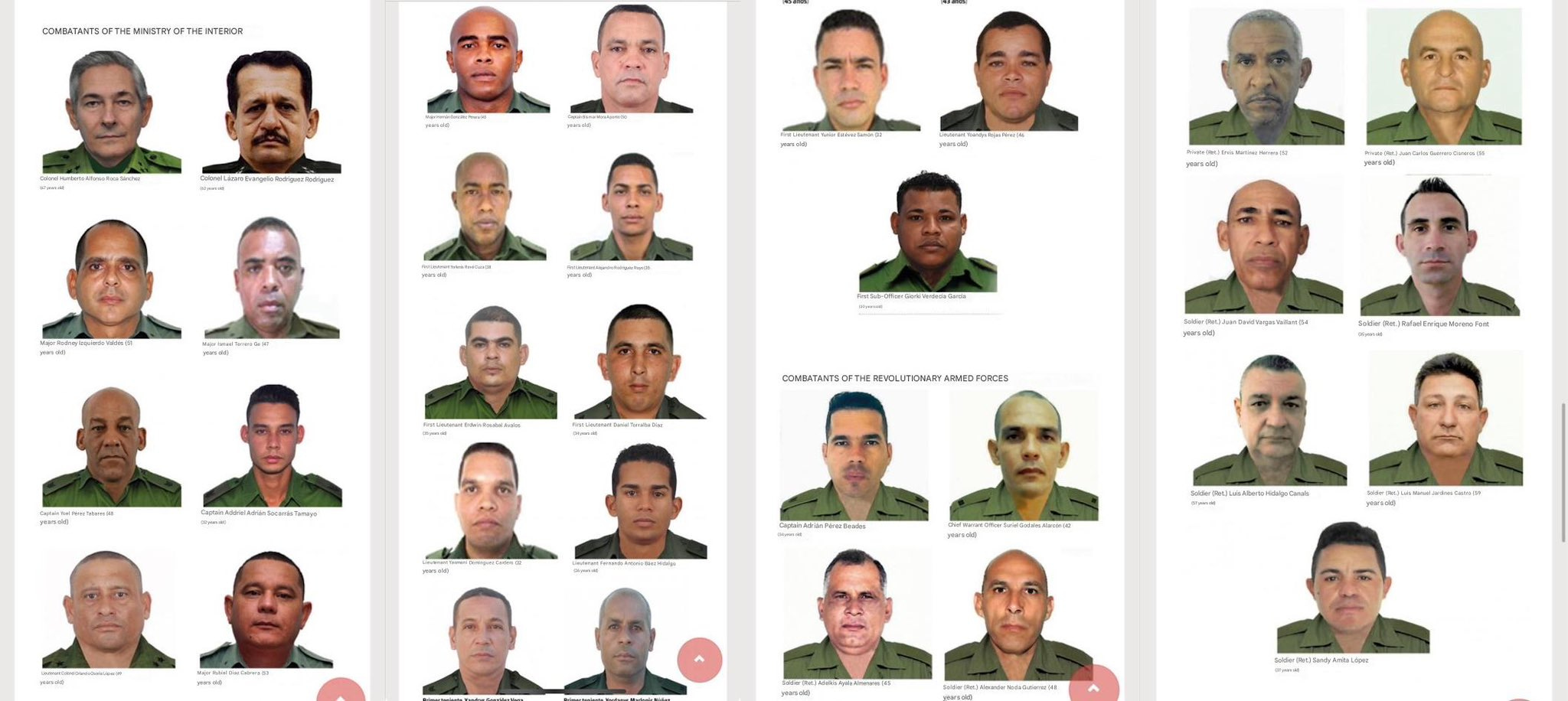
Thirty-two Cuban military and intelligence personnel died defending Nicolás Maduro on January 3.5 Cuban special forces, embedded with Venezuelan security, were killed when US forces struck Caracas. The Cuban government has released the names and ranks of the dead. Their deaths reveal something the regime has spent decades hiding: the Cuban military is a hollow force.
“The blood of the 32 Cuban special forces troops and 40+ others who died during the US’s January 3 attack on Venezuela is barely cold, but Wall Street is already smacking its lips readying to feast on the Latin American resource giant’s carcass.”
— Geopolitics Prime analysis6
[CAPTION: On January 6th, Cuba published photos of the 32 killed militants in the raid on Maduro by US forces in Venezuela.]
These were Cuba’s best. They were deployed to protect Cuba’s most important ally, the source of the subsidized oil that keeps the lights on in Havana (when the lights are on at all). They failed. If 32 of Cuba’s elite personnel could not defend the Miraflores Palace against a US raid, they cannot defend the Palace of the Revolution.
The capability of the Cuban security apparatus to resist a similar operation is negligible. This is not American propaganda. It is the conclusion drawn from watching Cuban forces die in combat for the first time in decades.
The Military Reality
Cuba’s conventional forces exist on paper. In practice, they are an army of obsolescence and decay.
Troop strength officially stands at 40,000 to 50,000, but these numbers are inflated by conscripts suffering from malnutrition and lacking meaningful training.7 Equipment dates to the Vietnam era: T-55 and T-62 tanks largely non-operational due to lack of spare parts, a handful of MiG-21 and MiG-23 aircraft with minimal pilot flight hours, air defense systems from the 1960s (S-75 and S-125) that would be ineffective against modern American aircraft.8
The comparison to Venezuela is instructive. Venezuela had S-300VM air defense systems, Russian-supplied and relatively modern. Cuba has Soviet relics from the Kennedy administration. Venezuela is 1,300 miles from the US mainland, requiring complex logistics and aerial refueling. Cuba is 90 miles from Florida, within direct range of virtually every US military installation on the Gulf Coast.
Factor Venezuela Cuba Distance from US 1,300+ miles 90 miles Air Defense S-300VM (modern) S-75/S-125 (1960s) Logistics Complex refueling Direct from Florida Estimated timeline Hours Less than 24 hours
A hypothetical operation against Cuba would be simpler in every dimension, and the Venezuela template provides the blueprint.
How It Would Happen
The Venezuela operation was not an invasion. It was a decapitation strike: capture the leader, not the country. The same model applies to Cuba, but with easier logistics and a weaker target.
Phase One: Air Superiority
F-35s and F-22s from Homestead Air Reserve Base and Tyndall Air Force Base would neutralize Cuban air defenses within the first hour. The S-75 and S-125 systems that constitute Cuba’s air defense network were designed to shoot down aircraft that no longer exist. Against fifth-generation stealth fighters, they are effectively useless. Cuba’s handful of operational MiG-21s and MiG-23s would not leave the ground; their pilots know that takeoff means death.9
The distance advantage is overwhelming. Venezuela required aerial refueling, carrier-based aircraft, and complex logistics chains spanning 1,300 miles. Cuba is 90 miles from Key West. Every air asset on the Florida Gulf Coast can reach Havana, complete its mission, and return without refueling. The operation can be sustained indefinitely from existing bases.
Phase Two: Decapitation
With air superiority established, special operations forces would execute simultaneous raids on three targets.
The Palace of the Revolution in Havana’s Plaza de la Revolución houses the Council of State and Council of Ministers. This is the administrative heart of the Cuban government. The Ministry of the Interior (MININT), located nearby, controls state security, intelligence, and the internal repression apparatus. Punto Cero, the compound in western Havana where Fidel Castro lived and where current leadership maintains residences, represents the symbolic and personal center of regime power.10
Delta Force operators, the same unit that extracted Maduro from Miraflores Palace, would hit all three locations within a narrow time window. The goal is not to hold territory but to remove leadership: Díaz-Canel, key ministers, and senior military commanders. Those captured would be transported directly to US custody, likely landing at Homestead or Miami within hours of the operation’s commencement.
The legal framework is already in place. Díaz-Canel can be indicted on narco-terrorism charges (Cuba’s State Sponsor of Terrorism designation provides the hook), extracted under the Ker-Frisbie doctrine, and arraigned in federal court before the sun sets on the day of the operation.
Phase Three: Blockade and Stabilization
The immediate concern following leadership removal is migration. The 1980 Mariel boatlift brought 125,000 Cubans to Florida in six months; a 2026 collapse could trigger movement of that scale within days.11 US Navy vessels would establish a maritime quarantine within hours of the strike, intercepting vessels before they reach international waters.
This is not occupation. The administration has no interest in governing Cuba. The Venezuela model made this explicit: Trump said the US would “run the country until such time as we can do a safe, proper and judicious transition,” but provided no details because the details do not matter.12 The goal is regime removal, not nation-building. Install a transitional government composed of Cuban exiles and pliable internal figures, secure the debt claims and asset recovery that American investors are waiting for, and withdraw to a posture of economic and diplomatic supervision.
Secretary of State Rubio described the Venezuela approach as “control through economic pressure” and an “oil quarantine,” explicitly stating “this is not an occupation.”13 Cuba would receive the same treatment: decapitation, blockade, transition, withdrawal. The US takes the head; Cubans deal with the body.
Why Not a Full Invasion?
Full-scale military occupation of Cuba would require 100,000+ troops, cost billions per month, generate an insurgency, and create a political nightmare with no exit strategy. The Pentagon learned these lessons in Iraq and Afghanistan. The Trump administration has shown no interest in repeating them.
The decapitation model is cheaper, faster, and politically sustainable. Maduro was captured by a force measured in hundreds, not hundreds of thousands. The operation lasted hours, not years. American casualties were minimal. The domestic political cost was effectively zero; Republicans celebrated, Democrats complained but had no mechanism to stop it, and the news cycle moved on.
Cuba would follow the same pattern. Strike, capture, blockade, transition, declare victory, leave. The “order” that Tim Scott promises to establish is not American military government. It is the removal of the current regime and its replacement with something amenable to American interests and American creditors.
The lack of strategic depth on the island means organized resistance would likely crumble once leadership was removed. Estimated timeline to secure key nodes in Havana: less than 24 hours.
Why This Won’t Be Bay of Pigs
The ghost of April 1961 haunts any discussion of American military action against Cuba. The Bay of Pigs remains the most humiliating failure in CIA history: 1,400 Cuban exiles landed at Playa Girón, expecting American air support and a popular uprising, and were captured or killed within three days.14 The failure shaped Cuba policy for sixty years. It does not constrain this administration.
The Bay of Pigs failed for four reasons that no longer apply. Kennedy relied on Cuban exiles rather than American forces; a 2026 operation would deploy Delta Force directly, as in Venezuela. The 1961 invasion assumed a popular uprising; sixty-five years later, the July 2021 protests proved Cubans will mobilize against the regime when conditions deteriorate, and current conditions are worse. The Bay of Pigs was a covert operation that became public, producing maximum embarrassment; the Trump administration conducts regime change on live television and calls it law enforcement. And in 1961, the Soviet Union stood behind Cuba; in 2026, Venezuela proved that Russia and China will issue statements and do nothing.
The conditions that produced failure have been systematically eliminated. Direct American force. Overt action with legal framing. No great power protector. This won’t be Bay of Pigs because the lessons of 1961 have been studied and corrected.
Rubio’s Fifteen-Year Crusade
Marco Rubio has spent his entire Senate career building toward this moment. His elevation to Secretary of State transforms a personal crusade into official policy, and Cuba has always been the ultimate prize.
The “Venezuela First” strategy is Rubio’s intellectual framework. The theory is explicit: Venezuela functions as the “ATM” of the Cuban regime, providing the oil and cash necessary to maintain the security apparatus that keeps Díaz-Canel in power.15 Cut off Venezuela, and Cuba starves. The regime collapses under its own weight, or becomes so weak that military intervention becomes trivial. Rubio articulated this publicly in December 2024: “Cuba is the head of the monster. If you don’t cut off the head, the venomous snake will continue to do harm in America.”16
His legislative record reflects this obsession. In 2017, Rubio was the primary influence behind Trump’s National Security Presidential Memorandum 5 (NSPM-5), which prohibited direct financial transactions with entities controlled by the Cuban military and intelligence services.17 The target was GAESA (Grupo de Administración Empresarial S.A.), the military conglomerate that controls an estimated 60% of the Cuban economy, including tourism, retail, and foreign exchange. NSPM-5 effectively froze foreign investment in Cuba’s tourism sector, the regime’s primary source of hard currency.
Rubio blocked Obama-era normalization at every opportunity. He opposed the embassy reopening. He opposed cruise ship travel. He opposed every measure that might have allowed the Cuban economy to diversify beyond Venezuelan subsidies. The strategy was deliberate: keep Cuba dependent on Venezuela, then take Venezuela.
“If Maduro falls, the Cuban regime will fall as well.”
— Marco Rubio, December 202418
With Operation Absolute Resolve, Rubio’s theory is being tested in real time. Venezuelan oil shipments to Cuba (approximately 45,000 barrels per day at subsidized rates) have been severed. The demands Rubio delivered to Venezuela’s interim leader included the expulsion of Cuban military advisers. The economic strangulation is now complete. What remains is either regime collapse or regime change.
Rubio has waited fifteen years for this sequence. He is now the Secretary of State, with the authority to execute what he has long advocated. The man who built the policy is now in charge of implementing it.
The Legal Trap
The legal architecture that enabled the Maduro capture applies directly to Cuba, but with additional pretexts already in place.
Cuba was redesignated as a State Sponsor of Terrorism in January 2021.19 This designation, which the Biden administration declined to reverse, activates domestic legal authorities for the use of force that do not exist for ordinary nations. A State Sponsor of Terrorism can be targeted under counterterrorism statutes without the constitutional complications of declaring war on a sovereign state.
The Ker-Frisbie doctrine, which the administration relied upon for Maduro, holds that a criminal defendant cannot challenge a court’s jurisdiction based on the manner of their apprehension, even if that manner was forcible abduction from foreign territory.20 Cuban President Miguel Díaz-Canel could be indicted tomorrow on drug trafficking or terrorism charges, extracted by Delta Force next week, and arraigned in a Miami courtroom the week after. The legal framework poses no obstacle.
The 1962 Kennedy-Khrushchev understanding, in which the United States pledged not to invade Cuba in exchange for Soviet missile withdrawal, is easily circumvented. The administration can argue (and likely will) that Cuba’s hosting of Chinese intelligence facilities and its support for “narco-terrorist” regimes in Venezuela and Nicaragua violate the spirit of the agreement.21 The reintroduction of Russian naval vessels to Cuban waters in 2024 provides additional pretext. The gentleman’s agreement that has protected Cuba for sixty years can be declared void with a press release.
“The act of state terrorism that has just taken place in Venezuela is a blatant violation of international law. This is not your backyard. We refuse to recognize the Monroe Doctrine. For Venezuela and for Cuba, we are ready to give even our blood and our lives.”
— President Miguel Díaz-Canel, January 7, 202622
Díaz-Canel’s defiance is understandable. It is also futile. International law did not protect Maduro. The UN did not protect Maduro. Russia and China did not protect Maduro. Blood and lives are precisely what the United States is prepared to spend.
The Vultures Circling, Paul Singer
The financial architecture for Cuban regime change has been under construction for decades. Outstanding American claims from the 1959 nationalizations total nearly $8 billion with accumulated interest.23 These claims have never been paid. A new Cuban government, installed under American supervision, would face immediate pressure to settle them.
The Paul Singer playbook provides the template. Elliott Investment Management, Singer’s hedge fund, acquired Citgo (the US subsidiary of Venezuela’s state oil company) for $5.9 billion in November 2025, less than one month before the raid.24 Citgo was valued at upwards of $12 billion. The forced sale by a US court satisfied defaulted bonds that Singer’s firm had purchased for pennies on the dollar. Massive transfer of wealth from the Venezuelan state to American private capital, enabled by American courts and American military power.
Singer is a major Republican donor ($42 million to MAGA super PACs in 2024) who specializes in purchasing sovereign debt of distressed nations and using American courts to enforce full payment.25 The pattern is consistent: in Argentina, Elliott purchased $48 million in defaulted bonds and extracted $2.4 billion after fifteen years of litigation, a 5,000% return enforced through US courts that seized an Argentine naval vessel in Ghana.26 Peru and Congo received similar treatment.2728 Buy distressed debt for pennies, refuse restructuring, litigate for decades, collect face value plus interest.
Cuba’s $8 billion in outstanding claims represents the same opportunity at larger scale. Investors could utilize the US court system to seize Cuban assets, place liens on future foreign investment, and effectively mortgage the island’s recovery to American financial interests. The “order” to be established in Cuba will prioritize these claims. Democracy is the rhetoric. Debt collection is the mechanism.
Why China and Russia Cannot Save Cuba
The Venezuela operation demonstrated the hollowness of Chinese and Russian security guarantees. Neither power has the capability to militarily defend Havana.
Russia’s impotence is structural. The US Navy seized Russian-flagged “shadow fleet” tankers in the Atlantic without kinetic response from Moscow.29 Russia cannot protect its own commercial interests in the Western Hemisphere, let alone defend a client state 6,000 miles from Russian territory. Bogged down in Ukraine, lacking the logistical capacity to sustain a lifeline to Cuba across an American-dominated ocean, the Kremlin’s options are limited to UN speeches and nuclear threats that everyone knows are bluster.
China’s calculus is more complex but leads to the same conclusion. Beijing values its trade relationship with the United States and European Union far more than a listening post in Cuba.30 Chinese intelligence facilities on the island are useful but not essential. When forced to choose between economic warfare with Washington over Cuba or a negotiated exit for intelligence personnel, China will negotiate. The Belt and Road does not extend to military confrontation in America’s backyard.
Intelligence assessments indicate neither China nor Russia will intervene militarily to defend Cuba.31 Russia may invoke the 1962 Missile Crisis and issue apocalyptic warnings, but conventional impotence means the response will be confined to the Security Council. China will protest through diplomatic channels while quietly extracting its people and equipment. Cuba will be cut loose.
A Cubana de Aviación Ilyushin Il-96-300 was observed circling off Venezuela’s coast on January 8, apparently waiting for authorization to land in Caracas.32 The aircraft remained in the area without descending. Even retrieving their dead requires American permission now.
Cuba’s Internal Collapse
The regime’s external vulnerabilities compound internal ones. Cuba is in the midst of its worst economic crisis since the “Special Period” following Soviet collapse.
Power grid failures have become routine, with blackouts lasting 20 hours or more.33 Food shortages have reached crisis levels. Emigration waves are accelerating as Cubans who can leave do so by any means available. The protests of July 11, 2021 (”Patria y Vida”) proved that the barrier of fear had been breached. Cubans chanted for “Corriente y Comida” (Power and Food), driven by biological necessity rather than abstract political ideology.
The security forces that Díaz-Canel relies upon to suppress dissent are suffering from the same deprivations as the population they police. The “Black Berets” and regular police lack adequate food, fuel, and motivation.34 Loyalty of rank-and-file personnel is questionable when their families are hungry.
Approximately 45,000 barrels per day of subsidized Venezuelan oil kept the Cuban economy and security apparatus functional.35 With Operation Absolute Resolve, that lifeline has been severed. Secretary of State Marco Rubio outlined US demands to Venezuela’s new interim leader at a closed-door meeting: expel military advisers from China, Cuba, Iran, and Russia.36 The oil will not flow to Havana.
Rubio’s “Venezuela First” strategy, which he has advocated for fifteen years, posited exactly this sequence: Venezuela falls, Cuba starves, the regime collapses.37 The theory is now being tested in real time.
The “Patria y Vida” Trigger
The administration is not planning to invade a stable country. It is planning to intervene in a collapse already underway.
The generational divide in Cuba has become unbridgeable. The legitimacy of the “historic generation” (the Castro brothers, their revolutionary comrades) has evaporated. Cuban youth, connected to the outside world through intermittent internet access, view the regime not as a political system to be reformed but as an obstacle to their survival.38 The July 2021 protests demonstrated that mass mobilization was possible. What was missing was a trigger.
The current crisis provides multiple triggers. Hunger. Darkness. The spectacle of Cuban soldiers dying in Venezuela while Cuban civilians die of preventable causes at home. The knowledge that the regime’s protector has been captured and its patron state is under American control.
Congressional rhetoric has shifted accordingly. Senator Rick Scott and his allies have hardened their language from “democracy promotion” to “immediate liberation.”39 The invocation of “Patria y Vida” frames potential intervention not as American imperialism but as support for an internal uprising that is already happening.
The question is not whether the US will act against Cuba. The question is whether the regime collapses from internal pressure before Washington needs to intervene, or whether American forces will be required to, in Tim Scott’s words, “establish order.”
The Timeline
The rhetorical shift from “maximum pressure” (economic sanctions, diplomatic isolation) to “establishing order” (kinetic intervention, regime decapitation) is observable and documented.40 Pre-Venezuela, the policy frame was containment. Post-Venezuela, the frame is intervention.
Element Pre-Venezuela (2024) Post-Venezuela (2026) Policy Frame Containment Intervention Legal Justification Human rights National security, Narcoterrorism Key Terminology “Sanctions,” “Pressure” “Liberation,” “Establish Order” Operational Implication Economic strangulation Kinetic strikes, Leadership extraction
Senator Rick Scott provided the timeline explicitly: Cuba and Nicaragua “fixed,” new president in Colombia “next year.”41 If we take him at his word (and the Venezuela operation suggests we should), the Cuba operation is measured in months, not years.
The 90-mile distance simplifies everything. The legal pretexts are in place. The military capability is overwhelming. The regime is weak and isolated. The population is desperate. The vultures have their claims ready. China and Russia will not intervene.
Díaz-Canel said Cuba is ready to give “blood and lives.” The administration has demonstrated, in Caracas, that it is prepared to take them.
This is the third article in a series examining the Venezuela operation and its implications. Previous articles: “400 Tons Gets You a Pardon” on the false drug charges, and “The Architects of Hemisphere Control” on who built the infrastructure.
* Senator Tim Scott, remarks reported via multiple sources including New Rules Chat transcript, January 8, 2026. Direct quote on establishing order in Cuba and timeline for Nicaragua and Colombia.↩︎
* Senator Rick Scott, remarks reported via Geopolitics Prime, January 7, 2026. Full quote: “What they did in Venezuela is gonna change Latin America. This is the start of changing Venezuela, then we’re gonna fix Cuba, Nicaragua will get fixed, next year we will have a new president in Colombia.”↩︎
* National Security Advisor Mike Waltz, remarks reported via New Rules Chat transcript, January 8, 2026. Statement dismissing UN as “ridiculous organization.”↩︎
* Stephen Miller, remarks reported via New Rules Chat transcript, January 8, 2026. Quote on use of force as “iron law of the world.”↩︎
* Military.com. “Cuba Releases Details of 32 Officers Killed in US Strike on Venezuela.” January 2026. Cuban government official acknowledgment of military personnel killed during Operation Absolute Resolve.↩︎
* Geopolitics Prime analysis, January 6, 2026. Commentary on Cuban casualties and Wall Street positioning for Venezuelan assets.↩︎
* CSIS. “What Just Happened in Venezuela? And What Comes Next?” January 2026. https://www.csis.org/↩︎
* Analysis includes assessment of Cuban military capabilities and force readiness.↩︎
* Defense Intelligence Agency assessments of Cuban military equipment, compiled from multiple open source analyses. T-55/T-62 tank serviceability, MiG-21/MiG-23 flight hour limitations, and S-75/S-125 air defense system obsolescence documented in Congressional Research Service reports on Cuba.↩︎
* Defense Intelligence Agency assessments of Cuban Air Force capabilities. MiG-21 and MiG-23 aircraft operational status and pilot training hours documented in Congressional Research Service reports. Analysis of S-75/S-125 air defense effectiveness against fifth-generation aircraft.↩︎
* Council on Foreign Relations and Congressional Research Service documentation of Cuban government structure. Palace of the Revolution, Ministry of Interior (MININT), and Punto Cero compound locations and functions.↩︎
* Migration Policy Institute. “The Mariel Boatlift: A Cuban Migration Twenty-Five Years Later.” Analysis of 1980 migration crisis and implications for future Cuban instability scenarios. https://www.migrationpolicy.org/↩︎
* CBS News. “Trump says U.S. is ‘in charge’ of Venezuela.” January 3, 2026. https://www.cbsnews.com/live-updates/venezuela-us-military-strikes-maduro-trump/ Trump’s statement on running Venezuela “until such time as we can do a safe, proper and judicious transition.”↩︎
* Rybar in English, January 5, 2026. Rubio interview on Fox describing Venezuela approach as “control through economic pressure” and “oil quarantine,” explicitly stating “this is not an occupation.”↩︎
* CIA Historical Review Program. “Official History of the Bay of Pigs Operation.” Declassified 1998. https://www.cia.gov/readingroom/collection/bay-pigs-release Comprehensive account of Brigade 2506, the landing at Playa Girón, and the operation’s failure.↩︎
* Congressional Research Service. “Cuba: U.S. Policy in the 119th Congress.” Analysis of Cuban economic dependence on Venezuelan subsidies and the “ATM” relationship.↩︎
* CiberCuba. “Marco Rubio’s strategy for Cuba and Venezuela: ‘If Maduro falls, the Cuban regime will fall as well.’” December 2024. https://en.cibercuba.com/noticias/2025-12-14-u1-e199894-s27061-nid316702-estrategia-marco-rubio-cuba-venezuela-cae-maduro Full quote on Cuba as “head of the monster.”↩︎
* White House. “National Security Presidential Memorandum 5: Strengthening the Policy of the United States Toward Cuba.” June 16, 2017. NSPM-5 text and subsequent Treasury Department regulations targeting GAESA-controlled entities.↩︎
* CiberCuba, December 2024. Rubio’s explicit statement linking Maduro’s fall to Cuban regime collapse.↩︎
* U.S. Department of State. “State Sponsors of Terrorism.” Cuba redesignated January 11, 2021. https://www.state.gov/state-sponsors-of-terrorism/ Designation activates specific legal authorities under counterterrorism statutes.↩︎
* Ker v. Illinois, 119 U.S. 436 (1886); Frisbie v. Collins, 342 U.S. 519 (1952). Bowen Law Repository analysis of Ker-Frisbie doctrine application to extraterritorial apprehension.↩︎
* Homeland House Republicans. “CCP Surveillance Infrastructure in Cuba.” Congressional report on Chinese intelligence facilities. PBS News. “Russian warships arrive in Cuban waters for military exercises.” 2024. Both provide potential pretexts for declaring Kennedy-Khrushchev understanding void.↩︎
* President Miguel Díaz-Canel, statement translated and reported via Russian news sources, January 7, 2026. Response to Venezuela operation and assertion of Cuban sovereignty.↩︎
* Foreign Claims Settlement Commission records on certified claims against Cuba from 1959 nationalizations. Principal plus interest calculated at approximately $8 billion. Congressional Research Service. “U.S. Cuba Policy: Recent Developments and the 119th Congress.”↩︎
* Mother Jones. “Trump’s Venezuela Move Could Deliver a Big Win for This MAGA Megadonor.” January 2026. Details Elliott Investment Management acquisition of Citgo for $5.9 billion in November 2025.↩︎
* Federal Election Commission filings. Paul Singer and Elliott Management contributions to Republican super PACs in 2024 election cycle totaling approximately $42 million.↩︎
* New York Times. “Argentina Reaches Deal With Hedge Funds Over Debt.” February 29, 2016. https://www.nytimes.com/2016/03/01/business/dealbook/argentina-paul-singer-hedge-fund.html Details of Elliott Management’s $48 million purchase yielding $2.4 billion settlement after 15 years of litigation.↩︎
* Financial Times and Reuters coverage of Elliott Management litigation against Peru. Settlement terms and Peruvian government characterization of tactics as “predatory.”↩︎
* American Lawyer and Wall Street Journal coverage of Elliott Management sovereign debt litigation against Republic of Congo and Democratic Republic of Congo. Pattern of purchasing distressed debt and pursuing full payment through US courts.↩︎
* The Guardian. “US seizes Russian-flagged oil tanker in Atlantic.” 2025-2026. Documentation of US Navy interdiction of Russian shadow fleet vessels without Russian military response.↩︎
* ThinkChina. “Trump unbound: The US unravels the world order it built.” Analysis of Chinese strategic calculus regarding Western Hemisphere commitments versus trade relationship priorities.↩︎
* Brookings Institution. “The global implications of the US military operation in Venezuela.” January 2026. https://www.brookings.edu/↩︎
* Assessment of Russian and Chinese response options and limitations.↩︎
* Frontline Report, January 8, 2026. OSINT observation of Cubana de Aviación Il-96-300 circling Venezuelan airspace awaiting landing authorization.↩︎
* YouTube and international press coverage of Cuban power grid failures. Blackouts documented at 20+ hours in multiple provinces. BBC, Reuters, and AP reporting on Cuban energy crisis throughout 2025-2026.↩︎
* Open source analysis of Cuban security force conditions. Reporting on “Black Beret” unit resource constraints and morale issues from Cuban exile sources and international human rights organizations.↩︎
* Reuters and OPEC data on Venezuelan oil shipments to Cuba. Pre-crisis volume approximately 45,000 barrels per day at subsidized rates.↩︎
* New York Times, reported via Two Majors English Channel, January 7, 2026. Rubio’s demands to Venezuelan interim leader Delcy Rodríguez at closed-door meeting, including expulsion of Cuban military advisers.↩︎
* CiberCuba. “Marco Rubio’s strategy for Cuba and Venezuela: ‘If Maduro falls, the Cuban regime will fall as well.’” December 2024. Rubio’s explicit “theory of change” linking Venezuela and Cuba regime change.↩︎
* Analysis of Cuban generational divide from multiple sources including Freedom House, Human Rights Watch, and academic studies of July 11, 2021 protests. Youth mobilization patterns and internet connectivity impact.↩︎
* Senator Rick Scott press releases on Cuba policy, 2025-2026. Shift from “democracy promotion” rhetoric to “liberation” framing documented in Senate floor speeches and official communications.↩︎
* Rhetorical analysis comparing Trump administration Cuba policy statements pre and post Venezuela operation. CSIS, Brookings, and Chatham House assessments of policy frame shift.↩︎
* Senator Rick Scott, January 7, 2026. Explicit timeline statement: Cuba and Nicaragua “fixed,” new Colombian president “next year.”↩︎