"If you strike us, we open every port. We put 500,000 people on boats. Your Coast Guard can't stop them. Florida drowns."
— The threat Cuba hasn't made yet
Senator Tim Scott said the United States will "establish order" in Cuba. Senator Rick Scott said Cuba will be "fixed" this year. The operational template is proven: decapitation strike, leadership extraction, transitional government, withdrawal. Twenty-four hours from first strike to mission accomplished.
The previous articles in this series documented the infrastructure, the timeline, and the military reality.[1] Cuba cannot stop a US strike. Its air defenses are relics from the Kennedy administration. Its special forces died in Venezuela. Russia and China will issue statements and do nothing. The question is not whether Cuba can defeat American military power. It cannot. The question is whether Cuba has any cards left to play.
The answer is yes, but the hand is weak.
What Doesn't Work
Before examining Cuba's options, it is worth understanding why the obvious strategies fail.
Nuclear weapons provide absolute deterrence, which is why North Korea pursued them. But proliferation requires years of development, extensive infrastructure, and the ability to survive preemptive strikes during the vulnerable development period. Cuba has none of these. The nuclear option is not an option.
Martyrdom operations (the "poor man's nuclear bomb") provided Iran and Hezbollah with asymmetric deterrence that defeated American and French forces in Lebanon.[2] The 1983 Marine barracks bombing killed 241 Americans and drove the United States out. But martyrdom operations require ideological infrastructure: a theological or revolutionary framework that makes death desirable, a culture of sacrifice that can sustain recruitment, and networks capable of operational security. Iranian Shia theology provided this for Hezbollah. Palestinian nationalism layered onto Islamic martyrdom provided this for Hamas. Cuban Marxism-Leninism does not. Che Guevara is a secular saint. There is no paradise waiting. The martyrdom option requires ideological foundations that Cuba lacks.
Great power protection proved hollow in Venezuela. Russia issued statements. China expressed concern. Thirty-two Cuban special forces died defending Maduro while Moscow and Beijing watched. Neither power has the capability or willingness to militarily challenge the United States in its own hemisphere. The protection option is an illusion.
International law did not save Maduro. The UN Security Council convened and did nothing. The United States holds veto power over any resolution condemning American action. International law is not self-enforcing, and no one will enforce it against Washington. The legal option is theater.
Regional solidarity collapsed at CELAC. Latin American governments could not agree on a statement, let alone coordinated action. The right-wing bloc (Argentina, El Salvador, Ecuador) celebrated Maduro's capture. The left-wing bloc (Brazil, Mexico, Colombia) condemned it and did nothing. The solidarity option is fractured beyond utility.
What remains are the tools of the weak: hostages, migration, intelligence, and economic disruption. None can stop a strike. All can impose costs. The question is whether the costs are sufficient to change the calculus.
Thanks for reading Tatsu’s Newsletter! This post is public so feel free to share it.
The Hostage Card
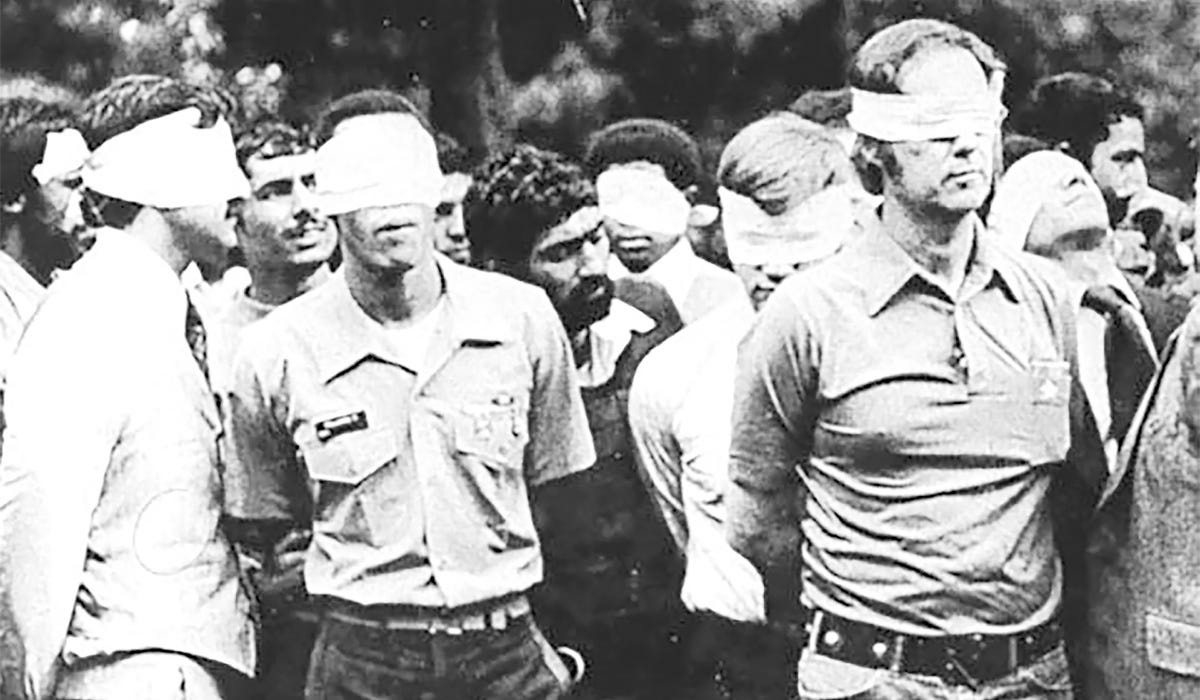
The Iranian hostage crisis of 1979-1981 demonstrated that a small number of American captives can paralyze a superpower.
Fifty-two American diplomats and citizens held for 444 days. The mechanics of paralysis were relentless. Ted Koppel's "America Held Hostage" became ABC Nightline, the first nightly news show dedicated to a single story.[3] Every broadcast opened with the day count. Day 100. Day 200. Day 300. The visual repetition transformed hostages from a foreign policy crisis into a national obsession, a nightly reminder of American impotence broadcast into every living room in the country.
Carter's options narrowed as the crisis lengthened. A rescue operation would risk killing the hostages. Air strikes would guarantee it. Negotiation required accepting terms that looked like capitulation. Doing nothing looked like weakness. Every choice was bad. Every day made every choice worse. When Carter finally authorized Operation Eagle Claw, the rescue attempt crashed in the Iranian desert and killed eight American servicemen.[4] The images of burned helicopters and body bags became the defining visual of his presidency.
Iran extracted everything it wanted: $8 billion in unfrozen assets, a pledge of non-intervention, and the psychological satisfaction of humiliating the world's most powerful nation for more than a year. The hostages were released minutes after Ronald Reagan took the oath of office, a final degradation timed for maximum impact. Carter had spent 444 days trying to solve the problem. His successor inherited the solution simply by being someone else.
The strategic logic is simple: American presidents cannot tolerate American hostages. The domestic political cost is unbearable. Military options become constrained because any strike risks killing the hostages. Every day of captivity is a news cycle, a reminder of American impotence, a drain on presidential approval. The crisis consumes the presidency, crowding out everything else, making the hostages the only issue that matters.
"You have your B-52s and your aircraft carriers. We have your people."
— Iranian revolutionary logic, 1979
Cuba has Americans. Tourists, journalists, academics, business people, NGO workers. Not many, given the embargo, but enough. If Díaz-Canel detained American citizens preemptively, before any strike, he would create the hostage dynamic that paralyzed Carter.
The timing is critical. Once Delta Force is inbound, it is too late. The strike happens in hours. Hostages taken during or after the operation have no deterrent value; they become bargaining chips for the aftermath, not shields against the attack. For hostages to work as deterrence, they must be taken before the strike order is signed. This requires intelligence about American intentions and the willingness to act preemptively, accepting the international condemnation that comes with detaining foreign nationals.
The calculation for Trump would change. He could not claim a clean "capture the dictator, declare victory" narrative if American citizens were in Cuban prisons. His voters, whatever they think about Cuban communism, care about American hostages. The political cost of leaving Americans behind would compete with the political benefit of regime change.
This is Cuba's strongest card. It is also the hardest to play. Taking hostages before an attack means taking hostages when no attack may come, creating an international crisis based on an assessment of American intentions that may be wrong. The window between "early enough to deter" and "too late to matter" may be measured in days.
Weaponized Migration
Geography gives Cuba a second card: demographic warfare.
The Mariel boatlift of 1980 demonstrated how migration can become a weapon. Castro opened the port of Mariel and announced that anyone who wanted to leave could leave. Within weeks, a flotilla of boats from Florida arrived to collect relatives. Within months, 125,000 Cubans had crossed the Florida Straits.[5]
Castro weaponized the exodus in ways that maximized American pain. He emptied prisons and psychiatric hospitals into the boats, ensuring that "Marielito" became an epithet. The actual criminals and mentally ill were a small fraction of the migrants, but they dominated the news coverage, poisoning public perception of Cuban refugees for a generation. The political cost fell heaviest on Florida, transforming Cuban immigration from an asset (anti-communist refugees who voted Republican) into a liability (chaotic masses who might include criminals). Some analysts credit the Mariel backlash with costing Carter Florida's electoral votes, though the hostage crisis was the larger factor.[6]
Castro repeated the tactic in 1994 during the balsero crisis. When Cubans began hijacking ferries and boats to flee the island, Castro responded not by stopping them but by announcing that anyone who wanted to leave could leave. Tens of thousands put to sea on rafts, inner tubes, and anything that would float. The Clinton administration, facing images of desperate refugees drowning in the Florida Straits, was forced to negotiate directly with Havana. The result was a migration agreement that gave Cuba exactly what it wanted: the ability to control when and how many Cubans could leave, turning migration into a pressure valve the regime could open or close at will.[7]
That was 125,000 people over six months in 1980, and roughly 35,000 in the weeks before the 1994 agreement. Both waves were partially organized, partially spontaneous, constrained by the logistics of boat availability and Castro's willingness to let the exodus continue.
A deliberate, fully organized migration wave could be larger and faster. Cuba's population is 11 million. If even 5% decided to leave simultaneously, that is 550,000 people. The Florida Straits are 90 miles wide. The US Coast Guard has approximately 250 cutters of all sizes, many deployed elsewhere.[8] It cannot physically intercept 500,000 people in small boats, rafts, and anything that floats.
The threat is not subtle: "If you strike us, we open every port. Every Cuban who wants to leave, leaves. All at once. Your Coast Guard cannot stop them. Your processing facilities cannot hold them. Your Florida politics cannot survive them. And it happens on live television."
This is not martyrdom. No one needs to die. It is the weaponization of desperation, turning the Cuban people's desire to flee into a strategic asset. Cynical, cruel, and effective.
The migration weapon has advantages over hostages. It does not require detaining anyone preemptively. It can be deployed after a strike begins, as retaliation rather than deterrence. It imposes costs on Florida specifically, which matters because Florida is the political base of the Republican Party and the home of the Cuban-American lobby that supports regime change. The very constituency that wants Díaz-Canel removed would bear the immediate cost of removing him.
The Trump administration would face an impossible choice: accept the migration wave and own the humanitarian chaos, or try to stop it with force and create images of American vessels turning back desperate refugees. Either option is politically damaging in ways that a clean decapitation strike is not.
The Intelligence Card
Cuban intelligence is more sophisticated than Cuba's military.
The Dirección de Inteligencia (DI) is one of the most capable intelligence services in the Western Hemisphere, punching far above Cuba's weight. For six decades, it has prioritized penetration of American institutions over conventional military capability. The results speak for themselves.
Ana Montes, the highest-ranking analyst at the Defense Intelligence Agency, spied for Cuba for seventeen years before her arrest in 2001.[9] She was the senior Cuba analyst at the Pentagon, responsible for assessing Cuban military capabilities and intentions. Every assessment she wrote went to Havana before it went to her superiors. She compromised the identities of American intelligence officers, the details of US military exercises, and sensitive operations in El Salvador. She was not the only Cuban agent in the US government, merely the most damaging one discovered.
The Wasp Network, dismantled in 1998, placed Cuban agents inside the Brothers to the Rescue organization, Southern Command, and the Cuban American National Foundation.[10] The network tracked exile groups planning operations against Cuba and provided intelligence that allowed Havana to shoot down two Brothers to the Rescue aircraft in 1996, killing four Cuban Americans. Other networks, not yet uncovered, may still be operational.
The DI's tradecraft is patient and professional. It recruits ideologically motivated assets (Montes believed she was serving peace, not Havana), places them in positions where they can rise naturally, and runs them for decades without exposing them through unnecessary communications. This is intelligence capability that outlasts any single American administration.
What does Cuba know? After sixty years of targeting American institutions, the answer is: probably a great deal. Operations in Latin America during the Cold War. Intelligence relationships with governments that publicly criticize American policy. Covert actions that would embarrass Washington if documented. The identities of current intelligence officers. The details of current operations. Cuba may possess information that could be strategically released to impose reputational and diplomatic costs.
"Strike us and watch what gets leaked."
This is a weaker card than hostages or migration. Leaks take time to have effect. They do not stop military operations in progress. They impose costs after the fact, not before. Intelligence exposure embarrasses rather than deters. But combined with other tools, it adds to the price of intervention. And unlike hostages, which require preemptive action, intelligence can be released at any time, making it useful even after a strike has begun.
The Scorched Earth Option
Cuba and Venezuela have economic relationships with countries other than the United States. European companies, Canadian investors, Chinese state enterprises have assets and agreements that would be affected by regime change.
The threat: "If you strike, we default on every obligation. We nationalize every foreign asset. We tear up every contract. Your allies lose billions, and they blame you."
This is not powerful alone. European and Canadian losses would not stop an American military operation. But it creates friction in relationships that the United States needs for other purposes. It gives European governments domestic political reasons to criticize Washington. It complicates the post-strike environment by ensuring that the new Cuban government inherits legal chaos and international litigation.
The economic scorched earth option is a spoiler strategy. It cannot prevent regime change. It can make the aftermath more expensive and contentious than the Trump administration expects.
The Precedents: When Weak Hands Won
History offers examples of small states successfully deterring large ones through asymmetric means. The patterns are instructive.
Iran, 1979-1981: The hostage crisis demonstrated that 52 Americans could paralyze a superpower. Carter's failure to resolve the crisis contributed to his electoral defeat. Iran secured $8 billion in unfrozen assets and a non-intervention pledge. The lesson: hostages work, but only if you have the stomach to hold them through international condemnation and the willingness to wait out the American political calendar.
North Korea, 1994-present: When conventional military options became too costly (Seoul's proximity to North Korean artillery guaranteed massive civilian casualties in any conflict), Pyongyang accelerated nuclear development. The nuclear program gave North Korea the ultimate deterrent: the threat of mutual destruction. Kim Jong Il and Kim Jong Un have survived American hostility that toppled Saddam Hussein and Muammar Gaddafi. The lesson: nuclear weapons provide absolute deterrence, but require years of development and the ability to survive preemptive strikes during the vulnerable period.
Hezbollah, 1983: The Marine barracks bombing killed 241 Americans and drove US forces out of Lebanon within months.[11] Martyrdom operations provided effective deterrence against a superpower unwilling to absorb casualties for peripheral interests. The lesson: martyrdom works, but requires ideological infrastructure that produces volunteers willing to die.
Somalia, 1993: The "Black Hawk Down" incident killed 18 Americans and led to US withdrawal. The political cost of casualties in a conflict Americans did not understand proved too high. The lesson: American tolerance for casualties is low when vital interests are not at stake, but this requires actually inflicting casualties, which requires military capability Cuba does not possess.
Saddam Hussein, 2003: Iraq had neither nuclear weapons nor effective asymmetric deterrence. Saddam waited, assumed the invasion would not happen, and was pulled from a spider hole nine months later. The lesson: passivity is death.
Gaddafi, 2011: Libya gave up its nuclear program in 2003 in exchange for normalization with the West. Eight years later, NATO airpower supported rebels who captured and killed him. The lesson: giving up deterrence in exchange for promises is fatal. The promises expire. The vulnerability is permanent.
The successful cases share common features: preemptive action, willingness to accept international condemnation, and capabilities that actually impose costs. The failures share a different feature: waiting to see what the adversary would do.
Playing a Weak Hand
None of these cards, individually, stops a decapitation strike. The question is whether they can be combined into a package that changes the calculus.
The preemptive package:
* Detain American citizens (hostages)
* Announce that any strike triggers immediate mass migration
* Signal that intelligence will be released
* Threaten economic scorched earth
The message to Washington:
"You can take Havana in 24 hours. But your people will be in our prisons. Half a million Cubans will be in the Florida Straits. Your secrets will be on WikiLeaks. And your European allies will be suing whoever you install to replace us. Is this worth it for an island with no oil?"
The logic is not to make intervention impossible. It is to make intervention costly enough that Washington chooses a different approach. Sustained pressure, economic strangulation, waiting for internal collapse. These options are slower and less satisfying than a Delta Force raid, but they do not come with hostages on CNN and refugee boats swamping Key West.
The Problem with the Weak Hand
The strategy has a fundamental vulnerability: it assumes the United States cares about the costs.
The Trump administration has demonstrated tolerance for:
* International condemnation (ignored after Venezuela)
* Allied anger (dismissed as irrelevant)
* Congressional opposition (overcome 51-49)
* Humanitarian optics (not a priority)
The only costs that clearly matter are domestic political costs. American hostages matter because American voters care about American hostages. Florida migration matters because Florida is a Republican state with a Republican governor and Republican electoral votes.
But even these costs may not be sufficient. The Iran hostage crisis paralyzed Carter because Carter was Carter: a president who agonized over decisions, who sought international consensus, who believed in process. The hostages consumed him because he let them consume him. He televised his paralysis.
Trump is not Carter. Trump's response to hostages would not be anguished negotiation. It would be escalation. "They took our people. Now we take everything." The same nationalist framing that justifies the original intervention would justify its expansion. Cuban hostage-taking would become proof of Cuban barbarism, justification for regime change on punitive rather than strategic grounds.
"They took our people hostage. They sent an invasion of migrants. This proves we were right to act. Now we finish the job."
The migration weapon faces similar reframing risks. Trump built his political brand on immigration restriction. A migration wave from Cuba would not create the Carter-era optics of desperate refugees seeking freedom. It would create the Trump-era optics of an invasion, masses of people crossing borders that America refuses to protect. The images would energize his base rather than constrain it. "Cuba attacked us with demographic warfare. We respond with everything we have."
This is the asymmetry that makes Cuba's position so difficult. The costs it can impose are real, but they require an adversary who processes costs rationally, who seeks to minimize pain, who can be deterred by the prospect of complications. The Trump administration processes resistance as provocation, complications as proof of necessity, and pain as something to be inflicted rather than avoided.
The weak hand is weak not just because the cards are low-value. It is weak because the opponent may not be playing the same game. Cuba calculates costs and benefits. Trump calculates dominance and submission. In that framework, Cuban resistance is not a deterrent. It is a confirmation that the strike was necessary. It is an invitation to hit harder.
What Díaz-Canel Probably Will Not Do
The strategies outlined above require preemptive action: taking hostages before a strike, not after; announcing migration threats before invasion, not during. They require accepting international condemnation for aggressive moves based on American intentions that may never materialize.
Díaz-Canel has shown no indication that he will take these steps. His response to Venezuela was rhetorical: "We are ready to give even our blood and our lives."[12] This is the language of martyrdom without the infrastructure of martyrdom. It suggests Cuba will wait, absorb the strike, and hope that somehow the aftermath becomes ungovernable.
History suggests this hope is misplaced. Noriega waited and was captured. Maduro waited and was captured. The regimes that survive American pressure are the ones that act preemptively to change the calculus: Iran with hostages, North Korea with nuclear weapons, Venezuela under Chavez with oil leverage before the shale revolution eliminated it.
Cuba has a weak hand. But a weak hand played boldly can still impose costs. A weak hand held passively is just weakness.
The Uncomfortable Conclusion
Cuba's deterrent options are:
1. Hostages (high impact, requires preemptive action)
2. Migration (high impact, can be reactive but better if threatened preemptively)
3. Intelligence (medium impact, slow, post-hoc)
4. Economic scorched earth (low impact, complicates aftermath)
None of these stop a decapitation strike. All of them impose costs. Whether the costs are sufficient to deter depends on factors outside Cuban control: American domestic politics, Trump's personal calculations, the news cycle, random chance.
The honest assessment is that Cuba probably cannot stop the United States from "establishing order" if Washington decides to do so. The infrastructure is built. The template is proven. The will exists. What Cuba can do is make the operation more expensive, more politically complicated, and more likely to produce long-term blowback.
That may not be enough. But it is what they have.
This is the fourth article in a series examining the Venezuela operation and its implications. Previous articles: ["400 Tons Gets You a Pardon"] on the false drug charges, ["The Architects of Hemisphere Control"] on who built the infrastructure, and ["We Will Establish Order in Cuba"] on what comes next.
Notes
[1] See previous articles in this series: "400 Tons Gets You a Pardon" (January 5, 2026), "The Architects of Hemisphere Control" (January 7, 2026), and "We Will Establish Order in Cuba" (January 8, 2026). https://tatsuikeda.substack.com/
[2] Wright, Robin. "Sacred Rage: The Wrath of Militant Islam." Simon & Schuster, 1985. Documents the development of suicide bombing as a strategic weapon by Iranian-backed forces in Lebanon, including the 1983 Marine barracks bombing that killed 241 American servicemen.
[3] Koppel, Ted. "Nightline: History in the Making and the Making of Television." Times Books, 1996. ABC's "America Held Hostage" began November 8, 1979, eleven days after the embassy seizure, and evolved into Nightline, the first nightly news program devoted to a single ongoing story.
[4] Bowden, Mark. "Guests of the Ayatollah: The Iran Hostage Crisis." Atlantic Monthly Press, 2006. Comprehensive account of the 444-day hostage crisis, Operation Eagle Claw's failure, and the political destruction of the Carter presidency.
[5] Migration Policy Institute. "The Mariel Boatlift: A Cuban Migration Story." https://www.migrationpolicy.org/article/mariel-boatlift-cuban-migration-story Analysis of the 1980 migration wave, Castro's tactical inclusion of criminals and psychiatric patients, and long-term impact on Florida politics.
[6] Masud-Piloto, Félix Roberto. "From Welcomed Exiles to Illegal Immigrants: Cuban Migration to the U.S., 1959-1995." Rowman & Littlefield, 1996. Documents the political fallout from Mariel and its effect on Carter's Florida campaign.
[7] LeoGrande, William M. and Kornbluh, Peter. "Back Channel to Cuba: The Hidden History of Negotiations Between Washington and Havana." University of North Carolina Press, 2014. Documents the 1994 balsero crisis and subsequent migration agreements between the Clinton administration and Castro government.
[8] U.S. Coast Guard. "Fleet Mix Analysis." Coast Guard cutter inventory and deployment data. The Coast Guard's 250+ cutters are distributed globally, with only a fraction available for Florida Straits interdiction at any given time.
[9] Popkin, Jim. "Code Name Blue Wren: The True Story of America's Most Dangerous Female Spy." Hanover Square Press, 2023. Account of Ana Montes's seventeen-year espionage career for Cuban intelligence while serving as the Defense Intelligence Agency's senior Cuba analyst.
[10] Latell, Brian. "Castro's Secrets: Cuban Intelligence, the CIA, and the Assassination of John F. Kennedy." St. Martin's Press, 2012. Documents Cuban intelligence operations including the Wasp Network and the DI's penetration of American institutions.
[11] Friedman, Thomas L. "Marines' Role Stirs Hot Debate in Congress." New York Times, October 25, 1983. Coverage of the Marine barracks bombing and subsequent congressional debates that led to US withdrawal from Lebanon.
[12] President Miguel Díaz-Canel, statement responding to the Venezuela operation, January 7, 2026. Translated and reported via multiple sources including Russian state media and Cuban government communications.