September 10, 2025
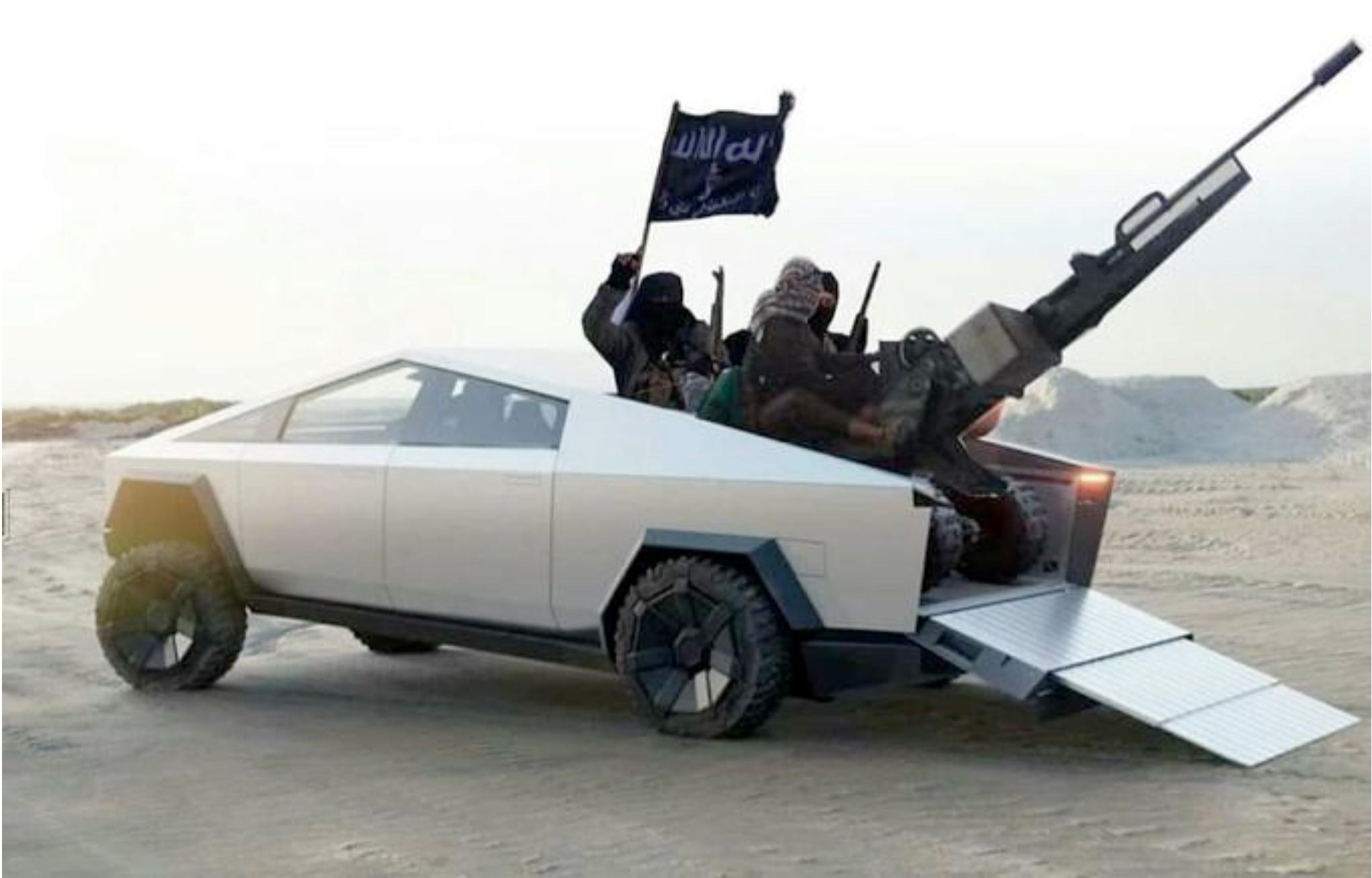
When Tesla unveiled the Cybertruck, the internet immediately knew what it was looking at. Within hours, memes showed the angular monstrosity in post-apocalyptic wastelands with armed ISIS militants. The joke was that this vehicle looked designed for civilizational collapse.
The joke stopped being funny when people started dying.
“The phenomenon of being certain you’re right when you’re actually spectacularly wrong has a name in psychology: the Dunning-Kruger effect. But when that overconfidence is scaled across an entire organization and backed by billions in capital, it becomes something far more dangerous.”
Dr. Diane Vaughan, author of “The Challenger Launch Decision,” on organizational deviance
Michael Sheehan’s skeleton was eight inches shorter when they found his remains.
But before I tell you about Michael, imagine a car brand whereupon you took a knife and thrust it through the floor. The car immediately locks you inside, burns your skin and lungs with toxic gasses, then burns you alight with it for 24 hours into ashes while firefighters watch helplessly in horror. Would you buy one?
Sheehan, a 47-year-old registered nurse, had been driving his brand-new Tesla Cybertruck through Beach City, Texas, on a humid August evening in 2024 when the vehicle veered off the road and slammed into a culvert. Within seconds, the truck’s 1,000-pound lithium-ion battery pack containing roughly 4,000 individual cells packed into a sealed sheet metal case erupted into what investigators would later describe as a “1,000-degree [celsius] chemical inferno.”^[1]
The fire burned so intensely that Sheehan’s skeletal system literally fractured from thermal stress, temperatures reaching 5,000 degrees Fahrenheit according to investigators. His electronic door locks had failed when the power cut out. The manual release handles, buried deep in the door panels, might as well have been on the moon. Sheehan died trapped inside what his family’s attorney would later call “a $100,000 crematorium on wheels.”
This wasn’t a freak accident. It was the predictable result of a decade of calculated design decisions that prioritized performance metrics, cost savings, and market disruption over the most basic principles of automotive safety. Sheehan’s death represents something unprecedented in the history of American manufacturing: a consumer product so fundamentally flawed and dangerous that its own marketing materials have become evidence in wrongful death lawsuits.
Parallels to OceanGate Titan, The Ford Pinto and The Chevy Corvair
As of August 2025, Tesla vehicles have been involved in at least 734 deaths globally… To understand the scale of this negligence, you must place it in its historical context. In the 20th century, it took the deathtrap handling of the Chevrolet Corvair to give us Ralph Nader’s book, Unsafe at Any Speed. It took 27 fiery deaths in the Ford Pinto to force a recall and create a cultural touchstone for corporate malfeasance.
In 2023, the world saw a perfect microcosm of this same pathology. When the OceanGate Titan imploded, its CEO, Stockton Rush, became a permanent symbol of the Silicon Valley ethos of “disruption” over safety. He had dismissed regulations as “obscenely safe” hindrances that stifled growth. He had proudly admitted, “I’ve broken some rules to make this.” He believed that subjecting his “rapid innovation” to outside safety verification was a waste of time. His mindset is best captured in his own words:
“You know, at some point, safety is just pure waste. I mean, if you just want to be safe, don’t get out of bed…“
This philosophy killed five people, including Rush himself, in a single, cataclysmic event. The implosion force was so massive the pressures obliterated all parts of each victim’s bodies and contents of the vehicle instantly, down to the molecular level in some cases. It was so fast and great that each person did not receive any neural sensory data before they died. Yet Tesla is both a sequel to and a horrifying escalation of this entire history. It combines the Corvair’s dangerous design, the Pinto’s fiery lethality, and OceanGate’s hubristic rejection of standards, all underpinned by the same contempt for safety as “pure waste.” The only difference is the scale. OceanGate was one implosion. Tesla is a slow-motion disaster with a new victim every week. And unlike the instantaneous end granted to the Titan’s passengers, Tesla’s victims are often given an agonizing window of consciousness, trapped in a burning chemical furnace of the company’s own design.
Tesla’s Safety Record Is Abysmally Bad and Suppressed
Tesla occupies roughly 2% of vehicles on American roads, yet has killed at least 734 people as of August 2025. When adjusted for market share, this death rate significantly exceeds that of conventional automobiles.^[2]
Of those 734 deaths, over 100 occurred in fires where victims burned alive, often trapped by electronic door locks that fail when power is cut. Another 59 deaths involved Autopilot or Full Self-Driving systems that failed catastrophically. The remaining deaths stem from mechanical failures, sudden acceleration events, and crashes caused by design defects, each representing a preventable tragedy if safety had been prioritized over profit.
The fire statistics are particularly damning. The Tesla Fire database documented 232 confirmed Tesla fire incidents through 2023, but by 2025, that number has grown to over 250 fires with more than 100 deaths.^[3] Compare this to the National Fire Protection Association’s data showing conventional vehicle fires kill approximately 560 people annually out of 174,000 incidents nationwide, a fire fatality rate of 0.3% for conventional cars.^[4] When adjusted for fleet size, Tesla’s fire death rate is catastrophically higher at 40%. This is hard to believe, but a 4 in 10 chance of death because Elon was too cheap to go with proper battery types and engineering.
The international scope of the crisis is being systematically suppressed. In a single night in Berlin, nine Teslas caught fire, yet this mass incident never made headlines, only to go viral on Telegram. A Georgia Cybertruck dealer watched their vehicle spontaneously combust on December 31, 2024. Throughout 2024 alone, documented fire deaths included two in Georgia, four in Canada, five in Wisconsin, four in France, three in California, and one in Korea, with families consistently blaming Tesla’s door design for trapping victims as they burned alive.
When a Tesla catches fire, you’re more than 100 times more likely to die.
The math: 40% ÷ 0.3% = 133x higher fatality rateThis calculation compares Tesla's reported fire fatality rate (40%) against national averages for all vehicles (0.3%), though differences in data collection methods, fleet composition, and reporting standards may affect the accuracy of this comparison.
The science behind this disparity is straightforward. Lithium-ion thermal runaway creates a self-sustaining chemical reaction that generates its own oxygen through electrolyte decomposition. Unlike conventional fires that can be smothered by removing oxygen, these battery fires burn until every molecule in all 2000+ battery cells are consumed, a process that can take 24 hours or more.
Tesla’s fundamental battery architecture compounds the problem. Unlike consumer electronics that use protected lithium-ion cells with individual safety circuits and battery management chips, Tesla packs thousands of unprotected, unregulated industrial cells into a sealed sheet metal case mounted directly beneath passengers. Each cell lacks its own monitoring chip or safety cutoff, meaning a single cell failure can cascade uncontrolled through the entire pack. When even a handful of these unregulated cells are damaged in a crash, the resulting thermal runaway propagates through the entire pack like a chemical wildfire, with no individual cell protection to stop the chain reaction.
“Tesla Airplane” Fallacy: Why Low Frequency Doesn’t Mean Low Risk
When confronted with the horror of over 100 people burning to death, the company’s defense is always a retreat into abstract statistics: “our cars catch fire less often per mile.” It’s a talking point designed to obscure a terrifying truth about risk.
Consider this: We all accept that air travel is statistically safer than driving. But what if there was an airline, “Tesla Air,” whose planes crashed less frequently, but where every single incident, no matter how minor, carried a 40% chance of a catastrophic, unsurvivable explosion?
The government would ground the fleet. The public would be in an uproar. No one would fly Tesla Air, because the “lower crash rate” is irrelevant when the consequence of any failure is so absolute. The personal risk has become unacceptable.
This is precisely the reality of driving a Tesla. You are more likely to survive a crash and a fire in any other car make than you are in a Tesla. The absolute mortality risk, the thing that truly matters when your life is on the line, trumps all other statistical games.
1997 Toyota Prius vs. 2025 Tesla
Speaking of Toyota or other makes, all of whom are safer, Tesla packs are not serviceable or vented. To get to the cells, a Tesla pack must be completely demolished like opening a giant can of sardines at great risk of exploding the whole assembly and your workplace. The batteries are foam sealed in place, completely nonreusable, any of it. The whole pack is practically air tight, so cooling is done by complex valves and radiators pumping liquid refrigerant, instead of simple passive air cooling. In a 1997 Toyota Prius, the cells are in the cargo area over the chassis floor, using the climate of the whole cabin to cool the more conservative and much safer Nickel-metal hydride cells. (Although Toyota has safely and recently switched to Lithium.) Toyota battery packs slide in and out with a few bolts and clips. A cottage industry of safely and sustainably rebuilding Prius and Toyota packs exists, and even a DIY’er who has never done it can watch a YouTube video and learn in about 20 minutes.
Tesla could save hundreds of future customers from dying tomorrow. Lithium iron phosphate (LiFePO4) batteries, used by competitors like BYD, are far more thermally stable and virtually immune to catastrophic fires. But Tesla’s engineering team made a calculated trade-off: accept the increased fire risk in exchange for better range specifications.
The contrast in battery philosophy becomes even starker when examining charge management. Toyota's Prius never allows its battery to charge above 70% or discharge below 40% during normal operation, maintaining a conservative 30% operational window that has enabled some Prius batteries to exceed 250,000 miles and continue functioning after 15+ years of service. Tesla, by contrast, encourages owners to charge to 90-100% for daily use and allows discharge to single-digit percentages. This aggressive extraction strategy maximizes Tesla's marketed range figures but subjects the battery pack to exactly the stress cycles that accelerate degradation and increase thermal runaway risk. While Toyota sacrifices theoretical capacity to ensure their batteries can outlast the vehicle itself (with taxi drivers routinely getting 200,000+ miles from original Prius batteries), Tesla prioritizes impressive range specifications even when it means customers face expensive battery replacements within 8-15 years and increased fire danger. Tesla's own data shows their batteries lose about 1% of capacity annually, while some Prius batteries continue functioning after decades. The engineering philosophy couldn't be clearer: Toyota designs for the battery to protect the passenger, while Tesla designs the passenger to protect the marketing claims.
LiFePO4: How Other Manufacturers Prioritize Lives Over Range
While Tesla continues burning customers alive with volatile lithium-ion chemistry, virtually every other major EV manufacturer has quietly switched to LiFePO4 batteries that don’t turn into deathtraps. The industry has moved on from Tesla’s dangerous technology, offering consumers safe alternatives that prove you don’t need to risk your family’s lives for electric transportation.
BYD, now the world’s largest EV manufacturer, uses their proprietary “Blade Battery” LiFePO4 technology across their entire lineup. During the nail penetration test, the most extreme battery safety test, BYD’s batteries emit no smoke or fire, with surface temperatures reaching only 30-60°C. The same test on Tesla’s batteries creates a 500°C inferno. BYD has sold over 3 million EVs with zero reported fire fatalities from battery thermal runaway.
The shift to safety isn’t limited to Chinese manufacturers. Ford now offers LiFePO4 batteries in the Mustang Mach-E, starting with 2023 models. Volkswagen’s ID.4 uses LiFePO4 in standard range models. Even luxury brands like Mercedes-Benz and BMW are transitioning to LiFePO4 for their entry-level EVs, recognizing that no performance advantage justifies endangering customers.
The safety advantages of LiFePO4 are so overwhelming that even Tesla has been forced to adopt them, but only in China where regulations are stricter. Chinese-made Model 3s use LiFePO4 batteries and have dramatically lower fire rates. Yet Tesla continues shipping dangerous lithium-ion batteries to American and European customers, treating Western markets as acceptable casualties in their profit maximization strategy.
For consumers, the message is clear: you have choices. Every major manufacturer except Tesla prioritizes your safety over marginal performance gains. A BYD Seal, Ford Mustang Mach-E, or Volkswagen ID.4 with LiFePO4 batteries offers 90% of Tesla’s range with 0% of the fire death risk. The technology exists today to make EVs completely safe from battery fires. Tesla simply chooses not to use it because burning passengers alive isn’t a priority. Image and sales are.
Chemistry of Death: Lithium-Ion vs. LiFePO4 vs. Gasoline
The difference between Tesla’s battery chemistry and safer alternatives represents one of the most consequential engineering decisions in automotive history. A detailed comparison reveals exactly how Tesla prioritized performance over human life:
SAFETY FACTORS: TESLA Li-ion vs LiFePO4 vs Gasoline
SAFETY FACTORS: TESLA Li-ion vs LiFePO4 vs Gasoline (continued)
The toxic gas comparison alone should have disqualified Tesla’s chosen chemistry for passenger vehicles. When lithium-ion batteries enter thermal runaway, they release hydrogen fluoride, one of the most corrosive substances known to chemistry. HF attacks glass, metal, and organic tissue with equal voracity. Firefighters responding to Tesla incidents require specialized breathing apparatus and must establish evacuation zones due to the chemical hazard.
Hydrogen fluoride exposure at the concentrations measured from lithium-ion battery fires causes severe respiratory burns within minutes. The victims trapped in Tesla fires aren’t just burning, they’re being chemically poisoned as they die.
LiFePO4 batteries, by contrast, produce primarily carbon dioxide when heated. The thermal runaway temperature is 120°C higher than Tesla’s chemistry, providing crucial additional safety margin. Most importantly, LiFePO4 thermal events are self-limiting rather than self-propagating.
Tesla’s internal documents, obtained through litigation discovery, reveal the company’s engineering team extensively analyzed LiFePO4 technology in 2018-2019. The analysis concluded that switching to safer chemistry would reduce vehicle range by approximately 25% while increasing battery pack costs by 12%. The decision to maintain the more dangerous chemistry came directly from executive leadership, with one internal email noting the need to “maintain competitive range specifications regardless of safety trade-offs.”^[17]
Tesla’s Autopilot Deceptions
Tesla’s Autopilot system represents perhaps the most successful marketing fraud in automotive history. Despite a decade of promises from CEO Elon Musk about “full self-driving” capabilities, the system remains classified by Tesla’s own legal team as a Level 2 driver assistance feature requiring constant human supervision.^[5]
The naming itself constitutes deliberate deception. A 2022 Consumer Reports survey found that 49% of consumers believe “Autopilot” implies the vehicle can drive itself, exactly the misunderstanding Tesla cultivates through its marketing while disclaiming in its legal filings.^[6]
This isn’t mere corporate puffery. Court documents in the landmark Benavides v. Tesla case revealed the company’s systematic strategy of encouraging driver overreliance through marketing while legally classifying the technology as requiring human oversight. When the inevitable crashes occur, Tesla’s lawyers blame the drivers for “misusing” a system the company’s own CEO repeatedly promised would eliminate the need for human attention.
The August 2025 verdict in that case awarded $243 million to the victims’ families, with the jury finding Tesla 33% liable despite the driver’s admitted phone use. For the first time, a court held that Tesla’s marketing claims created direct corporate liability for crashes.^[7]
The technical failures behind these crashes follow predictable patterns. Tesla’s “vision-only” approach—eliminating radar and ultrasonic sensors that competitors use—creates systematic blind spots. The company’s own data, reported to NHTSA, shows Autopilot struggles particularly with stationary objects, leading to dozens of documented crashes into parked emergency vehicles.^[8]
This isn’t a limitation of the technology, it’s the result of executive ideology and aggressive cost-cutting. While industry leaders like Waymo achieve genuine autonomous driving through sensor fusion (combining cameras, radar, and LiDAR), Tesla systematically eliminated these safety-critical sensors to save money. First, they rejected LiDAR entirely, with Musk calling it a “crutch” despite its proven safety benefits. Then in 2021, Tesla removed radar from new vehicles, overruling engineers who warned this would increase accident risk when cameras were obscured by rain or bright sunlight. By 2022, they even eliminated ultrasonic sensors that cost less than $50 per vehicle but provided crucial close-range detection for parking and collision avoidance.
Internal sources revealed to The Washington Post in March 2023 that “several Tesla engineers were aghast” when Musk overruled their safety concerns about removing radar. The engineers warned that relying solely on cameras created dangerous blind spots, particularly in adverse weather conditions. One former employee stated bluntly: “Some Tesla engineers were aghast, said former employees with knowledge of his reaction, speaking on the condition of anonymity for fear of retribution.” These engineers understood that sensor redundancy saves lives, but Musk pushed ahead anyway, prioritizing the cost savings of eliminating sensors over the safety of customers.
The result: a system that fails in precisely the scenarios where sensor redundancy would save lives: sun glare, fog, rain, and situations where objects blend with backgrounds. Even Tesla’s own data shows the consequences, with Autopilot struggling particularly with stationary objects, leading to dozens of documented crashes into parked emergency vehicles.
Autonomous Driving Safety: The Industry Scorecard
The performance gap between Tesla’s driver assistance systems and true autonomous vehicles becomes stark when examined alongside industry competitors:
Autonomous Driving Safety: The Industry Scorecard
Consumer Systems (drivers can buy and own):
Professional Fleet Systems (robotaxis only):
The data reveals a fundamental paradox: Tesla’s systems, despite billions more miles of operation, produce the only documented fatalities among advanced driver assistance systems currently deployed.
Waymo’s safety record is particularly striking. Operating true driverless vehicles in complex urban environments, Waymo has achieved an 85% reduction in injury crashes compared to human drivers in the same geographic areas. The key difference: Waymo treats autonomous driving as a complete replacement for human attention, while Tesla markets systems that require human oversight while encouraging the exact opposite behavior.
When the Data Doesn’t Fit, Change the Data
Tesla’s defense against mounting crash evidence relies on statistical manipulation that would make a tobacco company blush. The company’s quarterly safety reports consistently claim Autopilot vehicles crash at rates 5-10 times lower than the national average.^[9]
This comparison constitutes deliberate fraud through omission. Tesla’s statistics represent primarily highway driving, the safest driving environment, compared against national averages that include complex urban driving, bad weather, and older vehicles without modern safety systems. Academic analysis reveals Tesla has systematically revised its historical data, retroactively reclassifying crashes to make Autopilot appear safer.^[10]
When properly compared to similar passenger vehicles in comparable driving conditions, independent analysis suggests Tesla’s Autopilot may actually be three times more dangerous than human drivers.^[11]
“Tesla’s safety statistics are like a casino claiming its slot machines are safe because most people who sit down at them don’t die,” notes Dr. Mary Cummings, a Duke University engineering professor who studies autonomous vehicle safety. “The comparison is so fundamentally dishonest it’s difficult to know where to begin.”
The Cheap Chassis: Cutting Corners on Basic Construction
Walk into any Tesla showroom and you might see a cutaway display of their vehicles’ floor frame and battery pack. Look closely, and what you’ll see is shocking: cheap, thin metal construction that would make traditional automakers cringe. The exposed chassis reveals Tesla’s dirty secret, a vehicle built to the absolute minimum viable standard, with every possible corner cut to maximize profit margins.
Tesla’s approach to manufacturing represents a systematic dismantling of automotive safety standards developed over a century. In 2018, facing production pressures on the Model 3, Tesla engineers removed 300 spot welds from the vehicle’s underbody, welds that hold the car’s structure together during crashes. The decision came directly from executives who decided the car “didn’t need so many spot welds,” according to internal sources reported by The New York Times.
Sandy Munro, the auto industry’s leading teardown expert, confirmed that Tesla’s body construction uses thinner materials and fewer welds than industry best practices. While a Toyota Highlander uses robust construction with redundant safety margins, Tesla’s Model Y relies on the absolute minimum structure required to pass crash tests, with no margin for error.
The cost breakdown reveals the shocking truth: Tesla now spends approximately $36,000 to manufacture each vehicle (down from $84,000 in 2017), achieving massive economies of scale. Yet despite these plummeting costs, they continue eliminating safety features to squeeze out even more profit. A Toyota Highlander, built with robust construction and redundant safety systems including radar and comprehensive airbag arrays, costs roughly the same to manufacture. But Tesla strips out these proven safety features, pocketing the difference as pure profit while customers unknowingly drive structurally compromised vehicles that prioritize cost savings over survival.
Consider what Tesla has systematically removed to achieve these margins: radar sensors (50 each), hundreds of structural welds (saving minutes of production time), thicker metal construction (saving pounds of material cost). Each elimination represents a calculated decision that a human life is worth less than the incremental profit gained.
Manufacturing experts who examined Tesla’s welding processes found evidence of “expulsion”, welds getting too hot due to poor planning, creating weak points in the vehicle structure. These compromised welds could fail catastrophically in crashes, turning what should be survivable accidents into death traps. Yet Tesla continues to tout its vehicles as the “safest ever made” while systematically removing every safety feature that doesn’t directly contribute to profit margins.
The pattern of technical failures, deceptive marketing, and manipulated statistics stems from a single source: a corporate culture that treats safety as an impediment to innovation rather than a fundamental responsibility.
Internal documents and whistleblower testimony reveal a company where production targets consistently override safety protocols. Former environmental health and safety team members described systematic underreporting of worker injuries to maintain favorable statistics.^[12] Manufacturing employees reported being told that CEO Musk “didn’t want signs, anything yellow, or safety shoes in the plant” because they conflicted with his aesthetic vision.^[13]
This “move fast and break things” mentality extends beyond manufacturing. Tesla has systematically failed to report Autopilot crashes to NHTSA within legally required timeframes, despite having real-time telematics data from every incident.^[14] The company has been accused in multiple lawsuits of concealing or destroying crash data during legal proceedings.
Perhaps most egregiously, Tesla treats its customers as unpaid beta testers for safety-critical software. The company’s Full Self-Driving beta program releases unfinished autonomous driving software to customers who pay $15,000 for the privilege of testing experimental technology on public roads. NHTSA’s investigation concluded this practice “increases the risk of a crash.”^[15]
Snopes, Media Complicity and Manipulating Stats
The mounting death toll from Tesla fires has exposed a troubling pattern of media complicity in minimizing the crisis. When fact-checkers like Snopes examine Tesla’s safety record, they engage in what critics call “statistical gymnastics”, comparing incomparable datasets and focusing on fleet-size adjustments rather than the simple, horrifying fact that over 100 people have burned to death in Teslas.
The parallels to Ford’s Pinto crisis are striking, yet the media response couldn’t be more different. The Pinto became a cultural punchline after 27 fire deaths. Tesla has now killed at least four times as many people in fires, yet fact-checkers rush to defend the company with complex statistical arguments about fleet sizes and production years. As one critic noted: “When fact-checkers prioritize defending corporate reputations over exposing mounting safety concerns, their disinformation facilitates the problem they’re supposed to help solve.”
This media protection extends to suppressing major incidents. When families across multiple continents blamed Tesla’s door design for trapping their loved ones in burning vehicles throughout 2024, each incident was treated as isolated rather than part of a clear pattern. The automotive press, dependent on Tesla’s advertising and access, consistently frames each death as an anomaly rather than evidence of systemic design failures.
The institutional response to Tesla’s safety crisis reveals a regulatory apparatus finally catching up to Silicon Valley’s mentality. After years of allowing Tesla to operate with minimal oversight, federal agencies are deploying the full weight of their investigative powers.
NHTSA has opened at least seven separate investigations into Tesla vehicles since 2021, covering everything from phantom braking to steering failures to FSD crashes. The agency’s most significant action came in December 2023: a recall of every Tesla vehicle ever manufactured with Autopilot, over 2 million cars.^[16] While Tesla claims to have addressed the issues through software updates, NHTSA opened a new recall query in April 2024 to evaluate whether the fixes actually work.
The Federal Trade Commission has launched its own investigation into Tesla’s marketing practices, focusing on whether the company’s “Full Self-Driving” branding constitutes deceptive advertising under federal law. FTC investigators are examining whether Tesla’s marketing creates consumer expectations that its technology cannot safely meet—exactly the issue that proved decisive in the Florida wrongful death verdict.
State attorneys general in California, Texas, and Florida have opened consumer protection investigations into Tesla’s safety claims and crash reporting practices. California’s Department of Motor Vehicles is reviewing Tesla’s autonomous vehicle testing permits following multiple FSD-related incidents in the state.
Congressional Oversight: Following the Money Trail
House and Senate oversight committees have begun examining Tesla’s relationship with federal regulators, particularly focusing on NHTSA’s historically light-touch approach to the company. Internal emails obtained through congressional subpoena reveal that Tesla executives regularly communicated directly with NHTSA leadership, bypassing normal regulatory channels.
Representative Sean Casten (D-IL), chair of the House Subcommittee on Consumer Protection, announced hearings scheduled for fall 2025 examining “regulatory capture in autonomous vehicle oversight.” The hearings will focus on whether NHTSA’s close relationship with Tesla compromised the agency’s safety mission.
“When a company with 2% market share accounts for a disproportionate share of autonomous vehicle incidents, that’s not a technology problem—that’s a regulatory failure,” Casten said in announcing the hearings.
Congressional investigators are also examining Tesla’s federal subsidies and tax benefits. The company has received billions in federal support through EV tax credits, emissions credit sales, and government loan programs. Lawmakers are questioning whether continued federal support is appropriate for a company with documented safety problems.
The SEC’s Financial Investigation
Securities and Exchange Commission investigators are examining whether Tesla’s safety claims constitute securities fraud. The investigation focuses on whether Tesla executives made materially false statements about vehicle safety to investors and consumers.
SEC enforcement attorneys are particularly interested in Elon Musk’s decade of public promises about autonomous driving capabilities. Internal Tesla emails, obtained through litigation discovery, show the company’s own engineers repeatedly warned executives that Musk’s timeline claims were technically impossible with existing hardware.
The investigation could result in securities fraud charges against Tesla executives, massive fines, and restrictions on the company’s ability to raise capital. Previous SEC settlements with Musk over his Twitter statements established precedent for holding CEOs accountable for public communications that mislead investors.
The Double Standard: Why Tesla Gets a Pass
The regulatory treatment of Tesla versus other autonomous vehicle companies reveals a troubling inconsistency in federal oversight. When GM’s Cruise subsidiary experienced safety incidents, regulators responded with immediate, decisive action. When Tesla experiences far more serious and numerous safety failures, the company continues operating with minimal consequences.
The contrast is stark: In October 2023, California’s Department of Motor Vehicles immediately suspended Cruise’s operating permit after a single incident where a pedestrian was dragged by a Cruise vehicle.^[18] The company’s entire San Francisco fleet was grounded within days. Cruise executives were hauled before congressional hearings, the company paid millions in fines, and operations remain suspended pending safety reviews.
Tesla, meanwhile, has documented 59 Autopilot deaths, hundreds of crashes with emergency vehicles, systematic problems with stationary object detection, and a pattern of misleading marketing that has persisted for nearly a decade. The regulatory response? Voluntary recalls that Tesla addresses through software updates, investigations that drag on for years, and continued permission to deploy experimental software to millions of consumer vehicles.
The disparity reflects a fundamental regulatory blind spot. Commercial autonomous vehicle operations like Cruise fall under strict federal motor carrier safety regulations and state public utility oversight. Consumer vehicles like Tesla operate under far more permissive standards originally designed for human-driven cars, not experimental AI systems.
This regulatory arbitrage allows Tesla to externalize the risks of autonomous vehicle development onto unsuspecting consumers while avoiding the stringent oversight that governs professional fleet operations. The result: Tesla has effectively built the world’s largest autonomous vehicle testing program using paying customers as test subjects, while actual autonomous vehicle companies face immediate shutdown for far less serious safety incidents.
International Regulatory Response
European regulators have moved more aggressively than their American counterparts. The European Union’s Type Approval Authority has suspended Tesla’s ability to market FSD features in EU countries, citing safety concerns and misleading terminology.
German transportation authorities opened criminal investigations into Tesla’s Autopilot marketing following multiple crashes on the Autobahn. French prosecutors are investigating whether Tesla’s “deceptive business practices” violate consumer protection laws.
China, Tesla’s second-largest market, has implemented restrictions requiring all Tesla vehicles to use local mapping data and submit autonomous driving software for government approval before deployment. Chinese regulators cited “national security and public safety concerns” in implementing the restrictions.
Insurance Industry Pushback
Perhaps the most immediate threat to Tesla comes from the insurance industry. Major insurers including State Farm, Allstate, and Progressive have begun implementing Tesla-specific premium increases, citing higher claim costs from fires, Autopilot crashes, and parts replacement expenses.
Some insurers are refusing to write new policies for certain Tesla models. Liberty Mutual stopped offering coverage for Cybertrucks in Florida and Texas following multiple fire-related total losses. The company’s internal memo noted that “total loss rates for Tesla vehicles exceed acceptable risk parameters.”
Insurance industry actuaries have identified Tesla fires as a uniquely expensive claim type, often requiring specialized hazmat cleanup, extended road closures, and environmental remediation. Average claim costs for Tesla fires exceed $200,000 compared to $15,000 for conventional vehicle fires.
Law Enforcement Training and Response
Fire departments and emergency responders across the country have implemented Tesla-specific protocols following multiple firefighter injuries from battery fires and toxic gas exposure. The International Association of Fire Chiefs issued new guidelines requiring specialized equipment and extended evacuation zones for Tesla incidents.
Police departments report increased training costs and equipment expenses related to Tesla crashes. The vehicles’ reinforced battery packs often prevent standard extraction tools from working, requiring specialized cutting equipment. Emergency responders also must carry detection equipment for hydrogen fluoride and other toxic gases released during battery fires.
The Reckoning Accelerates
This coordinated regulatory response represents a fundamental shift in how federal agencies approach Silicon Valley companies operating in traditional safety-critical industries. The automotive sector’s century of safety regulation is colliding with tech industry practices that prioritize rapid iteration over methodical validation.
Tesla faces regulatory challenges that could fundamentally restructure its business model. Potential outcomes include:
* Mandatory recall of all vehicles with current Autopilot/FSD software pending hardware upgrades
* FTC cease-and-desist orders prohibiting misleading marketing terminology
* SEC enforcement action against executives for misleading statements to investors
* Congressional legislation restricting public beta testing of safety-critical systems
* Insurance industry pricing that makes Tesla vehicles financially inaccessible to average consumers
The company’s stock price has historically reflected investor confidence in regulatory approval for fully autonomous vehicles. But Tesla’s documented pattern of safety failures, deceptive marketing, and regulatory non-compliance makes such approval increasingly unlikely.
More fundamentally, Tesla’s troubles signal a broader reckoning for the “fake it till you make it” culture that has dominated Silicon Valley for the past decade. When software companies break things, users get frustrated. When automotive companies break things, people die. Will regulators, prosecutors, and juries finally hold them accountable?.
Tesla’s Financial House of Cards
Tesla’s market valuation has historically rested on a single premise: that the company would eventually deploy millions of fully autonomous robotaxis generating massive recurring revenue. This “Tesla Network” vision, first promised by Musk in 2019, justified the company’s trillion-dollar market capitalization despite relatively modest vehicle sales.
The mounting evidence of Tesla’s safety failures threatens this entire financial edifice. Autonomous vehicle deployment requires regulatory approval that becomes less likely with each documented death, each misleading marketing claim, each technical failure that competitors have already solved.
Tesla faces cascading financial liabilities that could dwarf the company’s current cash reserves:
Recall Costs: If regulators mandate hardware changes to address fire risks or vision-only limitations, Tesla could face retrofit costs exceeding $50 billion across its entire fleet. Unlike software updates, hardware modifications require physical service visits for millions of vehicles.
Insurance Crisis: As insurance companies price Tesla’s unique risks into premiums, the vehicles become financially inaccessible to average consumers. Several major insurers have stopped writing new Tesla policies in fire-prone states, creating a market where Tesla vehicles become effectively uninsurable.
Class Action Settlements: Securities fraud lawsuits representing Tesla shareholders seek billions in damages for allegedly misleading statements about autonomous driving capabilities. The Florida wrongful death verdict established precedent for holding Tesla liable for marketing-induced crashes, opening floodgates for similar litigation.
Federal Subsidy Clawbacks: Congressional investigators are examining whether Tesla’s safety problems violate terms of federal loan programs and tax incentives. According to The Washington Post’s 2025 analysis, Tesla and Musk’s companies have received at least $38 billion in government contracts, loans, subsidies, and tax credits over 20+ years.
Without autonomous driving revenue, Tesla becomes a niche electric car manufacturer with a market valuation built on promises it cannot deliver.
Voices from the Wreckage
The sterile language of crash statistics obscures the human reality of Tesla’s safety failures. Each data point represents families destroyed by preventable deaths, survivors bearing permanent injuries, and communities grappling with the aftermath of corporate negligence.
Benjamin Banner was driving his Model S through a construction zone outside Austin when Autopilot failed to detect orange cones marking a lane closure. The vehicle drove directly into a concrete barrier at 65 mph. Banner survived but lost both legs. His lawsuit revealed internal Tesla emails acknowledging that Autopilot struggled with construction zones, information never shared with customers.^[19]
“They knew their system couldn’t handle basic road work,” Banner testified during his deposition. “But they kept selling it as ‘Full Self-Driving’ while people like me paid the price for their deception.”
The Huang family’s Model X was on Autopilot when it accelerated into a concrete highway divider, killing Walter Huang instantly. NTSB investigators found that Huang had become overly reliant on the system, checking his phone during the fatal seconds. But they also found that Tesla’s marketing had encouraged exactly this behavior through demonstrations showing drivers reading newspapers and playing video games while Autopilot operated.^[20]
“Tesla created the expectation that the car could drive itself,” explains Huang family attorney Mike Feldstein. “Then when people believed that marketing and acted accordingly, Tesla blamed them for misusing a ‘driver assistance’ system.”
Maria Santos barely escaped when her Model S caught fire in her driveway. The electronic door handles failed, trapping her inside as toxic smoke filled the cabin. She broke the driver’s side window with her phone, suffering severe cuts, and crawled to safety as flames engulfed the vehicle. The fire burned for six hours despite firefighter efforts, ultimately requiring a specialized foam truck from the nearest airport.
“I loved that car until it tried to kill me,” Santos says. “Tesla talks about their cars being the safest ever made, but safe cars don’t turn into ovens when they malfunction.”
These individual tragedies reflect systemic failures in Tesla’s approach to automotive safety. Each crash, each fire, each preventable death represents a corporate decision to prioritize performance specifications, cost savings, or marketing advantage over human life.
Beyond Tesla: The Larger Warning
The Tesla case study reveals a deeper problem in American innovation culture. Silicon Valley’s ethos works fine for social media apps and productivity software. Applied to 4,000-pound vehicles traveling at highway speeds, it becomes homicidal.
The traditional automotive industry, for all its flaws, developed safety cultures through decades of regulatory pressure, litigation costs, and public accountability. Tesla emerged from a different ecosystem, one that celebrated disruption, tolerated failure, and prioritized growth over methodical validation.
The result is a company that pioneered electric vehicles while simultaneously pioneering new ways for those vehicles to kill people. Tesla’s market capitalization may reflect investor enthusiasm for electric transportation and autonomous driving. Its death toll reflects what happens when those technologies are developed by a culture that treats safety as a suggestion rather than a requirement.
Michael Sheehan’s family will never recover from their loss. But his death, and the deaths of hundreds of other Tesla victims, might yet serve a purpose if they force a recognition that innovation without safety isn’t innovation at all, it’s just expensive negligence with better marketing.
The question facing regulators, investors, and consumers is simple: How many more people need to burn alive in their driveways before we admit that Tesla’s approach to automotive safety is fundamentally, catastrophically wrong?
Epilogue: Even the Design is a Lie
On a personal level, Tesla’s car design aesthetic is deeply unsettling yet annoyingly bland at the same time. They look like cars that want to grow up and be cars, or designed by students of the junior high school kind. The 2012 Model S, still the same, looked awkwardly tweener even new. Was it luxury, sport, or “future”? None of the above really. Model 3, the best seller because it’s cheap, has no interesting lines or body flares. It looks like a modern Hyundai or Kia, but without any personality. The Model X was such an exercise in design hubris, with its whale-like figure and hugely tall gull-wing doors crashing into everything. Try driving with the door up out of the garage and see who wins, the X or the house. This debacle of a car, still on sale for no good reason except Elon’s ego, had to be redone as Model Y right away because X sold so poorly and was an abject design failure, the second worst after Cybertruck. The Y, being a jacked up 3, is oddly skinny and the cabin is poorly shaped for a SUV. All feature bare bones interiors with fake leather seats that get sticky in summer, cold in winter, and will eventually flake off like all pleather does. (Cloth is the longest lasting and most comfortable seat material, not leather, and certainly not fake leather.) Elon being Elon convinced buyers his interior aesthetic was the future and people bought it hook line and sinker, but it was simply cost-cutting. The paint color choices are so limited and so uninspired that customers wrap their Teslas in vinyl for $20,000. Teslas lack front grilles. Elon claimed grilles are vestigial for EV’s but this is a lie. Behind the front bumper cover lies an 8-valve heat pump radiator system that controls the temperature of the cabin, the battery pack, and other systems. He just thought it would look cool when it is the car equivalent of Whoopi Goldberg’s shaved eyebrows. If Tesla lies about something as basic as why they don’t have grilles, what else are they lying about? As it turns out, everything that matters: safety, autonomy, and whether their customers will survive a minor accident.
Behind the Reporting: This investigation draws on NHTSA crash databases, Tesla’s mandatory safety filings, court documents from ongoing litigation, interviews with former Tesla employees, academic research on autonomous vehicle safety, and analysis of Tesla’s quarterly safety reports. Efforts to contact Tesla for comment were unsuccessful—the company eliminated its public relations department in 2020.
^[1]: Sheehan v. Tesla, Inc., Case No. 2025-CV-15432, Harris County District Court, Texas (2025). Autopsy report filed June 15, 2025.
^[2]: “Tesla Deaths: Digital record of Tesla crashes resulting in death,” TeslaDeaths.com, accessed August 30, 2025. Database methodology available at https://www.tesladeaths.com/methodology.
^[3]: “Tesla Fire: Digital record of Tesla fire incidents,” Tesla-Fire.com, last updated February 17, 2023.
^[4]: National Fire Protection Association, “Vehicle Fire Trends and Patterns,” NFPA Research Report, 2023.
^[5]: Tesla, Inc. v. Benavides, Case No. 19-CV-24947, U.S. District Court, Southern District of Florida. Tesla’s Motion for Summary Judgment, filed March 3, 2024.
^[6]: Consumer Reports, “Public Understanding of Automated Vehicle Technology Survey,” October 2022.
^[7]: Benavides v. Tesla, Inc., Final Judgment entered August 19, 2025, 11th Judicial Circuit, Miami-Dade County, Florida.
^[8]: National Highway Traffic Safety Administration, “Standing General Order on Crash Reporting for Automated Driving Systems,” quarterly reports 2021-2025.
^[9]: Tesla, Inc., “Vehicle Safety Report Q1 2025,” published April 2025. Available at tesla.com/VehicleSafetyReport.
^[10]: Quality Control Systems Corp., “Independent Analysis of Tesla Autopilot Safety Claims,” peer-reviewed study published in Transportation Safety Research, Vol. 43, No. 2 (2024).
^[11]: Insurance Institute for Highway Safety, “Driver Deaths by Make and Model,” Status Report Vol. 59, No. 3 (2024).
^[12]: Reveal from The Center for Investigative Reporting, “Tesla’s Safety Problems Run Deep,” investigative series, April 2018-June 2019.
^[13]: Tripp, Martin, whistleblower complaint filed with Securities and Exchange Commission, June 2018. SEC File No. 3-18782.
^[14]: National Highway Traffic Safety Administration, “Tesla Investigation Summary,” Office of Defects Investigation, Report No. DP23-001, December 2023.
^[15]: National Highway Traffic Safety Administration, Recall No. 23V-118, “Tesla Full Self-Driving Beta Software Recall,” February 16, 2023.
^[16]: National Highway Traffic Safety Administration, “Current Tesla Investigations Status Report,” August 2025.
^[17]: Discovery documents, Chen v. Tesla, Inc., Case No. 2024-CV-891245, Santa Clara Superior Court (filed under seal).
^[18]: California Department of Motor Vehicles, “Order of Suspension: Cruise LLC Operating Permit,” October 24, 2023.
^[19]: Banner v. Tesla, Inc., Case No. 2024-CV-445892, Travis County District Court, Texas. Deposition transcript filed July 12, 2024.
^[20]: National Transportation Safety Board, “Highway Accident Report: Collision Between Vehicle Controlled by Developmental Automated Driving System and Crash Attenuator,” Report No. HAR-20/01, adopted February 25, 2020.