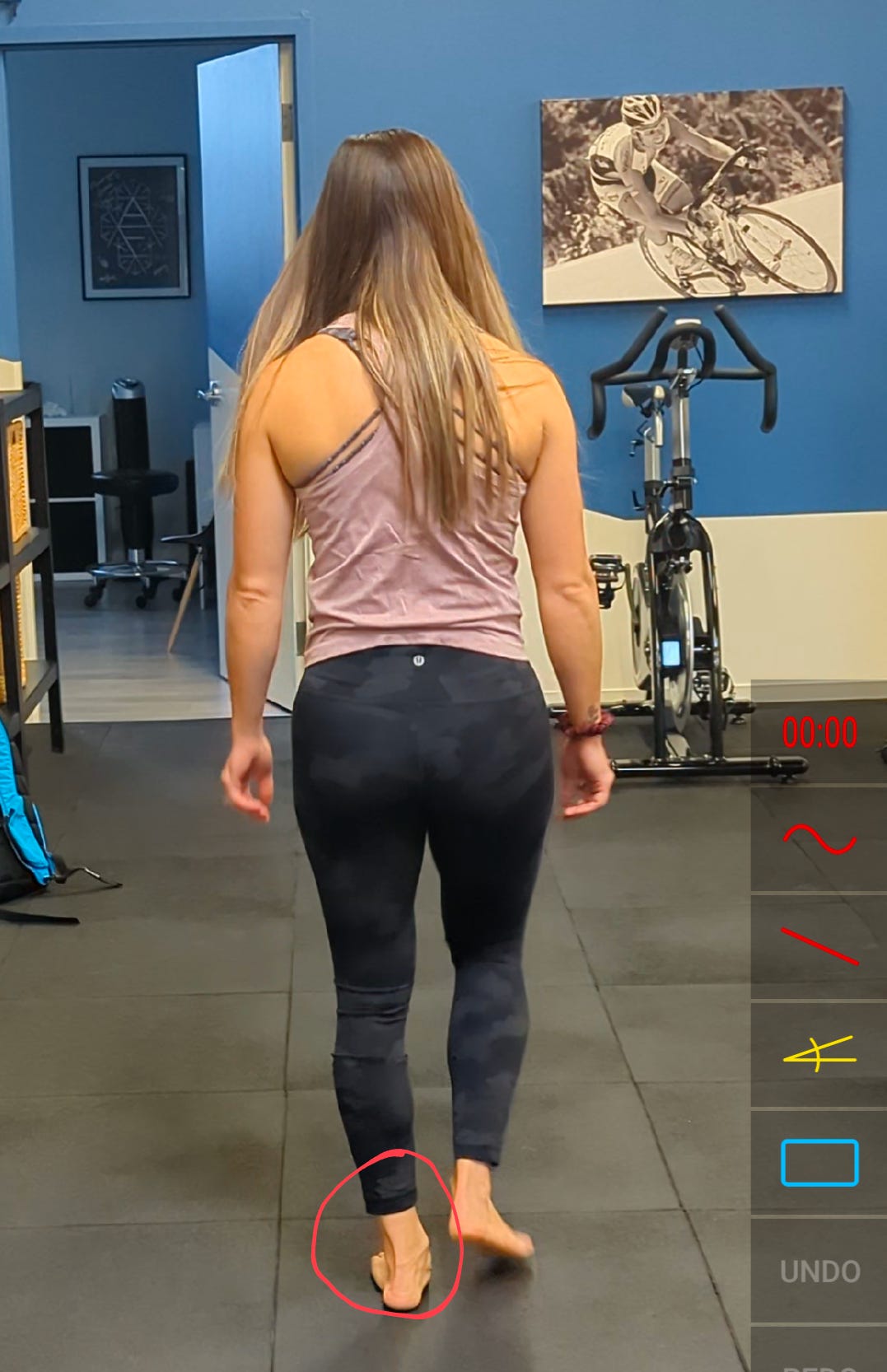
I love me a good gait analysis. If you do too, you’ll love this post.
Gait mechanics won’t necessarily tell you what’s wrong with someone, but assessing gait will guide you to where to investigate further to get to the root of their problems and unravel them joint by unruly joint.
Today we must thank Xsenia for donating a gait analysis video. Her video is a good example of a person’s body adapting to having one foot very, very “pronated” compared to the other. We get to seethe impact of that more pronated foot on whole body movement patterns up the chain.
Or is it even her foot to blame??
After doing this analysis I was left with the questions:
* Did something happen to her left ankle? (because of how it is stuck so everted)
* Did something happen to her right leg, hip, knee, foot, or ankle? (because of how she doesn’t seem to want to get her mass fully on top of it… Notice the torso lean away to the left?)
* Did something happen to her neck or skull? (because of how her head sits in a left laterally flexed position and forward of her body through every single gait phase, although this may be difficult to confirm from the video alone, because hair…).
Excitingly, I have the answers to these questions!
Relevant injury history
I sent Xsenia my analysis video and the questions above, to which she replied:
Did something happen to your left ankle?
“Yes, I've had multiple ankle sprains bilaterally - some very badly requiring crutches and longer recovery. Most significantly/recently (2 summers ago) I stepped in a hole in the grass and dislocated my left ankle. I have very lax ligaments (all over my body, really) and I think that's the only reason I didn't fracture the ankle.”
Did something happen to your right leg, hip, knee, foot, or ankle?
“Right knee - almost complete MCL tear in university (so 2010) - long rehab, 6 months before returning to soccer - probably why I'm not loading it well. When I squat heavy, I tend to shift pretty badly to that side. Multiple ankle sprains on the right as well. No hip issues”
Did something happen to your neck or skull?
“Neck is pretty good.
Pretty constant right thoracic spine pain (between scap and spine) - likely from MVA in 2009? - airbags went off and wasn't treated probably long enough after to see improvement - so I still have pain there
I got a soccer ball directly to my R eye at close range in 2016/2017? I lost my site in that eye for ~3 hours, ended up being bleeding and bruising of the eye - retina was fine but also a mild concussion as a result
Of note: 2x right shoulder dislocation, multiple GHJ subluxations bilaterally.
2 tears in right labrum as a result
Likely tears in left labrum. No pain.”
How interesting, eh?! Certainly tracks with the story her movement patterns tell us.
Is she perhaps avoiding adducting her right hip and getting her mass on top of her right leg due to the old MCL injury?
Is her ribcage shifting to the left as a compensatory response to the right shoulder dislocations?
Or is her spine shape more of a result of her MVA?
Has her left foot looked like that (everted AF) before the shoulder dislocations and MVA, or is that a more recent adaptation?
Answers to these questions would surely come out in the investigation process and slowly giving Xsenia’s body back the movements she is missing.
AiM Official Analysis Structure
My hope is that this gait analysis video can be used to help those who are preparing to do the Anatomy in Motion accredited practitioner exam, so I’ll structure this analysis in the way you might be asked to do so in the official exam (hint hint: I would get in the habit of watching gait videos with these questions in mind…)
What do you notice in the big picture? Can you name 3 observations from the gait video:
Gait is often subtle. It will be the big, obvious things will stand out at full speed. When I watched at full-speed, these are the big things that jumped out:
* Left foot very everted compared to the right.
* Lots of movement at thoraco-lumbar junction in transverse and/or frontal plane compared to anywhere else in her body.
* Skull stuck in a right hike; cervical spine in a left lateral flexion.
What is missing? What mechanics can they not access?
Remember, in the AiM assessment process our mantra is “what’s missing?”. Here are some of the mechanics I noted to be missing for Xsenia:
* Skull hike left; cervical spine lateral flexion right
* Left foot supination (rearfoot inversion, talus external rotation)
* Left leg supination in left leg back phases:
* Left knee extension/internal rotation
* Left hip extension, abduction, external rotation
* Pelvis shift BOTH directions; hip adduction bilaterally
* Spine lateral flexion right and coming on-axis onto pelvis in right suspension phase
* Right foot pronation
* Thoracic spine extension, lumbar spine flexion
* Center of mass getting right
What phase(s) might be difficult for them to access?
* Left leg back phases (left leg supination):
* Left propulsion, left shift
* Right suspension:
* Missing foot pronation, spine on-axis frontal plane
* Left suspension
* Missing c spine lateral flexion right
* Left transition:
* Missing left foot supination
* Bilateral heel strike, missing:
* Lumbar flexion
* Pelvis shift
* Heel strike posterior/lateral contact
What are 3 things you could do to feed better movement back into the system:
* Sagittal plane wall cogs, optimizing for:
* Thoracic spine extension
* Lumbar spine flexion
* On-axis movement
* Frontal plane cogs, optimizing for:
* Thoracic and cervical spine opposition, in particular T-spine lateral flexion left coupled with C-spine lateral flexion right.
* Spine lateral flexion right coupled with head’s current position (right hike)
* Left transition:
* Supinate left foot and leg
* Right suspension:
* Pronate right foot
* Lumbar/thoracic lateral flexion right and stacked on-axis on pelvis
* Thoracic spine extension
* Right hip adduction
(yeah I wrote 4 things because I’m a keener)
Conclusions?
There are probably many, many more observations that could be made. Care to share your own that may differ from mine? Leave them in the comments!
I think that the most important thing is to trust that the stuff that your eye is drawn to is real, not imaginary, and is the stuff that you are currently equipped to address based on the tool-box of skills you have. You will only see what you are currently able to see. Don’t stress about what you can’t.
A good way to get stuck in analysis paralysis is to worry about what you can’t see or don’t understand. Start with the stuff you CAN see and DO understand. Things will become more clear with time.
More and more details will be flushed out through the process of addressing what you are confident you can see.
Gait analysis is fun (for weirdos like me). Its a great assessment tool. But it is not the be-all-end-all of movement assessment. Following this analysis, I feel guided to assess all the mechanics and phases of gait that I noted as “missing” and compare this with her injury history and resting alignment.
If you’d like to learn more about the Flow Motion Model and closed chain joint mechanics, check out Gary Ward’s online courses, or come join me in a live course sometime.
If we’re lucky, perhaps Xsenia will find some inspiration in this and play with some new AiM movements and refilm a video for me to re-assess ;)
Leave any comments, observations, or questions below :) And stay tuned for next time!