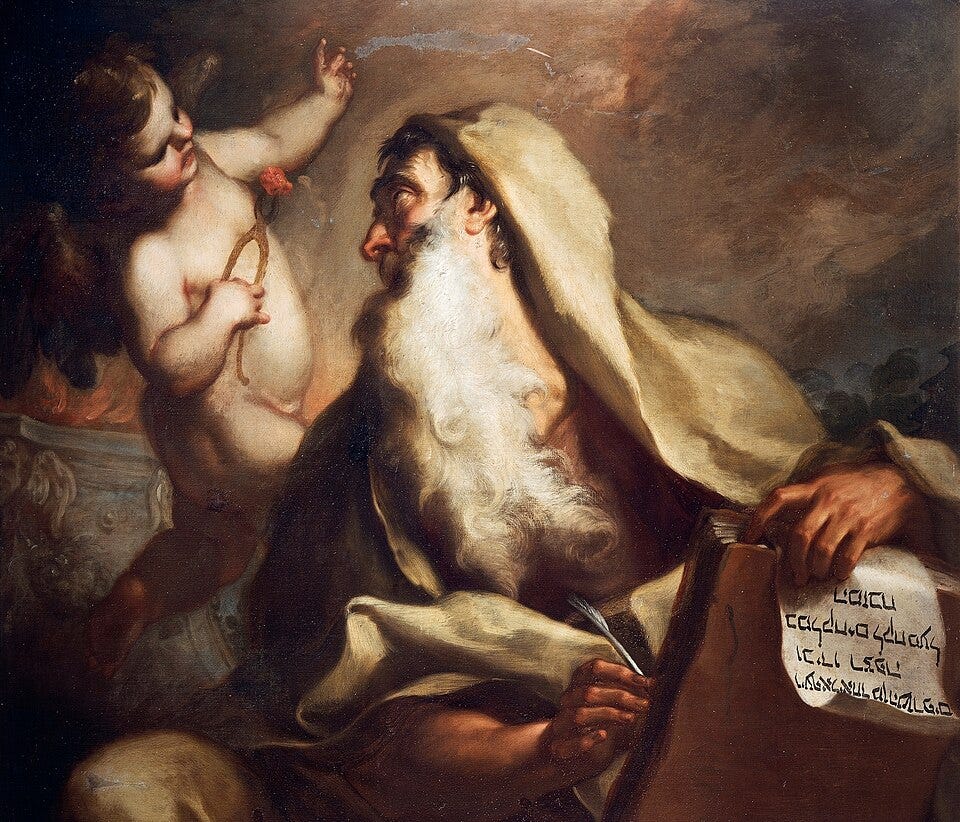
When ye received the word of God which ye heard of us, ye received it not as the word of men, but as it is in truth, the word of God, which effectually worketh also in you that believe. (1 Thess 2:13)
We should approach the Bible as Scripture. You might think, “Duh, the Bible is Scripture.” True, but let’s be more specific. The Bible is our Scripture because we’re Christians. The Quran is also Scripture, but I would not advise us to approach the Quran as Scripture because the Quran is not our Scripture since we’re not Muslims. How would we approach the Quran? We would read it with some critical distance, as a source of information on Muslim beliefs. We would not read it as a source of divine revelation, as a text through which God addresses us.
That description needs nuance. God might address us through the Quran, just as he might address us through any literature, whether Plato’s Republic or Paradise Lost or Pride and Prejudice. Not just literature, but also great films or other media (e.g., the heavens, as we’ll see in a moment). One of my projects in life is to hear what God wants to tell me through all of these works. All truth is God’s truth. Is there truth in the Quran? I presume, though I have not read much of it. And yet, Christians have not regarded any of these works to be “the word of God” in the technical sense used for Christian Scripture. Perhaps God addresses people through the Quran or Paradise Lost, especially if they are seeking such divine communication, but Christians regard their Scriptures as the site from which we can anticipate hearing God’s voice most often and most directly. Indeed, it is the Christian Scriptures that should offer the training to the reader to discern the voice of God, so that his voice can be most fruitfully detected in other media. That’s what it means to call the Scriptures “canonical,” normative.
Thanks for reading Gallagher! Subscribe for free to receive new posts and support my work.
There is more to say about all of this, such as the role of the Old Testament as canonical Scripture within a Christian theological system, and about differences in the biblical canon (e.g., does God speak through Tobit?). And at some point perhaps I will address these topics on this Substack, as I have done in my conventional academic publications. But for now let’s return to the subject of the present essay.
A lot of people read the Bible not-as-Scripture. That’s what scholars do. In large measure, that’s what academic biblical studies is all about. I would argue, and I will argue in a later post (deo volente), that such a reading strategy is incredibly helpful for the purpose of reading the Bible as Scripture. I work at a school that exists to train Christian ministers, and a big part of how we do that is by training students in academic biblical studies. Now the value of academic biblical studies to ministers is variegated, not simply in helping them read the Bible as Scripture, but that is one way it is helpful to them. Listen: reading the Bible not-as-Scripture means that you cultivate critical distance toward the text, and you read it as a source of information on Christian beliefs. It seems obvious to me that such a reading strategy would be helpful to a Christian reading of Scripture, but it is certainly incomplete toward that end. At some point that critical distance that academic biblical studies requires needs to evaporate for a fully Christian reading. To read the Bible as Scripture requires that we not only read it as a statement of beliefs from people long ago in a foreign culture but also that we read it as a revelation from God to us.
By the way, this matter of reading the Bible as Scripture is very in vogue right now; a lot of people like talking about it. A few times a year, it seems like, a book comes out promising to look at a portion of the Bible as Scripture. Maybe it started with Brevard Childs. In 1979 Fortress Press published his seminal book Introduction to the Old Testament as Scripture. But now you can find books on Reading the Gospels as Christian Scripture (by Joshua Jipp, Baker, 2024), or Reading the Prophets as Christian Scripture (by Eric Tully, Baker, 2022), or 1 Samuel as Christian Scripture (by Stephen Chapman, Eerdmans, 2016), or Theological Hermeneutics and the Book of Numbers as Christian Scripture (by Richard Briggs, Notre Dame, 2018), or Reading the Psalms as Scripture (by James Hamilton and Matthew Damico, Lexham, 2024), or Reading the Psalms and Wisdom as Christian Scripture (by Christopher Ansberry, Baker, 2024). There is also the classic book by Sandra M. Schneiders, The Revelatory Text: Interpreting the New Testament as Sacred Scripture (2d ed., Liturgical Press, 1999).
Now, as helpful as these books sound, I haven’t read many of them, though I have read the book by Childs that, I guess, got it all started. Let me nuance that statement a little: what Childs got started was not reading the Bible as Scripture—Christians have been doing that since Jesus—but academics talking about reading the Bible as Scripture. Since I haven’t read most of the books that claim to be doing it, I don’t really know how they think we ought to go about the project of reading the Bible as Scripture, or even what they think it means to do so. But here, again, is my understanding of the goal of a Christian reading of the biblical text: it means to attend to the divine voice in the text, to desire and seek to read the Bible for the purpose of hearing God speak, to encounter the living and active word of God. That is what I mean by approaching the Bible as Scripture
To read the Bible not-as-Scripture is to read without this purpose. It is to read the Bible like any other book, in the phrase made famous by the Anglican clergyman Benjamin Jowett in 1860. We’ll get to Jowett some other time, and how reading the Bible like any other book might be good and helpful, indeed invigorating, spiritually edifying. But for now we want to know how to read the Bible like no other book.
What is it that we want from the Bible when we read it as Christian Scripture? I have already given my answer a few times: we want to hear the voice of God. (Many writers say the same thing; this formulation is not at all unique to me.) As I have mapped out a path toward spiritual growth, the first step is “hear,” and the voice of God is my way of formulating what it is that we want to hear. You could say that people should hear the gospel, or the message of Christ, or Scripture. But I prefer to say that people should hear the voice of God, because it suggests that God mystically continues speaking through the ancient text, that the word of God is truly living and active, that God is, indeed, speaking directly to us in our own situation, if only we had ears to hear, if only our hearts were softened. As the psalmist said, “Today if ye will hear his voice, harden not your heart.”
In Richard Foster’s book Celebration of Discipline, the very first discipline discussed is meditation, which is presented as a sine qua non of the Christian. Foster quotes Bonhoeffer’s explanation for the reason he meditates: “Because I am a Christian,” Bonhoeffer said. (I quoted Bonhoeffer last time; his guide to meditation can be found at DBWE 14, pp. 931–36.) But what is meditation? Foster answers (p. 17): “Christian meditation … is the ability to hear God’s voice and obey his word.” So maybe what I’m talking about is a meditative or contemplative approach to the Bible. Meditating on Scripture is for those who want to be like God.
Now, Foster briefly explores other forms of meditation, other ways of hearing God’s voice, besides meditation on Scripture. We might think of Scripture that substantiates the point.
The heavens declare the glory of God and the firmament sheweth his handywork. (Psa 19:1)
The voice of the Lord is upon the waters. (Psa 29:3)
The earth, nature, creation, provides testi…