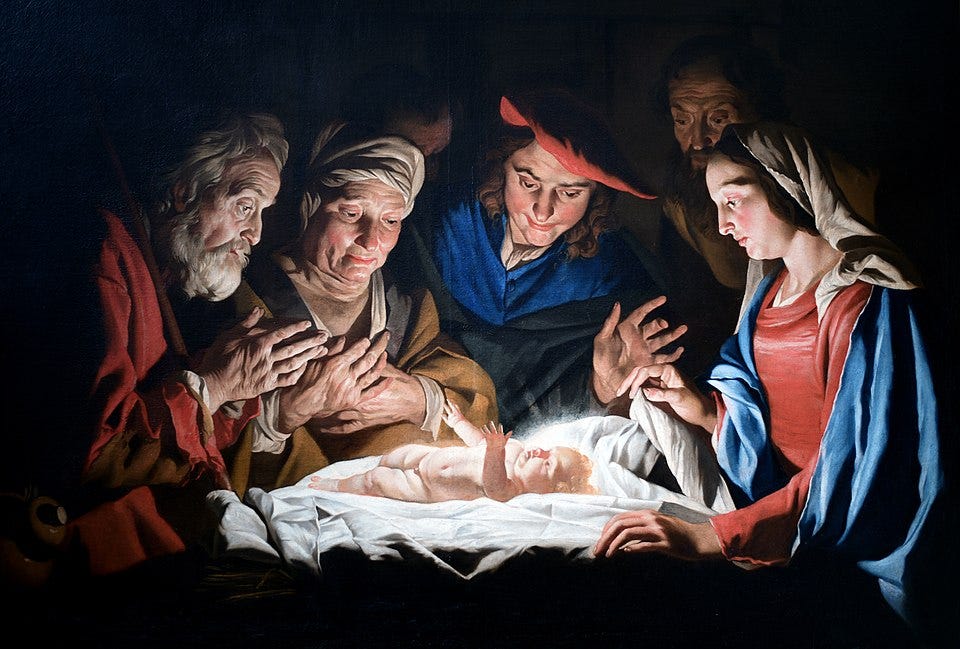
Okay, so we know that it’s sinful, displeasing to God, to celebrate Christmas as a religious holiday, but we saw last time that by the turn of the twentieth century, most Christians who had traditionally opposed Christmas had come around to the by-now traditional trappings of the day: feasting, gift-giving, time with family, and even Christmas trees and Santa Claus. I say most Christians had come around to this notion, not all. In the Churches of Christ, discomfort with Christmas—or even outright rejection—continued to the mid-point of the twentieth century, or even later. But when I was growing up in the 1980s and 1990s, I was completely unaware that some people thought that Christmas should not be celebrated at all, not even as a family holiday. That view was—and is—still around, but it’s pretty fringe.
But where do some people get off actually talking about the birth of Jesus on Christmas? How could they do such an ungodly thing?
Thanks for reading Gallagher! Subscribe for free to receive new posts and support my work.
Come to think of it, how do we know that observing Christmas as a religious holiday is sinful or ungodly? Last time we encountered the argument that we’ve got to avoid anything that makes us look like one of the denominations, and celebrating Christmas is, apparently, what the denominations do. Then again, last time we also learned that it was Protestant denominations like the Presbyterians who spearheaded the Christian opposition to Christmas, so it might be that refusing to celebrate Christmas is an imitation of the denominations. Hmm.
Let’s go back to the 1976 essay by John Waddey published in the Firm Foundation (“Christians and Christmas,” December 14, 1976, p. 792).
But no New Testament writing instructs us to observe a holy day for Christ’s birth. To so observe the day is to go beyond what is written. According to Christ such religious practices are vain worship for they are the precepts of men (Matt. 15:9). God gave his church only one special day, the first day of the week.
Wait a second; is that the reasoning? Let’s go over that again: “no New Testament writing instructs us to observe a holy day for Christ’s birth.” Um, okaaay. What in the world does that matter? Well, Waddey thinks that to observe this holy day in the absence of New Testament instruction would entail going beyond what is written, an allusion to 1 Corinthians 4:6. And he thinks Christ characterized such a departure from the written word as vain worship, citing Matthew 15:9.
That’s the same argument you’ll find in other authors. The early Protestants often opposed Christmas because it couldn’t be found in the Bible. Let me quote again an essay from The Oxford Handbook of Christmas (2020): “Those opposed to Christmas [in the sixteenth and seventeenth centuries] objected to any religious observance that was not explicitly commanded in the Bible (the so-called regulative principle) and which was seen as a vestige of popery” (p. 168).
And just to be clear about the argument, let me quote one of the most authoritative voices in Churches of Christ in the second half of the twentieth century. In the first volume of his Questions and Answers, Guy N. Woods had this to say about Christmas.
The observance of Christmas, as a religious holiday, did not originate in the apostolic age, and is thus without divine sanction. As a matter of fact, it is not possible to determine in what month, or on what day the Saviour…
and I pause just to note that the word “Saviour” is spelled in the British fashion, with a ‘u.’ I just think that’s weird. Anyway, back to the quotation:
…or on what day the Saviour was born and inasmuch as there is neither precept nor example for its observance, faithful Christians do not keep it as a religious festival. (p. 203)
Okay, “neither precept nor example for its observance.” That sounds similar to what Waddey had said.
Honestly, I can’t make any sense out of this. To go over it again, the idea is that it would be vain worship to observe a holy day in honor of Christ’s birth because such a holy day is not mentioned in the New Testament. I think part of my difficulty is this term “holy day.” That’s Waddey’s term; Woods used the term “religious festival,” and I assume that in this context “holy day” and “religious festival” are basically synonymous; whatever Waddey meant, Woods meant the same thing with his term. I’m not sure what these terms are supposed to mean, or what opponents of holy days think that they are opposing. Isn’t “holy day” and “holiday,” like, the same thing? It’s just a day set aside to observe a particular thing, right?
I mean, everyone would agree that it’s okay for Christians to observe Mothers Day, wouldn’t they? Have you ever heard of a church preaching against Mothers Day? I don’t remember Mothers Day being mentioned in the New Testament, but it doesn’t seem like Christians have usually thought about a special day for mothers as going beyond what is written, as vain worship. In fact, for my entire life, every single time the second Sunday of May rolls around, the sermon has revolved around mothers, and the mothers in the audience are specially singled out for greetings and warm wishes, and maybe even given a flower or some other present. Oftentimes the children’s Bible class that day focuses on mothers, and the children make a craft designed for their mothers. In a similar way, the churches I have been a part of have observed Fathers Day, and Veterans Day, and Thanksgiving Day, and the Fourth of July, and other special days. Is this going beyond what is written? Is this vain worship?
These special days are certainly not mentioned in the New Testament. But the excuse for observing Mothers Day that I have heard and that I have made is that Romans 13:7 tells us to honor those who deserve honor, and mothers—most mothers—deserve honor. It is not going beyond what is written; it is doing what is written. Now, I’ve never heard anyone say that Mothers Day is being observed as a holy day for mothers, or as a religious festival, but I have heard people talk about the holiday called Mothers Day. I’m not sure what the term “holy day” is supposed to communicate, and I’m not sure that people that oppose holy days do either.
Let’s go back to the reasoning for opposing the religious observance of Christmas. Nope, actually, before we do that, let’s think about that phrase: “religious observance.” Do churches typically oppose or embrace the religious observance of Mothers Day? I don’t know how you could get any more religious than centering your worship service around the reason for the season in the second week of May. Yes, of course, most American churches observe Mothers Day religiously. Again, it’s the same for Fathers Day and Thanksgiving Day and even the Fourth of July.
Now, let’s go back to the reasoning for opposing the religious observance of Christmas. As Waddey put it, “No New Testament writing instructs us to observe a holy day for Christ’s birth.” I have suggested that “holy day” is a term without clear meaning, and is basically in this discussion a red herring, a distraction. Let’s omit it. “No New Testament writing instructs us to observe Christ’s birth.” Or, as Woods said, there is “neither precept nor example for its observance.” As I see it, that claim is the nub of the argument against the religious observance of Christmas. We will have to consider whether the claim is true. Does the New Testament instruct us to observe Christ’s birth?
What Is There to Celebrate?
Does God want us to celebrate the birth of Jesus? Celebrate it in our churches and in our homes? Does God want us to religiously observe the birth of Jesus? Does Woods correctly evaluate the New Testament when he says that “there is neither precept nor example” for the observance, the religious observance, of the birth of Jesus? Or are there examples in the New Testament? Does the New Testament i…