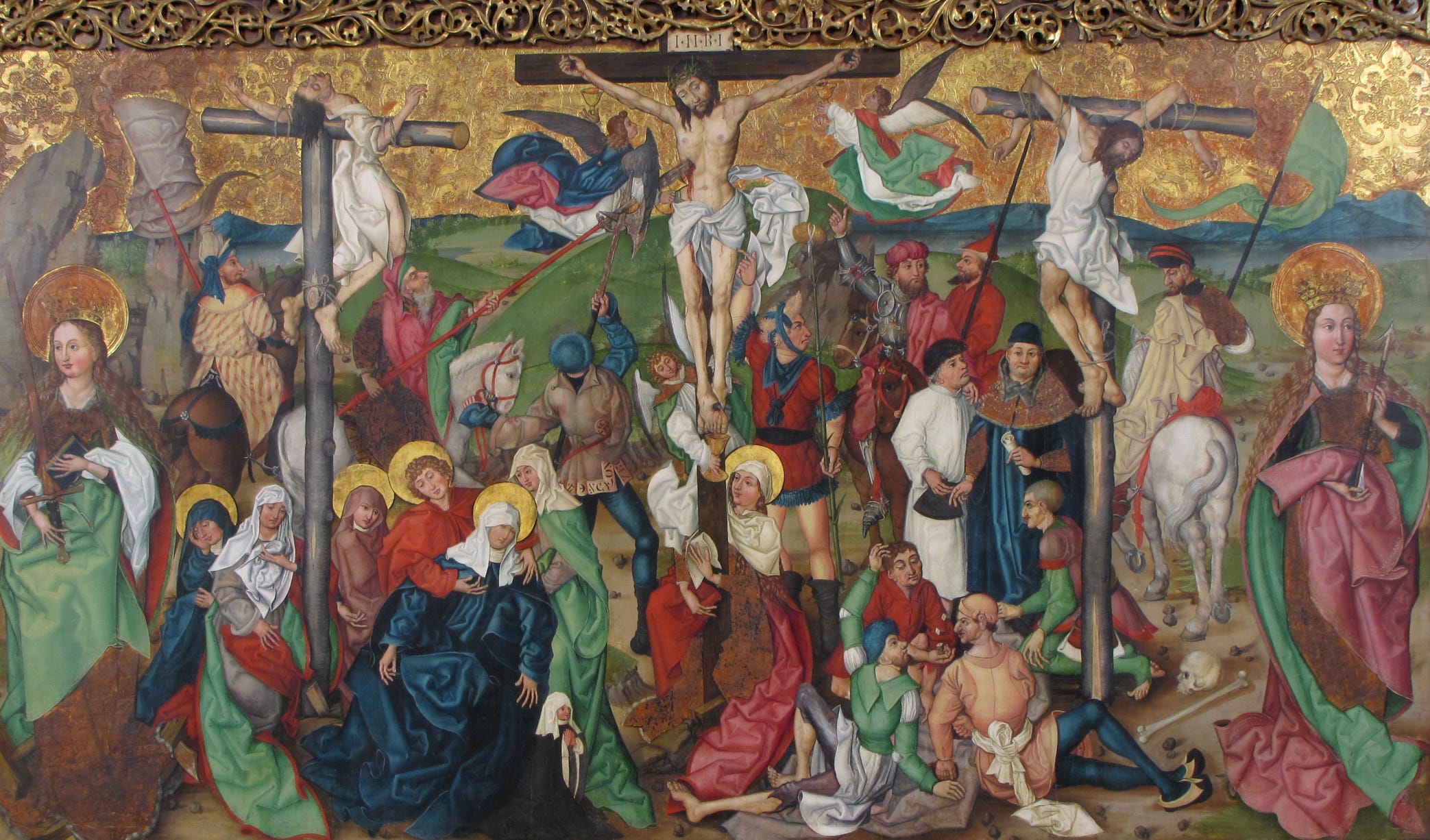
According to the Gospel of Luke, while hanging on the cross, Jesus prayed for the people participating in his execution.
Father, forgive them; for they know not what they do. (Luke 23:34)
Or did he?
This prayer—which appears only in the Third Gospel—is absent from some important Greek manuscripts of Luke. Anyone who has studied the New Testament at a serious level understands that our English versions are translated from Greek, and that the Greek text used by translators is itself edited from the thousands of Greek manuscripts that preserve portions of the New Testament. But all of these manuscripts differ from each other in some ways, often very small but sometimes significant. These differences are called textual variants, passages in which the texts vary. So, again, with regard to Luke 23:34, some Greek manuscripts contain the prayer and others don’t; here there is a textual variant.
This is not one of the small differences among the manuscripts but one of major importance. The New Testament scholar Dirk Jongkind has said that this “may be the single most important textual variant in the Greek New Testament” (Introduction, p. 85). In a way, that statement shows how insignificant most textual variants are. Even if a variant is longer than this one, contains more words, it does not really affect Christian theology. Does this variant affect Christian theology? Maybe somewhat. Our understanding of Jesus is affected somewhat by whether he prayed for the people who were executing him while they were executing him. We might expect that Jesus would do that kind of thing, especially in light of his own teaching, such as Luke 6:28, where he told his followers to “pray for them which despitefully use you.” Praying for his enemies from the cross seems like something Jesus might do, but it would be nice to have the explicit statement confirming it.
So did he say it? Unfortunately, the evidence is rather difficult to parse, but most scholars say no. Most scholars consider this prayer a later addition to the Third Gospel, not something that the Gospel writer included but something a scribe inserted later, in the second century. It couldn’t have been added later than the second century, for Irenaeus of Lyon, at the end of the second century, already knows about it (though he doesn’t say explicitly that it’s found in Luke’s Gospel).
Now, by the fact that the Lord said on the cross, Father, forgive them, for they know not what they do, Christ’s long-suffering, patience, compassion, and goodness are shown forth, inasmuch as He Himself who suffered also excused those who had treated Him wickedly. For the Word of God who told us, love your enemies and pray for those who hate you, did just that on the cross, loving the human race so much that He prayed even for those who put Him to death. (Against Heresies 3.18.5; trans. Unger, p. 90)
Many scholars hold the view that the prayer was added in the second century, but not all. There are good reasons for considering the prayer a genuine part of Luke’s original composition. This post surveys the evidence.
The easiest place to examine the evidence is in a recent edition of the Greek New Testament. The edition I am going to use here is the United Bible Socities’ edition (UBS), and the reason I am using this edition is because of an interesting feature unique to it. The UBS edition has a ranking system for the level of confidence of the modern editors. That is, it tells us how confident the editors are that they got the right answer, that they figured out which reading among the manuscripts is the better reading, which variant is right. The ranking system is quadripartite, A being the highest (very confident), and D the lowest (not at all confident), and B and C in the middle.
Here is the relevant page from the UBS fourth edition. There is a fifth edition (2014), which presents the exact same evidence.
The first half of the page presents a portion of the New Testament text, and the bottom part of the page displays the critical apparatus. It’s the apparatus that is the real star of the show here, detailing which manuscripts say what. But before we get to the apparatus, notice that in the top half of the page this edition puts double brackets around the prayer of Jesus at Luke 23:34.
Now to the apparatus. Here’s an image of what the apparatus says about this variant.
Note that the very first thing said, after the verse number (34), is an A in curly brackets. That is the confidence ranking. As the introduction to this edition tells us: “The letter A indicates that the text is certain.” We have an A here, so the editors are confident that they got the right answer here. But what is the answer that they decided upon?
The next portion of the apparatus says: “omit verse 34a.” That’s the answer. The editors are completely confident that Luke did not include this prayer from Jesus in his Gospel; it must have been added later by a scribe—according to these editors.
Next, there are a few Greek words, just giving the beginning and ending of the variant unit. And then there is the citation of Greek manuscripts. Here are the Greek manuscripts that omit the prayer: P75 א B D* W Θ 070 579 597* 1241. All of these numbers and letters refer to particular Greek manuscripts. They are listed more-or-less in order of age, so P75 is the earliest (papyrus 75, early third century), and 1241 is something like the latest (12th cent.). After the number 1241 in the apparatus, there are a few more items listed that omit Jesus’ prayer: ita, d syrs copsa, bo pt. These aren’t numbers, so they aren’t Greek manuscripts. Instead, they are ancient translations: it = itala (i.e., an early Latin translation), syr = Syriac, cop = Coptic.
The next thing in the apparatus is a double slash mark introducing the next group of manuscripts, those which “include verse 34a.” Here are the manuscripts that do contain the prayer of Jesus, and the first one listed (after the parentheses) is א. This symbol is the first letter of the Hebrew alphabet, aleph, and it refers to a famous Greek manuscript called Codex Sinaiticus (fourth century). You’ll notice that there is an asterisk by א, and then also a 2. The asterisk refers to the original reading of this manuscript, so it is telling us that this manuscript originally contained the prayer of Jesus. The 2 refers to a corrector, a later scribe who changed the manuscript.
Let me explain: these ancient manuscripts were often used for centuries, and the users would sometimes write in the manuscript. I do the same thing with my Bible, sometimes writing in the margin, sometimes even crossing out something in the text and marking down what I think is a better translation. These scribes using the manuscripts sometimes did that kind of thing. The apparatus also presents the evidence of these later users of the manuscript.
The 2 by א refers to the “second corrector” of Sinaiticus; this second corrector also thought the prayer should be included. But why would we know that, since the original text of Sinaiticus already had the prayer? Because someone had tried to remove the prayer from Sinaiticus. If you look in the apparatus back on the manuscripts that “omit verse 34a,” you’ll see that the second manuscript listed is א with a 1 beside it, the first corrector. The apparatus is telling us that א originally contained the prayer, and then the first corrector tried to delete it, and then a second corrector reinserted it.
Or something like that. Actually, there was no erasing and insertion. Here is Codex Sinaiticus with the prayer of Jesus from the cross.
The beginning of the variant is near top left, where you see the Greek letters ΟΔ. You can see that Sinaiticus includes the prayer. But the manuscript also preserves the attempt to delete it. Right beside that ΟΔ, to the top left of the Ο, there is a faint mark that looks like a C or maybe like a parenthesis. …