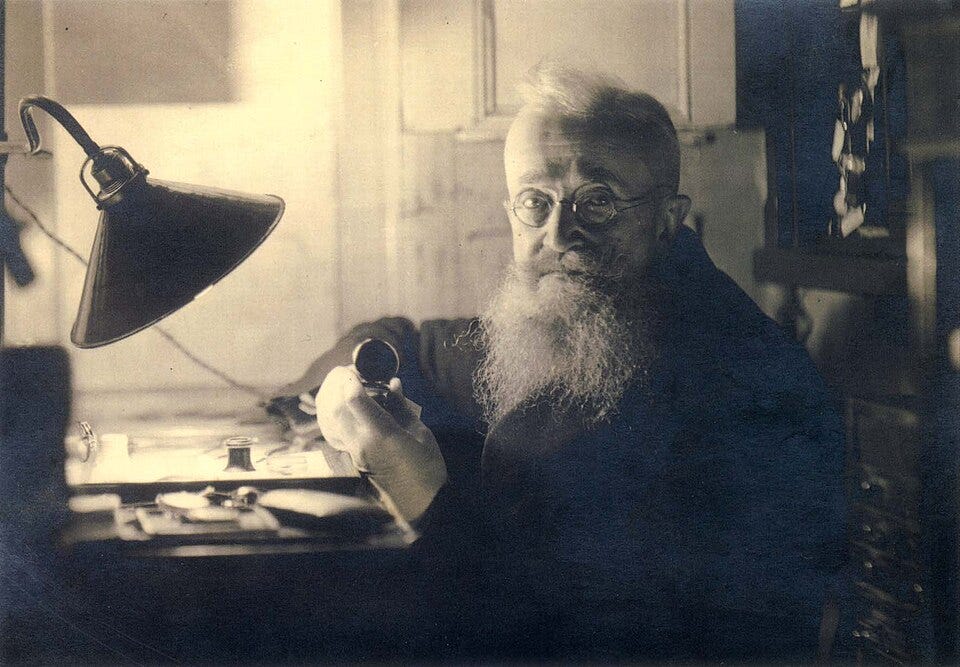
In chapter 7 of The Hiding Place, Corrie ten Boom described the trouble she had finding a placement for a Jewish infant. Of course, this is during the Nazi occupation of the Netherlands, perhaps in 1943, and the ten Boom family was involved in the underground resistance to the Nazis, especially by hiding Jews. (Their house in Haarlem was 15 miles or so west of where Anne Frank was hiding in Amsterdam, though their stories do not intersect, as far as I know.) Hiding an infant presents a special challenge, because you can’t tell them to be quiet. Corrie ten Boom says she had a good prospect, a family friend who she thought would be receptive to the idea of hiding this baby. When the man entered her watch shop, she went to get the baby to show to the man. She describes the scene that transpired.
Back in the dining room, I pulled back the coverlet from the baby’s face.
There was a long silence. The man bent forward, his hand in spite of himself reaching for the tiny fist curled around the blanket. For a moment I saw compassion and fear struggle in his face. Then he straightened. “No. Definitely not. We could lose our lives for that Jewish child!”
Unseen by either of us, Father had appeared in the doorway. “Give the child to me, Corrie,” he said.
Father held the baby close, his white beard brushed its cheek, looking into the little face with eyes as blue and innocent as the baby’s own. At last he looked up at the [man]. “You say we could lose our lives for this child. I would consider that the greatest honor that could come to my family.”
It’s an amazing scene, an amazing comment from this 82-year-old man, Casper ten Boom, about whom there is a wikipedia page. He cultivated a deep Christian faith as a lifelong member of the Dutch Reformed Church, which was basically the state church of Holland. He lived a simple, pious life. He read the Bible to his family morning and night, and during the day in between, he worked in the watch shop that he inherited from his father. He was a man of prayer, a characteristic powerfully illustrated in ch. 5 of The Hiding Place, at the time that the Nazis first attacked the Netherlands. Corrie ten Boom describes the situation.
Thanks for reading Gallagher! Subscribe for free to receive new posts and support my work.
For five days Holland held out against the invader. We kept the shop open, not because anyone was interested in watches, but because people wanted to see Father. Some wanted him to pray for husbands and sons stationed at the borders of the country. Others, it seemed to me, came just to see him sitting there behind his workbench as he had for sixty years and to hear in the ticking clocks a world of order and reason.
They wanted to hear him pray. They wanted to see him work. In a world turned upside down, they wanted to witness stability, faithfulness, and they found it in an old man behind the counter of a watch shop.
And later, when the ten Boom family, along with a group of about 35 resistance leaders and workers, were arrested by the Nazis, Corrie ten Boom witnessed this scene.
When I got back the last time, a group had gathered around Father for evening prayers. Every day of my life had ended like this: that deep steady voice, that sure and eager confiding of us all to the care of God. The bible lay at home on its shelf, but much of it was stored in his heart. His blue eyes seemed to be seeing beyond the locked and crowded room, beyond Haarlem, beyond earth itself, as he quoted from memory: “Thou art my hiding place and my shield: I hope in thy word. … Hold thou me up, and I shall be safe….” (near the end of ch. 9 of The Hiding Place)
The topic I want to address is: does Christianity make people good? And Casper ten Boom and his family, especially his two spinster daughters, Corrie and Betsie, who never left home—this ten Boom family is Exhibit A for the positive answer to the question. Yes, Christianity makes people good. Just look at the ten Boom family. They prayed daily. They read their Bible, daily. They went to church. They had a genuine faith that came out in their actions. And when they saw people in need, it was their faith that told them they must act. They believed 1 John 3:17–18, where they read these words:
But whoso hath this world’s good, and seeth his brother have need, and shutteth up his bowels of compassion from him, how dwelleth the love of God in him? My little children, let us not love in word, neither in tongue; but in deed and in truth. (1 John 3:17–18)
So when the Jews in the Dutch city of Haarlem started wearing gold stars, the ten Boom family learned for the first time who among their acquaintances were Jewish.
Some of these Jews were, in fact, Christians, having been baptized years earlier, followers of the one perfect Jew, as some of them said. No matter; in something akin to the one-drop rule, the Nazis counted these Christians as Jews, and they wore the star. When the Jews started to be rounded up and shipped out, it quickly became obvious to the ten Booms what they must do. In 2008, the ten Boom family was named by the State of Israel as belonging to the Righteous among the Nations, for their heroism in saving Jews from extermination in the Holocaust.
Naturally, they put themselves in danger. But, again, they believed the words of 1 John 3:16, “Hereby perceive we the love of God, because he laid down his life for us: and we ought to lay down our lives for the brethren.” That man, that family friend, presented by Corrie ten Boom with a Jewish infant that needed shelter correctly perceived that, in his words, “We could lose our lives for that Jewish child.” Casper ten Boom correctly perceived that such an outcome would be a great honor—a chance to imitate Christ.
Does Christianity make you good? Yes! Behold, the love of God displayed in the ten Boom family. As the apostle Paul tells us, the fruit of the Spirit is goodness, and the divine Spirit has been at work in the ten Boom family. The Spirit has made good use of its tools, the spiritual disciplines, especially prayer and Scripture and communal life, frequent worship with other believers, and we can see the fruit. It’s obvious. You come to Christ a sinner, helpless, desperate, and Christ enters your life and changes everything. The evidence is overwhelming. Christianity makes you good.
If only it were so easy.
The man called into the ten Boom dining room, the family friend who ultimately refused to help a Jewish infant because of the real danger the child presented—that man was a Christian pastor, who worked for a congregation in a small town outside of Haarlem. It was a Christian pastor who refused to help that Jewish infant. This Christian pastor surely, like the ten Boom family, read the Bible regularly and prayed daily, and he certainly attended church services frequently. And when called upon to put his Christian ideas into action, he declined. He was fearful that helping others would put himself in danger. He had read and probably preached the verse that says “perfect love casts out fear,” and when the moment of decision came, he chose fear over love. He was willing to offer God only that which cost him nothing.
Does Christianity make you good? No, not always.
But let me say this about that Christian pastor—it was a struggle for him. He gave in to fear, but at least he wanted to help, however weakly. It’s not like he said that the infant deserved whatever it got. It’s not like he reported the infant to the Nazis. He clearly wanted to help the child and the ten Boom family. He was not sympathetic to the Nazi cause. That is something. In the face of evil, Christians might not stand for goodness in the way you would like, but at least they don’t root for the evil.
Christianity might not make you good, but at least it doesn’t make you evil. I mean, Christians aren’t Nazis.
Are they?
Okay, some Christians are Nazis. I use the present tense advisedly.
I am reminded of another situation, when in hindsigh…