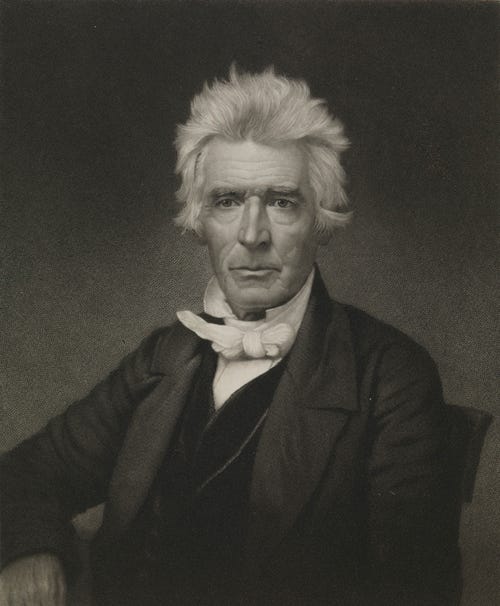
I return now to Eugene Boring’s book Disciples and the Bible (1997), which I recently read and wrote about here. There was so much of interest in this book that I need a second post on it. But go back to the first post for an introduction to the book and my basic—rather lengthy—take on it.
Alexander Campbell
There were several things I learned about Alexander Campbell.
Thanks for reading Gallagher! Subscribe for free to receive new posts and support my work.
Campbell’s Canon within the Canon
One new thing for me was Campbell’s canon within the canon. Of course, I knew that this would be the New Testament, and more specifically Acts and the Epistles. I knew this not only through having read about the history of the Stone-Campbell Movement, but from personal experience of Campbell’s intellectual descendants—that is, growing up in Churches of Christ. But what was new was that Campbell’s own canon within the canon was less Acts and more Epistles. Indeed, I would have assumed the opposite. Before reading Boring, if you had asked me to identify the one book of the Bible that has been most important to Churches of Christ, without hesitation I would have said the book of Acts. Indeed, I have said such a thing, and I remain convinced that it is true. I have experienced it. More than any other book, it is the book of Acts that has been cited to justify different practices in the churches and schools I have known—how to become a Christian, how to worship, how often to take the Lord’s Supper. There are other Christian groups that are known more for their emphasis on, let’s say, Paul’s epistle to the Romans. I would not locate Churches of Christ among them. So it is interesting to me that for Campbell, the Epistles were more influential than Acts. From Boring’s description, it seems that Acts was not in the first rank, but probably ahead of the Gospels in terms of importance. It was the evangelist Walter Scott—and later J. W. McGarvey (see below)—who bequeathed to us our emphasis on Acts.
I certainly would not have picked Hebrews as the most influential biblical book (p. 75), though I would have ranked Hebrews ahead of Romans. According to Boring, Hebrews was the canon within the canon for Alexander Campbell, a surprise for me just as Boring says that it surprised him. When Boring said that there was one particular section of the Epistles that was especially important to Campbell, I had no idea what section he meant. It was Hebrews. Boring does say that Romans was very important to Campbell, close to Hebrews in Campbell’s thought (p. 75 n. 23). And again: “one could say that Romans and Hebrews were central to Campbell’s thought. But this would be misleading….”
Also new to me: the implications that Boring draws from this favoritism of the Epistles. Campbell’s christology was Pauline, meaning propositional with little reflection on the actual life of Jesus as narrated in the Gospels (p. 74). “This Pauline christological perspective carried with it as its corollary that Christian life would be conceived not as ‘following Jesus’ but as response in faith to the exalted Christ within the church” (p. 75).
Of course it wasn’t new to me that Revelation has played a limited role in the Restoration Movement (pp. 77–79), but it was new that one corollary is that Disciples do not anticipate the imminent return of Jesus (bottom of p. 79), just as Campbell did not.
Campbell and Restoration
What about the claim that “Alexander Campbell was not as ‘restorationist’ oriented as either his father or his contemporary Walter Scott, but he did use the language of restorationism, which was inherent in the Protestant tradition from which he sprang” (82)?
I wonder if this is right. Compare what Richard Hughes says in the first edition of Reviving the Ancient Faith, 22–23, where he shows that the early Campbell was much more ready to talk about a restoration of Christianity than the later Campbell. Campbell explicitly magnified his restoration movement over Luther’s reformation. Campbell wrote the following in 1825.
Celebrated as the era of Reformation is, we doubt not but that the era of Restoration will as far transcend it in importance and fame, through the long and blissful Millenium [sic], as the New Testament transcends in simplicity, beauty, excellency and majesty, the dogmas and notions of the creed of Westminster and the canons of the Assembly’s Digest. Just in so far as the ancient order of things, or the religion of the New Testament, is restored, just so far has the Millenium commenced.
This is the early Campbell; the above quotation is from the end of his first article titled “A Restoration of the Ancient Order of Things,” which appeared in his first journal, The Christian Baptist (see here, and the quotation appears in the second volume [1824] on p. 156 of the version available online).
The later Campbell, according to Hughes, was less interested in restoration, a change recognized (Hughes says, p. 390 n. 47) already by Jeremiah Jeter, in Campbellism Examined (1855), 338–53, 357–58.
So Boring’s assessment, quoted earlier, reflects the mature Campbell more than the young firebrand. That quotation from Boring comes in a section (pp. 80–84) in which he argues that Campbell wasn’t as committed to pattern restorationism as his followers. Here’s another quotation from that section: “Once the ‘movement’ had become a denomination of considerable size, a denomination for which he rightly felt some responsibility, he settled matters of the life and practice of churches not by an appeal to a New Testament pattern, but by appealing to common sense and practicality.” I think Hughes and, more recently, Douglas Foster (Campbell’s recent biographer) would basically agree.
Campbell Leads a Denomination
Speaking of Campbell’s leadership of a denomination, I was intrigued that Boring was able to cite (p. 84 n. 32) a statement from Campbell himself using this term, denomination, for his movement. In the lead-up to the Campbell-Rice debate of 1843, Campbell wrote to a fellow: “You represent a denomination; so do I.” Here I quote a little more:
Other Stuff I Learned about Campbell
I appreciated Boring’s comments on how Campbell treated Acts 8:37 (p. 88). Campbell published his own translation of the New Testament called The Living Oracles. In this translation, he had to decide what to do with verses that were in the KJV but—as the further study of Greek manuscripts was showing—were not well attested in the Greek manuscripts of the New Testament. One of these problematic verses is Acts 8:37, which records the confession of faith of the Ethiopian eunuch immediately before his baptism. Because this verse records a pre-baptismal confession, it has become influential in Churches of Christ, even though it is not well-attested in Greek manuscripts. Whatever influence this verse has exerted on Churches of Christ, apparently it is not owing to Campbell’s influence. In the first edition of his translation, Campbell printed the verse in italics, and in subsequent editions he omitted the verse entirely. On the other hand (p. 88 n. 35), Campbell retained the long ending of Mark and provided no note indicating any textual problem.
Campbell accepted the silly interpretation about the camel through the eye of a needle (cf. Mark 10:25), and even put it as a note in his Bible translation (Boring, 104).
I appreciated the discussion as to whether Alexander Campbell was a scholar (57–60). Boring does conclude that “Campbell was a scholar” (p. 59), even though he acknowledges that “Campbell was not only not a member of, he was utterly unknown to, the scholarly community of his own generation” (pp. 58–59). Boring justifies his evaluation of Campbell by providing a three-part definition of a scholar: (1) one who studies; (2) who bases his conclusions on evidence rather than tradition and publishes these conclusions; and (3) uses the prevailing methods of scholarship. “Alexander Campbell quali…