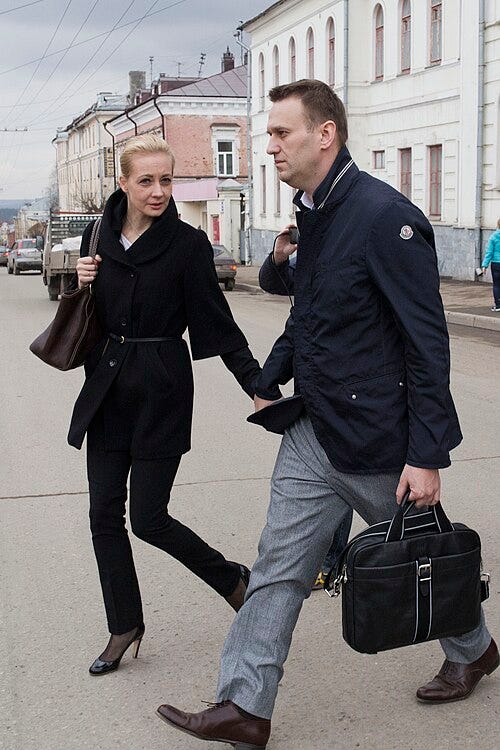
Alexei Navalny died on February 16, 2024, and a few days later (Feb 21) I spoke briefly about him in a chapel service at Heritage Christian University. If you listen to that speech (see the video here), you’ll find that I really didn’t know much about Navalny at the time, just what had been widely reported. His memoir, Patriot, was published a few months later, and I eagerly read it. By the way, while in prison, Navalny mentioned that one of the reasons he was writing the memoir was for the royalties that would come to his family in case of his own death. “Let’s face it, if a murky assassination attempt using a chemical weapon, followed by a tragic demise in prison, can’t move a book, it is hard to imagine what would. The book’s author has been murdered by a villainous president; what more could the marketing department ask for?” (p. 406).
He nailed that. That’s why I read his book.
The essay below is a heavily edited version of that chapel speech from two years ago, with material added from my reading of his memoir.
On January 17, 2021, Alexei Navalny boarded a plane in Germany and returned to his home country of Russia. This seemingly simple action required great bravery and—according to some people, even people who knew and loved Navalny—great folly. For the last time Navalny had been in Russia, he had been poisoned and thought he was going to die. This poisoning—about which there is an entire Wikipedia article—happened on a Russian plane on August 20, 2020. A passenger on the flight used his phone to capture video of Navalny’s moaning. Here is a 60 Minutes story about Navalny that covers the poisoning and plays a brief clip of that passenger’s video.
He was in safety in Germany. He chose to go to Russia. He was immediately detained in the Russian airport and never left Russian state custody. He died in a Russian prison on February 16, 2024. He was 47 years old.
While in prison, in 2021, Navalny recalled that his publisher, who had already contracted his memoir, was concerned that he wouldn’t be able to finish the book if he returned to Russia. He remembers the publisher saying, “Of course, we admire your courage, but anything can happen in that country of yours, and then what would become of the book?” To this remembered statement Navalny replied, “I understand that you are saying ‘courage’ because you are polite, but you are thinking ‘stupidity’” (p. 405).
Navalny’s decision to return to Russia despite the risks is reminiscent of similar decisions. My daily Bible reading has Acts 21 fresh in my mind, where friends of the apostle Paul were urging him to avoid Jerusalem, assured by unimpeachable authority that his entrance into the city would bring him great suffering.
While we were staying there [= Caesarea] for several days, a prophet named Agabus came down from Judea. He came to us and took Paul’s belt, bound his own feet and hands with it, and said, “Thus says the Holy Spirit, ‘This is the way the Jews in Jerusalem will bind the man who owns this belt and will hand him over to the Gentiles.’” When we heard this, we and the people there urged him not to go up to Jerusalem. Then Paul answered, “What are you doing, weeping and breaking my heart? For I am ready not only to be bound but even to die in Jerusalem for the name of the Lord Jesus. (Acts 21:10–13)
Paul’s response to his friends sounds remarkably like Navalny’s response to those urging him to stay in safety. And if we recall the courageous entrance into Jerusalem of the apostle of Jesus, we surely must also think of Jesus himself, who knew what awaited him in the city and that it must take place (see, e.g., Mark 8:31).
Closer to our time, Navalny’s decision echoes that of Dietrich Bonhoeffer.
In June 1939, Bonhoeffer was in New York City, having come there specifically to avoid the sufferings that the Nazi regime was visiting upon German society. After a weeklong layover in Britain, he boarded the Bremen for a five-day voyage to NY. He had been there before, a decade earlier, to study at Union Theological Seminary, and it was the friendships he had forged at that time that paved the way for this return visit. His friends, particularly his former teacher Reinhold Niebuhr, urged Bonhoeffer to flee to safety, and Bonhoeffer acquiesced.
Bonhoeffer arrived on June 2. His hosts were out of pocket, on summer holiday. In his journal he mentions that he went to the movies, saw Juarez, enjoyable and diverting. But the movie was no match for the anguish Bonhoeffer felt inside. “I would have liked to take the next ship. This inactivity, or rather activity spent on trivialities, is simply no longer bearable for us, thinking of the brothers and the precious time. The full force of self-reproaches about a wrong decision comes back up and is almost suffocating. I was filled with despair.” (This journal entry is dated June 15, 1939 and is printed in DBWE 15, #137, p. 222.) Bonhoeffer’s recent(-ish) biographer, Charles Marsh (who quotes this journal entry), comments: “The situation at home, it was now clear, had depleted his lifelong love of idle pleasures to a remarkable degree. Dietrich had become consumingly serious” (p. 280). He left New York on July 8, returning to Germany.
In Germany, Bonhoeffer became an agent for the Abwehr, but he was working against the Nazis. He had some involvement in the July 20 Plot, which led to his arrest in 1943 and eventually his execution on April 9, 1945, a few weeks before the end of the war.
Why did he return to Germany? As Bonhoeffer scholar Victoria Barnett writes in the introduction to DBWE 15 (p. 9), “Bonhoeffer came to New York because of his uncertainty about what would happen to him in Germany and his fears of military conscription. From the moment he arrived, however, he was haunted by the sense that he had abandoned his students and fled to safety while they confronted a precarious future.” In late June, he tried to explain himself by letter to Niebuhr, and the relevant passage is quoted at Wikipedia, but I quote below the entirety of the excerpt as printed in DBWE 15 (2005), #129, p. 210.
… Sitting here in Dr. Coffin’s garden I have had the time to think and to pray about my situation and that of my nation and to have God’s will for me clarified. I have come to the conclusion that I made a mistake in coming to America. I must live through this difficult period in our national history with the Christian people of Germany. I will have no right to participate in the reconstruction of Christian life in Germany after the war if I do not share the trials of this time with my people. My brothers in the Confessional Synod wanted me to go. They may have been right in urging me to do so; but I was wrong in going. Such a decision each man must make for himself. Christians in Germany will face the terrible alternative of either willing the defeat of their nation in order that Christian civilization may survive or willing the victory of their nation and thereby destroying our civilization. I know which of these alternatives I must choose but I cannot make that choice from security. …
(The original of this letter does not survive. This quotation was provided by Niebuhr himself in an article he wrote about Bonhoeffer’s death.) Bonhoeffer returned, though he knew that this decision would cost him dearly. And yet, what would be the point of his life if he avoided suffering? Some people might be fine with a life of easy pleasure; as Charles Marsh argues, Bonhoeffer himself was content with such a life earlier, but things had changed—German society and Bonhoeffer himself. He chose suffering.
Likewise Navalny.
Back to Navalny
Navalny died after three years in a Russian prison. Was it an assassination? Well, whatever you call it, it was certainly ordered by Russian president Vladimir Putin. How do I know? Uhhh. You …