Near the end of Mere Christianity, C. S. Lewis includes a chapter called “Two Notes,” a very brief chapter which essentially offers two long footnotes to the previous chapter, which is called “The Obstinate Toy Soldiers.” The first note explores why God created humans as toy soldiers and not as sons; Lewis answers that it had to be this way, but I’ll let you read how he presents his case. The second note concerns how humans are connected to one another and yet different. “Christianity thinks of human individuals not as mere members of a group or items in a list, but as organs in a body—different from one another and each contributing what no other could.” As members of a body, we should recognize our connection to one another and respect our differences. Lewis explains: “If you forget that he belongs to the same organism as yourself you will become an Individualist. If you forget that he is a different organ from you, if you want to suppress differences and make people all alike, you will become a Totalitarian. But a Christian must not be either a Totalitarian or an Individualist.”
I love that for Lewis these are not political choices. Well, of course they are political choices, but beyond that, they are moral choices, religious choices. “A Christian must not be either a Totalitarian or an Individualist.” Of course, this phrase “must not be” does not indicate that one’s salvation is at stake. Is it a salvation issue? Can a Totalitarian or an Individualist gain admittance through the pearly gates? I don’t know, but that’s not the point. It puts distance between you and Jesus. That’s the point. Being a Totalitarian or an Individualist means that you are less like Jesus. A Christian must be like Jesus. Must be, but will never be, not in this life.
Thanks for reading Gallagher! Subscribe for free to receive new posts and support my work.
And now we get to the part of the chapter that I really want to talk to you about, the final paragraph. Jumping off from the notion that Totalitarianism is no good, and neither is Individualism, Lewis now says:
I feel a strong desire to tell you—and I expect you feel a strong desire to tell me—which of these two errors is worse. That is the devil getting at us. He always sends errors into the world in pairs—pairs of opposites. And he always encourages us to spend a lot of time thinking which is the worse. You see why, of course? He relies on your extra dislike of the one error to draw you gradually into the opposite one. But do not let us be fooled. We have to keep our eyes on the goal and go straight through between both errors. We have no other concern than that with either of them.
Note well what Lewis said here. The devil “relies on your extra dislike of the one error to draw you gradually into the opposite one.”
It’s not that I think individualism is good, but people are so crazy—I just want to let them do whatever they want. I wash my hands of the whole thing!
It’s not that I like totalitarianism, but do you see what those people over there are trying to do? Somebody needs to stop them!
As Lewis says, the choice itself is diabolic, because it is a choice between two godless errors, and our supposed piety steers us away from the godlessness of the one into the godlessness of the other. Or, to put it another way, the choice is driven not by love but by hate. It’s not that I love the thing I choose; it’s that I hate the other thing more.
I was reminded of this point from Lewis by an online article published in the Spring at The Dispatch, which is, by the way, the best news and commentary outfit in the English language. You should, at the very least, make a habit of listening to The Dispatch Podcast. But, anyway, The Dispatch website published an article back in March called “The Philosophers and Churchmen who Fell for Fascism,” written by Nathan Beacom. The article treated the Frenchmen during the 1930s and 1940s who ended up supporting the pro-Nazi government of France based in Vichy, and those who resisted this collaborationist French regime.
Times of intense stress, such as WWII, present many opportunities, almost universal opportunities, it seems, for people to choose something important. It therefore presents many opportunities for moral compromise.
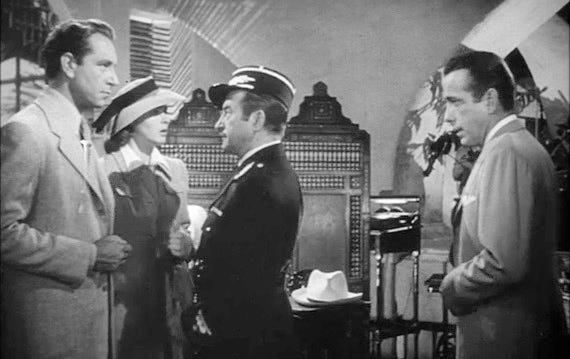
Eight and half decades of hindsight makes it obvious to all of us that it was the resisters of Vichy France who were right, while the collaborators compromised their morality in all kinds of amazing, depressing ways. But without that hindsight—if we had been there, at that time—what would we have done, resist or collaborate? What is so clear to us in the 21st century was perfectly clear to a lot of people in the early 1940s; I mean, the film Casablanca was released in 1942, for goodness sake. But, of course, the Nazis had their intellectual apologists, and what is so distressing about the article by Nathan Beacom is his profile of, primarily, two apologists from within Christianity: the French bishop François-Louis Auvity and the theologian and friar Réginald Garrigou-Lagrange. For our consideration of how Christianity does—or does not—make people good, we could simply read the entire article by Beacom, but here I’ll just present some excerpts. Beacom sets up the struggle in 1940s France this way:
In that frothy age in France, there were many forks in the road. A person did not wake up one day and decide to collaborate with the Third Reich. There was a slow, almost imperceptible process of decision whereby someone was led one way or another. Of those who counted themselves faithful Christians, many adapted to Vichy, but many others stood against it in favor of a different idea of France—and a different idea of faith.
It is instructive, however, to consider how individuals who began from similar starting points went two separate ways. Some, like the philosophers Jacques Maritain and Étienne Gilson, saw the wickedness of Vichy for what it was, while others, like Bishop Auvity, compromised themselves morally step by step. How to maintain moral clarity and avoid a blind wandering into wickedness is a question of perennial importance.
Who is this Bishop Auvity? Well, you know where to go to get quick answers to such questions, and let me now read to you the opening paragraph of Wikipedia’s entry on the bishop.
François-Louis Auvity (9 January 1874 – 15 February 1964), bishop of Mende (1937–1944), was one of seven French Roman Catholic bishops who were obliged to submit their resignations to Pope Pius XII … because of their enthusiastic collaboration with the occupation of France by Germany.
That’s the opening sentence. This guy was a bishop who lived to be 90 years old. Who knows how many people he helped during his long life, how much good he did in this world? But, according to Wikipedia, the first thing you need to know about Bishop Auvity is that he collaborated with the Nazis. My goodness, talk about beclowning yourself, covering your legacy with shame! Whatever good you did in the world is overshadowed, because in the moment of decision, when the stakes were the highest, when you had the opportunity to be a hero or a villain, you chose poorly, and that’s what people need to remember about you. Yikes!
Back to Beacom’s article.
To the end, Auvity operated out of a fear of the liberal Republicans, and at each decision point he decided to go whatever direction would most clearly work against them.
I pause here to explain that Republicans in this context does not mean conservatives or the GOP or MAGA, as it does in America now, but it means almost the opposite in Auvity’s context. Republicanism in France is most clearly associated with the French Revolution at the turn of the nineteenth century. Being a conservative, and being a fan of the Catholic Church, means that Bishop Auvity disliked French Republicanism. He longed for the old days; he wanted to make France great again. Note, as Beacom tells it, that the bishop operated out of fear; he chose the Nazis because h…