In this post—the last in the series—we cover the ancient evidence that some ancient people did, indeed, consider Psalm 2 (as we call it) the first psalm. How could they do such a thing? Either because Psalm 1 (as we call it) was considered a preface, or because Psalm 2 was considered the second half of Psalm 1.
Get caught up on the series with Part 1, Part 2, Part 3, and Part 4.
Thanks for reading Gallagher! Subscribe for free to receive new posts and support my work.
Rabbinic and Hebrew evidence for variability in psalm numbering
The Midrash on the Psalms 3.2 (sefaria) briefly discusses the reason that the psalms are not in their proper order. In other words, there is a recognition in this text that the Psalms are ordered strangely. The text gives a simple answer for this issue: that’s the way God wants it.
Among the sayings attributed to R. Joshua b. Levi, is this one that assumes that there are 147 psalms in the Psalter. This paragraph is from the Jerusalem Talmud (y. Shabb 16:1, Neusner’s translation, but see also sefaria at §7).
The hundred and forty-seven psalms included in the book of Psalms correspond to the number of years of the life of Jacob, our father [Gen 47:28]. This teaches that all the praises which Israel offer to the Holy One, blessed be he, correspond to the number of years of the life of Jacob, our father. What is the scriptural basis for this view? ‘Yet you are holy, O you that are enthroned upon the praises of Israel’ (Psa 22:3).
So, 147 psalms? In our Bibles, there are 150 psalms, and our English Bibles are translations of the Hebrew book of Psalms, so there should be (one would think) 150 psalms in the Hebrew Psalter. But, according to scholar William Yarchin, medieval Hebrew manuscripts present quite a bit of variation in the presentation of the psalms, even though the actual content is the same across all the medieval manuscripts.
In the quotation below, Yarchin uses the term “TR” for textus receptus, that is, the received text, or the traditional text of the Psalms (traditional for us). The number refers to the psalm number in what we regard as the traditional Psalter, i.e., TR 78 = the psalm we call Psalm 78 (according to the Hebrew, not the LXX).
This observation extends well beyond the commonplace that, for example, the occasional medieval Hebrew manuscript will show TR 1 and 2 as a single psalm, or that some manuscripts divide TR 78 into two psalms. There is much more here. The total body of evidence reveals at least twenty-five different attested conjoinments of what TR presents as two or more discrete psalms and at least thirteen different attested divisions of what TR presents as complete psalms. Moreover, these various conjoinments and divisions appear in a great variety of configurations. The result is that sēper tәhillîm [i.e., the book of Psalms] comes to us comprised of varying psalms totals ranging from 144 to 156, depending on which manuscript is in question. (Yarchin, p. 781)
Yarchin hints at something that we will examine more closely in a moment: that the first two psalms are sometimes treated as a single psalm. In the previous post (part 4 of the series), I mentioned that the Church Fathers occasionally attest to this aspect of the Hebrew Psalter.
Before getting to the Hebrew biblical manuscripts, let’s look at one more example from rabbinic literature in regard to different psalm numbers, and this passage is longer. It’s from the Babylonian Talmud, tractate Berakhot, and it argues from several angles for the combination of Psalms 1–2. The translation below is taken from the Soncino edition, but you can check out the text and translation at sefaria.org, where the passage begins at Berakhot 9b §25. The point of the passage is that the end of Psalm 19 (“let the words of my mouth…”) should be considered the conclusion of the eighteenth psalm, because in that way there would be a parallel with a famous Jewish prayer called the Amidah, a.k.a., the Eighteen Benedictions, a.k.a. the Tefillah. The importance of this passage is shown by its repetition in a briefer version in the Jerusalem Talmud (y. Taanit 2:2; in the Neusner translation at vol. 18, p. 185; or §3 at sefaria).
Here is the Soncino translation of the long passage from the Babylonian Talmud.
See that this verse ‘Let the words of my mouth be acceptable etc..’ [Psa 19:14, English version] is suitable for recital either at the end or the beginning [of the tefillah], why did the Rabbis institute it at the end of the eighteen benedictions? Let it be recited at the beginning?—R. Judah the son of Simeon b. Pazzi said: Since David said it only after eighteen chapters [of the Psalms], the Rabbis too enacted that it should be said after eighteen blessings. But those eighteen Psalms are really nineteen?
Let me pause here just to make sure everyone is following along. Again, the point of the passage is that the words “Let the words of my mouth…” should be considered the conclusion of Psalm 18, even though in our Psalter those words come at the conclusion of Psalm 19. So in the excerpt above, the rabbinic passage raises that objection. It’s “really nineteen” psalms, right? Not eighteen. Here’s the answer:
—‘Happy is the man’ [Psa 1:1] and ‘Why are the nations in an uproar’ [Psa 2:1] form one chapter.
So, the answer is that the first two psalms are combined. Now the text cites an authority as making the same point in a different way, some Rabbi called R. Judah the son of R. Simeon b. Pazzi.
For R. Judah the son of R. Simeon b. Pazzi said: David composed a hundred and three chapters [of Psalms], and he did not say ‘Hallelujah‘ until he saw the downfall of the wicked, as it says, Let sinners cease out of the earth, and let the wicked be no more. Bless the Lord, O my soul. Hallelujah. [Psa 104:35] Now are these a hundred and three? Are they not a hundred and four? You must assume that ‘Happy is the man’ and ‘Why are the nations in an uproar’ form one chapter.
So, again, the only way R. Judah son of R. Simeon b. Pazzi could have been correct in his statement is if he thought that the first two psalms were combined.
Now, here is the conclusion of the passage, presenting one further argument for their combination.
For R. Samuel b. Naḥmani said in the name of R. Joḥanan: Every chapter that was particularly dear to David he commenced with ‘Happy’ and terminated with ‘Happy’. He began with ‘Happy’, as it is written, ‘Happy is the man’, and he terminated with ‘Happy’, as it is written ‘happy are all they that take refuge in Him’.
That is, Psalm 1 begins with the word “happy” (or “blessed”) and Psalm 2 ends with a verse beginning with the word “happy,” and so actually Psalms 1–2 must be a single psalm.
Do I think those are good arguments? Um, no. But the passage does show that some Rabbis considered Psalms 1–2 to be a single psalm. And that explains what is going on with those manuscripts of Acts—and, more importantly (because more of them), the Church Fathers—that cite Psalm 2:7 as coming from “the first psalm.”
Psalm 1 as a preface to the Psalter
This is a pretty common idea in scholarship today: Psalm 1 forms a preface to the Psalter. Scholars usually don’t tie this idea to the psalm numbering, just to the interpretation of the book of Psalms. Gillingham’s 2018 study has an extensive discussion in this vein—or, actually, she argues that Psalms 1–2 both serve as a preface to the Psalter. If we’re looking for evidence that Psalm 2 counted as Psalm 1, Gillingham’s idea (which is not unique to her) wouldn’t work. Willgren’s 2016 study pushes back against the “preface” idea. At any rate, there is a common thought in modern scholarship on the Psalms that Psalm 1, and maybe Psalms 1–2, serve as an introduction or preface. Wenham (2012: 78) says matter-of-factly: “Psalm 1 is the introduction not only to the Psalter but also to the third section of the Hebrew canon, the Writings.” That doesn’t necessarily mean that Psalm 1 shouldn’t be numbered.
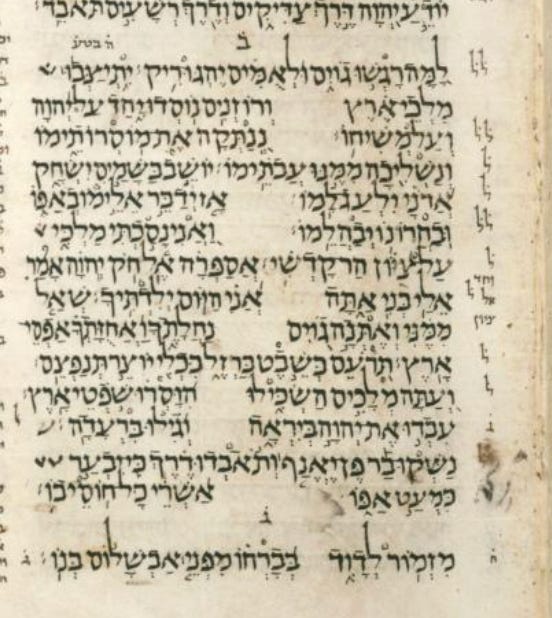
But that is what we find in some medieval Hebrew manuscripts: an unnumbered Psalm 1, and the psalm numbering starting at Psalm 2, assigning to it the number 1 (or aleph, א, the first letter of the Hebrew alephbet). Apparently, then, these manuscripts treat Psalm 1 as a kind of preface, and when users of these manuscripts wanted to find Psalm 1, apparently they would find the psalm beginning, “Why do the heathen rage?”
Which medieval manuscripts? Well, I haven’t actually seen any myself. The evidence that is cited comes from two scholarly works produced near the turn of the nineteenth century. They are both basically multi-volume collections of variant readings in Masoretic manuscripts. One of them was produced by the Englishman Benjamin Kenicott, and the other by the Italian Giovanni Bernardo de Rossi. They are still standard reference works. Fortunately, (at least some of) these volumes have been placed online. Unfortunately, they have their own citation methods, so I’m not always sure about the identity of the manuscripts they reference. But I do know that all of these manuscripts are medieval Masoretic manuscripts.
Kennicott provides notes for many medieval manuscripts, and on at least two of them—the ones he calls codex 157 and codex 168—he says that the numbering of the psalms starts with our Psalm 2, where there is an aleph (א), indicating that it is considered the first psalm. (You can see Kennicott’s notes on these manuscripts, in Latin, here.)
As for de Rossi, I paste here an image from his notes on the beginning of the Psalter (here, p. 1). He has two notes, and the first concerns the prefatorial function of Psalm 1, while the second will concern us in our next section. The first note says: “Psalm 1 is not numbered, as if a prologue, as in some Greek codices, and number 1 begins from Psalm 2, in my codices 234, 879.”
There are some relevant patristic comments (surveyed by Willgren, cited earlier). For instance, in his commentary on the Inscriptions of the Psalms, Gregory of Nyssa discusses why some psalms (such as Psalms 1–2, but also others) do not have superscriptions. He suggests that “in a sense, the first Psalm is an inscription of the second” (2.8.75; translation by Heine, p. 144). But this statement should not be pressed too far, and it is improbable that Gregory thought that Psalm 1 should be unnumbered.
Psalm 2 as the second part of Psalm 1
John T. Willis begins his 1979 article “Psalm 1—An Entity” by reminding readers that several scholars had a few years earlier argued that the first two psalms (as we consider them) were originally one. Willis names Lipinski, Brownlee, and Bardtke. The point of Willis’ article is to establish the opposite position.
But the idea that Psalms 1–2 might be one has precedent long before the twentieth century. Indeed, some medieval Hebrew manuscripts present them as a single psalm. We have just seen that a lot of different numbering schemes and combinations were happening in medieval manuscripts of the Psalms, and even though the Rabbis had the same Psalter as we do in terms of content, they didn’t take it for granted (as we might) that there were 150 psalms in the book. We shouldn’t be surprised if Psalms 1–2 occasionally get combined, as they did.
The combinations in the medieval manuscripts are reported, again, by Kenicott and de Rossi. I have not actually seen these medieval manuscripts themselves, just the reports about them by Kenicott and de Rossi.
First, Kennicott. Here is his note (the first note on the left):
“This psalm is written as part of the preceding one: 17, 37, 216, 409, 505.” That’s the first part of the note, and the only part that interests me at the moment. But I am not an expert in medieval Hebrew manuscripts, and I’m not sure of the best way to track down these manuscripts. Kennicott does describe them in the first volume of his work, so at least you can learn where (in what city) they are located, but I’m not sure of the library always. The first two of these manuscripts are in the Bodleian, but they are not digitized yet, as you can see here. Anyway, I haven’t seen images of any of these manuscripts. (See also Kennicott’s description of manuscript 164, which also combined Psalms 1–2.)
Now for de Rossi. Earlier I pasted an image from de Rossi’s volume, and now we focus on the second part of that image (the part numbered II, signaling that the discussion now concerns Psalm 2). De Rossi says about Psalm 2 that it is considered a part of Psalm 1 in Kenicott’s manuscripts (already named, except that de Rossi omits 409) and de Rossi adds a few more: “my 554, 596, 782.” He also says that there was such a manuscript known to Origen (see my previous post), and some more in the time of Kimchi.
(Wilson, 204–5 n. 8, also says that de Rossi, in his volume 5, pointed to some additional Hebrew manuscripts that combined the first two psalms. I have not been able to locate de Rossi’s fifth volume online. According to Wilson’s translation of de Rossi, there are four further manuscripts that mark our Psalm 2 with an aleph: codex 1117, Erfurtensi 5, Haalens Bible, MS. I Erfurtensi Jarchiani Commentarii)
Willis also adds a further manuscript (based on Bardtke): Wiener Nationalbibliothek ms no. 4 (12th cent.).
Conclusion
Let’s draw our thoughts to a close. I do think the correct reading of Acts 13:33 is “second psalm,” and I do not think it is best to read Psalm 1 and Psalm 2 as a single psalm—they are best read as separate compositions—and while I do think that Psalm 1 (and maybe Psalm 2) forms some sort of preface to the Psalter, that does not mean that it is not itself a psalm that deserves its own psalm number. I am not arguing that we should renumber the psalms in the book of Psalms. In that sense, perhaps this 5-part series has been a giant nothingburger.
But the matter is worth pursuing because it shows us how certain things we considered settled about the Bible—simple things, like psalm numbering, and manuscript readings in the book of Acts—are somewhat more complicated than often considered. Things like this are part of what makes biblical studies so much fun, discovering that what you thought you knew, might end up being true, or probably true, but not as obvious as it had seemed. Learning to live with uncertainty is important for someone entering into biblical studies, or probably any academic field. Studying such small details as the numbering schemes of the psalms helps us understand what can be known and how we can know it.
Thanks for reading Gallagher! Subscribe for free to receive new posts and support my work.