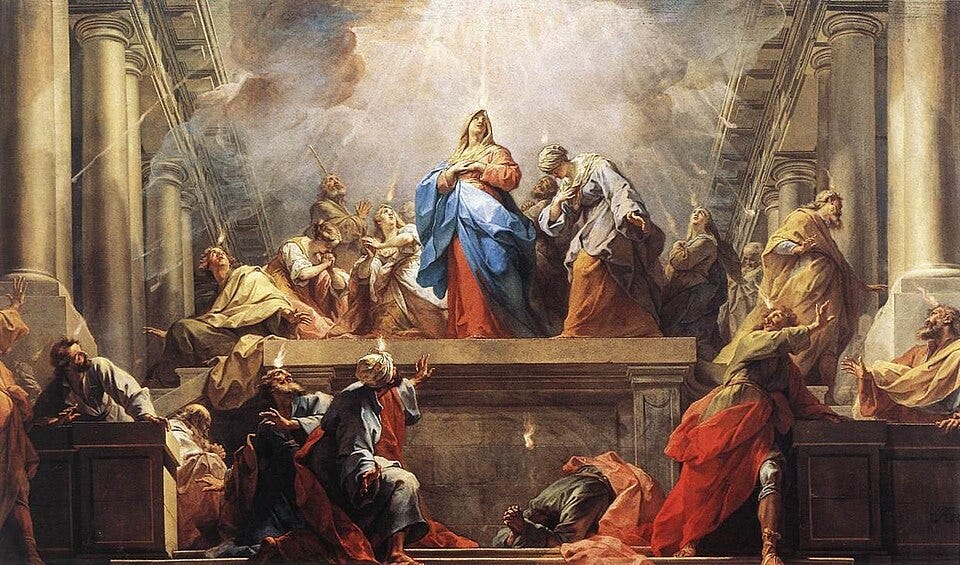
I have no experience with speaking in tongues. First of all, though I can read a few languages for academic purposes, I speak only a single language. (I’m not going to tell you which one; you’ll just have to guess.) Secondly, the phenomenon known today as “speaking in tongues” and practiced—encouraged—among charismatic Christians is something completely foreign to me. I’ve never done it and I’ve never even seen it done. I have heard reports from people who have done it, and I have read a little bit about it. This post is not about that practice except tangentially.
Here, we’re talking about the first century, and specifically about the New Testament.
Thanks for reading Gallagher! Subscribe for free to receive new posts and support my work.
There are a few passages in the New Testament that mention speaking in tongues.
* Acts 2:4–11
* Acts 10:46
* Acts 19:6
* 1 Corinthians 12–14
Is this really the entire list of New Testament passages on “speaking in tongues”? I would have thought it came up more, especially in Acts. Let’s survey the evidence.
Glōssa in the New Testament
The Greek word for tongue is glōssa (γλῶσσα), which forms in English the first part of the word glossolalia. (The second part, lalia, relates to the Greek word for “speaking,” so glossolalia basically means “tongue speaking,” but I’ll offer a more precise definition in the next section.) Glōssa appears 50x in the New Testament, and by far the most number of times is in 1 Corinthians (21x), all in chapters 12–14, mostly chapter 14. Other than that, it appears as follows:
* Gospels, 4x (twice in Mark, twice in Luke)
* Acts, 6x (4x in ch. 2, and then once each in ch. 10 and ch. 19)
* Epistles other than 1 Corinthians
* Paul, 3x (Rom 3:13; 14:11; Phil 2:11)
* Catholic Epistles, 7x (mostly James, also 1 Peter 3:10; 1 John 3:18)
* Revelation, 8x, always referring to the many nations and peoples and tongues (except for 16:10)
There are plenty of times when glōssa means simply “tongue,” as in the body-part, the organ inside the mouth. Jesus healed a guy’s tongue (Mark 7:32–37) and Zechariah’s tongue was loosened (Luke 1:64) and Dives wanted a drop of water to cool his tongue (Luke 16:24). Sometimes glōssa means “language,” as on Pentecost when the gathered Jews marveled that they heard the apostles “telling in our own tongues the mighty works of God” (Acts 2:11), and in most of its appearances in Revelation.
In the book of Acts, the word glōssa does not appear after Acts 2, except in the two verses already mentioned, 10:46 and 19:6.
So, yes, confirmed! The only passages in the New Testament that mention “speaking in tongues” are the ones listed earlier: three passages in Acts and the discussion in 1 Corinthians.
Except for one interesting verse in your Bible that has been judged—rightly—to be a later addition to the Gospel of Mark. Here’s the verse in the KJV:
And these signs shall follow them that believe; In my name shall they cast out devils; they shall speak with new tongues (γλώσσαις λαλήσουσιν καιναῖς). (Mark 16:17)
Hmm, “new” tongues. That’s interesting, and this passage—though inauthentic to Mark—should be considered as part of the reception history of the “tongues” phenomenon in the New Testament, and possibly as evidence of early Christian experience. This verse will come up again later in this post.
The Four “Tongues” Passages in the New Testament
A new article in the Journal of Biblical Literature by Joshua H. M. Chan considers the interpretation of these passages and argues against the view that any of them describe glossolalia, arguing instead that some of them describe xenolalia and others naturally acquired languages. I’ll explain what this means in a minute. Let me introduce Chan: he’s affiliated with Oxford University, and I would guess he’s a doctoral student there. The first footnote of this article says that the article itself is based on his masters thesis at Dallas Theological Seminary, under the supervision of Darrell Bock and Joseph Fantin. Here’s Chan’s LinkedIn page, where you can see a picture of him.
Now, to define terms.
glossolalia, i.e., “speaking in tongues,” means making utterances that are unintelligible to (most) other humans. This is the charismatic practice I mentioned earlier. The person who engages in glossolalia says that he or she is speaking an angelic or heavenly language, and this person is enabled to do this by the power of the Holy Spirit. Sometimes an interpreter, also empowered by the Holy Spirit, offers a translation of the heavenly language into a language that humans speak.
xenolalia, speaking in foreign languages, i.e., known human languages—but, here’s the catch: the speaker hasn’t ever studied the language before. Like if you’ve never studied Russian and then all the sudden you’re speaking Russian.
So, which one is the New Testament talking about? I grew up hearing—and this view was reinforced when I was a student at FHU—that all of the “speaking in tongues” passages in the New Testament were describing xenolalia and not glossolalia, and that this interpretation is most clear from Acts 2, which provides the lens for interpreting 1 Corinthians 12–14. And this interpretation would mean that the modern phenomenon of glossolalia is not reproducing anything known from the New Testament. This view still makes most sense to me, and this article by Chan argues similarly.
But apparently it’s not a very common view among biblical scholars.
Scholarship on New Testament “Tongues” Passages
Using Chan’s article for a survey of scholarship, here’s the lay of the land on the scholarly interpretation of those New Testament passages.
1 Corinthians 12–14
According to Chan (at the very beginning of his article), it is pretty rare for biblical scholars to interpret the phenomenon in Corinth as xenolalia. Rather, they interpret it as some sort of glossolalia.
Note these verses.
For those who speak in a tongue do not speak to other people but to God; for nobody understands them, since they are speaking mysteries in the Spirit. (1 Corinthians 14:2)
For if I pray in a tongue, my spirit prays but my mind is unproductive. (1 Corinthians 14:14)
(Chan, note 85, indicates a forthcoming article in ZNW under the title “The Unintelligible Intelligibility of Tongues: The Early Reception of Glossolalia as Human Languages in 1 Corinthians 14,2.14.”)
Chan divides the glossolalia interpretations into three categories and lists proponents of each.
* ecstatic speech: Johannes Behm (TDNT 1.719–27); Luke Timothy Johnson (ABD 6.596–600); Dunn; Hovenden; Mills; Hiu; Choi.
* angelic tongues: Poirier; Fee; Hays; Conzelmann; Martin; Quesnel.
* voces magicae: Stroud; Nasrallah.
But some people do interpret Paul’s statements in 1 Corinthians about tongues as implying that the phenomenon involves known human languages.
* xenolalia. Tibbs; Forbes; Eurell; Tupamahu; Schottroff; Schreiner.
Acts 2
Here there is still a strong tradition in scholarship to interpret the “tongues” phenomenon as xenolalia, but this interpretation is not universal.
Note this verse:
All of them were filled with the Holy Spirit and began to speak in other languages, as the Spirit gave them ability. (Acts 2:4)
* xenolalia. Keener is the only scholar named by Chan, but Chan no doubt intends for Keener to represent an entire tradition of scholarship and as a guide to that tradition.
* glossolalia. Scippa; Lüdemann; Horn.
* akolalia (i.e., a miracle of hearing rather than speaking). Hunter. Chan (pp. 139–40) argues (based on Hovenden) against this interpretation, though he can cite in its behalf Gregory of Nazianzus (Oration 41.15) and the Venerable Bede (Comm. Acts 2.6), not to mention more modern scholars besides Hunter: Everts; Dunn; Johnson.
Acts 10:46 and 19:6
Apparently the dominant view of these passages, concerning Cornelius and the twelve disciples in Ephesus that Paul baptized, is that they refer to glossolalia. See Johnson; Menzies; Witherington; Hiu.
Chan’s Argument
It’s the interpretation of the phenomenon in 1…