But now the time has come to go away. I go to die, and you to live; but which of us goes to the better lot, is known to none but God.
To live is Christ and to die is gain.
—Paul
One time Peter got put in prison in Jerusalem during the time of Passover. The story is told in Acts 12. The year was probably AD 44. The text says that it was King Herod who put him in prison. Now, there are various Herods mentioned in the New Testament. This Herod in Acts 12 is not the most famous Herod, the one who killed the babies of Bethlehem (Matt 2:16). That was Herod the Great, the first in the line of Herods. Our Herod in Acts 12 is called Herod Agrippa, and he is the grandson of Herod the Great. Later on in Acts, Paul will meet another king whom the biblical text calls Agrippa (Acts 25–26), who is the son of the Herod Agrippa in Acts 12. Historians call the father Herod Agrippa I and the son Herod Agrippa II.
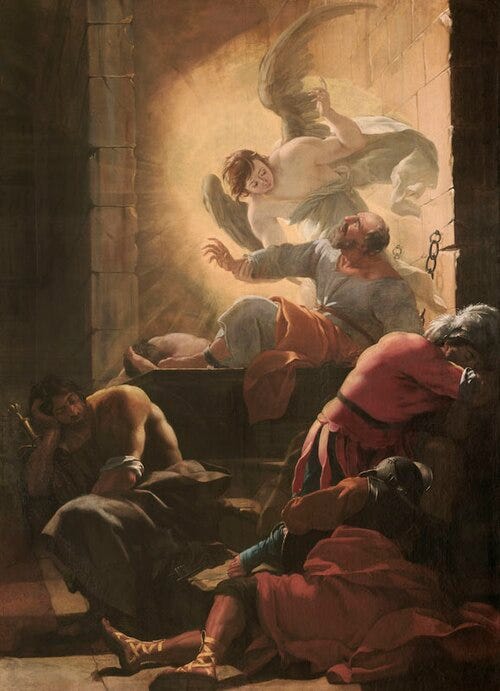
Herod Agrippa I put Peter in prison with the plan to execute him after Passover and the days of unleavened bread (Acts 12:4). But on the night before the scheduled execution, an angel showed up in the prison and set Peter free. God sent an angel to save Peter’s life, to rescue him from certain death. Our God can do things like that. Once Peter was out of the prison, he went to the house of Mary, mother of John Mark, where the church had gathered to pray on Peter’s behalf. You remember what happened next. Peter knocked on the door and announced that he had been released. Rhoda the servant was so excited to tell everyone that she forgot to let Peter in. Nobody believed Rhoda; they thought it must have been his angel (Acts 12:15), whatever that means. When Peter finally got into the house, he reported about his escape and left.
Thanks for reading Gallagher! Subscribe for free to receive new posts and support my work.
We know what year all this happened because of the next event narrated in the chapter: Herod Agrippa I died. According to Josephus, Agrippa I died in the year AD 44. (Of course, Josephus does not use our dating system; see the report of Agrippa’s reign at Antiquities 19.351–52.) The story Luke tells about this death contains the memorable and potentially confusing wording that the king “was eaten by worms and breathed his last” (Acts 12:23). We sometimes say that once a person has died, he becomes worm food, but Acts says that the worms were eating Agrippa before he died. Of course, that sometimes happens. The ancient Greek historian Herodotus described something similar about Queen Pheretima in Libya in the sixth century BC: “she died a horrible death, her body seething with worms while she was still alive” (4.205). According to Luke, the judgment of God came upon this King Herod for his arrogance, illustrated in his futile attempt to kill one of the Lord’s apostles.
Acts 12 is a story of liberation. It shows us the power of God, who is able to rescue from death. This story encourages us as readers to recognize that a hopeless situation is brimming with hope as long as we trust in the God who loves us and can cause everything to work out for our benefit (Rom 8:28).
This story is not the only time that Peter had seen the Lord rescue someone from death. During his ministry in Galilee, Jesus sometimes raised up people who had already died. One time there was a synagogue leader named Jairus who approached Jesus asking for help for his sick daughter. By the time Jesus got to Jairus’ house, the report was already circulating about the girl’s death. Jesus’ response to this report? “Do not fear, only believe” (Mark 5:36). Jesus went into the girl’s room and simply said, “Talitha cum” (5:41)—and she got up! Peter was there, he heard those words from Jesus’ mouth, he saw the girl rise and eat. Do you remember who else was in that room at the time? Aside from the girl’s parents, it was only Peter, James, and John.
We sometimes see this trio of apostles granted special privileges, not enjoyed by the other apostles. These were the three on the mount of transfiguration, who witnessed Jesus glowing and talking with Moses and Elijah (Mark 9:2–8). Later, in what seems like the moment of Jesus’ greatest need, it was Peter and James and John with him in the garden of Gethsemane (Mark 15:32–42). While all twelve apostles had their mission from Jesus, it seems like the Big Three were an especially important group with an unusually intimate relationship with Jesus.
Peter, the rock (John 1:42).
James and John, the sons of thunder (Mark 3:17).
No doubt Jesus had big plans for these three special apostles, some sort of special project.
The Gospels record some stories that involve just James and John without Peter. It was these two brothers who suggested to Jesus that they could call fire down from heaven against some rude Samaritans. Sons of thunder. Jesus rolled his eyes (Luke 9:51–55). It was also James and John (Mark 10:35–40)—or, actually, their mother (Matt 20:20–28)—who asked for the best seats in the kingdom of God, on the right and left of the Messiah. This time, Jesus did not roll his eyes but asked a question: “Are you able to drink the cup that I drink, or be baptized with the baptism with which I am baptized?” (Mark 10:38). James and John answered confidently, “yes, we can do that!” Did they know what they were talking about? We can be sure that they did not know the full import of their words. Jesus actually told them, “You do not know what you are asking” (10:38). But did they realize that the cup Jesus mentioned, and the baptism, had to do with suffering? I’m not sure, maybe. They may have thought that they were proclaiming their readiness to serve on the front lines in the coming war, to put themselves in dangerous situations for the kingdom of God. They probably did not realize that there would be no battle against Rome or any earthly foe. But they may have thought that they had signed up for some degree of suffering. And Jesus told them that they were right about that. “The cup that I drink you will drink; and with the baptism with which I am baptized, you will be baptized” (10:39). Jesus would endure suffering, and so would James and John.
Acts 12 does not start with King Herod putting Peter in prison. It starts with Herod imprisoning James, the brother of John. In prison is one of the sons of thunder, one of the Big Three apostles. There is no rescue plan from God, no miraculous escape. Instead, Herod “had James, the brother of John, killed with the sword” (Acts 12:2). Peter would be saved by a miracle, but not James. Why the one and not the other? Luke does not tell us.
When Peter was imprisoned, Christians gathered to pray in the house of one of their members. They asked God to spare the life of this beloved leader. Do you think that the church did the same for James? When James was taken by the authorities, do you think the Christians prayed for him, too? What did they pray? Of course, we don’t know the words of their prayer, but let me offer a suggestion by reminding you about an incident that James witnessed.
One of those occasions when the Big Three were alone with Jesus was in Gethsemane. The way Mark tells the story (perhaps based on the memories of Peter; see Eusebius, Ecclesiastical History 2.15.1–2), the apostles were having trouble staying awake. It was late at night. Even if they hadn’t fallen asleep, I’m not sure they were close enough to overhear what Jesus prayed, but somehow people found out what the Lord prayed in the garden, because it’s reported in all three of the Synoptic Gospels (Matt 26:39; Mark 14:36; Luke 22:42): “Let this cup pass from me; yet not what I will, but your will be done.”
Do you think it’s possible that—assuming the church gathered to pray for James after his arrest—they reflected on Jesus’ prayer in the garden? James had probably told them many times about what he witnessed that night, about his shame at falling asleep in that hour, about how he wished he had realized at the time the significance of the events he was experiencing, and about Jesus’ prayer. James had probably said that when it came to his own hour of death, he hoped he would face death in the same way Jesus did. Do you think it’s possible that the church prayed for James just as Jesus prayed in the garden, so that they asked God to let this cup pass from the apostle, if it be God’s will—and if it be not God’s will, but if rather God will that James should drink the cup to the dregs, perhaps the church prayed that James would show himself worthy of imitating Jesus through a brave and noble death.
We usually recoil from death, try to prevent it by every means possible, even though we all know that it’s coming. Sometimes we encounter people who seem to stare at death and—far from recoiling at it—endeavor to die in a particular fashion. There’s a moment in the novel Dracula when Arthur Holmwood (by now, Lord Godalming) is asked to give his beloved Lucy Westenra a transfusion of blood (ch. 10). Poor Lucy has been experiencing a repeated and mysterious loss of blood. Only Abraham Van Helsing seems to have any idea of how the blood was leaving her body, and what those two tiny pinprick holes on the side of her neck might have to do with it. At any rate, she needs blood immediately, and Van Helsing asks Arthur to supply the blood. Arthur answers, “If you only knew how gladly I would die for her.”
We can think of other examples. I believe that not every state has a designated state hero, but the state hero of Connecticut is a man named Nathan Hale. At age 21, he was arrested by the British as an American spy during the early period of the Revolutionary War. When he was hanged on September 22, 1776, his last words were reported as, “I only regret that I have but one life to lose for my country.”
There are plenty of examples of noble deaths in religion as well. Near the end of the second century AD, the Christian author Tertullian wrote in his Apology (ch. 50), “The blood of the martyrs is the seed of the church,” meaning that Christians endure death in so noble a fashion that it actually attracts people to this illegal religion. The writer of Hebrews mentioned people who accepted death in this way: “Others were tortured, refusing to accept release, in order to obtain a better resurrection” (Heb 11:35). The author here is probably thinking of the Maccabean martyrs, who had experienced terrible suffering and death about two centuries before Jesus was killed. We know the story of these martyrs from the apocryphal book of 2 Maccabees, probably written in the second century BC. The wicked king Antiochus Epiphanes tried to force Jews to abandon their law, threatened death if they didn’t eat pork. Of course, some gave in, abandoned their faith to preserve their earthly lives. But 2 Maccabees 7 describes a family of seven brothers and their mother who “were tortured, refusing to accept release, in order to obtain a better resurrection.” Each brother, and their mother, made a speech, declaring their resolve to endure the worst suffering the Greek tyrant could offer—and the chapter describes some pretty awful punishments. They basically said, like Arthur Holmwood, “If you only knew how gladly we would die for our God,” or like Nathan Hale, “I only regret that I have but one life to lose for my Lord.”
I am not sure how James faced his death. Did he make a speech? Did he face it bravely? Luke does not say. The fourth-century church historian Eusebius told a story about James going to his death, a story in which James did make a speech, bravely declaring the name of Christ, such a moving speech that the soldier guarding him gained the courage to reveal that he himself was also a Christian, and the two marched out together and were both executed (Ecclesiastical History 2.9). Should we trust that story? Is that close to the way it happened? Did James cower in fear before the executioner, or did he welcome the chance to prove his faith in the way that martyrs before and after him did?
To ask the question is to encounter an obvious answer. Surely this son of thunder did not shrink in fear. I bet that at the moment of his death, James remembered having been on the mountain, one of the privileged few, amazed at the bright light emanating from his Lord, standing there with Moses and Elijah.
I’m sure as he walked toward the executioner, James remembered the instructions of Jesus, if you would be my disciple, you will take up your cross (Mark 8:34). I bet he remembered his younger and more impetuous self, and that once (or was it more than once?) he had the audacity to ask for the best seats in the kingdom. And I bet he remembered how Jesus answered this request with a question about drinking a cup and about a kind of baptism—a question to which he had confidently asserted, “Yes! I will drink that cup! I will receive that baptism!” Walking toward the executioner, he finally realized the significance of those words, and Jesus’ reply, “You will drink that cup. You will receive that baptism.” Luke does not tell us how James felt in that moment, but I bet he remembered the words of Jesus and saw his death as an opportunity to fully imitate his master, to be a true disciple of Jesus, to glorify God. “If you only knew how gladly I would die for him.”
That makes me wonder how Peter felt to be rescued.
I’ve never been in combat, never been in a war zone, never been a part of the military. I understand from TV and movies that soldiers sometimes experience something called survivor guilt. Out of the many great World War II movies, one of the greatest is called The Best Years of Our Lives (1946), starring Fredric March and others. It tells the story of some WWII veterans who return from war and have trouble adjusting to “normal” life, in part because it seemed so pointless after what they had just experienced, in part because of the physical toll the war took on them, and in large measure because they wonder why they survived to live this easy and comfortable life while so many of their friends had died in battle. Why was I chosen to live? You might think about the last scene of Saving Private Ryan: “Tell me I’m a good man.” Near the end of Les Miserables, Marius sings these words:
Oh my friends, my friends forgive meThat I live and you are goneThere’s a grief that can’t be spokenThere’s a pain goes on and on.
—From the song “Empty Chairs at Empty Tables.”
And in the Japanese novel Silence, written by Shūsaku Endō (1966), the priest Rodrigues envies his dead friend, Garupe, who had drowned. “Behind his eyelids like a hallucination floated the head of Garupe sinking down into the sea. How he envied his companion! Yes, how he envied Garupe freed from anguish such as this!” (ch. 8).
How did Peter feel about the miraculous rescue he enjoyed after witnessing his dear friend and fellow apostle, co-member of the Big Three, die such a cruel and noble death? Peter had no doubt joined with others and prayed for James, prayed for his release, prayed for God’s will to be done no matter what. James was given an opportunity denied Peter by that angel. Did Peter feel guilty for living?
The most famous speech in American history contains this passage.
It is for us the living rather to be dedicated here to the unfinished work which they who fought here have thus far so nobly advanced. It is rather for us to be here dedicated to the great task remaining before us—that from these honored dead we take increased devotion to that cause for which they gave the last full measure of devotion—that we here highly resolve that these dead shall not have died in vain.
For present purposes I am not so interested in “government of the people, by the people, for the people,” but I quote Lincoln for what he says about the purpose of living after so many have died. “It is for us the living rather to be dedicated here to the unfinished work which they who fought here have thus far so nobly advanced.” The apostle James was given the opportunity—and seized it!—to so nobly advance the kingdom of God. Peter was not given that same opportunity in Acts 12. What should he do? Be dedicated to the unfinished work.
We are in the position of Peter. God has allowed us to live to this point. What do we do with that? Be dedicated to the unfinished work until we are granted the privilege of honoring God through our deaths. James enjoyed that privilege in Acts 12. Peter would have to wait. For now, his great task was to honor God with his life.
According to a popular report, George Washington once said to a young lieutenant colonel who had dreams of dying for the patriot cause during the Revolutionary War: “Dying is easy, young man; living is harder.” James had the privilege of honoring God through his death. Peter now had the burden of honoring God through his life. We share that burden. Until that day when God permits us to imitate James, he calls on us to imitate the apostle who lived.
Thanks for reading Gallagher! Subscribe for free to receive new posts and support my work.