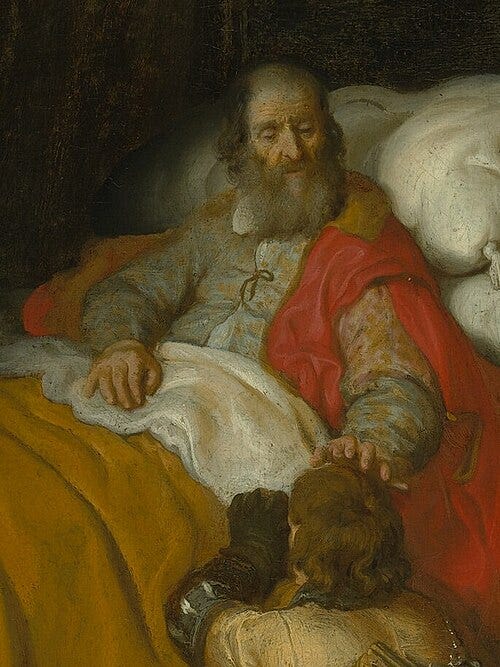
And Jesus said, For judgment I am come into this world, that they which see not might see; and that they which see might be made blind. And some of the Pharisees which were with him heard these words, and said unto him, Are we blind also? Jesus said unto them, If ye were blind, ye should have no sin: but now ye say, We see; therefore your sin remaineth. (John 9:39–41)
Old Isaac in Genesis 27 was fortunate to be blind. Let me explain.
But first I want to tell you why I read Dracula every year. Well, actually, I don’t read it, I listen to it.
Come October, it starts to feel like Dracula season, and I take a break from podcasts and listen once again to the classic vampire novel. It’s because Dracula is, on the one hand captivating, enthralling, exciting, and on the other hand, a deeply Christian novel. One of the ways the novel provides an escape into fantasy land is that, for the most part, the novel presents clear moral choices; there are bright lines between right and wrong.
That kind of clearly demarcated morality does happen in our world, the real world, but there is also a lot of gray here. There’s not much gray in Dracula, and that is, in some ways, a relief. The character for whom the novel is named is clearly evil, pursuing an evil plan, and stopping him is a good thing. There are some heroes in the book, mostly the men who, about halfway through the novel, have committed themselves to destroying the Count. There are five men, led by Abraham Van Helsing, and one woman, Mina Harker, and they are all brave and virtuous, ready to offer their lives in pursuit of their just goal. There is no ambiguity about whom to root for.
(The novel does not completely lack nuance. In ch. 23, Mina Harker told the assembled men that killing Dracula would be good even for Dracula, and so they should not pursue him out of hate but rather out of love. “That poor soul who has wrought all this misery is the saddest case of all. Just think what will be his joy when he, too, is destroyed in his worser part that his better part may have spiritual immortality. You must be pitiful to him, too, though it may not hold your hands from his destruction.”)
My favorite character is Quincey Morris, and not just because he’s the only American in the novel. He is, in fact, the bravest of all. When he becomes convinced that he knows the right thing to do, he does not hesitate. This characteristic of Mr. Morris is represented well near the end of chapter 24, when the group is discussing what they will do when they find Count Dracula resting in his coffin. Van Helsing says that they will wait for an opportunity when no one is looking, because they need to drive a stake through Dracula’s heart, and that’s not the kind of thing you want people to witness. You don’t want to be accused of murder. But to this counsel of caution from Van Helsing, Quincey Morris responds, in his Texas accent:
I shall not wait for any opportunity. When I see the box I shall open it and destroy the monster, though there were a thousand men looking on, and if I am to be wiped out for it the next moment!
I love that attitude: I am ready to do what is right, come what may! That attitude contrasts so sharply with my own, because I find myself pursuing peace and comfort and avoiding risk. I need to be inspired to lay down my life in the work of God, just as Christ demands.
What Can I Offer?
What is the point of life? There are different ways of saying it, and I myself—in my teaching and preaching—say it in different ways, just as the New Testament does. Sometimes I say that the point of our lives is to be conformed to the image of Jesus (Romans 8:29), and I think that’s a good way of putting it. Or, we could say that, since Jesus calls us to die (Mark 8:35; cf. Gal 2:20), then our entire life is about figuring out how to die for Jesus. Both of those ways of articulating the point of our lives are true and biblical and could be restated like this: we dedicate ourselves to God.
In the past few years we’ve started singing a song at church that I now learn through google was popularized by Brandon Lake, a song called “Gratitude.”
It’s got a section that resonates with me.
I know it’s not muchbut I’ve nothing else fit for a king,except for a heart singing hallelujah.
I definitely feel that. I don’t have anything to give to God, nothing worthy of what he has done for me. All I’ve got is this heart singing hallelujah.
But here’s the thing: the saints have always longed to give more to God than just a worship song; they’ve given their entire lives. The saints have longed for a chance to sacrifice themselves on behalf of Christ, and many of them were granted that opportunity.
For example, in her classic of spirituality called The Story of a Soul, St. Thérèse of Lisieux recalls a trip to Rome that included a visit to the Coliseum, where she kissed the ground.
My heart beat violently as I pressed my lips to the dust once reddened with the blood of the early Christians, and I asked the grace to be a martyr too for Jesus. At the bottom of my heart I felt that I was heard.
—St. Thérèse of Lisieux, describing her visit to the Coliseum in Rome (ch. 6, p. 75)
Thérèse ended up dying at age 24 of tuberculosis; but throughout her memoir she described her own life, lived entirely in dedication to God as a nun, as a type of martyrdom. Indeed, at one point she mentioned that “theologians call a martyrdom” the religious life (ch. 9, p. 123). She knew what it was that Paul meant in Philippians 1:29, when he said that the Christians in Philippi had been granted by God’s grace not only to believe Christ but also to suffer for him.
Isaac
And now we come to Isaac, the overlooked patriarch. But how could he avoid being overlooked? His own father is Abraham, the father of the faithful. We sing songs about father Abraham. The blessing awaiting the faithful who have departed, according to Jesus in Luke 16:22, is to rest in the bosom of Abraham. It’s hard for a son to live up to such a father. And then Isaac’s own son is Jacob, who is, literally, Israel (cf. Gen 32:28), the father of the twelve tribes. It’s easy for such a son to overshadow his father.
What about Isaac? What did he do? The most famous thing he ever did was get born (Gen 21), finally, after Abraham waited decades for a son. Or maybe the most famous thing about Isaac was his near-death experience on Mount Moriah (Gen 22). But, in any case, the well-known stories involving Isaac aren’t really about Isaac at all. Abraham died in Genesis 25, and then it’s Isaac’s time to shine, but immediately the attention of Genesis turns toward the next generation, so that Jacob and Esau, and especially Jacob, dominates the next chapters, until we get to Joseph in the following generation.
Abraham—wow!
Jacob—wow!
Isaac—who?
There’s really just one chapter where Isaac is the star of the show, and that’s Genesis 26, the one where Isaac follows the example of his father Abraham (cf. Gen 20) by lying to Abimelech about his wife, Rebekah, claiming that she is, instead, his sister. Isaac doesn’t even have Abraham’s excuse that he’s married to his half-sister (cf. Gen 20:12). Rebekah is Isaac’s cousin. It’s also interesting that there is no indication in Genesis 26 that anyone had thought about taking Rebekah as a wife, as Pharaoh (Gen 12:15) and Abimelech (Gen 20:2) had done with Sarah. The rest of chapter 26 describes conflict between Isaac and the Philistines in regard to some wells.
Isaac is a hundred years old at the end of chapter 26, which we can calculate based on the information given in the text: Isaac was sixty years old at the birth of his twin sons (25:26), and at the end of chapter 26 those twins are 40 years old (26:34).
Now Isaac thinks he’s about to die. It’s not an unreasonable thought for a man who measures his life in triple digits, but it turns out to be premature. Isaac lives to be 180 years old (35:28)…