The medieval Hebrew manuscripts of the Bible are called Masoretic because they contain the Masorah (“tradition”), which includes elements such as the vowel signs and notes and accent marks and, of course, the consonantal text of the Hebrew Bible. The best Masoretic manuscripts that survive, and the oldest, are the Aleppo Codex (925 AD) and the Leningrad Codex (1009 AD). It is the latter, the Leningrad Codex, that serves as the base text for the standard edition of the Hebrew Bible, BHS (and its replacement, BHQ).
Thanks for reading Gallagher! Subscribe for free to receive new posts and support my work.
Let’s take a look at how these manuscripts treat the Minor Prophets, specifically in terms of the division between the books. As we begin, it’s important to understand that in Jewish tradition—still today, and traceable to ancient times—the Minor Prophets count together as a single book of the Bible. If you ask a Jewish Rabbi today how many books are in the Jewish Bible, he (or she) will answer 24. Those 24 books are the same as the 39 books of the Protestant Old Testament, just counted differently. With regard to these counting differences, the Protestant Old Testament reflects ancient Christian tradition that is still maintained in all Christian Bibles, whether Catholic or Orthodox or Protestant or whatever. Christians count the books of the Old Testament differently from Jews. There are five counting differences, and in each case Christians divide where Jews combine.
* Samuel
* Kings
* Chronicles
* Ezra-Nehemiah
* Minor Prophets
The first four of these biblical books are divided into two by Christians but count as a single book for Jews. The last one, the Minor Prophets, counts as twelve for Christians but one for Jews. That’s how you go from 39 books in the Protestant Old Testament to 24 books in the Jewish Bible without omitting any material. The content is the same in both cases, just calculated differently.
But in the case of the Minor Prophets, the individual prophets are also distinct from each other; they are not simply different sections of the same book. And the Masoretic manuscripts show that the Minor Prophets form a single unit or biblical book but also are separate from each other.
Aleppo Codex and Leningrad Codex
There are interesting stories for both of these manuscripts that I won’t go into right now; I’ll provide only basic information. The Aleppo Codex—housed for centuries in a synagogue in Aleppo—is now in Jerusalem and is, unfortunately, incomplete, but most of the Minor Prophets are there. As for the Leningrad Codex, it is housed today in the Russian National Library in St. Petersburg, as you would expect from the name, and it is a complete manuscript, so it has the honor of being the earliest complete manuscript of the Hebrew Bible, just over a thousand years old. The Aleppo Codex is several decades older, and is generally recognized as the superior manuscript in terms of the quality of its text, but is, alas, lacking nearly 40% of its original text.
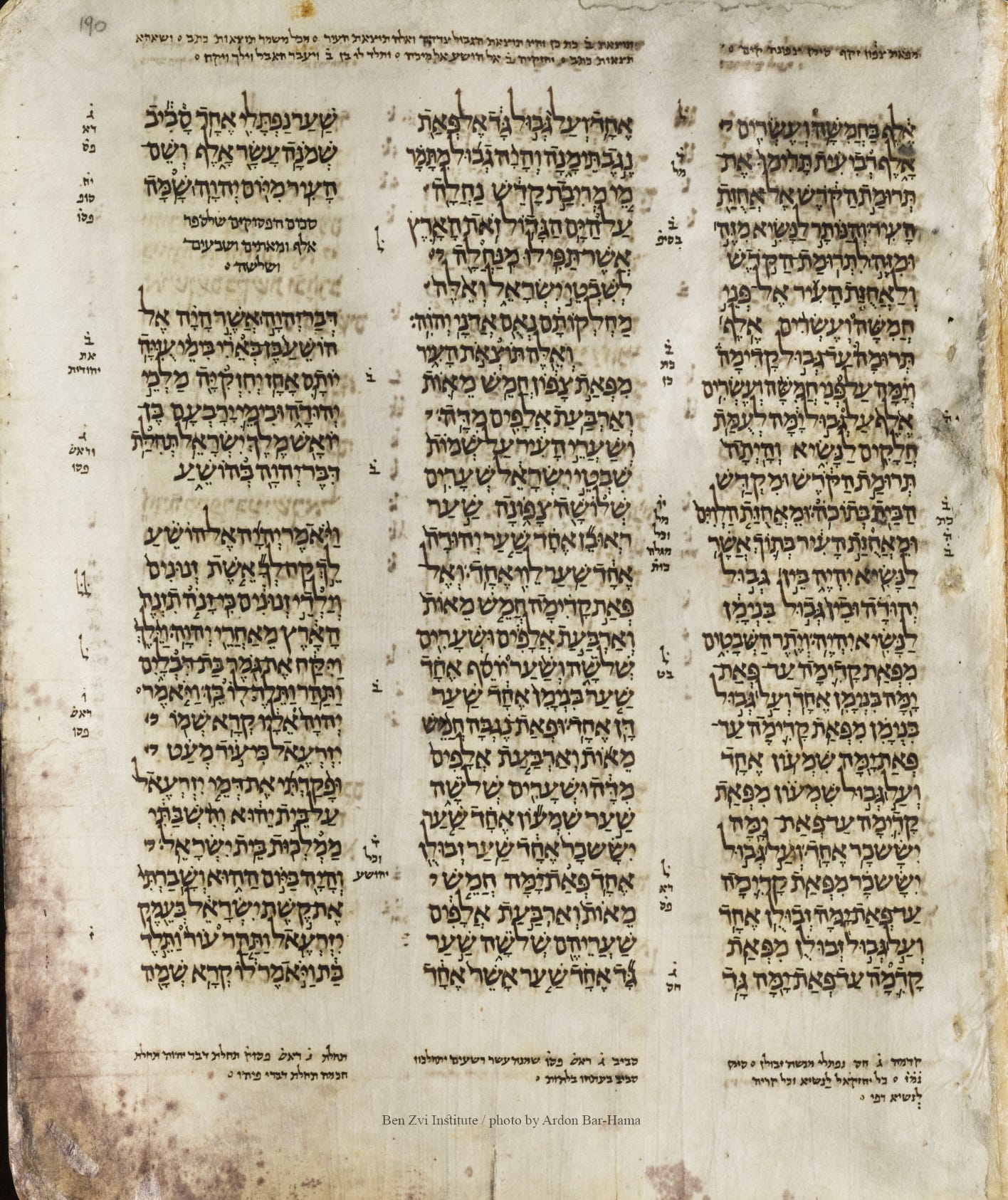
Now for some pictures. This first image shows the end of Ezekiel and the beginning of Hosea in the Aleppo Codex.
Most of this page is Ezekiel, but the text of Ezekiel comes to an end in the left column near the top. (Remember, Hebrew is written right to left.) After three lines of the biblical text, there is some smaller writing, also three lines, and then a blank line, and then the text of Hosea starts. The smaller Hebrew writing between the books is a Masoretic note indicating the total number of verses in the book just completed (in this case, Ezekiel). It signals the end of a biblical book. These sorts of notes appear after ever biblical book in a Masoretic manuscript, displaying the number of verses.
It’s the same thing in the Leningrad Codex.
The Masoretic notes at the end of the book of Ezekiel are in the right column (i.e., the first column, reading right to left).
What about between Hosea and Joel? Are there the Masoretic notes for the end of a biblical book? No, there are not. Well, there is a small version of the notes, not the full version—in keeping with the idea that a book of the Minor Prophets is not a full-fledged biblical book but it is more than a mere section of a book.
Hosea comes to an end in the left column, and Joel begins in the same column. Between the two prophets, there are a few Hebrew letters. Here is a close-up of those letters.
The dots above the letters indicate that the letters function as numbers here, and the number represented is 197—the number of verses in Hosea. It’s the same in the Leningrad Codex, except the number is spelled out, like “one hundred ninety seven.” Here’s an image.
But the end of Malachi is treated as more than the end of just Malachi, but also the end of the book of the Twelve.
As it happens, in the Aleppo Codex, the scribe started copying on a page when he had left of Malachi only a few words, so hardly any biblical text needed to be written on the page. In the image above, the larger letters show the end of the text of Malachi, five lines of text, mostly lines with just one word. On the fifth line, there is also a number (with the dots), 55, which is the number of verses in Malachi. After a few blank lines, there is then this note: “The number of verses of the book: one thousand fifty.” The “book” (sepher) in this instance is, of course, the book of the Twelve.
The Leningrad Codex presents things a little differently.
The text of Malachi ends at the second line in the center column. Then comes the Masoretic note indicating the number of verses for Malachi (not in Hebrew numerals but spelled out). Then we do not find the number of verses for the Twelve but rather a whole bunch of notes indicating the number of verses for each book of the Prophets, starting with Joshua, and the sections of those books. You have to flip the page to complete the list, where you find the last book of the Prophets, called Trei Asar (Armaic for 12; see the names listed at the beginning of this wikipedia article), and then the number of verses and sections.
Now, there’s one more manuscript I want to mention, another early Masoretic manuscript, and this one I will present in somewhat more detail.
Cairo Codex of the Prophets
This manuscript, from about the year 1000 AD, contains only the Prophets section of the Hebrew Bible, i.e., the books of Joshua, Judges, Samuel, Kings, Isaiah, Jeremiah, Ezekiel, and the Twelve. The Cairo Codex is perhaps a little earlier than the Leningrad Codex but not as early as the Aleppo Codex.
Location of the manuscript
The whereabouts of this codex are currently unknown. It was owned for a long time, about a millennium, by the Karaite (non-rabbinic) community in Cairo, Egypt. But the situation for Jews in Egypt became fraught following the establishment of the State of Israel in 1948. The Karaites persevered in Cairo for a few more decades. Scholars and officials were permitted to examine and photograph the codex in the early 1980s in Cairo. But, according to this 2024 article by Nadine Epstein:
Sometime in the mid-1980s, the guardians of the Cairo Codex and the other remaining Karaites left Egypt for Israel. Did they leave their beloved manuscript behind, or take it with them … ? For 30 years, its whereabouts have been uncertain. “It is one of the great mysteries,” says Kurtzer.
And that’s that. No one—officially—knows where it is, though in the last section of her article, Epstein quotes some Israelis who say things that make it sound like they know more than they’re letting on.
But, good news! There is a digital edition available, which makes available black-and-white photos, originally taken (perhaps) in 1926. (I can’t find on the website when the photographs were originally taken, but my 1926 date comes from this article, p. 226, if I’m interpreting it correctly.) The image quality is excellent.
The date of the manuscript
Now, for the date of the manuscript. It is strange that the website for the digital edition takes at face value the colophon in the manuscript which supplies the date 894 or 895; for decades, as even Wikipedia knows, this date has been questioned or even outright rejected.
It was long believed that the earliest dated manuscript with a colophon was the famous Prophets Codex preserved in the Karaite synagogue Moussa Dari’i in Old Cairo, with a colophon stating that the manuscript was written by Moshe ben Asher in 894/5, possibly in Tiberias, but it is now widely accepted that this colophon was copied from an earlier colophon; according to [Malachi] Beit-Arié, the manuscript was copied before 1129–30 (Codices Hebraicis 1:28). (David Stern, p. 226 n. 15)
The book cited by Stern, available here for $425 and reviewed here, is unavailable to me, but a different book by Beit-Arié that contains similar information is available open access (here; see pp. 70–71). according to Beit-Arié, this Prophets Codex should be dated to ca. 1000.
The article by Epstein, linked above, contains further details, with interviews of some major scholars.
“I don’t think somebody changed the Codex; it wasn’t tampered with, it was the original writing of someone who wanted to attach a lot of yichus,” says Beit-Arie, using the Yiddish word for pedigree. “It was a forgery but a genuine forgery.” Stefan Reif, professor emeritus of medieval Hebrew at University of Cambridge, explains it this way: It is as if, in order to preserve the manuscript, someone copied it in its entirety in the 11th century—updating the spelling and punctuation—and included the original colophon as well. “A parallel would be finding a letter written 100 years ago and recopying it in 2016: You copy everything but you correct it and modernize it,” Reif says. “But at the end of the letter is written: ‘This was written in 1916,’ and you copy these words out, too. So it is not really a document accurately dated to 1916, but rather to 2016.”
The Minor Prophets in the Cairo Codex
Let’s take a look at the presentation of the Minor Prophets in this manuscript. But first, for a point of comparison, here is the end of Jeremiah and the beginning of Ezekiel.
An entire column separates the two books, with an interesting symbol at the bottom of that column (the embellished circle). At the top of the column there is a quotation, three words, from Isaiah 55:6, translating to “Seek YHWH while he may be found.” Between this exhortation and the circle, there is the Masoretic note indicating the number of verses in Jeremiah. Ezekiel starts at the top of the left column.
We might say there are four elements that signal the end of a biblical book in this Cairo Codex: the Masoretic note about the number of verses in the book that just ended; the exhortation to seek YHWH; a little ornamentation; and a lot of blank space.
Now here is the end of Ezekiel and the beginning of Hosea.
Here again we have a center column separating the two books, except that the text of Ezekiel carries over into the center column, contained to the right edge of the column, reaching to its bottom. Most of the column contains the book-closing indicators that we previously observed, or similar ones. In the middle of the center column is the boxed phrase, “Seek YHWH while he may be found.” Below that is a diamond shaped symbol, and at the bottom, encircled, is the Masoretic note about the number of verses in Ezekiel. Hosea starts at the top of the left column.
Next, we have the transition between Hosea and Joel.
There is much less fanfare here, though it is clear where one prophet ends and the other begins, near the bottom of the center column. Between them, in a box, is the quotation from Isaiah 55:6, “Seek YHWH while he may be found.” Immediately above that box is the Masoretic note regarding the number of verses in Hosea. Here is a close-up.
Out of the four elements signaling the end of a biblical book that I mentioned earlier, we find two of them here: not the white space and not the ornamentation, but we do have the number of verses and the exhortation to seek YHWH.
There is a slight variation when Joel comes to an end, as we see next.
Here again we have a box with a biblical quotation, and above the box, to the right, is the reference to the number of verses in the book of Joel. The two letters (עג) with dots above them, indicating that there are 73 verses in Joel.
In the box, there is a different quotation, not from Isaiah 55:6 but now from Zephaniah 2:3. That verse contains the imperative, “Seek YHWH, all the humble of the land who do his judgments.” But the words in the box cut off at “all,” so the address, apparently, is to everyone: “Seek YHWH, all,” or maybe “Everyone, seek YHWH.” By the way, it’s a different word for “seek” here as opposed to Isaiah 55:6: בקש (baqash) here and דרש (darash) there. This is not the first time that the words of Zephaniah are used to bring an end to a book in the Cairo Codex; it’s the much more common verse used to end a book in this manuscript, as we are about to see.
It’s the quotation from Zephaniah that appears most frequently after the individual prophets of the Minor Prophets: after Amos, Obadiah, Jonah, Nahum, Zephaniah, Haggai, and Zechariah. The quotation from Isaiah 55:6 appears after Hosea, Micah, and Malachi. That reckoning omits Habakkuk, where there is—oddly—no box, no quotation, just the couple Hebrew letters (with the dots over them indicating that they function as numbers) signaling the number of verses in Habakkuk.
By the way, the quotation from Zephaniah also appears at the end of Joshua, Judges, Samuel, Kings, and Isaiah.
Here is what the end of Malachi looks like.
The biblical text comes to an end in the center column, and then in the left column, in the big box, is the Masoretic note indicating the number of verses in the book of the Twelve, and then in the smaller box the quotation from Isaiah 55:6. I don’t see an indication of the number of verses in Malachi by itself.
Conclusion
The Masoretic manuscripts treat the Twelve as a biblical book, and the individual prophets in the Twelve as not a full-fledged biblical book even if more than a mere chapter. It’s the Cairo Codex of the Prophets that comes closest to treating the individual Minor Prophets as full-fledged biblical books, not only indicating the number of verses for each prophet—which also happens in the Aleppo Codex and the Leningrad Codex—but also ending each prophet with the command to seek YHWH, either according to Isaiah 55:6 or Zephaniah 2:3, the same practice by which it ends each of the biblical books in the Prophets section.