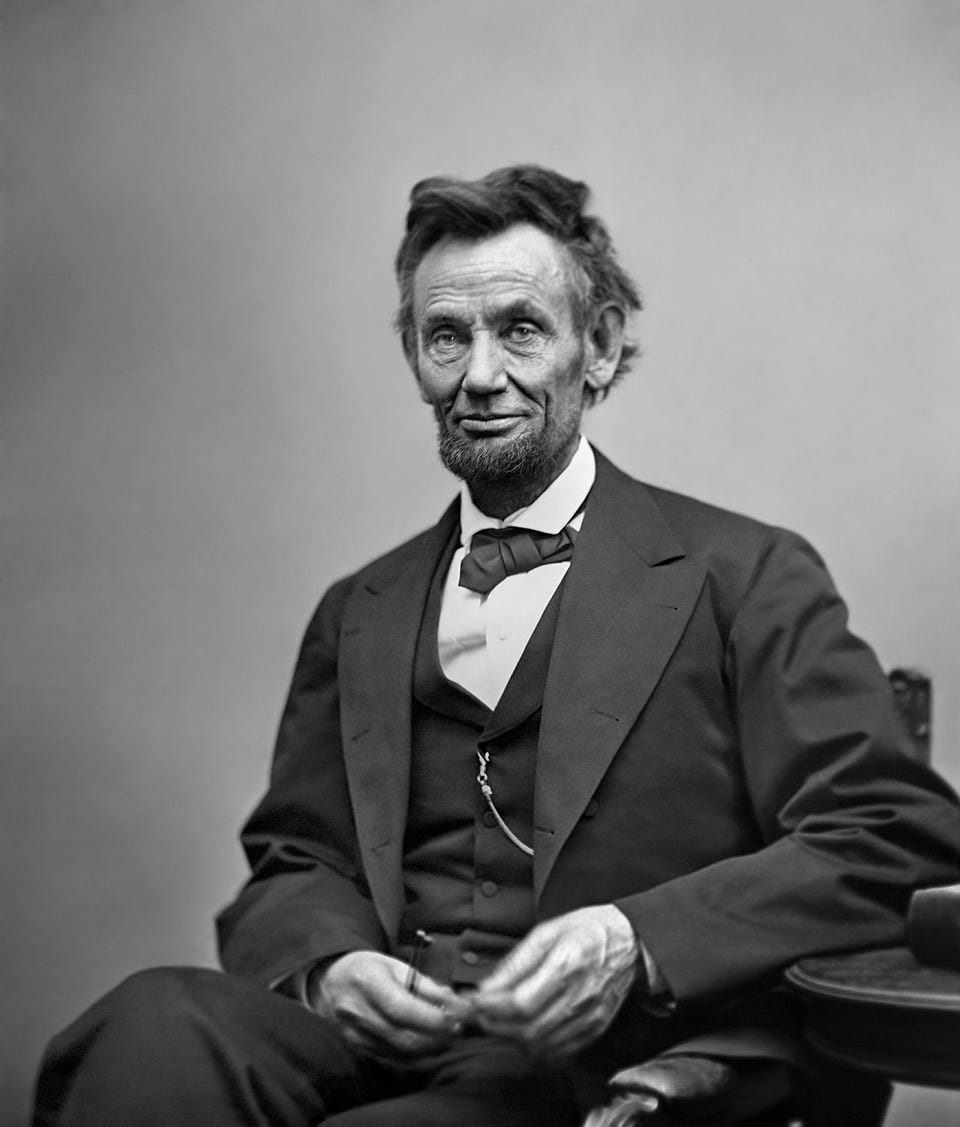
In what is perhaps the most famous speech in American history, maybe the greatest speech in American history, the sixteenth president of these United States envisioned “a new birth of freedom.” Let’s consider what he meant, and how it has turned out.
George Whitefield (1714–1770)—who died younger than did Abraham Lincoln, by the way—liked to tell people that they needed new birth. Whitefield was an Anglican clergyman, a Calvinist, a preacher of revivals during the Great Awakening.
One story I’ve heard about him is that when asked why he so frequently preached that people had to be born again, he replied, “Because ye must be born again!” There’s a documentary about him that you can find on YouTube under the title Born Again
Whitefield was right: people do need to be born again—if we take Jesus as any kind of authority.
Verily, verily, I say unto thee, Except a man be born again, he cannot see the kingdom of God. (John 3:3)
This is what Jesus told Nicodemus. Of course, this Jewish leader, this Pharisee, had trouble understanding what Jesus meant, and often readers—rather unsympathetically—are confused at Nicodemus’ confusion; we are astonished at his astonishment. Nicodemus himself knew that Jesus could not be talking about physical birth, and he himself rules out such an interpretation in the very next verse (John 3:4), but he can’t grasp what Jesus what getting at. Jesus used the bulk of the rest of the chapter to explain.
For us, often the new birth seems so easy. Especially in light of Jesus’ explanation a couple verses later, that the new birth involves “water and spirit,” many readers think of baptism. And baptism is a piece of cake. Just get dunked under water—or, in many Christian traditions, you don’t even need to do that; just a little water on the forehead will do—and it’s all over. Voilà, new birth! Nothing could be easier.
We should pause and reflect.
What about normal birth, or physical birth, or what we might call the first birth? Is physical birth easy? I can report that for a father, it’s pretty easy. But I hear that for the other parties involved, it’s somewhat taxing. For both the baby and the mother, there’s a lot of yelling involved. And even for a father, after the birth, life gets somewhat difficult, no matter how much practice you have. As Jim Gaffigan said, if you want to know what it’s like to have a fourth kid, just imagine you’re drowning, and then someone hands you a baby.
But back to the new birth. Is it as hard as a first birth? Well, there’s usually a lot less screaming involved. Sometimes we tell people how easy the new birth is. Just give your life over to God, apply some water, baddabing, baddaboom, and you’re done. Simple!
Is it that simple?
That’s not the impression made by every (any?) passage in the New Testament when describing the process of becoming a Christian. Ephesians 4 talks about taking off “the old man, which is corrupt according to the deceitful lusts,” and putting on “the new man, which after God is created in righteousness and true holiness” (4:22–24). I think what Paul is talking about here is becoming a Christian, which he likens to changing clothes, stripping yourself of a former manner of life and clothing your self with some new behaviors. I guess you could look at that as another description of an easy process, just like we don’t give much thought to taking off our pajamas and putting on some daytime clothes. But Paul seems to have more in mind; he seems to think this is more difficult than just changing clothes, or that this process of changing clothes is going to necessitate our sustained attention, it’s going to require time and effort. After all, he is writing this letter to people who have already committed themselves to Jesus, people who are baptized, people who are Christians. But he’s telling these Christians to continue putting off the old man and putting on the new man. And he explains further what this looks like in practice.
Wherefore putting away lying, speak every man truth with his neighbour: for we are members one of another. Be ye angry, and sin not: let not the sun go down upon your wrath: Neither give place to the devil. Let him that stole steal no more: but rather let him labour, working with his hands the thing which is good, that he may have to give to him that needeth. Let no corrupt communication proceed out of your mouth, but that which is good to the use of edifying, that it may minister grace unto the hearers. And grieve not the holy Spirit of God, whereby ye are sealed unto the day of redemption. (Ephesians 4:25–30)
And that’s not all; Paul keeps going, describing the behaviors that the Ephesian Christians need to adopt, the new man that they need to continually put on.
Consider another biblical passage about becoming a Christian, as described, again, by the apostle Paul.
Know ye not, that so many of us as were baptized into Jesus Christ were baptized into his death? Therefore we are buried with him by baptism into death: that like as Christ was raised up from the dead by the glory of the Father, even so we also should walk in newness of life. For if we have been planted together in the likeness of his death, we shall be also in the likeness of his resurrection: Knowing this, that our old man is crucified with him, that the body of sin might be destroyed, that henceforth we should not serve sin. (Romans 6:3–6)
Easy enough, right? Just get baptized and you’re dead to sin. Here the old man is not just taken off but crucified. Baddabing, baddaboom, new birth!
Hmm, not quite.
To these Roman Christians whom he has never met, Paul writes about the new birth as a continual process of dying to sin and becoming enslaved to righteousness. It doesn’t sound very easy.
Now, don’t misunderstand me. I don’t mean to say that it takes a lot of work on our part to get God to save us. Nope, we don’t get God to save us. He’s eager to do so. Remember the prodigal son’s father. But the new birth is not merely about salvation. That is the easy part. The harder part is becoming conformed to Christ, putting on the new man. It turns out that the new man is Christ (Gal 3:27), and the process of putting him on is a lifetime project. The new birth is not so easy after all.
Now let’s return to that famous American speech. I’m not sure if the Gettysburg Address really is the most famous American speech; that honor might go to the “I Have a Dream” speech by Martin Luther King Jr. (pdf, wikipedia), but that speech by MLK, delivered in 1963 on the steps of the Lincoln memorial, began with a reference to the Gettysburg Address, given in 1863. The first few words of King’s speech are “Five score years ago…,” and then he mentions the Emancipation Proclamation.
It’s Lincoln’s speech (wikipedia) that I want to consider for a moment.
It is a short speech, much shorter than the I Have a Dream speech. The entire thing is carved into the left wall of the Lincoln Memorial. Here’s an image.
At the dedication of a cemetery at the location of an extraordinarily bloody battle, part of an extraordinarily bloody war, Lincoln guessed, hoped, “that these dead shall not have died in vain,” but rather “that this nation under God shall have a new birth of freedom.” Given that context, it seems that this new birth of freedom was about as difficult as the new birth that Jesus mentioned to Nicodemus.
Lincoln was not the only person who thought they saw in the American Civil War the hand of God. Check out these familiar words, written by Julia Ward Howe in 1861 (wikipedia).
Mine eyes have seen the glory of the coming of the LordHe is trampling out the vintage where the grapes of wrath are storedHe has loosed the fateful lightening of His terrible swift swordHis truth is marching on. Glory, glory, hallelujah!
Julia Ward Howe, a fervent abolitionist, witnessed the bloodletting of the Civil War and thought she was seeing the work of God. “Glory, glory, hallelujah!” Perhaps she was right.
Lincoln thought so, anyway. The Gettysburg Address is a wonderful speech, deservedly famous and revered and often memorized—I hope, still. But it is not my favorite speech by Lincoln. That would be the other one carved in granite in the Lincoln Memorial, the one on the right as you climb the steps, Lincoln’s Second Inaugural (text, wikipedia), delivered March 4, 1865, forty-two days before his assassination.
In this theologically profound speech, I want ponder one passage.
Fondly do we hope—fervently do we pray—that this mighty scourge of war may speedily pass away. Yet, if God wills that it continue, until all the wealth piled by the bond-man’s two hundred and fifty years of unrequited toil shall be sunk, and until every drop of blood drawn with the lash, shall be paid by another drawn with the sword, as was said three thousand years ago, so still it must be said “the judgments of the Lord, are true and righteous altogether” (Psalm 19:9).
Here Lincoln imagines that the American Civil War will last until atonement is made for the sins of the past. Was he right?
Sometimes later generations pay for the sins of the past.
Think about the fiscal situation of the United States. The current US debt is close to $40 trillion, and the annual budget deficit is in the neighborhood of a trillion dollars. I don’t know what’s going to happen to all that money, but some people think that a later generation is eventually going to have to pay for it. Saddling our children and grandchildren with enormous debt has been a great American tradition for more than a generation, and we’re not about to stop now. We imitate Hezekiah, who responded to Isaiah’s prophecy of doom in a future generation: “Is it not good, if peace and truth be in my days?” (2 Kings 20:19). (Not that we’re enjoying much peace and truth in 2026, but you can’t have everything!)
Or think about climate change. Some people think climate change is real and is caused by humans, other people deny certain elements of that statement. The people that think humans have caused climate change essentially say that later generations are going to pay for the misdeeds of the past and present.
Now, take a look at the Third Commandment.
Thou shalt not make unto thee any graven image, or any likeness of any thing that is in heaven above, or that is in the earth beneath, or that is in the water under the earth: Thou shalt not bow down thyself to them, nor serve them: for I YHWH thy God am a jealous God, visiting the iniquity of the fathers upon the children unto the third and fourth generation of them that hate me; And shewing mercy unto thousands of them that love me, and keep my commandments. (Exodus 20:4–6)
“Visiting the iniquities of the fathers upon the children.” I don’t know exactly what God means by this. I’d like to interpret it in harmony with that statement from Ezekiel, “The soul that sinneth, it shall die” (Ezek 18:20). Perhaps God meant more than what I’m about to suggest, but I think at least he meant that the misdeeds of the fathers create problems for the children. If you have any experience with foster care, you’ve got examples out the wahzoo of one way that this concept plays out. The national debt might be another, and climate change another.
Abraham Lincoln thought the American Civil War might cause so much death and destruction that it would atone for America’s history of slavery. He was wrong. That atonement continues, as recent years have so clearly demonstrated. The sins of the fathers are visited upon their children, and it’s been longer than the third or fourth generation specified in Scripture. Of course, in part the sin continues. I wonder if it will ever end.
The new birth of freedom wasn’t so easy as Lincoln had hoped.
That is the way of new birth. I’m not disagreeing with Lincoln’s Gettysburg Address. I’m affirming it, and explaining it. New Birth is never an easy process, one and done. Whether or not birth is painful, new birth is always painful, and new birth never stops, until we are finally delivered unto God.
Thanks for reading Gallagher! Subscribe for free to receive new posts and support my work.