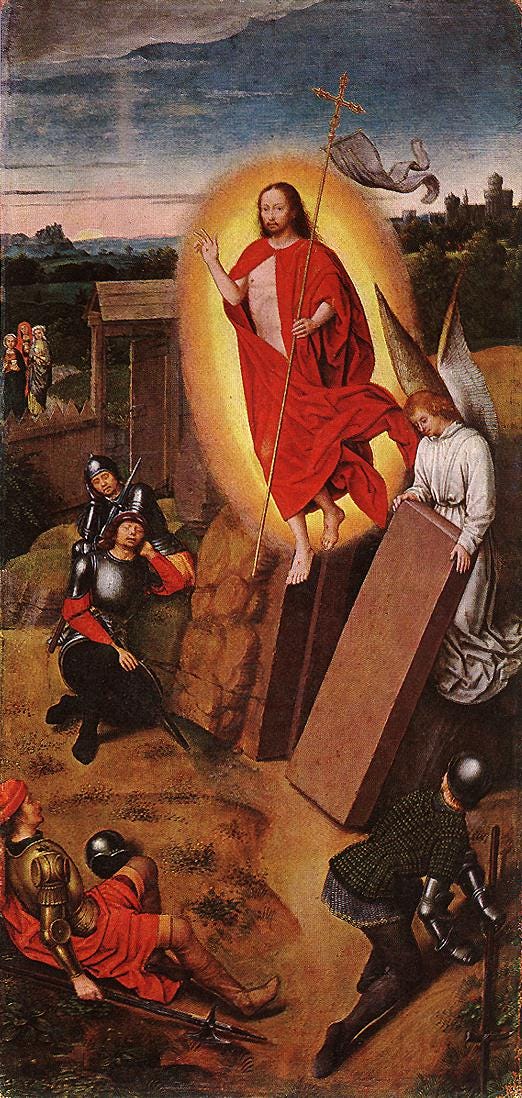
At the Resurrection, when our bodies come out of the ground and are reconstituted and transformed into whatever a spiritual body is so that they are fit to inhabit whatever that new reality is that we sometimes call heaven or the new heavens and new earth—when that happens, will we still maintain the sex distinctions common to our bodies now? In other words, in the Resurrection, will I be male?
This is a question that people have asked. And answered. We will review some of the answers in just a moment. But let’s think together about what sort of evidence we could have for such a question. Well, there’s Jesus. He died, and rose from the dead, a model for our own resurrections, and after he did so, he was still male. That’s one data point.
Thanks for reading Gallagher! This post is public so feel free to share it.
Maybe also the Bible says something specific about our resurrection bodies and the potential for sex distinctions?
Does the Bible say something? Hmm, maybe Jesus did in his conversation with the Sadducees. Now, you remember that the Sadducees were sad, you see, because they denied the resurrection. As part of his response to their question about the one bride for seven brothers, Jesus says that those accounted worthy of the resurrection “neither marry nor are given in marriage, for neither are they able to die anymore, for they are angel-like and are sons of God, being sons of the resurrection” (Luke 20:35–36). Well, if they can’t marry, does that mean that the sons of the Resurrection are not distinguished by sex—no male and female? After all, Paul said that in Christ there is no male and female (Gal 3:28), which does not exactly describe life as we experience it now, but maybe that vision will be fulfilled in the Resurrection. But, in reference to what Jesus says to the Sadducees, let me point out that even now, in this life, some people don’t get married and yet they are—usually—specifically one sex or the other.
So, I am not clear on whether the Bible addresses the question. Does the great tradition of Christianity have an answer? No, I don’t think so. There does not seem to be a unified answer when you look back at the great thinkers in the history of the church. Well, I will say, I have not put in much work on this question. I don’t know whether Thomas Aquinas provided an answer; that would be interesting. But I have relied on a few scholarly discussions written in the last few decades, and these discussions have served as my guide to the history of interpretation.
One sorta recent answer from an authoritative source comes from Pope John Paul II. Now, when I say the pope is authoritative, I mean that he’s authoritative for a lot of Christians, and that he’s almost always (these days, at least) brilliant, and that, by virtue of his office, he’s sorta obligated to say things that are in harmony with traditional Christian teaching, as he understands it. So I think of popes, at least modern popes, as authoritative voices in regard to what the Christian tradition is. And in his book Theology of the Body, JPII affirmed that
human bodies, which are recovered and also renewed in the resurrection, will preserve their specific masculine or feminine character and the meaning of being male or female in the body will be constituted and understood differently in the ‘other world’ than it had been ‘from the beginning’ and then in its whole earthly dimension. (§66.4, p. 388)
The pope is reflecting on Christ’s reply to the Sadducees, and in particular his assertion that in the resurrection people will “take neither wife nor husband.” According to this papal statement, humans will continue to be distinguished by sex in the Resurrection, though those sex distinctions will function differently in that realm of existence.
Does the pope’s statement accurately represent the tradition? Yes, sorta; depends on whom you ask. If you ask scholar Taylor Petrey (pp. 666–69), he would say yes, citing Tertullian (Resurrection 60) and Ps-Justin (Resurrection 2–3), but he would also tell us that this is a question that did not receive much attention in the history of the church. If you asked Nonna Harrison, she would say, no, the pope does not accurately represent the Christian tradition, or at least the early Christian tradition, and she can cite more patristic authors, and more famous ones: Clement of Alexandria, Basil of Caesarea, Gregory of Nazianzus, John Chrysostom, Maximus the Confessor, not to mention Gregory of Nyssa (discussed by Marc Cortez, ch. 1). I myself haven’t checked all of these sources, but according to Harrison and other scholars, these early Christian writers said that in the Resurrection, our bodies will be glorified and will reflect the true essence of humanity—not the trueness of a man or a woman, but of a human. (See also Soskice, pp. 44–45, reporting that Augustine “rejected … the more orthodox view, that the resurrected body will be ‘sexless’.”) There is an argument hidden in here also about what it means to be created in the image of God and its relation to sex distinctions, but we will not explore that line of thinking here. I simply note that the Christian tradition is divided regarding whether the resurrection body will maintain sex distinctions.
The best argument, it seems to me, for the idea that sex distinctions are maintained in our resurrected state is the experience of Jesus. As Marc Cortez (pp. 198–202) has recently written, echoing Nonna Harrison: “we also need to account for the fact that Jesus retains his identity as Jesus in the resurrection, an identity that is unavoidably linked to the fact that he is male. Although the resurrection narratives present Jesus’s body as transformed in some way, nothing about those narratives suggests a transformation of identity such that he is no longer the same male individual the disciples knew him to be” (p. 199). There are other arguments that could be put forward, and have been, but tied up in the whole question is a lot of speculation. And that’s where we will leave the matter of sex distinctions.
The Flesh Resurrected
The Christian tradition is divided on whether the resurrection body will reflect our maleness or femaleness. The Christian tradition is not divided on whether there is a resurrection body, and whether it is the same as our current body. On that point, there is unanimous affirmation.
Yes, our current bodies will be raised and transformed.
The only way it makes sense to wonder about whether sex distinctions continue in the hereafter is if we have our current bodies in the hereafter. And that is certainly the dominant Christian tradition: our souls will be reunited with our bodies.
Listen to the Westminster Confession of Faith.
At the last day, such as are found alive shall not die, but be changed: and all the dead shall be raised up, with the selfsame bodies, and none other (although with different qualities), which shall be united again to their souls for ever. (32.2)
Again, this is the Westminster Confession of Faith, written in 1646, which was—I’m sure you remember—the confession of faith that at one time expressed the theology of Barton Stone and Thomas Campbell and his son Alexander. Of course, they left behind this confession of faith in the first decade of the nineteenth century, and they repudiated it and other Protestant creeds, but I am unaware that they ever expressed any disagreement with this particular point, that—to quote it again—“the dead shall be raised up, with the selfsame bodies, and none other.”
Is it just Presbyterians who think this? No, it’s not. Here is the Catechism of the Catholic Church.
In death, the separation of the soul from the body, the human body decays and the soul goes to meet God, while awaiting its reunion with its glorified body. God, in his almighty power, will definitively grant incorruptible life to our bodies by reuniting them with our s…