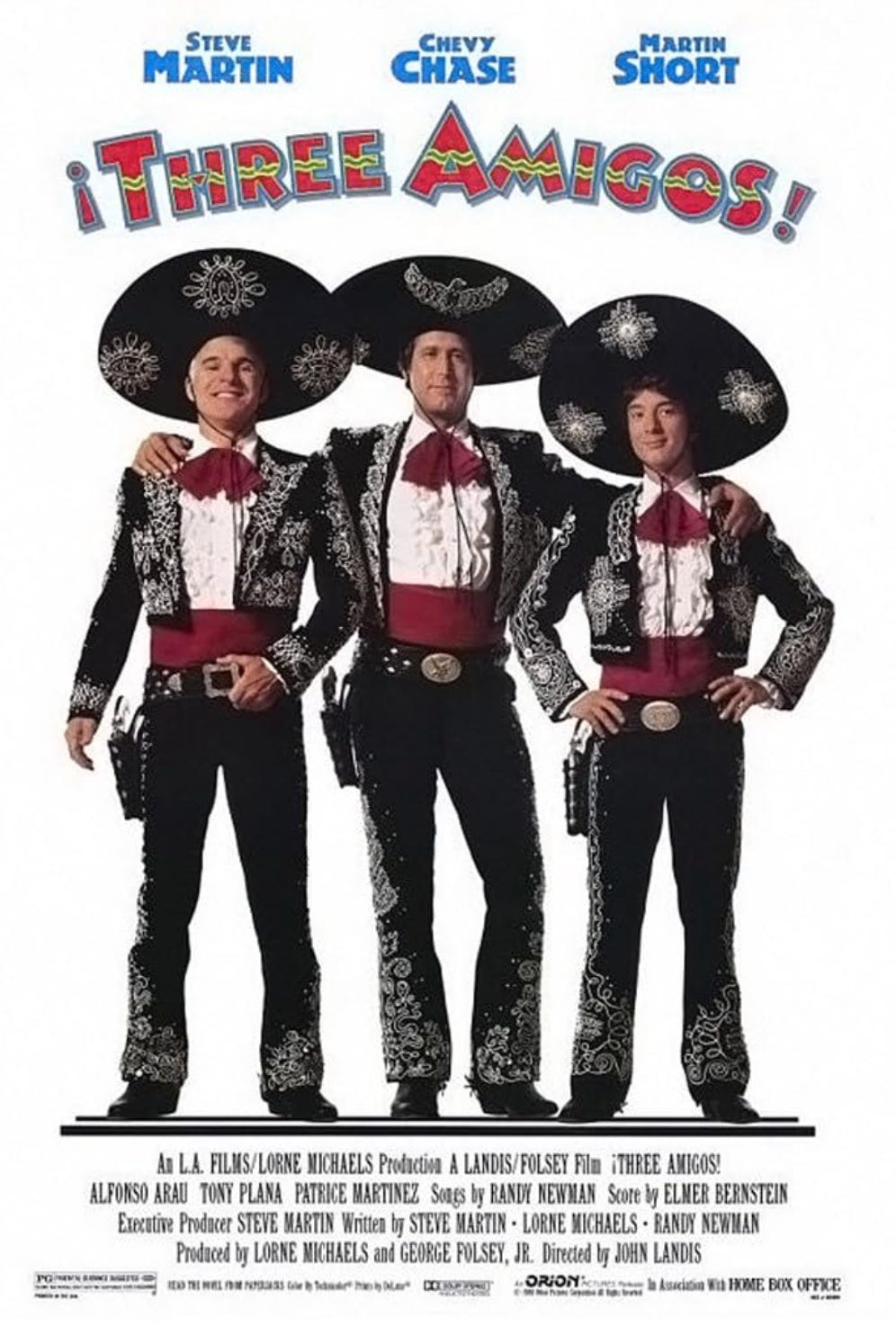
What is your favorite scene from the classic 1986-film The Three Amigos? It’s an impossible question, because there is a plethora of great scenes. There’s the scene where the Amigos in their underwear receive a telegram about the infamous El Guapo—excuse me, the in-famous El Guapo—there’s the scene just a moment later when Lucky Day is on top of what turns out to be a not-very-high wall and he’s trying to get the attention of his fellow amigos, with imitation bird calls that get increasingly loud and verbal until he finally resorts to shouting.
There’s the scene in that Mexican cantina, where someone had been with the ugly stick. There’s the initial confrontation with the Mexican gangsters, and later with El Guapo himself.
There’s the search for El Guapo’s lair, including the attempted conversation with a bush that just won’t stop singing, and the unfortunate demise of the Invisible Swordsman. I’ve listed here just a sampling.
I assume I’m reminding you of scenes you’ve watched many times, as I have. But just in case you’ve not seen it or can’t remember the plot, think A Bug’s Life. Three silent movie stars who play heroes on the big screen are confused for actual heroes by Carmen, the woman sent to find help for the village of Santo Poco. In turn, the Three Amigos imagine that they are being invited to Santo Poco not to drive out a villain but to perform alongside the biggest star in Mexico. They realize their mistake only when one of them falls off a horse in mid-performance and discovers blood on his arm. It turns out that the Mexican bandits are using real bullets! The Amigos start weeping because of the predicament they’re in, but lucky for them El Guapo only kills men, not crying women. They slink out of town, and El Guapo burns the village and kidnaps Carmen. Eventually the Amigos do return and they do save the day, with the help of the villagers.
I don’t know for sure that I saw the movie in the theater when it came out, but I bet I did—the family I grew up in was a family that went to the movies. I do recall that in eighth grade—this would have been 1993—for an assignment in English class I spliced together some clips of Chevy Chase movies, including the scene where the Amigos are looking for El Guapo’s out in the desert, desperate for water and Dusty Bottoms is the only one with a full canteen, but he’s too dim-witted to realize that his companions need the water that is spilling on the cracked earth and not the lip balm.
If forced to pick a single favorite scene, I’d probably go back to that Mexican cantina. No, I’m not thinking about My Little Buttercup—although, yes, of course, My Little Buttercup. But I’m thinking about something before that song and dance, when the Amigos first approach the bar, and there begins to be a case of mistaken identity. The bartender gives the three Amigos a knowing look and says, “You are the… wink, wink?” And they reply with laughter and false modesty, “yes,” unsurprised to encounter fans of theirs even in this sleepy Mexican town. Then the bartender says with his voice low: “I have a message for you. The German says to wait here.” The audience knows exactly what the bartender means, but none of the Amigos has a clue, though they don’t want to let on. I love how Lucky Day, with squinted eyes, draws out the word “yeeaah.” That’s it; that’s my favorite part of the move, that confused and elongated “yeeaah.”
The Three Amigos turns forty this year. Is it worth remembering so fondly? The critics in 1986 would surely be surprised that anyone would remember it on its 40th anniversary. It holds a 45% rating on the tomatometer, and Roger Ebert—my go-to critic—awarded the film one star out of four. It is certainly dumb comedy, and it doesn’t deliver the insight into the human condition that is achieved by the likes of Groundhog Day, but what can I say? It makes me laugh, and I have seen it so many times by now that there is a nostalgia element. And I think there are even points worthy of reflection for Christians in the year 2026.
The movie itself gestures toward some life lessons in an inspiring speech by Lucky Day in the village of Santo Poco while standing on the wing of a Tubman 601.
First, he warns that El Guapo is on his way, an announcement that elicits gasps from the crowd. But Carmen wisely declares that “Someday the people of this village will have to face El Guapo. We might as well do it now.” What the villagers need is a motivational speech, and it’s a lucky day that witnesses Steve Martin provide it.
In a way, all of us have an El Guapo to face someday. For some, shyness might be their El Guapo. For others, a lack of education might be their El Guapo. For us, El Guapo is a big dangerous guy who wants to kill us. But as sure as my name is Lucky Day, the people of Santa Poco can conquer their own personal El Guapo, who also happens to be the actual El Guapo.
Man, this speech sounds like every youth devotional ever. But it also mocks the absurd comparisons we sometimes make among completely different situations: you have cancer and I have acne, which just shows that we all have trials to bear. But, then again, the idea that we all must face our personal El Guapos is, um, sorta true. If you imagine Three Amigos has nothing to teach about life, the movie encourages you to think a little more seriously.
So let’s get serious. I find poignance in the depiction of Santo Poco’s desperation. It is their desperation in the face of evil that initially led them to send Carmen to a bigger city for help, but unfortunately she’s never seen a movie before and doesn’t realize that the cinematic heroics of the Three Amigos are all scripted. When the Amigos flee before El Guapo, themselves desperate to stay alive, the villagers are all the more hopeless and wretched. It’s a familiar tale in this world of woe. How many psalms include the question, “how long, O Lord?” The answer is ten, in the KJV.
O YHWH God, to whom vengeance belongeth; O God, to whom vengeance belongeth, shew thyself.
Lift up thyself, thou judge of the earth: render a reward to the proud.
YHWH, how long shall the wicked, how long shall the wicked triumph?
How long shall they utter and speak hard things? and all the workers of iniquity boast themselves?
They break in pieces thy people, O YHWH, and afflict thine heritage.
They slay the widow and the stranger, and murder the fatherless.
Yet they say, YHWH shall not see, neither shall the God of Jacob regard it. (Psalm 94:1–7)
Or there’s this from Psalm 6:
My soul is also sore vexed:but thou, O YHWH, how long? (Psa 6:3)
And this from Psalm 13
How long wilt thou forget me, O YHWH? for ever?How long wilt thou hide thy face from me?
How long shall I take counsel in my soul, having sorrow in my heart daily?how long shall my enemy be exalted over me? (Psa 13:1–2)
The Bible is full of desperation, just like the village of Santo Poco, and often for roughly the same causes. Lucky Day is right: El Guapo is not unique. We all have our own El Guapo, and many times it is actually a big dangerous guy who wants to kill us. We also remember this prayer in a garden: “Abba, Father, all things are possible unto thee: take away this cup from me.” And we remember the answer to this prayer, that the one who prayed it was not liberated from the cup of suffering but he drank it all. Certainly a desperate situation, and yet this Man of Sorrows seemed somehow not desperate, but in control, even as he faced unarmed a detachment of soldiers led by a traitor. His self-command and ultimately his hope is the blueprint for his followers in their own desperate situations. Do you remember what Paul and Silas were doing in that Philippian jail in Acts 16:25? They experienced mistreatment, injustice, a desperate situation, and they neither fought back in conventional terms, nor did they despair, but rejoiced that they could suffer shame for the name.
That’s not to say that fighting back is necessarily wrong. While Jesus does forbid resisting him who is evil and he commands turning the other cheek—and not only that but he modeled that behavior—Christians have traditionally allowed that self-defense and especially defense of the poor and oppressed is warranted and even necessary according to Christian ethics. While there has always been disagreement on the question of whether Christians are ever justified in using violence, the predominant ethical view throughout church history would not condemn Santo Poco for seeking deliverance from El Guapo even through force. (CCC 2263–65.)
Like in Santo Poco, the problems presented in this life seem insurmountable, and I guess they are—unless God chooses to act. And as we all know, God often chooses not to act in the way we desire. As Lucky says, we all face an El Guapo, and often El Guapo prevails, at least temporarily. But the Christian hope guaranteed by the one who could not be held in death’s power allows us even in those desperate situations to sing praises.
But the lesson I appreciate most from the Three Amigos is that the Amigos recognize themselves as implicated in the fate of Santo Poco. As they tell El Guapo on their first meeting, “We’re not gunfighters, we’re movie stars.” Their pathetic abandonment of Santo Poco allows the Mexican outlaws to wreak havoc on the village, terrorize the villagers, and kidnap Carmen. But the Amigos return, at first, apparently, only to see how much damage the village endured at the hands of El Guapo’s men. But then Ned starts to load his gun—with real bullets!—and he issues a challenge to Dusty and Lucky: “I’m drawing a line. Men or Mice? What’ll it be?” After some hesitation, they all three decide to be, in Ned’s words, “the Three Amigos for real,” and retrieve Carmen from El Guapo’s fortress.
Why do the Amigos do this? Why do they try to help Santo Poco? Because they recognize themselves as implicated in the plight of this little village. They had been brought to Santo Poco by a silly mistake. They had no intention of misrepresenting themselves as vigilantes; they just wanted to come perform, and to get paid. But they could not ignore—or, at least, Ned could not ignore—that they had been brought to Santo Poco. False pretenses or not, they had met these people, they knew their plight, and they had witnessed the terror caused by El Guapo. They were now involved with the lives of the people of Santo Poco, and they were implicated in the fate of this tiny Mexican village. They did not want to be, but they were. It was their cowardice that led to the village’s destruction, and—whether they like it or not—it was ethically incumbent upon them to do what they could to help its residents.
The point is that we are implicated in the lives of other people, by virtue of the fact that we live near them, that we go to school with them, that we go to church together. We may not want to be bound up in their lives, but that choice is not afforded to us. Two hours southeast of where I live, Martin Luther King, Jr., sat in jail in 1963 and wrote a letter featuring these words near its opening.
Moreover, I am cognizant of the interrelatedness of all communities and states. I cannot sit idly by in Atlanta and not be concerned about what happens in Birmingham. Injustice anywhere is a threat to justice everywhere. We are caught in an inescapable network of mutuality, tied in a single garment of destiny. Whatever affects one directly, affects all indirectly. Never again can we afford to live with the narrow, provincial “outside agitator” idea. Anyone who lives inside the United States can never be considered an outsider anywhere within its bounds.
Those are lofty sentiments, difficult to fulfill. But sometimes their truth hits close to home. In the case of the Amigos, when a town in desperate need has called on you for help, and you have accepted their offer, under mistaken identity or not, you find yourself implicated in their lives, and it’s time to decide whether you’re a mouse or a man.
And when you find yourself implicated, the Amigos also teach us that you can do more than you think. The Amigos are not heroes, they just play them for the movies. If we were talking about spiritual gifts, the Amigos would tell you that their gift is entertainment, not bravery, not rescuing captives, but they step into the role because … well, ya know, somebody needed to. If we don’t perceive ourselves as gifted in a particular area, that doesn’t mean we shouldn’t put ourselves out there and do something. The Amigos are scarred they might get killed, but they go for it, so that the mottos they have been reciting for years could finally become sorta true.
Wherever there is injustice, you will find us.
Wherever there is suffering, we’ll be there.
Wherever liberty is threatened, you will find... The Three Amigos.
I think we could say that the Amigos discovered that they were, indeed, not talented at being gunfighters, but they accomplished more than they anticipated.
So too the town. It turns out that the villagers of Santo Poco are talented at almost nothing—certainly nothing that could be helpful in a gunfight. The only thing they can do is sew. But with a little creativity, even that random skill becomes a weapon leading to the downfall of evil and the establishment of justice.
Seeing the Amigos rally the town to stand up to El Guapo and defeat his gang will provide a model for you as you face your own personal El Guapo, be it shyness, lack of education, or something much more serious. And we Christians know that with Jesus on our side, El Guapo doesn’t stand a chance.
Thanks for reading Gallagher! Subscribe for free to receive new posts and support my work.