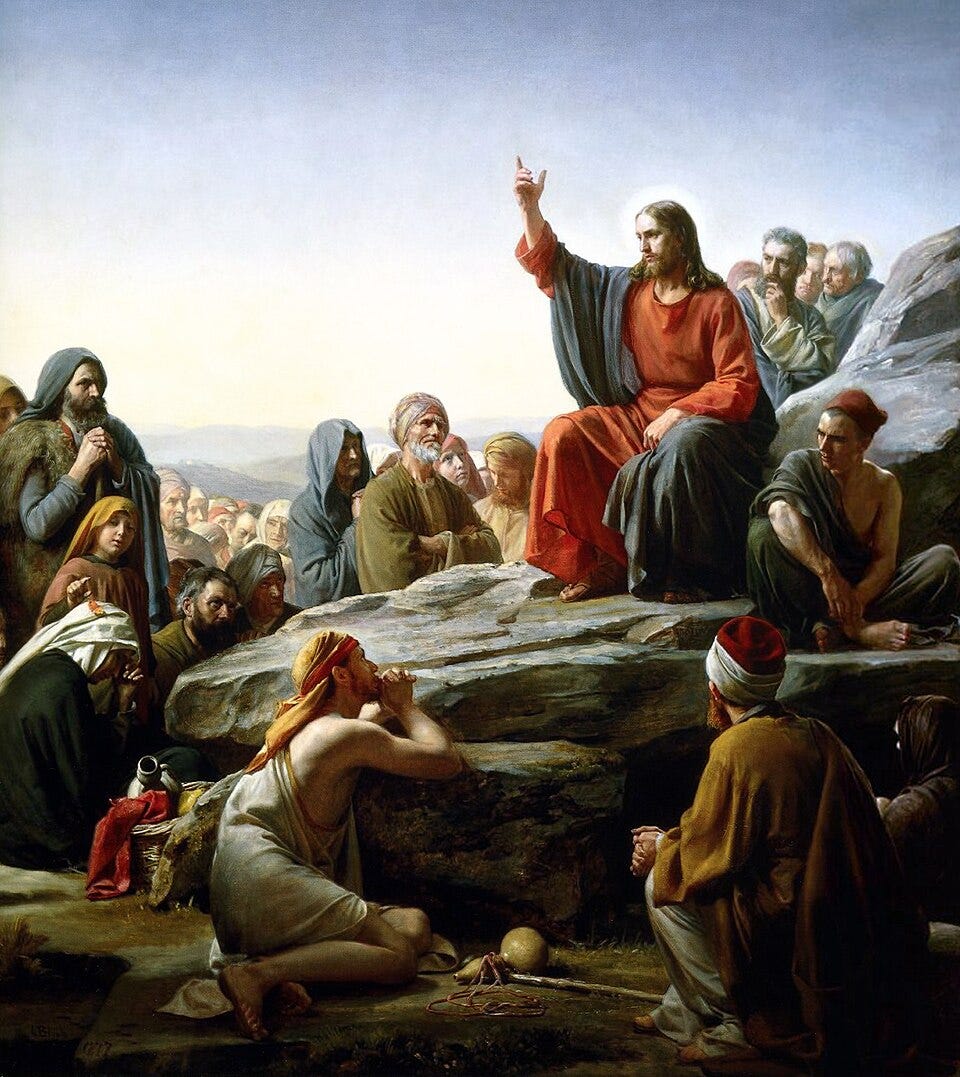
This essay is the text of a presentation I made on October 2, 2025, at The Light Network Conference, which convened at the Henderson Church of Christ in Henderson, Tennessee. Some of the comments here reflect that context. Other comments have been updated.
You ever go to a grocery store for just an item or two, maybe a place like Aldi, where they don’t have a self-checkout lane, and you just have to wait in the back behind a bunch of people with full carts—and then, oh glory of glories, what happens, but another cashier walks up from the back and opens a register, and we see with the eyes of flesh that the last shall be first? What had been the back of the line becomes now the front of the line, as you move over to another register. If 30 seconds earlier someone had walked into the Aldi with a robe and sandals, you probably would have hardly noticed, but if that person had proclaimed for all to hear, “blessed are you who wait in the back of the line,” you would probably roll your eyes. No, not blessed, cursed. This is no fun at all. I’m not fortunate to be at the back of the line. I’d rather be up closer. And yet, 30 seconds later as you move over to the new grocery line, you realize if you had been further up in the line, if you had not been in the back, you would not have been able to move over to the new line so easily, and someone in the back probably would have gotten ahead of you. Whether you knew it at the time or not, you were, indeed, fortunate to be at the back of the line.
Thanks for reading Gallagher! Subscribe for free to receive new posts and support my work.
This is a beatitude—or, to be more specific, I think what I have described in that Aldi check-out line is a reasonably close approximation of the kind of beatitude we have at the beginning of the Sermon on the Mount, and in the Sermon on the Plain in Luke. But these beatitudes that we have in the Gospels are not your typical beatitudes. There is something unexpected about them; the blessing is pronounced on the kind of person that is normally not considered fortunate. Like the person in the back of a check-out line. Often beatitudes outside the Gospels do not have this element of surprise.
So, in general, a beatitude is a wisdom saying, something like a proverb, that highlights someone’s good fortune. Let me give you an example: Blessed is the man that walketh not in the counsel of the ungodly. I’ll stop there, and I’m sure some of you could finish that verse, or even that psalm. It is the first verse of the Psalter. A person is described as occupying a fortunate position, namely, the person who avoids ungodly counsel. Note two things about this beatitude:
* it is not at all surprising; you would expect a person to be considered blessed if that person avoids ungodly counsel. All cultures throughout the world and throughout history would have considered that kind of person fortunate. This is like pronouncing a blessing on the person who gets in the check-out line immediately before the rush.
* the point of the beatitude is to encourage people to recognize this truth, to recognize the fortunate position this person is in. The psalm goes on to describe this person who avoids ungodly counsel as akin to a firmly planted tree, whereas the ungodly themselves are like the chaff blown by the wind. Which would you rather be like, the tree or the chaff? The answer is obvious, and that means you need to avoid ungodly counsel. The function is much like the proverbs.
The first verse of the Psalter is a beatitude, and then many more beatitudes appear throughout the book of Psalms. Let me give you more examples, ten of them, all from the book of Psalms. As I read over these verses, give consideration to the two points I’ve already made: the lack of surprise in these beatitudes, and their proverbial nature.
Blessed is he whose transgression is forgiven, whose sin is covered.
Blessed is the man unto whom YHWH imputeth not iniquity, and in whose spirit there is no guile. (Psalm 32:1–2)
Blessed is he that considereth the poor: YHWH will deliver him in time of trouble.
YHWH will preserve him, and keep him alive; and he shall be blessed upon the earth: and thou wilt not deliver him unto the will of his enemies. (Psalm 41:1–2)
Blessed is the man whom thou choosest, and causest to approach unto thee, that he may dwell in thy courts:
we shall be satisfied with the goodness of thy house, even of thy holy temple. (Psalm 65:4)
Blessed are they that dwell in thy house: they will be still praising thee. Selah.
Blessed is the man whose strength is in thee; in whose heart are the ways of them. (Psalm 84:4–5)
YHWH of hosts, blessed is the man that trusteth in thee. (Psalm 84:12)
Blessed is the people that know the joyful sound: they shall walk, O YHWH, in the light of thy countenance. (Psalm 89:15)
Blessed is the man that feareth YHWH, that delighteth greatly in his commandments. (Psalm 112:1)
Blessed are the undefiled in the way,who walk in the law of YHWH.
Blessed are they that keep his testimonies, and that seek him with the whole heart. (Psalm 119:1–2)
Happy (ashrei, makarios) is he that hath the God of Jacob for his help, whose hope is in YHWH his God:
Which made heaven, and earth,the sea, and all that therein is: which keepeth truth forever:
Which executeth judgment for the oppressed: which giveth food to the hungry. (Psalm 146:5–7)
I have now read nine examples of beatitudes from the Psalter, and here is the tenth, somewhat longer, but still not long. This is the entirety of Psalm 128, one of the Songs of Ascents.
Blessed (ashrei, makarios) is everyone that feareth YHWH; that walketh in his ways.
For thou shalt eat the labour of thine hands: happy (ashrei, makarios) shalt thou be, and it shall be well with thee.
Thy wife shall be as a fruitful vine by the sides of thine house: thy children like olive plants round about thy table.
Behold, that thus shall the man be blessed (barak, eulogeō) that feareth YHWH.
YHWH shall bless (barak, eulogeō) thee out of Zion: and thou shalt see the good of Jerusalemall the days of thy life.
Yea, thou shalt see thy children’s children,and peace upon Israel. (Psalm 128)
Hebrew Words
This last example of a beatitude from the Psalter highlights the issue of terminology and meaning. For in this psalm there are two different words translated “blessed” in the KJV. The psalm was originally written in Hebrew, and the two Hebrew words in play are ashrei (אשרי) and barak (ברך). They mean, I think, two different things. Barak has to do with blessing someone, like when Melchizedek blessed Abram (Gen 14:19), or Jacob blessed Pharaoh (Gen 47:10). Here you are changing the status of someone, putting a blessing on a person that had not been in a blessed position, or, at least, didn’t have the blessing that you then gave them. It doesn’t necessarily mean that the person wasn’t in a fortunate position, but your action of blessing has added good fortune to them. So, for example, maybe you go to church with a rich lady. That rich woman is in a fortunate position. But maybe you send her a very sweet greeting card that touches her and feels her with joy. You have blessed her, moving her into a new position of blessing.
That’s barak. In Psalm 128, “YHWH shall bless (barak) thee out of Zion.”
The second Hebrew word translated “blessed” is ashrei, and it does not indicate movement into a new position, but rather acknowledges a current situation as fortunate. “Blessed is the man that walketh not in the counsel of the ungodly.” That’s ashrei. That man is in a blessed position, a fortunate situation. It’s not that he is being blessed by someone else, not even by God. Well, yes, of course, he is being blessed by God, but that’s not what the verse is stressing. It is highlighting that he is in a fortunate position. The first verse of Psalm 128 says “Blessed is everyone that feareth YHWH.” That’s ashrei. Sometimes this word is translated happy, which again emphasizes the state of t…