Dear Fergus,
(A reminder that letters addressed to Fergus are actually to everybody)
Thanks for drawing my attention to that spurious article about the Dalai Lama and Paul McCartney serenading a terminally ill Phil Collins in his hospital bed while a 7 foot beekeeper looked on. I had my doubts as well.
The advent of AI has made the perception of reality difficult. This a rare outcome among inventions.
It was hard enough before AI to figure out what is and what isn’t.
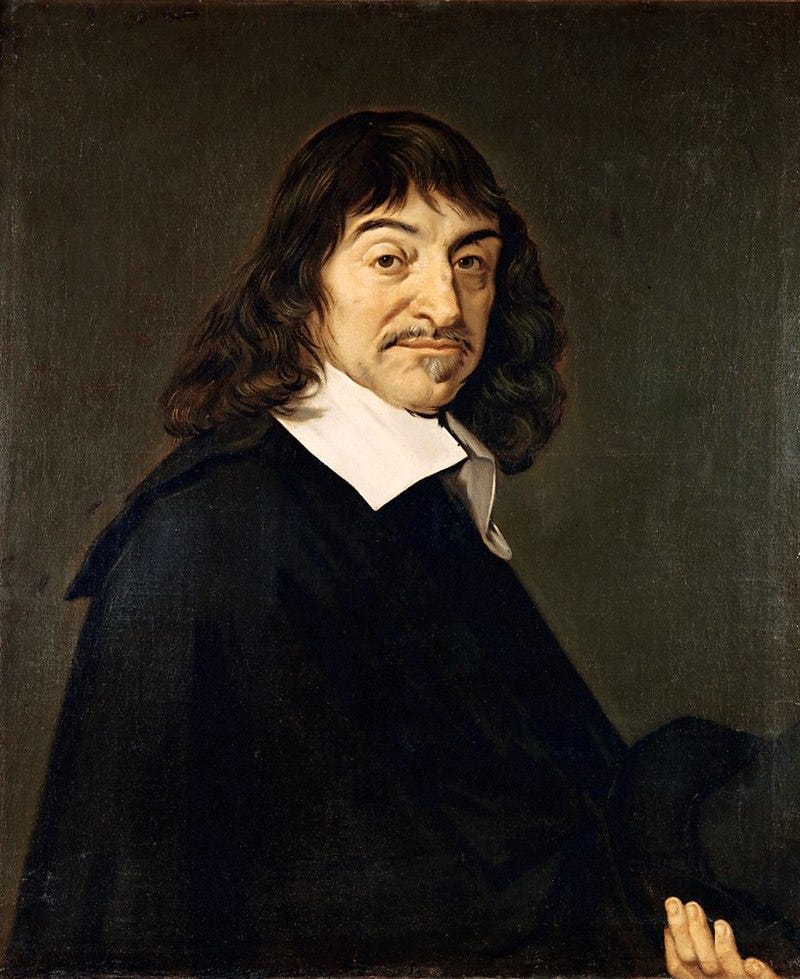
If you’ve had a chance to take an introductory philosophy class or you otherwise enjoy questioning existence you will have heard of René Descartes, popularly heralded as the father of modern philosophy. Descartes wrote in the first half of the 17th Century, but his reflections are timeless.
In his Meditations on First Philosophy Descartes questions reality itself. He does away with all that cannot be known for certain and rebuilds what can be known from the ground up. He ponders whether he is dreaming, or whether some evil entity has tricked him into perceiving a reality that isn’t there.
Descartes was eventually able to come to peace with most of his challenges to the status quo and determine “I think therefore I am.” (Some new philosophy students prefer to say the Latin, “Cogito ergo sum” because it sounds cooler.)
Descartes concluded that for him to even ponder his various doubts about his own existence there must be an “I” who is having the doubts. If I can ponder the existence of a deceiver who is tricking me into falsely believing I exist, there must a “me” who can be deceived. I, in reality, exist. And I exist in a reality.
Not all of Decartes’ Meditations are convincing, especially as they become more elaborate. But I always enjoyed pondering the first few meddys, as I call them.
To live in a world where humans increasingly have the ability to contort our images of reality, must we all become students of Descartes? Do we need to embark on a dramatic existential exercise each time we see something fantastical on instagram?
Not necessarily. But there is absolutely a Cartesian disposition of skepticism that would serve us well to adapt.
When I encounter an image or video that seems too wild to be true, I try to pause and reorient myself to life and its principles of operation. I believe we all need to have charge over our perceptions in this way. Perhaps in another letter we could talk about right perception as a matter of justice.
It’s cool to see Phil Collins and Paul McCartney together. But I am not going to take this at face value. I must question as Descartes did. Could this image be concocted by an evil genius playing with my mind? Is a demon at work?
In this instance, as innocuous as it may seem; yes. When an image or news story goes viral, someone benefits. More clicks bring more followers to engage with more doctored content, which in turn translates to higher ad revenue, at little to no cost. No practical effects needed, no Photoshop artists to pay on Fiverr.
In an unregulated AI world the system of capitalism itself is an evil genius hellbent on deceiving us, more than any piece of misleading advertising has ever done before.
Understanding that there are greedy, cynical people, companies, and political entities who benefit from fake content should be a critical motivator to our skepticism. It may be easy to have an attitude of nonchalance about AI creations, especially if it seems that the worst it can get is a picture of Jesus made of shrimp or Paul McCartney as a candy striper. But I think it’s worth remembering that there are bad actors out there who rely on passive, nonchalant consumers of media.
(This letter is not about how all AI is bad etc… but to me that is the point of looking at things critically. You can methodically work out the truth or quality of a thing without pressure or influence.)
If you are looking for practical ways to verify an image, video, or news story from a dubious source, there is nothing wrong with an initial Google search. To return to our image example, a quick search on Phil Collins tells me he is not in the hospital, and that beekeeper outfits are generally not welcome in hospitals.
A text example I noticed last week was an AI article, itself clearly informed by a misleading human piece, that said Pope Leo was putting together a summit of “hot priests” in Rome. This was going to be a big evangelizer. In fact, all the article contained was a reference to a young-ish priest who is popular on social media and believes it to be an effective way of reaching people. I mean, the dude TikToks his weightlifting sessions, but that’s about it.
To see if something is written by AI there are a number of detectors online. I find Scribbr to be relatively reliable, for instance: scribbr.com/ai-detector/
For images, videos, and general news stories, whether created by AI or not, I highly recommend Snopes: snopes.com
Thanks again for the note Fergus, and for keeping the kind of open mind that knows when to close.
Yours in ChatGPT,
Stu
Dear Stu is a reader-supported publication. To receive new posts and support my work, consider becoming a free or paid subscriber.
Thanks for reading Dear Stu! Share this letter with your friends.