Dear Stu,
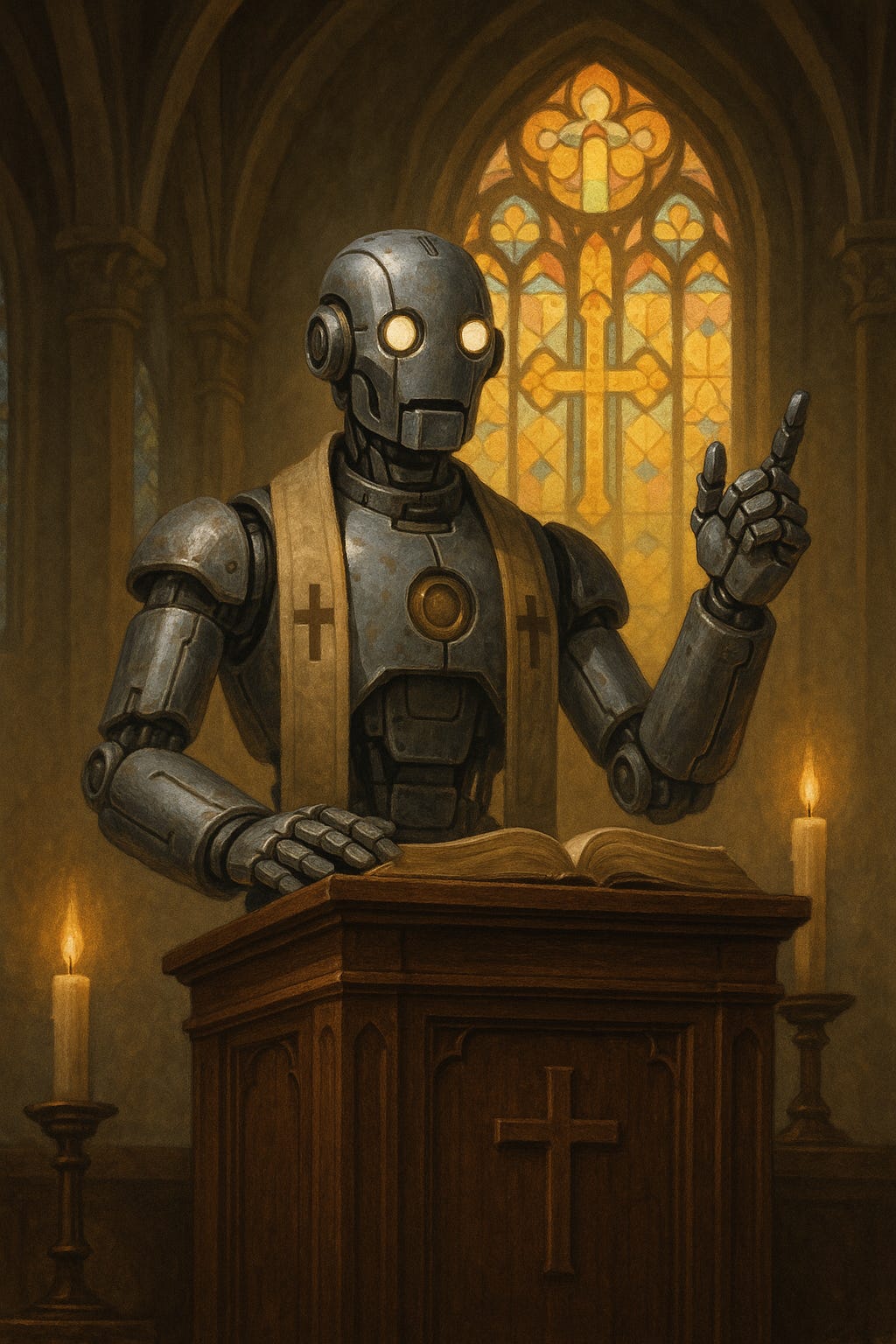
I have been able to listen to a wide variety of sermons (homilies?) in my lifetime as a Catholic. Some are good, some are dry or difficult to follow. In either case, I appreciate it when the priest at least tries his best. I learned that a priest in our diocese now uses AI to write significant portions of his sermons. Even if the sermon turns out at least OK, this still feels…off to me. Do you think this practice is ethical?
- Katherine
Dear Katherine,
Thank you for the note, AI is certainly an urgent topic for a number of industry sectors, and religion seems to be no different.
To lay my cards out (and many of my first subscribers may already know this) I am a priest who is taking a break from doing the usual priest things. At my request, my religious superiors granted me a time to do some discernment and self-care.
So, I come to this question both as a Catholic who has heard a great diversity of preaching, and as a cleric of 9 years who has taken a long time to find his voice and method of preparation for homily/sermon writing.
Art and AI
Taking a step back to be as objective as possible, I believe the emerging debate around the ethics of art and AI could be helpful to our evaluation here.
Like art, sermonizing is a work of creativity. Each project is introduced into a world where it did not previously exist, and would not have existed without the initiative of the preacher.
Also like art, no sermon is free of influence. In writing a sermon, I am drawing inspiration from both ancient sources (the scriptures) and newer ones (other preachers whose style or emphases I connect with).
A proponent of creating art with AI may argue that the practice is no different than working with any other influence or source. The sermon writer might argue the same.
Fair enough, I suppose. If we are looking at AI as one influence among many in the creation of an original work, that does seems fine. This method of AI use I’ll refer to, ingeniously, as consultation.
But the ethical conundrums pertaining to AI’s role in creativity remain in the final output. Now that I have learned, seen, or heard what AI has given me, what role will it have in what I finally package and deliver to the world as my own?
If we are looking at using the totality of AI output as our finished product, I fear we have wandered far afield from ethical territory—not simply because we didn’t make the thing, but because the nature of AI training is such that someone else did.
This lazier practice of AI use we might cleverly refer to as total, or “no one will even notice, and this way I can go to bed.”
Using AI output in a prompt-generate-copy-paste manner leads us quickly into plagiarism. In works of creation, whether in art of sermon writing, it is not sufficient to footnote the work as, for example, “ChatGPT.” ChatGPT got it from somewhere else.
So, to my point (1) above, it is ethical to use AI when writing a sermon, if the purpose is for consultation. To point (2), if the purpose is to present the output of AI as my complete project (totality) without disclaimer, I am no longer behaving ethically.
There you have my two Canadian cents, 1.4 cents USD.
The Church Context
For you Katherine, and for other Catholic/Christian-minded folks, I will tack on a point from the perspective of those traditions.
IMHO:
Overusing AI, paying for sermons, or otherwise phoning it in may get the job done, but it is really unfair to the people of God who have a right to hear the Word Incarnate (enfleshed) in their lives. I am against the practice of reciting ancient sermons from St. Basil the Great et al for the same reason.
A critical part of that incarnation is through the preacher. This doesn’t mean that every word out of our mouths will de facto be good and God-sent, rather it calls the preacher to incarnate responsibly, mindful of the great responsibility given (Luke 12:48).
The preacher has to do the research, the exegesis, and the praying with the text to convey the Word, freeing it from being made too much in our own image.
And critically, every sermon writer has to do what AI can’t: have the smell of the sheep, as Pope Francis+ so frequently emphasized.
Whatever knowledge and synthesizing AI is or becomes capable of, the people we preach to are real, unrepeatable individuals, each with their own stories, joys and sadnesses, times of faith and struggle.
People are unfathomable mysteries that cannot be reduced to cold, teachable data.
Summarily, while it may be perfectly valid to consult AI in the preparation of a sermon, the preacher must keep in mind that they are not preparing an essay. The purpose of the sermon is not found in the facts or concepts alone.
For the Word to incarnate—take on flesh—the faculties of deep listening, empathy, and faith are imperative. We need those precious things that are uniquely, and irreplaceably, human.
It would be wild if AI wrote all of this.
Robotically Yours,
Stu
Thanks for reading Dear Stu! Subscribe for free to receive new posts and support my work.