Dear Stu,
A friend of a friend of a friend told me you might be able to empathize with this. A lot of people seem to get down or depressed when winter arrives. I get it. It’s cold and the days start getting shorter. But most of my life I have been the opposite. I can handle winter, especially because there are more likely to be temperatures I can go for walks in with the right gear. But I feel trapped during these hot summers. It’s gets so hot and humid I feel it in my brain and body first thing in the morning. I guess my question is, what is there to do about this? What do you do about this? Do I just need to move somewhere colder?
- Anhil P.
Dear Stu is a reader-supported publication. To receive new posts and support my work, consider becoming a free or paid subscriber.
Dear Anhil,
God bless and keep you. Not to be dramatic, but is clear to me that summer is a consequence of the fall of humankind—that unhappy fault of Adam and Eve which has cursed us for generations. It gets worse because of global warming: that one is on us.
You contacted the right person. I pray you know the depths of my empathy with this issue. I have struggled with the sun and the summer most of my life.
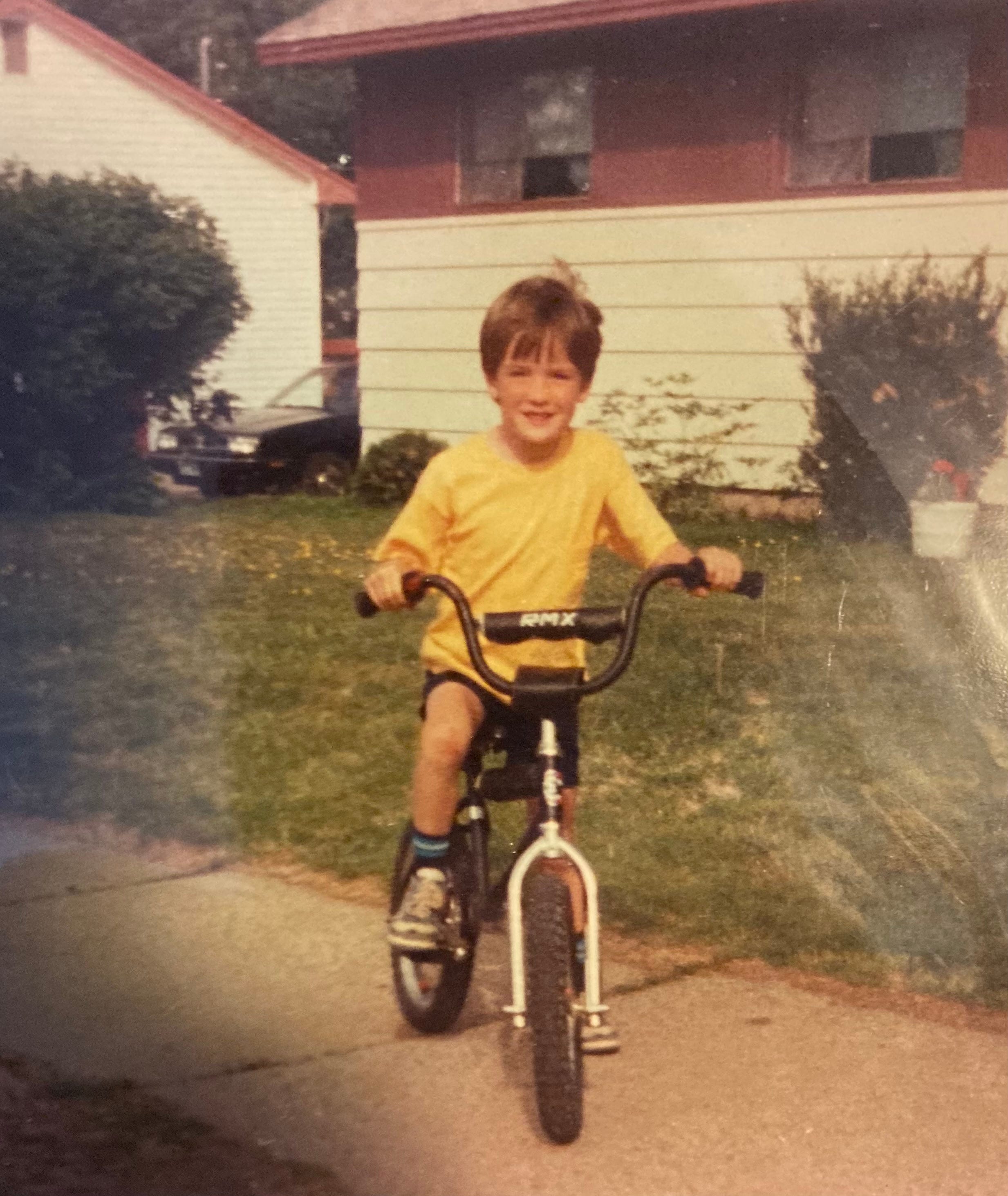
I say “most” because I happened to be looking at an old photo of myself and my mother from circa 1992 recently and I look about as content as any 7 year old in summer. I reflect back to those days and I remember that I was, in fact, content with that season.
But I wonder what role childhood summer shenanigans played in this positive outlook. My memories of those days are not of the heat, but of biking all over the neighbourhood with my friends, having a go at a lemonade stand, and playing baseball for the Elks. They were fun and innocent times. I was also smaller and wore shorts, neither of which I have any part of anymore.
When I think of sunny summer days now I think of a heaviness. I sit in a blissfully air conditioned house at this moment and yet as I look out the window, I can see the heat and the heaviness as sure as as rain in a thunderstorm.
My mood and mental health are generally at their worst in the summer. Like no other time of the year I find myself often fighting a crankiness that is bubbling up just below the surface. This is especially true of humid days, and how in the worst sense it takes my breath away the moment I step outside the door.
It is a season of oppressive trapping. It gets inside my brain and pushes it down, draining my energy, keeping me inside, attacking my body image with the combination of thinner clothes and eating without exercise. The heat gives me the sensation of ants crawling on my skin.
In fall and winter I can spend about as much time outside as I like. The cold doesn’t faze me. We grew up with long, cold, winters in the Maritimes. You can wear things to make it even more tolerable. My red scarf from The Bay. Long johns. Mittens, as close as possible to the kind my grandmother knitted for my brother and I as kids. Wooly socks.
Many seem to think my aversion to summer is some sort of bit that I am doing. An affectation. A gimmick. It is not. And while I am personally content enough to acknowledge how my experience of bipolar disorder bumps up against summer, there are specific diagnoses related to this phenomenon.
Season Affective Disorder (SAD) is a real condition characterized by depressive symptoms that usually arise in the late fall or winter. I am not an expert, so I refer you to the Mental Health Institute article on the subject as a place to get started. And of course, should these symptoms align with yours (or anyone reading this) please don’t wait to talk to your doctor.
The summer version of Seasonal Affective Disorder is called summer-pattern SAD. But even if you run into a doctor who prefers not to use that technical term, as I have, the most important part to attend to IMO is the reality of feeling depressed, and communicating how this manifests for you to physicians, friends, family, and loved ones in a way that challenges the aspect of this phenomenon that only sounds like a joke/gimmick.
The list of symptoms offered by NIMH are helpful, and I recognize them. In summer I connect especially with the loss of energy and/or motivation. Depressive episodes for me at any time of year are marked by what I call desirelessness. That is, not just wanting something to help me feel better, but struggling to want at all.
Summer compounds the problem of wantlessness by having so little to offer that could begin teasing me out of it. Paradoxically in the midst of the darkness, it’s harder to see a little ray of light that could say “look at this, maybe we could want this?” No.
But when I see snow I see something inviting and moldable. It’s a naturally occurring substance waiting for an activity to bring about its full potential.
What can we do about summer?
The question seems ripe for a self-proclaimed expert to make a listicle about. WatchMojo presents ten movies to lift you out of those summer blues. I want to try and do you a favour by not being too overly naive about this and just share a couple of ways I manage these days.
(1) I like to treat the sun and heat as many would the rain. Indeed, my sweat is likely to make my clothes just as wet, causing discomfort the rest of the day. I move between outdoor spaces with great speed. It is the only time I move anywhere with great speed. I have to get to the car fast: it is sunning cats and dogs out there.
If someone invites to an outdoor activity on a hot and humid day I have become comfortable saying no. Don’t do a thing that isn’t good for you just because others don’t see the big deal. Remember, in our minds it is as though it raining outside. I can’t go to your picnic, it’s raining outside. Instead: Would ya’ll like to come over and marathon Pirates of the Caribbean after? (Based on a real life example.)
Looking at a more literal example I have become inspired by an older man in the neighbourhood who walks around in the middle of a hot summer day with a big umbrella. Now that is taking this weather seriously. When I have to be outside I am desperate to look for the shade. This notion of taking your shade with you is simple, but effective. It is quite common in other countries but I feel like the appearance of silliness stops us round here. But I think the tradeoff is well worth it.
This is the approach we need to have: we are not strange. Let’s normalize mindfully allaying summer depression in whatever ways we need. We can do what works for us.
(2) Take advantage of “third spaces” as much as possible. I only learned this term a little while ago but I’ve been all about it for years. A first space is your home, a second space is your work, a third space is somewhere public you can go and be amidst others. These spaces include coffee shops, libraries, recreation/community centers, and houses of worship.
A popular third space definition would emphasize the community-building aspect of the space. You can chat with the people at the third space. To be honest, this is a bit less of a priority for me, but it’s chill if it is for you. I can see how that aspect of the concept makes sense. Those of us stuck inside due to weather aversion are inevitably more prone to isolation and loneliness. For me, just being amidst others does the trick.
Making use of third spaces has practical benefits. Air conditioning can be very expensive when you are trying to fight the heat as much as people of our disposition are. Let’s shut it off at home and go somewhere that has it in spades.
Some spaces also offer tasty food and drink.
I do not work for Panera. Panera does not pay me, which is too bad. But one of the greatest gifts I ever received in my life was a one-year subscription to the Panera Unlimited Sip Club. You can get a new icy drink every two hours, and refill as often as you want while you’re there. I sit at my table and either get some work done, write some creative-type things, or do a puzzle. A special treat is when I can meet a friend for Bananagrams!
The sum of these third spaces with their practicalities is a sense of life where I have a sizeable bubble in which to live and move and have my being. I can’t let the heat trap me at home; it only worsens the depression. I am still to be amidst the people. I cannot be stopped.
(3) Do something creative, outside the context of work or school. Make something. Have a project. It doesn’t need to be anything massive, just something that expresses yourself, relaxes your mind, and frees it from the anxieties of evaluation and completeness.
Work on a themed collection of poems, even if you’re not a poet. Start learning how to do basic code in Python or other languages and build a website for your dog.
By the time we reach kindergarten many of us have been introduced to something called crafting. When you think about it, it’s a little strange. For a few young years, no matter what happens next, each of us are little inventors, engineers, and artists.
My mom was such an avid proponent of crafting that all the neighbourhood kids she looked after in the summer would be so focused on their pipe cleaner and popsicle sticks as to delay chocolate pudding time. I would never go this far, but I understood it.
Crafts are satisfying, and far too socially limited to children. Go to Dollar Tree and start dreaming, as I say about many things. Summer is the perfect time to take over that dining table with strange and delightful materials.
If these types of creative efforts were only to justify myself, or to show others I’m living well despite my struggle with the weather, it might just be another veer toward identity as productivity. But the point of this creative exercise is to do it first and foremost for yourself, for the pleasure of it.
Keeping at least these three things in mind has not only helped me pass the summer in a distractive sort of way, it has helped me go so far as to flourish on many days. And what I’ve come to appreciate all the more, over time I’ve been able to rebuild new summer memories, new things to feel nostalgic about. And like that, much more than would be the case otherwise, summer doesn’t feel quite as bad.
Yours in snow forts and tomato soup,
Stu
Thanks for reading Dear Stu! This post is public so feel free to share it.
Dear Stu is a reader-supported publication. To receive new posts and support my work, consider becoming a free or paid subscriber.
Dear Stu is a reader-supported publication. To receive new posts and support my work, consider becoming a free or paid subscriber.