Dear Stu,
I don’t hate my job, but I am unmotivated by it. I am less than 3 years out of college and I didn’t expect to feel as jaded as this already. I was looking forward to work life, having my own place, all that. I feel like I could feel better about my life if my work had any impact or meaning, but I am starting to see that it doesn’t. I’m just doing it to survive, and because I don’t know what else to do. I don’t know how to phrase my question, but I think there is one in here somewhere.
- Adrian L.
Thanks for reading Dear Stu! Subscribe for free to receive new posts and support my work.
Dear Adrian,
I am sorry to hear about how you have been feeling. Most of us spend a significant amount of time at our jobs, and a lot of energy—neither of which we can get back. It sucks to feel like the whole thing might be meaningless. I promise it isn’t. But I have to start by saying I hear and connect with you on that feeling.
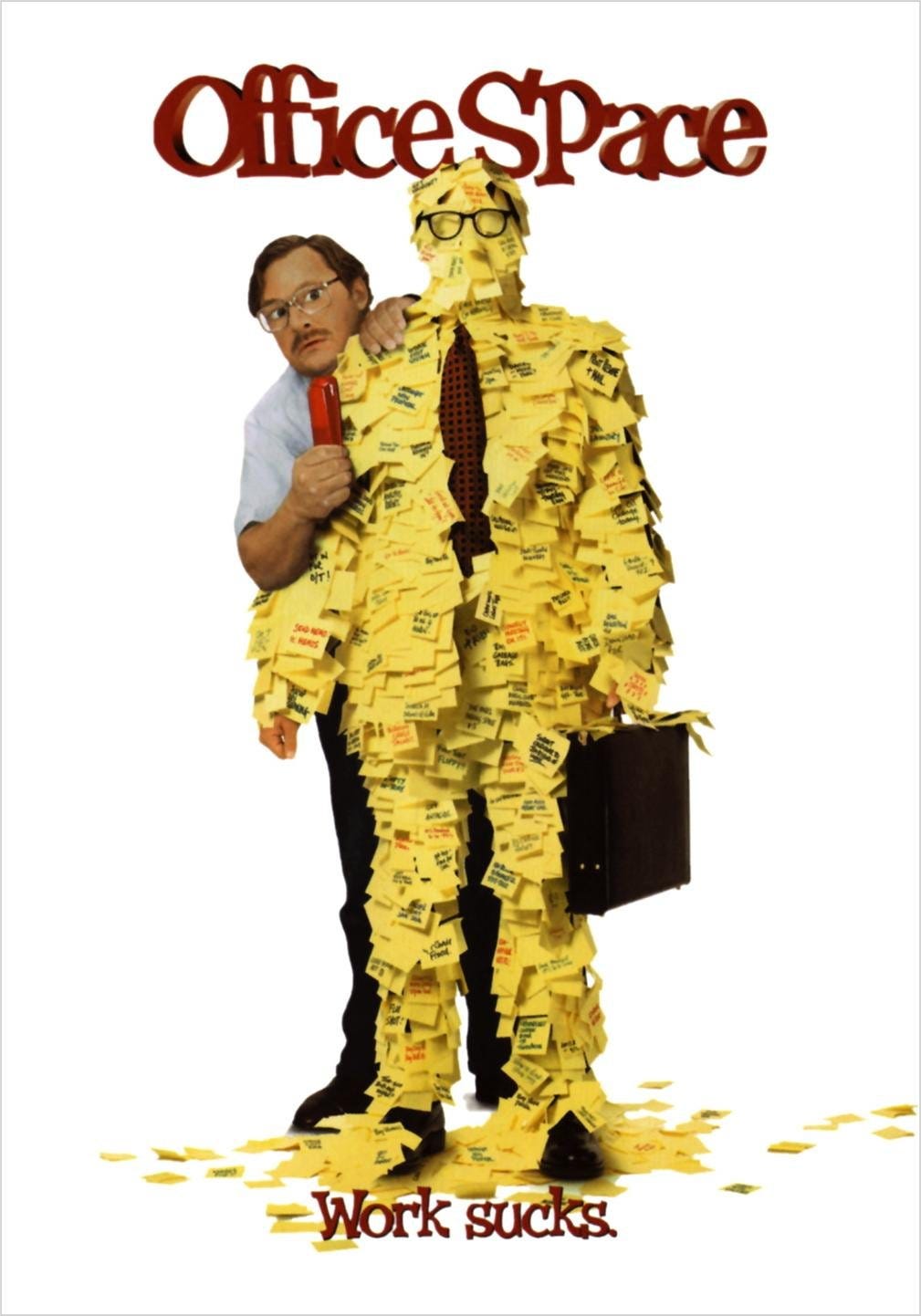
Even if only for the levity, you would be a good candidate for a viewing of the 1999 Mike Judge film Office Space. It follows a guy, famously named Peter (“Peter…what’s happening…”) who is bored and unmotivated by his job to the point of despair. Hypnotism suddenly grants Peter the ability to not care anymore. He shows up to work when he wants, ignores incessant corrections of minute details by a bloated roster of managers, hangs out with his friends, and suffers no negative consequences as a result.
The film goes further to examine deeper ethical and existential themes, but at least for a time, we get see the bliss that could result from utter detachment to one’s employment. That Peter never actually quits his job feels all the more delightful. The company shoulders the consequences of Peter’s checking out.
Adrian, I hope you will see Office Space. I think it is important. It is one of the funniest movies of all time and a personal favourite comfort rewatch.
Now, I would like to offer the rest of my answer in the form of a metaphorical pancake. There is one side we have just hinted at: the need for detachment. Then there is another side: the need to see value in all work. The butter and syrup is your viewing of Office Space.
Pancake Side I: Detachment
Unfortunately, as you contemplate following Peter’s style of detachment you may quickly realize that in real life, the pitfalls arrive more swiftly than in fiction. If you don’t show up to work without reason you will likely get fired. A shame is what that is.
In the spiritual life, detachment is about more than decisive action or inaction. It is a disposition toward things, people, events, and the unexpected in life that allows us to experience more freedom, and less distress.
In the case of your work, there may be room to adjust the importance you give it in defining you or the quality of your life.
A disposition of attachment may assign too much weight to the type of labour I do and its capacity for universal impact. If my work is valued by others, I am valued by others. If my work matters then I matter, and I’ve earned the right to be alive and feel good about it.
In reality, even if all your work does is keep you alive, then your work has meaning. You matter before you go to work. The fruits of your work—even just the paycheque—attend to your mattering. You’re worth keeping fed, having a safe and comfy house, and the pleasure of a family if you so choose. That’s enough.
I don’t at all want to discount the very real boredom a lot of work can entail! I’ve been there. But maybe sometimes at least a little of our boredom and lack of motivation comes from a sense that the work we are doing during the day is supposed to define us more that it was ever meant to.
It’s okay for work to have a smaller place relative to the rest of our lives. We don’t need to overcomplicate it or think something is gravely wrong because it does not change the world or grant us a great deal of fulfillment. It’s ok, and I’d say praiseworthy, to detach from lofty expectations about what we do, and simply let it be what it is. To keep it in its place.
When we reflect on some of the bigger things in life that are worth our attachment—the transcendentals, the eternals, love and the grandeur of nature—we might see the folly of investing too much of ourselves and our identity in things that do not invest in us in return.
Whatever they say at our job to keep us ignoring the low pay or lack of benefits (“We’re a family here!”) healthy detachment calls us to maintain an objective distance, ideally to the point where we can chuckle at the cynicism of capitalist enterprise vying to be more to us than they already are. Detachment keeps us from being owned by the people we work for.
I fear I may be wandering into an adjacent topic about which I am also passionate but hopefully this is generally making some sense.
Pancake Side II: Labour is Good in Itself
We have established that all (ethical, harmless—again, a topic for another day) work is meaningful even if it only accomplishes our maintenance and wellbeing. Even if this were not the case, I would also insist that even the most boring-seeming jobs are good and dignified.
I always appreciated the Catholic spin on this. Even if you are of another faith or none at all, perhaps it might resonate. God, of God’s own initiative created the world and all that resides in it. The Genesis myth describes God’s labour as something methodical. Creation didn’t all happen at once: it happened over minutes, hours, and days. And after six days of hard labour, God rested.
Six days on, one day off. Hard graft. We are all here because of that great shift worker in the sky.
The Genesis creation myth (there are two versions, both go hard) emphasizes the creation of humanity as a pinnacle moment. Adam and Eve, these two are a big deal. They are made in the image of their creator. And what is the first thing they are charged with as that image? Till the earth. Have stewardship over it. That’s right. Six days of tillin’. Then a day of Sabbath rest.
In this vision we identify labour as something inherently good because it mirrors and perpetuates the unfolding of creation—making us partakers in God’s own work—and it serves the purpose of keeping us alive and well. What more meaning could work possibly have?
Whether we take this narrative as our own or not, I do think there is something in most of us that derives some satisfaction in doing things, and doing them well. There is something deeply human about it.
When I was a newsie working the early morning beat outside subway stations, I was never more content and proud than when I started out, greeting people warmly, offering a fresh copy of Toronto’s second favourite commuter newspaper. It was only when I was phoning it in that the satisfaction started to go away. I wasn’t just telling the newspaper it wasn’t worth the effort. Not realizing it, I was telling myself I wasn’t worth the effort.
So, we work. We plug away. We support ourselves (which is enough!), we support our loved ones, we contribute to society in big and small ways that go beyond out literal 9-5.
And I don’t mean to be this guy but it could also just be that it’s time to quit, Adrian lol.
Yours in meaning-making,
Stu
Thanks for reading Dear Stu! This post is public so feel free to share it.