I just got back from HIMSS 2026, and my ears are still ringing mostly from the sound of vendors pivoting to “AI-First” strategies overnight.
In Episode 24 of Out of the FHIR, we’re skipping the press releases. I’m breaking down the three biggest lies being told on the conference floor and highlighting the few innovators who are actually using FHIR to move the needle.
The “Spicy” Summary:
* Stop calling it AI if your data is a mess. Clean FHIR data is the tax you haven’t paid yet.
* Interoperability isn’t a tech problem anymore. It’s a “who-gets-paid” problem.
* The patient is still an afterthought. Until we stop building silos, “patient-centricity” is just a marketing slogan.
Listen to the conversations from the show floor!
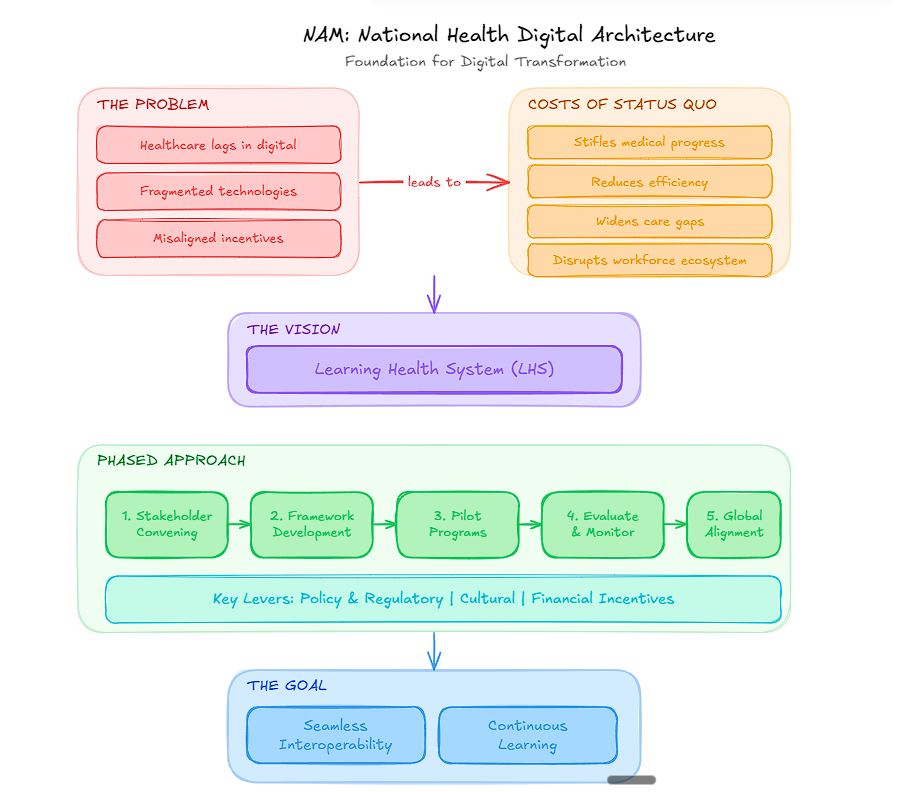
While at HIMSS I had a chance to look at the National Health Digital Architecture discussion paper released by the National Academy of Medicine.
Below are my thoughts on it.
The National Academy of Medicine’s (NAM) perspective on a National Health Digital and Data Architecture serves as a direct counterpoint to what is currently unfolding at HIMSS 2026. While NAM proposes a unified, foundational “operating system” for healthcare data, the reality on the conference floor is a fragmented landscape of competing interests.
Here is a review of the NAM strategy and why it is not gaining traction in the current HIMSS environment.
The Suggested Strategy: A Unified National Architecture
The NAM strategy calls for a fundamental shift in how health data is managed:
* A Shared Public-Private Utility: Treating data infrastructure as a “common good” (like roads or the power grid) rather than a competitive advantage.
* Standardized Semantic Foundation: Moving beyond just “sharing files” to a universal understanding of data meanings (FHIR-native, semantically aligned).
* A Single “Architecture of Trust”: A unified framework for identity, consent, and security that removes the need for thousand-point-to-point connections.
* Separation of Data from Applications: Storing data in a vendor-neutral layer so that clinical apps can be swapped in and out without data loss.
Why This Isn’t Happening at HIMSS 2026
1. The “FHIR-Washing” of Legacy Silos
Strategy: Standardized semantic alignment. Reality: While every booth at HIMSS 2026 prominently displays “FHIR,” most vendors are still “FHIR-washing.” They use FHIR as a thin translation layer on top of their proprietary, legacy databases. This maintains the vendor lock-in that the NAM strategy aims to destroy. True digital transformation requires data to be FHIR-native from the start, but vendors have no financial incentive to rebuild their core architectures.
2. The AI Distraction (Infrastructure vs. Shiny Objects)
Strategy: Laying the foundation first. Reality: HIMSS 2026 is dominated by Generative AI. Companies are racing to sell the “shiny” end-product (AI clinical scribes, predictive models) while ignoring the “plumbing” (data architecture). AI built on the current fragmented architecture results in “Black Box Silos” AI that only works within one specific EHR or payer system, which is the exact opposite of NAM’s vision for a national learning health system.
3. Competitive Moats vs. Common Utilities
Strategy: Infrastructure as a public-private utility. Reality: In the HIMSS exhibit hall, data is still viewed as an asset to be guarded, not a utility to be shared. The business models of many HIMSS “Anchor Tenants” (large EHR and data aggregators) rely on being the gatekeepers of patient data. There is significant resistance to a national architecture that would commoditize the data layer and force companies to compete solely on the quality of their software applications.
4. The “Information Blocking” Dance
Strategy: Seamless interoperability by design. Reality: Despite CMS and ONC mandates, “information blocking theater” is in full effect. Companies are technically compliant but operationally obstructive charging high API fees or creating complex workflows that discourage third-party integration. The NAM’s “Architecture of Trust” is impossible to build when the underlying participants are still incentivized to keep data within their own ecosystems.
This is why the NAM emphasizes that surface-level technical solutions alone won’t work. You have to resolve the underlying incentive misalignments through policy levers, shared commitment frameworks, and cross-sector collaboration.