Medicaid rarely comes up in interoperability conversations. Mathematica’s Marie Copoulos and Paul Messino said so in the first five minutes, and the rest of the episode explained why that is a mistake.
Marie came to Medicaid from Medicare and commercial data. Her point: ten years ago you could not analyze Medicaid across states. Today you can. The national data set is imperfect but usable, and most investors and builders still assume it is a black box.
Thanks for reading FHIR IQ playbook! This post is public so feel free to share it.
Paul spent eight years at Maryland Medicaid, on a COBOL system built to pay claims. His framing of the core problem: Medicaid grew up on transactional data designed for payment, and now states are being asked to measure outcomes from it.
Three things worth your time
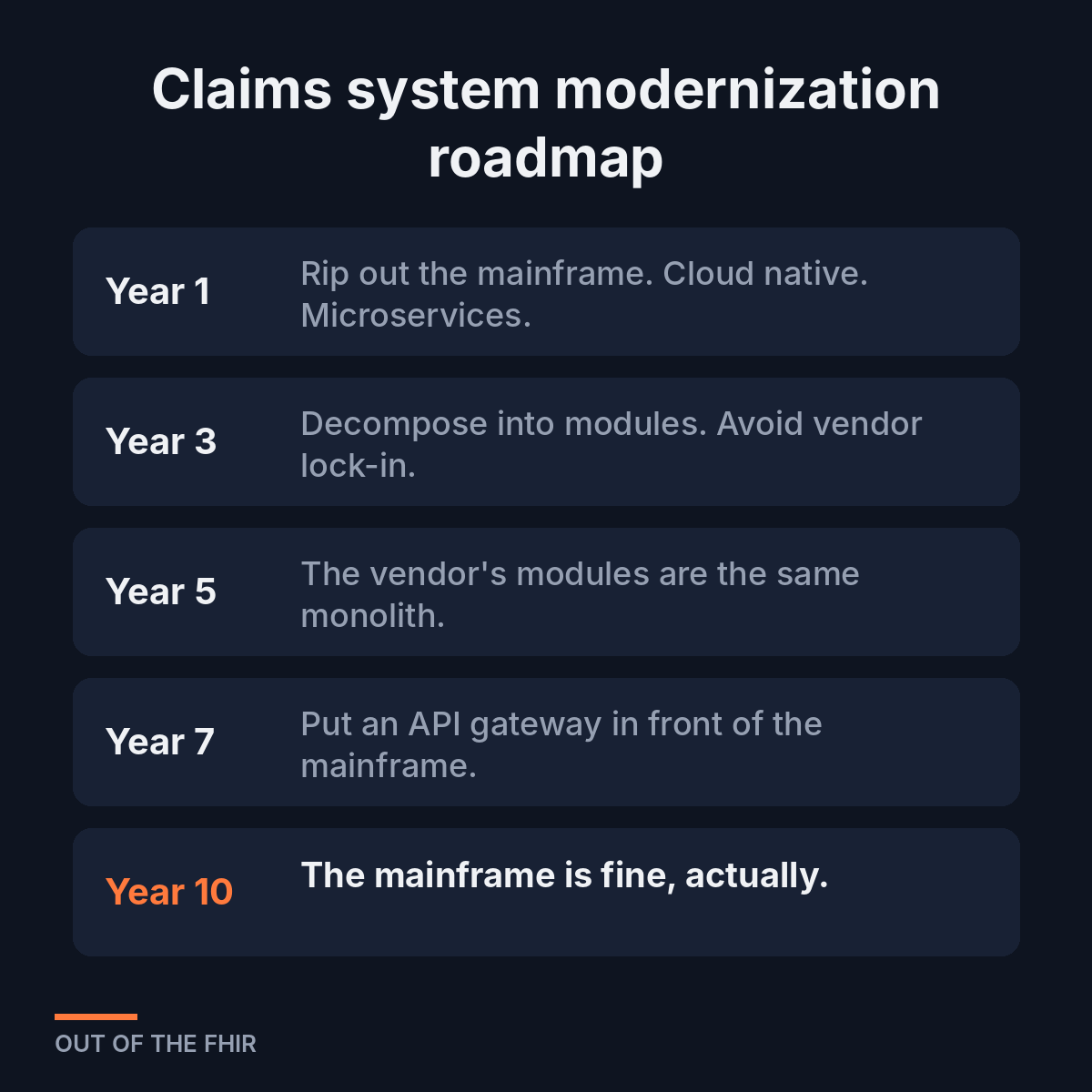
1. Wrap the mainframe, don’t replace it. CMS pays states an enhanced federal match to modernize their Medicaid Enterprise Systems and has pushed a modular approach for over a decade. Paul’s read on the results: mixed. Large vendors often sell the same monolith in modules. The approach that is working now is to leave claims processing alone and put a data model, analytics layer, and API or FHIR gateway on top. Benji added that commercial payers and Medicare contractors have hit the same wall: many rewrite attempts end with the core still on COBOL.
2. Health data’s most expensive habit. Marie’s sharpest line was about our own industry. Every organization rebuilds the same claims normalization pipeline from scratch. Her second point was about time horizons. Value-based contracts usually run a year. Chronic illness plays out over a decade and moves people between Medicaid, Medicare, and commercial plans. A ten-year contract would change how you think about attribution, churn, and prediction.
3. Local codes come from deadlines. When a legislature creates a new benefit and the standard code does not fit, a state program with a launch date will create a local code rather than wait on a balloting process. Marie’s caution on the fix: forcing everything into one standard strips out real program differences. The useful work is finding the 80 percent that can be standardized faithfully.
On AI and patients
We also covered the CMS ACCESS Model, a 10-year Innovation Center model that pays for outcomes from technology-enabled chronic care, starting July 2026. Paul named three gaps he hears from participants: reimbursement, data flow, and matching providers with the right digital tools. On Patient Access APIs, his assessment was blunt. States built them; apps and members have not shown up. Marie added that patients don’t make most care decisions alone. If the clinician has no time to look at app data, the app does not help much.
Listen
* Spotify: [link]
* Apple Podcasts: [link]
* YouTube: [link]
Out of the FHIR is independent and bootstrapped. If you work on health data infrastructure and have shipped something worth talking about, [reply to this post or email link]. Guests speak for themselves, not their employers.