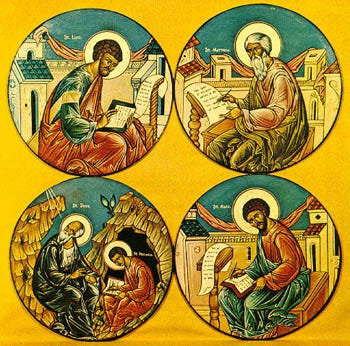
Have you ever noticed how similar Matthew, Mark, and Luke are? They share a tremendous amount of material, often word-for-word. Scholars call this the “Synoptic Problem,” and they have debated for centuries about how to explain this close literary relationship.
If you take a New Testament seminary class, chances are you will probably be introduced to the standard academic answer: a hypothetical document called “Q” (from the German word Quelle, meaning “source”). Scholars use Q to explain the material shared by Matthew and Luke that is not found in Mark. While Q is incredibly popular in academic circles, the more historically and biblically sound explanation is that the Gospel authors relied on widely circulated oral traditions that the early churches simply knew. We actually don’t need a lost written document to explain the shared material in the Synoptic Gospels.
The Roots of Q: The Reformation and German Higher Criticism
To understand the origins of the Q theory, it helps to trace its roots to the theological shifts of the sixteenth century. The Q hypothesis is fundamentally a product of German textual criticism. This movement is intrinsically tied to Martin Luther and the early Reformers.
When the Reformers broke from the historic church, they didn’t just challenge papal authority; they exhibited a startling arrogance in trying to redefine the biblical canon that had been received and universally accepted by the Christian faithful for centuries. Luther famously questioned the apostolic authority of books like James, Hebrews, Jude, and Revelation, while simultaneously moving the Deuterocanonical books into a separate “Apocryphal” index (which is also a complete misnomer that we’re still unfortunately dealing with today).
Luther’s arrogance effectively stripped away the validity of historical Christian witnesses. By deciding that the received biblical canon of the early church was subject to the private scrutiny of individual scholars, the Reformers inadvertently laid the groundwork for the modern critical era. They established a precedent that the traditional understanding of the Bible could, and should, be dismantled.
Fast forward to the eighteenth and nineteenth centuries, and this spirit of independent academic skepticism blossomed fully into German “Higher Criticism.” Scholars operating in this environment no longer viewed the Gospels through the reverent lens of early church witnesses. Instead, they treated the texts as mere literary puzzles to be dissected. It was in this cold, hyper-analytical climate that German philosopher and theologian Christian Hermann Weisse formally proposed the Two-Source Hypothesis in 1838, arguing that Matthew and Luke relied on Mark and a second, now-lost document, later dubbed Q.
To put it plainly: Q is not a historical discovery. It was born out of a critical tradition that had long since abandoned the authority of the church’s living memory.
The Flaws and Biases of the Q Hypothesis
The biggest problem with the Q hypothesis is the complete lack of physical evidence. Again, simply put, Q is entirely hypothetical. We haven’t found a single manuscript, fragment, or historical reference to it anywhere in early church history. Q is primarily a formulation created by academics who view history through a strict literary lens and frankly don’t believe oral tradition is a valid or reliable method of historical preservation.
The Q theory rests on a major assumption we could call the “written requirement fallacy.” It assumes that for Matthew and Luke to share exact sayings of Jesus, they had to be copying from a written text. This completely ignores the robust nature of memory in ancient cultures. As the classical scholar Milman Parry demonstrated in his groundbreaking studies of Homeric poetry, ancient societies routinely transmitted vast, complex narratives with incredible accuracy, without relying on written texts. Simply put, if humans don’t need perfectly preserved written texts to accurately pass on large, complex traditions, why would we assume God requires one to preserve His truth?
The Validity and Biblical Precedent of Oral Tradition
We have to remember that the church preceded the written text. Before the New Testament was codified in writing, the church operated primarily through the spoken word. As historian Jaroslav Pelikan points out, the oral Gospel existed as the authoritative norm long before the written Gospels were ever produced. The early Christian community didn’t desperately need a hypothetical written Q source because the living, spoken traditions of Jesus were already their primary, guiding authority.
Unlike the skepticism of modern academics, the Bible explicitly affirms the transmission of oral traditions. We see this clearly in Paul’s letters.
“So then, brothers and sisters, stand firm and hold fast to the traditions that you were taught, whether by our spoken word or by our letter” (2 Thessalonians 2:15).
The apostles placed the spoken word on the exact same authoritative level as their written letters. The early churches trusted what they heard from the apostolic witnesses.
Of course, recognizing the power of oral tradition in the first century doesn’t diminish the vital role of Scripture today. In fact, we have a massive advantage now. We aren’t left guessing what the apostles taught through centuries of unwritten transmission. God purposefully guided the early church to crystallize that living, apostolic faith into the written text of the New Testament. The written Word doesn’t replace the original oral tradition; it permanently captures and preserves it. Having the Bible today gives us the incredible blessing of an objective, unchanging anchor that protects us from doctrinal drift while connecting us directly to the authentic faith of the early church.
The point is that when the Gospel authors set out to write their accounts, they didn’t rely on a hidden Q document for the teachings of Jesus. Instead, they simply drew upon the rich, living oral traditions circulating at the time. As Danish scholar N. F. S. Grundtvig correctly identified, the early church was animated by the “Living Word,” which was the active, spoken confession of faith within the community. The Gospel teachings reflect the very words of Jesus that everyone in these early congregations already knew, recited, and lived by daily.
However, this transmission process wasn’t merely the rote memorization of dry facts. As Pelikan observed in his earlier work, true tradition is the “living faith of the dead,” whereas traditionalism is the “dead faith of the living.” The early church wasn’t engaging in lifeless traditionalism. They passed down the teachings of Jesus dynamically as vital, life-giving truth, ensuring a highly accurate yet living preservation of the gospel.
All this to say, we don’t need a hypothetical, unproven, undiscovered document to solve the Synoptic Problem. By rejecting the skeptical assumptions of modern textual criticism and embracing the reliable, biblically affirmed practice of oral tradition, we arrive at a much more natural explanation for how God inspired the Gospel authors to compose their accounts.