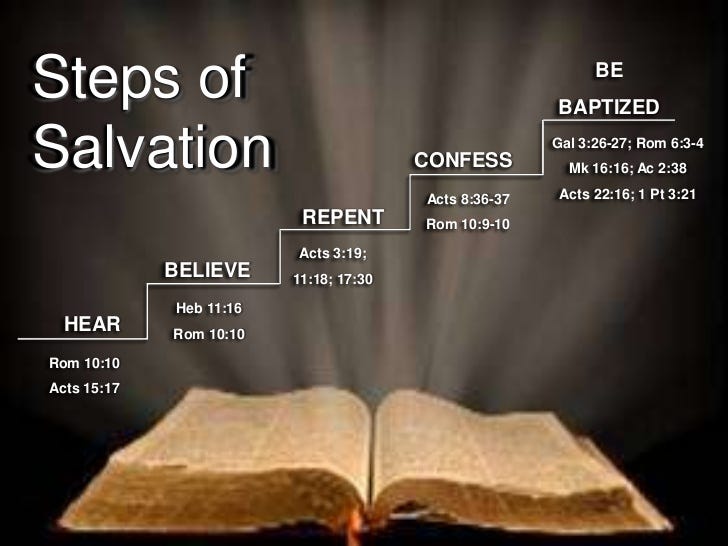
For many within the Churches of Christ, the “five steps of salvation” are among the first things taught and memorized. Hear. Believe. Repent. Confess. Be baptized. This sequence has been repeated in sermons, printed in tracts, illustrated on charts, and drilled into Bible class curricula for generations. The intent behind it is clear: to help people understand how to respond to the gospel simply and directly.
Each of these steps is grounded in Scripture. They reflect real moments of decision and obedience described in the New Testament. The framework has helped explain how people respond to the gospel and enter into a relationship with Christ. It also emphasizes that every individual has a personal responsibility to respond, and that salvation is not automatic or inherited.
This Substack is reader-supported. To receive new posts and support my work, consider becoming a free or paid subscriber.
But over time, a helpful teaching tool can become a limiting one. When the five steps are treated as the complete picture of salvation, or as a formula that must be checked off in order, they risk reducing a rich and relational process to a list of commands.
The gospel is not a mechanical system. It’s the announcement of what God has done in Christ to reconcile sinners and bring them into covenant with Him. Obedience is essential, but salvation is not a transaction.
Today, we’ll explore where the five steps came from, consider the biblical truth they reflect, and how we can gain a more complete picture of salvation as covenantal participation in the life of Christ.
Where They Came From
The “five steps of salvation” are not found in a single passage of Scripture and do not appear in list form anywhere in the Bible. Instead, they developed over time as a way for preachers and teachers to present a clear and structured summary of how individuals respond to the gospel.
In the late 19th and early 20th centuries, evangelists and gospel meeting speakers began using simplified outlines to communicate the message of salvation more effectively, particularly in public preaching and printed tracts. As revival culture emphasized decisions and personal response, a desire arose for straightforward, repeatable frameworks that could be taught easily and recalled quickly. Thus, the five-step model was born.
This approach attempted to organize scattered teachings of the New Testament into patterns that could be imitated. Rather than relying on theological systems or inherited traditions, the focus was placed on what the apostles preached and how people in Acts responded to the gospel.
Each step could be tied to a particular verse or passage. Romans 10:17 supported hearing the Word. John 3:16 and Hebrews 11:6 emphasized belief. Acts 2:38 called for repentance and baptism. Romans 10:9–10 taught confession. These were assembled into a sequence that could be taught from a chart or preached in a single sermon.
To be clear, the steps are rooted in Scripture. They were not invented out of thin air. But they were never meant to be a rigid formula. They were a tool—a way to make evangelistic teaching accessible and practical. The danger came later, when this tool began to be treated as a complete definition of salvation, and any alternative explanation was viewed as a compromise or error.
The 5 Steps Proper
Hearing the Word is the starting point. Faith comes by hearing, and hearing through the word of Christ (Romans 10:17). The gospel must be preached and heard before it can be believed. Christianity is not built on emotion or private intuition. It begins with a message.
Belief is the natural response to that message. Jesus said that whoever believes in Him will not perish but have eternal life (John 3:16). Hebrews 11:6 reminds us that without faith it is impossible to please God. Faith is more than intellectual agreement. It’s trust, loyalty, and allegiance to Jesus as Lord.
Repentance follows belief. When Peter preached on the day of Pentecost, he called those who were cut to the heart to repent and be baptized (Acts 2:38). Turning to Christ involves turning away from sin. It’s not just feeling bad about past choices; it’s a reorientation of a person’s heart and will in alignment with God’s.
Confession is both a personal declaration and a public witness. Romans 10:9–10 teaches that one believes with the heart and confesses with the mouth. Confession, in context, is affirming the lordship of Jesus, often in the face of opposition or persecution. It places a person within the identity of the church and before the watching world.
Baptism is the moment of union with Christ. It’s how a person is buried with Him and raised to walk in newness of life (Romans 6:3–4). It’s where sins are washed away (Acts 22:16), where one is clothed with Christ (Galatians 3:27), and where the appeal to God for a clean conscience is made (1 Peter 3:21). Baptism is not an optional symbol. It’s a decisive act of surrender and trust.
The strength of the five steps lies in their emphasis on personal responsibility. They reject the idea that salvation is inherited or that religious rituals can substitute for personal faith and obedience. They remind the hearer that the gospel is a call to action.
This Substack is reader-supported. To receive new posts and support my work, consider becoming a free or paid subscriber.
These steps also protect the central place of baptism, which is often misunderstood or marginalized in other religious traditions. The Restoration Movement rightly insisted that baptism is not a later act of obedience for the already saved, but the moment of conversion itself.
Where the Model Falls Short
While the five steps of salvation are rooted in Scripture, the model can fall short when treated as a complete definition of salvation rather than a summary of response. Like any simplified framework, it becomes problematic when it shapes our understanding more than the biblical narrative itself.
The five steps are often presented in a fixed order, as if salvation is a series of boxes to check or stairs to climb to achieve salvation. This approach can give the impression that if a person performs each step correctly, they have fulfilled their obligation and now possess salvation in a technical sense. While obedience is essential, Scripture describes salvation not as a transaction, but as an entry into a new relationship with God—a covenant sealed through the death and resurrection of Christ. The danger is reducing that covenant to a series of events rather than understanding it as surrendering one’s whole life to the reign of Jesus.
While each step reflects human response, the model often leaves little room for divine initiative. In Scripture, salvation is described as a work of God from beginning to end. It is by grace that we are saved through faith (Ephesians 2:8), through the washing of rebirth and renewal by the Holy Spirit (Titus 3:5). The five-step framework rarely highlights the Spirit’s role in transforming the heart, empowering obedience, and sealing the believer for the day of redemption (Ephesians 1:13–14). When the focus is entirely on what the individual does, it risks portraying salvation as something earned rather than received.
The model also typically ends with baptism. While some have tried to correct this by adding “living faithfully,” we may be too far gone. Ending at baptism can unintentionally separate the act of conversion from the ongoing life of discipleship. In the New Testament, baptism is not the finish line. It is the beginning of a new life under the lordship of Christ.
Jesus did not call people to simply make converts; He called them to make disciples (Matthew 28:19–20). Faithfulness to the gospel requires more than a one-time response. It requires daily spiritual formation through community, teaching, obedience, and the ongoing work of the Spirit.
Finally, the five steps are often presented by quoting isolated verses, sometimes from different books and settings, without reference to the covenantal structure or theological development of Scripture. This can lead to a fragmented understanding of salvation. For example, Acts 2:38 is part of Peter’s sermon, fulfilling Joel’s prophecy about the outpouring of the Spirit. Romans 10 emphasizes the righteousness that comes from faith, in contrast to the works of the law of Moses. When these texts are used as ingredients in a formula rather than as parts of a coherent narrative, the message of salvation can be reduced to proof texts instead of proclamation.
None of these concerns are arguments against calling people to obedience. The call to repent and be baptized is at the very heart of the gospel invitation. However, we should be cautious about presenting a man-made outline as if it were the totality of God’s plan. The five steps may point in the right direction, but the reality they point to is more profound and more transformative than a simple pattern can capture.
Reframing the Call to Obedience
The five steps of salvation can still serve a useful purpose, especially when introducing someone to the basic pattern of response found throughout the New Testament. But they must be understood as part of something larger. Salvation is not a sequence; it’s a life-altering reality that begins with God’s grace, received in obedient faith, and unfolds in the covenant relationship with Christ.
Rather than discarding the five steps, we can reframe them within the story Scripture tells.
* Hearing and believing the gospel is not just about acquiring information; it’s about receiving good news that changes everything.
* Repentance is not a one-time act of remorse; it’s a reorientation of one’s entire life toward the kingdom of God.
* Confession is not a ritual but a public declaration of loyalty to Jesus.
* Baptism is not the end of a process; it’s the moment a person is united with Christ, buried and raised with Him, and born again by water and Spirit.
In their proper context, the steps become more than a formula. They become markers of entry into a new reality—citizenship in God’s kingdom, participation in Christ’s death and resurrection, and inclusion in the community of the Spirit. They help express our part in the covenant, but they aren’t the whole of it.
If we want to teach the plan of salvation faithfully, we must do so as part of the larger call to be disciples. We should connect it to the cross, the resurrection, the work of the Spirit, and the church’s mission. We have to help people see that coming to Christ is not the end of a search but the beginning of a transformed life.
Thanks for reading! This post is public so feel free to share it.
This Substack is reader-supported. To receive new posts and support my work, consider becoming a free or paid subscriber.