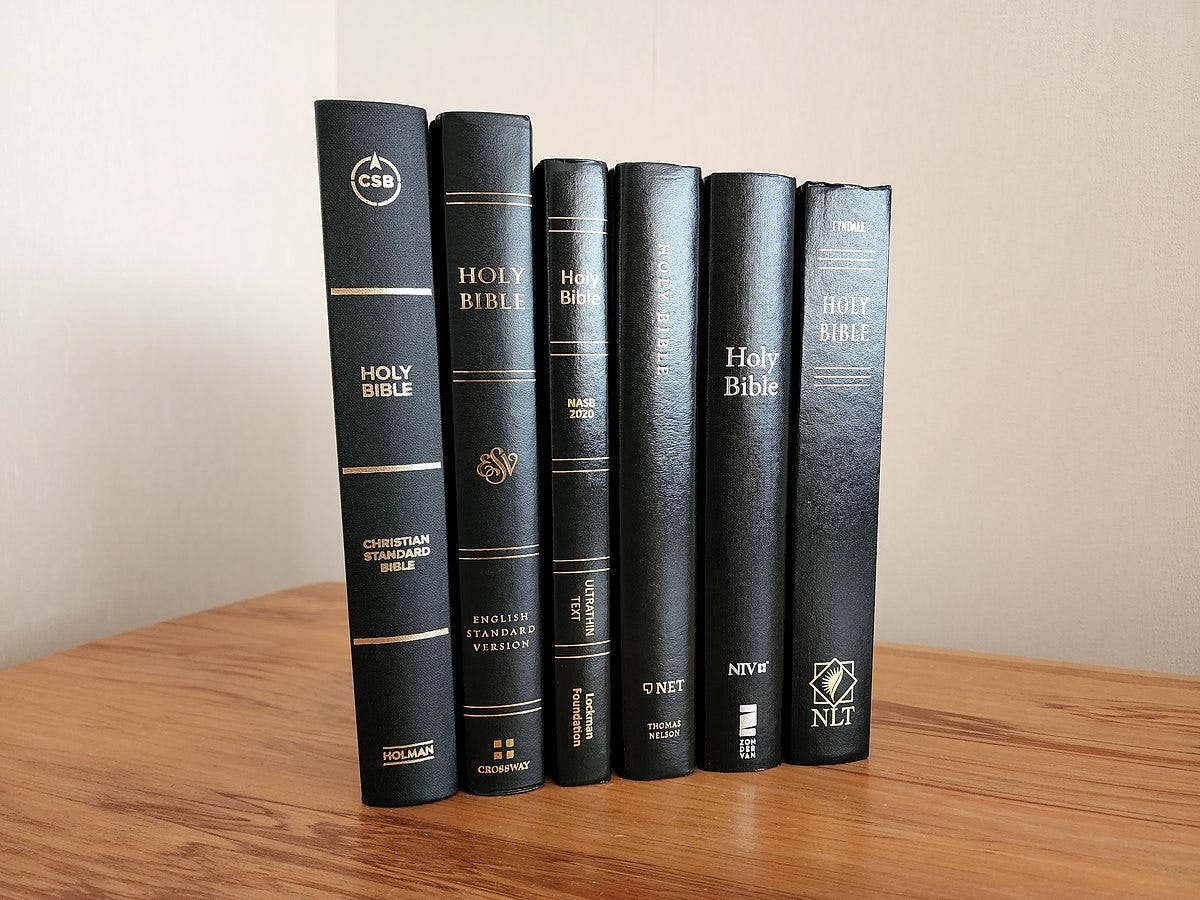
Bible translation discussions can stir up surprising levels of passion, and not always in healthy ways. For many Christians, the choice of Bible translation is a deeply personal one. For others, it becomes a hill to die on. And unfortunately, those hills are often built on shallow ground.
What I’d like to do is review and offer an analysis of several major English translations I’ve personally used (which is quite a bit, actually). I’ll explain the translation philosophy behind each version, offer an honest assessment of its strengths and weaknesses, and provide a personal recommendation based on biblical accuracy, readability, and theological clarity.
Test Everything is a reader-supported publication. To receive new posts and support my work, consider becoming a free or paid subscriber.
However, before delving into the individual translations, we must address some of the confusion and, frankly, the damage that has been caused by the translation debate itself.
The Danger of “-Onlyism”
Let’s start with the obvious arguments: those that make objective statements like “This is the only valid translation.” Most commonly, it ends up being KJV-onlyism. Extreme KJV-onlyism isn’t just unhelpful, it’s dangerous. At its core, it elevates one 17th-century English translation above the original languages. Many in that camp claim the KJV is “perfect” while ignoring its limited manuscript base and the fact that its language is now so archaic that it often confuses modern readers.
Ironically, many who adhere to KJV-onlyism also tend to distrust biblical scholarship, textual criticism, or even the original Hebrew and Greek texts. That’s ironic because the KJV was the product of serious scholarship in its own time. If anything, modern translators have access to far more manuscripts and far better tools than the KJV translators ever dreamed of.
KJV-onlyism is the most prevalent and outspoken of the “onlyists,” but certain translations also have cult-like followings, such as the ESV.
Heretical “Translations”
Some versions that claim to be Bible translations are, in reality, theological distortions. The clearest example is the New World Translation, produced by the Jehovah’s Witnesses. It deliberately alters foundational doctrines, most infamously changing John 1:1 to say “the Word was a god” instead of “the Word was God.” That’s not just misleading; it’s an intentional corruption of the original text to support false teaching.
Another clear example is the Passion Translation. Its creator, Brian Simmons, claimed that Jesus personally appeared to him and commissioned him to create a new translation of Scripture. That alone should raise red flags. He lacks any credible training in biblical languages, and his so-called “translation” frequently invents phrases and inserts theological concepts that have no basis in the Greek or Hebrew. It’s not just a loose rendering; it’s a reimagining of Scripture built on personal revelation and charismatic ideology. It should be completely rejected as a legitimate Bible.
I have read both of these translations, just as I have the others I will be covering, and I recommend that most people steer clear.
Paraphrases
The most well-known paraphrase is probably The Message. But to be clear, The Message is not a heretical translation like the Passion. It’s not even a translation; it’s a paraphrase.
Eugene Peterson was a pastoral writer who wanted to help readers engage with the tone and emotional impact of Scripture. He never claimed The Message was a substitute for serious Bible study. In fact, he encouraged readers to use it alongside a more accurate translation.
Test Everything is a reader-supported publication. To receive new posts and support my work, consider becoming a free or paid subscriber.
When used devotionally, The Message can be a helpful resource. But when it becomes someone’s primary Bible, or when preachers use it to teach doctrine, it becomes problematic. It takes considerable liberties with the text for the sake of style and accessibility. Not to mention, it’s a bit “cringe” most of the way through and sounds like a “Hello, fellow kids” meme.
That doesn’t make it dangerous, but it does mean it should be used with care and never treated as authoritative in the same way as a true translation.
The Real Problem: Loud Voices, Shallow Understanding
The biggest problem in Bible translation debates often isn’t bad translations. It’s unqualified voices speaking loudly and confidently about things they haven’t studied.
You’ve probably seen it online: someone shares a viral post warning that the NIV “removed verses” or that gender-neutral language is a slippery slope into heresy. These are typical arguments that people parrot, having likely never studied translation theory. They don’t know how textual criticism works. They couldn’t tell you the difference between formal equivalence and dynamic equivalence. But their meme got thousands of shares, and now someone’s questioning their beloved Bible for no real reason.
In many cases, this connects back to the KJV-only conversation. People often compare modern translations to the King James Version and use it as a benchmark for accuracy. To be blunt, that’s just silly and ignorant. Faithfulness to the original text should be judged by comparing translations to the Greek and Hebrew manuscripts, not to a 17th-century English rendering of them. When people treat the KJV as the gold standard, it reveals a shallow understanding of how translation and biblical scholarship actually work.
It’s also common to see people confuse translation philosophy with theological compromise. They assume that if a Bible uses more inclusive or neutral language or highlights or omits a verse that the KJV includes, it must be unfaithful or liberal. However, most modern translations are created by diverse committees of scholars from multiple Christian traditions, and these translations utilize older sets of manuscripts than those available during the development of the KJV. They’re not trying to deceive anyone. They’re trying to render the biblical text clearly, faithfully, and responsibly.
The Goal
I won’t promote a single “correct” Bible translation. I’m not here to crown one version as the best for everyone. Instead, I want to:
* Explain the differences between major translation philosophies
* Highlight the strengths and weaknesses of each version
* Offer practical advice for choosing the right Bible for study, teaching, or reading
* Push back against the shallow tribalism and misinformation that cloud this topic
Let me be clear about my own qualifications. I’m not a professional translator or a biblical language professor. I don’t claim to be an expert in the academic sense.
However, I have read the entire New Testament in every translation I’ll be reviewing, and in most cases, large portions of the Old Testament as well. I’m not the type of person to write or talk about something that I’ve not thought about and studied extensively like some people.
I’ve spent years now as both a teacher and student of the Bible, and I’ve done serious study in areas like textual criticism, translation methodology, and biblical interpretation. This series comes from that place of lived experience, thoughtful study, and a commitment to biblical clarity.
We don’t need more tribalism in the church. We don’t need more people parroting things that they don’t understand. We need more wisdom, humility, and discernment. My hope is that this series can help provide that.
As a final note, here are the translations we will cover throughout the series:
* New Revised Standard Version (NRSV)
* New Revised Standard Version Updated Edition (NRSVue)
* English Standard Version (ESV)
* Revised Standard Version (RSV)
* King James Version (KJV)
* New King James Version (NKJV)
* New American Standard Bible (NASB)
* Legacy Standard Bible (LSB)
* New Living Translation (NLT)
* New International Version (NIV)
* Christian Standard Bible (CSB)
Thanks for reading Test Everything! This post is public so feel free to share it.
Test Everything is a reader-supported publication. To receive new posts and support my work, consider becoming a free or paid subscriber.