Welcome to Future Faith, a podcast, newsletter, and publication about living faithfully in an age of democratic destruction, ecological collapse, and economic irrelevance, available for free on Spotify, Apple Podcasts, and Substack:
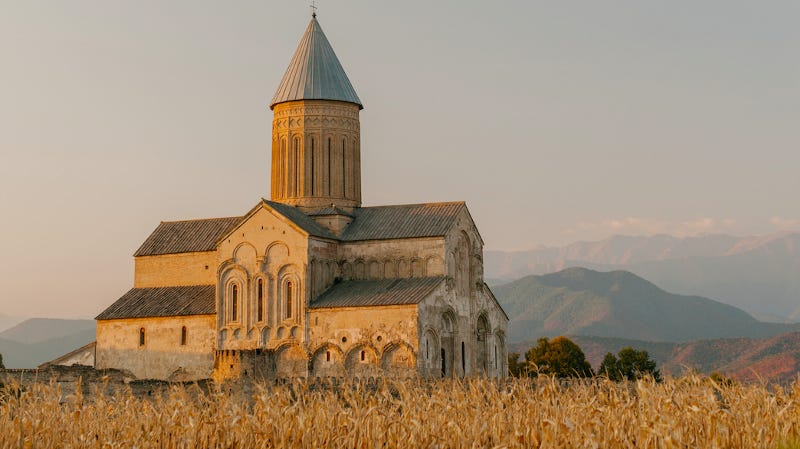
Every morning I go on a walk past a river, beside a centuries-old working millpond, into a graveyard and apple-laden church ground, and through the ruins of a twelfth-century abbey.
If you walk around my village, you’ll see dozens of houses that are made of the exact same stones as the former abbey.
There’s a reason for this: When Henry VIII dissolved all the monasteries and started his own church in order to self-bless his murder of innocent women, locals in my village stole the monastery’s rocks.
The faded tourist sign says that the locals treated the monastery as a “convenient quarry.”
A convenient quarry.
That’s Christianity vs. Secularism in a nutshell, isn’t it?
Because it’s inherently consumerist, post-modernity loves to harvest what Christians first cultivated:
* Hospitals
* Universities
* Human rights
* Universal basic income
Secularism wants the kingdom without the king, the light without the power, the cathedral without the cornerstone.
Monasteries
What do you picture when you hear the word “monk?”
Old men in black robes?Old women in white robes?
Why not a young bearded brewer who brews beer for the glory of God?Why not a stay-at-home dad who adores children and wants to adopt a dozen orphans?Why not a working mom who erects houses for the benefit of people who would never qualify for a mortgage?
What do you picture when you hear the word “monastery?”
A rotting stone building, utterly detached from the world?
Why not a vibrant house, street, neighborhood, village, or city?
When I hear the word “monastery,” I envision an estate.
When Henry VIII dissolved the monasteries, he sold their buildings and land to whichever local elite offered the most cash.
This allowed the British aristocracy to amass vast estates, with thousands of those plundered monasteries still owned by those same families to this day. (There are 144 estates over 10,000 acres in Scotland alone.)
Michelle and I have visited dozens of estates on various outings around the UK:
* Chatsworth (1,822 acres, down from 200,000) invented the banana we all know and love.
* Buccleuch (217,000 acres) raises 19,670 sheep, 700 cattle, 32,000 hens, and 117 red deer hinds.
* Atholl (124,000 acres) hosts weddings and functions, has a trailer park, and does castle tours.
* Highclere (5,000 acres) shot to fame as the shooting location for Downton Abbey.
When I picture a modern monastery, I picture a not-for-profit sustainable estate — studded with dozens of villages and hundreds of people — being run by kingdom principles for kingdom purposes.
The kingdom economy
The poor will always be among us because the rich will always be above us.
But not in the Acts 4 church, where there were “no needy people among them.”
And not in today’s monasteries, either.
For nearly 1,700 years, Christian monks and nuns have practiced Universal Basic Income.
In my travels, I’ve visited monasteries in Greece, Italy, Spain, England, Scotland, and elsewhere. I’ve been to many of the great foundations, including Monte Cassino, Assisi, Subiaco, etc. Monasteries are the last place in Christendom that still practice koinonia, the ancient and subversive Acts 2 practice that radically set apart the early church from the rest of society.
Koinonia is often translated as “community” or “fellowship,” but both are really terrible translations. “Brotherhood” and “communion” come closer, but the best description of koinonia might be “non-political spiritual communism.”
From each according to his ability, to each according to his need.
This isn’t forced or coerced secularist state-implemented communism. We know that doesn’t work.
This is a Holy Spirit-led sharing of life.
It is a communal life the world can never know or re-create.
In monasteries, koinonia looks like this: Everyone works a reasonable amount of time (typically 4–6 hours each day, 5–6 days each week) and contributes 100% of the proceeds to the monastery. The abbot and his team then ensure that everyone’s needs are provided for: food, clothing, shelter, medical, soul care.
No one is wealthy, but everyone is rich.
The impossibility of individuality
Just like biblical churches, monasteries aren’t democracies.
The abbot or abbess (from “abba,” meaning father) is in charge.
All the brothers or sisters put their faith in Christ and their trust in their abbot, and he is to lead them well — not as coercive politicians do, but as a true servant-hearted leader.
That’s why most rich Westerners — single or otherwise — will never enter a monastery.
It requires submission and surrender to a communal cause.
How will they know us?
I wish Christians were more like Jews and Muslims.
You can always spot a Jew in the crowd.
She’s the one with gorgeous hair and the husband with the yarmulke.
You can always spot a Muslim in the crowd.
They’re the ones not eating until sundown.
I’m not saying we should cover our women or face east at sunset. You know what I mean. Christians are barely discernible.
There’s only ever been one marker that really separates Christians from our neighbors — unconditional love, even for those who hate us.
But are we loving radically enough to make the world take notice in this attention culture?
Where are all the disturbing Christians?
Why don’t people leave our presence feeling deeply unsettled?
Being around Christians should feel conspiratorial, revolutionary, even dangerous.
After all, we serve a God who wants to change everything.
There is some biblical precedence for the concept of monasticism:
* Elijah fled to the desert during a time of great persecution, and communed with God until the day he was called the restore the kingdom to their heavenly king.
* Yahweh sent Moses and the Israelites into forty years of desert wanderings in order to shake off the mental shackles of slavery and prepare them for life as a free people.
* John the Baptist counterintuitively moved to the desert to become an evangelist and prepare the way for his cousin Jesus.
* If you study the life of Jesus, note how many times Christ removed himself “to a desolate place.”
Notice how all of these “monks” were incredibly connected to God and deeply invested in the renewal of the world? Notice how setting themselves apart actually allowed them to dive into culture and make a greater impact? It’s almost as though Christians are supposed to retreat in order to advance.
Let’s face it: Churches haven’t been churches in a long time. Worship bands and motivational preachers and fancy buildings take precedence over sharing our wealth, living a rule of life in community, and housing the poor.
It’s almost as if the monastery is a place of reformation and preparation for the next move of God in our lives and our culture.
First Egypt
When most people think about monasteries, they assume it’s just a retreat from “reality.”
And it definitely can be that.
But that wasn’t the original intention, not by a mile.
Inspired by Elijah and John the Baptist, monastics like Anthony the Great renounced the brutality, injustice, and oppression of the Egyptian mega-cities and moved to the desert to practice a Christ-centered life.
Pachomius developed the idea of monks living together, and in doing so, creating an alternate social structure to stand in sharp contrast to the rest of the world.
In an age before the Internet, social media, and viral videos, more than 50,000 people joined the Egyptian desert fathers and created what became known as Cities of God.
From there, the movement went viral, spreading all over the planet.
Monasteries aren’t retreats— they’re just new garden cities where the presence of God is actually welcomed.
Because monastics renounce individualism and work together as humans were meant to do, it means they inevitably become places of great art and culture, both attracting outsiders and sending people back out.
A nowhere always becomes a somew…