Section 1: The Uniform of the Body
We did not invent the uniform; we merely learned to wear it.In the years when visibility was a risk and difference drew blood, the body became our most reliable passport—trained, trimmed, disciplined until it could cross borders that language still could not. A chest could persuade where a sentence would be punished. Shoulders—broad, deliberate—announced a kind of safety. Muscles advertised that we would not be pushed this time.
History made the first pattern. The clone cut his hair, grew his mustache, and walked into the bar as if he belonged to the oldest nation on earth: men. It was a brave joke that worked too well. What began as camouflage and counterspell hardened into costume. By the time the joke reached the algorithm, the costume had become law. Profiles repeated the silhouette like a liturgy—square jaw, vein-lit forearm, tank strap carving the same diagonal across different lives. The app did not decree this; it simply amplified what our fear had already standardized.
I don’t say this to sneer. The uniform has its mercy. For the boy who was called soft, the gym can be a school of coherence. A barbell teaches that weight obeys sincerity; it will not flatter you. Reps become a kind of prayer where breath counts honestly and improvement arrives without theater. There are men for whom muscle is a truce signed with their own reflection: enough, you are safe here. I will not steal that from them.
But even mercies can curdle. When the mirror becomes a tribunal and every meal a hearing, the uniform begins to conscript. We call it discipline; sometimes it is a domesticated panic. We say “preferences” as if they were private; often they are market data written on the skin. Homophily does the rest. Men who train at the same hour, weigh out the same grams, divide their week into chest/back/legs, find each other. Accountability becomes camaraderie; camaraderie becomes caste. It is efficient. It is also lonely, even in a pack.
The uniform promises legibility: see me and know what I cost. But legibility levies its own tithe. Biceps do not translate longing any better than poetry does; they only delay the need for a fuller speech. And yet we keep paying. Why? Because the uniform purchases a brief exemption from the oldest tax we owe—shame. Shame for wanting, shame for failing, shame for not wanting the right things loudly enough. A visible truce with shame is still a truce.
“Isn’t this just straight culture with different lighting?” someone asks. Not quite. Among men who desire men, the eyes meet without a steward. There is no conventional choreography to soften the gaze, no small talk designed by tradition to buffer the risk of looking. Two vectors touch with nothing in between. Where there is no script, surfaces take the blame for meaning. If I can perfect the surface, perhaps I can survive the speed of recognition. Perhaps I can make my body pre-say what my mouth fears to learn.
Steroids complicate the catechism. They are the sacraments of acceleration—pledges paid in advance for futures that rarely arrive. The uniform tightens; the variance disappears. It becomes harder to tell men apart because the chemistry is doing the introductions. We pretend the sameness is preference; it may be administration. We are not immoral for wanting the shortcut; we are merely modern, which is its own peril.
What does a post-performative strength look like? Not an aesthetic refusal—asceticism is another costume—but a reordering of purpose. Train the body to become a neighbor, not a billboard. Make the back strong enough to bear a friend’s move, the lungs wide enough to carry grief up a hill without stopping, the legs competent in ordinary duty. Keep some softness on purpose; let the face remain legible to children and the tired. Strength that cannot be used in service is just anxiety in better lighting.
I have seen the uniform protect men who would not have made it out of their twenties without it. I have also seen it starve tenderness until nothing remained but maintenance. The paradox is not resolvable by denunciation. It is resolved by recollection: remembering what the uniform was trying to buy in the first place—belonging without betrayal, desire without humiliation, visibility without spectacle. No muscle can purchase that; only speech and covenant can.
So I ask a simple question the next time I scroll past twelve identical torsos, the next time I pass a flock of tank tops moving like a single idea: What would I recognize if these men changed shape tomorrow? Would I know their laugh in the dark? Would I trust them with news that hurts? Could we eat slowly together? Could they sit in a room where nothing is performed and not mistake it for failure? If the answer is yes, then the uniform is just a coat—useful, seasonal, easily hung. If the answer is no, then we are confusing a dress code with a people.
Uniforms are not abolished; they are outgrown. You step past them when the room no longer requires a password for entry. Until then, mercy. Mercy for the man who builds a body to keep his panic quiet. Mercy for the man who refuses the gym and still shows up to be seen. Mercy for the parts of us that learned safety late and are reluctant to surrender their guard. We will need all of them when we begin to speak to each other without the microphone of display.
The project here is not to shatter the mirror but to demote it. Let it become a tool again—like chalk, like a belt, like a towel on the bench—useful, ordinary, incapable of telling you who you are. Then the body can return to its first vocation: instrument, archive, door. Not a uniform, but a sentence that reaches for a truer paragraph. Not an answer, but a hinge.
Section 2: The Cathedral of Noise
We have always needed a room big enough for what the day could not hold.For a long time, churches did the work—vaulted ceilings to lift the ache, a choir to carry what words could not. When those doors closed to us or opened only with conditions, we found another nave with a cheaper cover: a warehouse, a basement, a bar whose floor remembered more confessions than its owner. The instruments changed, not the hunger.
Noise is what we call meaning before it consents to grammar.On a good night, the room learns to listen to itself. A bass line draws a boundary tighter than a law. Laughter chooses where the aisle runs. A pause becomes a treaty; a drop, a collective vow. The DJ—priest without pulpit—does not lead so much as read, adjusting the liturgy to the congregation’s breath. He hears the room’s doubt, its pride, its loneliness, and stitches a sequence that keeps panic from deciding the evening.
If you want to learn a people, count what they count together.On that floor we count eight. We measure repentance in steps, not apologies. A hand on the small of your back becomes the sacrament of inclusion; a nod across the circle absolves you of your awkwardness for three beats at a time. Water passed hand-to-hand is communion enough. We bless each other’s survival with sweat. It is not high theology, but it is honest.
There is law here too, older than the posted sign.The room regulates itself by glances. Excess volume is permitted—excess cruelty is not. Someone who pushes to the center without rhythm is not banished; the circle simply closes around him until he learns the dialect. In this way, humor and mercy police what security cannot. The bouncer at the door checks IDs; the beat checks intentions.
We mistake the volume for arrogance. Often it is protection.If shame is the weather we were raised under, loudness is a roof we can afford. You cannot hear a slur over a subwoofer. You cannot hear your father’s verdict when the hi-hat turns the air to rain. The cathedral of noise is not built to impress God; it is built to drown the gods that failed us.
Of course the night has its cheats. Chemicals borrow the courage we plan to repay. Light edits faces until everyone looks like the vow they made in the mirror. The lens on a stranger’s phone baptizes us into an archive we did not agree to join. Algorithms memorize the room more accurately than our friends do. The cathedral sells candles at the door—packaged transcendence with a return policy. We pay anyway. The hunger is real, even if the cure is rented.
Still, there are moments when the floor tells the truth without help.A joke—almost cruel—swerves into tenderness because a hand lands on a shoulder at the right syllable. A man whose body is an armor he cannot remove lets the song take his face apart, and for twenty seconds he is beautiful in a way his mirror never permits. Two enemies from last year find the shared ancestor of their rhythm and call it even. The room remembers who we are when we have not had time to invent it.
Authority does not enter; it interrupts.We know that sound: the sudden square of silence when the house lights rise without warning, the clipboard that tries to outweigh a thousand hearts working. The law holds up paper like weather and declares the night too loud for the hour. The room inhales—not fear exactly, something older: the memory of when being seen meant being counted against. Circles loosen, smiles flatten into safe shapes. Innocence is rehearsed. We obey enough to be left alone.
When the inspectors leave with nothing but their own echoes, relief does not sprint; it returns slowly, like blood to a hand that has been gripped too long. The music resumes narrower, then widens as trust remembers its lines. This is the cathedral’s greatest trick: not defiance, but resilience. To be interrupted and yet continue without becoming the interruption.
Noise has rules, and they are kinder than we admit.A floor that forgives a misstep teaches better than a sermon that punishes thought. We learn consent here—how to read a shoulder, how to exit a gaze without causing a bruise. We learn restraint: the pleasure of almost. We learn timing: the mercy of not speaking when the room has already said it. If the world outside practiced what the night discovers by accident, there would be fewer courts and more choruses.
But the cathedral is not a home.It cannot cook for you, wait with you at 3 a.m., or teach you the names of the birds. It is a shelter for weather, not a climate. If you try to live there, spectacle will colonize your hours. What was once ritual will become regimen; what was once mercy will become tax. You will start to confuse fatigue with transcendence. You will forget how to be moved without being managed.
So what is a post-performative relation to the noise?Attend it the way you would a thunderstorm—present, grateful, untricked. Enter with a name and leave with it. Dance until your pride sweats out of your shirt. Touch and be touched in a grammar you would not be ashamed to translate in daylight. And when the song that always tempts you to become your worst myth begins, know where the door is. A cathedral is holy because it has exits.
There is a quieter lesson too, for the witness and the dancer alike.Noise is ore. Meaning is what happens after heat and hammer. The room furnaces something—call it courage, call it hunger, call it the beginning of a sentence we cannot yet say—and gives it back to us uncoined. Our work begins after the song ends: to mint what we felt into speech that can stand without a drum.
Once, on a night the city tried to forget itself, the beat counted us into honesty and we obeyed. A boy who had been a rumor to his own body became a citizen of his skin. A man who had been hiding in the mirror came out as strong in public. A stranger in the corner learned where the room kept its mercy and stole just enough to teach the morning how to talk. This is the cathedral at its most serious: not a factory of abandon, but a school for remembering.
When dawn climbs the brick and the floor is only a floor again, the liturgy ends with sweeping. There is a holiness in that broom, in the bucket, in the quiet acknowledgement that ecstasy leaves work behind. The ushers—cashiers, bartenders, kids in black—restore the room to a state in which grief could also fit. It is their benediction. Go in peace, not in pieces.
We step outside. The city has a different meter. The river keeps time older than any club. Pigeons argue doctrine we cannot hear. We carry a rhythm under our ribs we did not have when we entered. If we are lucky, we will not spend it all by noon. If we are wise, we will let it teach us to walk without music—so that when we return, it is as citizens, not refugees.
The cathedral of noise is not the enemy. It is the rehearsal. The performance is the day.
Section 3: Liberty’s Double Bind
We won the right to do as we pleased and woke to discover we had no idea what to want.That is the double bind of our liberty: freedom from arrived faster than freedom for. The locks came off the doors; the house still needed rooms, vows, a table. Law yielded; longing did not learn its manners overnight.
The first freedom was beautiful and urgent. It had to be. When your kiss is a crime and your dance is evidence, the only honest prayer is let me live. We tore down what could be torn down. We learned new exits. We discovered what the body can pronounce when language is contraband. In those early years, abundance felt like ethics enough: more partners, more nights, more proof that no one could erase us again. To want became a kind of protest. Quantity disguised itself as meaning and, for a while, the disguise worked.
Then the plague arrived and welded paradox to our desire. Pleasure became the crime scene and the life raft. We were told to survive by refusing the form of touch that had just begun to heal us. Grief taught discipline, and discipline saved lives. But it also smuggled a new shame into the room: not the old clerical curse against the body, a biomedical suspicion of it. Even after medicine disarmed the worst of it, the mood lingered. We carried on—braver, lonelier, cleaner, thinner. We learned to narrate ourselves as risk profiles. We called that adulthood.
Apps finished what history started. They translated the old whisper network into a marketplace and called it liberation—no bouncer, no bar tab, no chance encounter required. The grid taught us to shop for each other and to format ourselves for purchase. Consent remained (thank God), but consent at scale is a slot machine: every yes spins; the house always wins. The dopamine economy does not need malice; it feeds on maybe. We told ourselves we were free because no one said we couldn’t. We forgot to ask whether anyone had taught us why we should.
Here is the bind in its clearest form: the more absolute our permission, the more performative our proof. To demonstrate that we are not ashamed, we must behave as if we have nothing to hide. To behave as if we have nothing to hide, we must keep showing. What began as a rescue from secrecy becomes a regimen of exposure. The algorithm calls it engagement. The soul calls it exhaustion.
I am not arguing for a return to closets or curfews. I am arguing that liberation without integration is just an expensive hinge—you can swing the door all night and still not leave the hallway. We need a different grammar for freedom, one that can conjugate both yes and no without blushing. The old tyrannies made no a wound; our moment too often makes no a failure of vibe. In either case, refusal is punished. A people who cannot refuse cannot be said to have consented.
Consent is the floor, not the house.It keeps predators from calling themselves lovers and judges from calling themselves fathers. But appetite is not an ethic. An ethic asks, What will this make of me? What will this make of us? The marketplace has no answer to those questions; it can only sort by price and speed. If we outsource our eros to the interface, we will spend our best years optimizing for visibility and calling the result a personality.
Chemsex clarifies the danger because it accelerates the lie. If desire is a tunnel, chemistry promises the other side before we start walking. The debt comes due at dawn with interest. What was a night of possibility becomes a liturgy of forgetting, rooms named after amnesia: kitchen, couch, bathroom, door you cannot find. The slogan of the age—no shame—is printed on the receipt, and still the body pays with it. We wake up emptied and overexposed, a paradox you cannot solve with hydration or a story about being “just open.”
What would a post-performative liberty look like? Not abstinence as ideology—abstinence as season, like winter: purposeful, restful, making room for a spring that is not counterfeit. Not a politics of scolding, a politics of stewardship: I treat your body as a neighbor because tomorrow you may need to recognize mine. Not purity theater, fidelity in the old sense—fides, faithfulness—to what we have said together when we were most ourselves.
There are older names for this that do not require a pulpit.Sabbath: the right to stop without losing your place.Vow: the art of limiting one thing so that another may live.Covenant: freedom arranged so it survives success.These can be spoken between two men without borrowing any shame from the past. They are simply technologies for keeping the human scale of love in a time that prefers spectacle.
“Isn’t this just respectability in better clothes?” someone asks. It could be—if the goal is approval. It isn’t. The goal is endurance. We have proved we can win nights. Can we keep days? Can we build an erotic life that does not require a camera to be believed? Can we teach the young something sturdier than technique—how to recognize their own hunger before they rent it out?
The old moralists said the body lies. They were wrong. The body tells the truth in a dialect the will cannot always translate. Liberty’s double bind tightens when we force the body to sustain a story it did not write—performing ease where there is panic, appetite where there is ache. The remedy is not more performance; it is better translation. Touch that confirms rather than edits. Pace that listens. Silence that is not a test but a room.
Notice how quickly jealousy dissolves when an encounter is legible—when the men in the tank tops are not a tribunal but a chorus, when the party is not a referendum on your worth but an event you can pass without indictment. Legibility is expensive; it costs us our favorite illusions. It gives back rest. It lets us decline what would hollow us without needing to hate who accepts it.
A final test for our freedom: Could we choose to be ordinary and remain ourselves?Could we risk being uninteresting to the grid and still be desired in daylight? Could we trade being seen by everyone for being known by someone and call that an upgrade? If the answer is yes, liberty has crossed from performance into life.
If the answer is no, do not despair. Every culture unlearns its first freedoms. We will, too. We will rediscover the uses of slowness and the dignity of appetite that is not monetized. We will remember that “no” is the first gift lovers give each other, because it makes every later “yes” credible. We will keep what was won—the kiss in public, the dance without permission—and add to it a practice that does not run on spectacle.
When the night ends and the floor cools and the feed forgets your name, what remains is the smallest liberty: to be with one person in a room and not perform. The double bind loosens there. You are not proving anything. You are not hiding anything. You are free enough to refuse, brave enough to accept, patient enough to listen for the sentence your body has been trying to say since the locks first came off.
Section 4: The Lost Elders and the Witness
A culture is not only what it celebrates; it is what it remembers on purpose.For us, memory broke. An entire stratum of men who should have become teachers was taken or silenced. The line that should have carried craft, tenderness, and the long view collapsed into emergency. We learned to survive nights; we forgot how to keep days. When the crisis eased, it left behind competence in logistics and a famine in meaning. You can rebuild a neighborhood with money. You cannot buy back a generation.
An elder is not a mascot for age. An elder is a timekeeper.He knows the names of storms and what they leave behind. He can place your grief on a map and tell you which roads flood, which bridges hold. He does not spare you limits; he teaches you their mercy. He remembers the forms that make freedom survivable: how to apologize without theater, how to bless without ownership, how to refuse without exile. He can say “I don’t know” in a way that steadies the table.
Our line snapped for reasons both brutal and banal.Plague took many. Shame gagged others. The survivors were tired, busy burying and bargaining. When we finally looked up, the pedagogy had been outsourced to interfaces. The feed offered what elders do not: speed without context, affirmation without companionship, instructions with no apprenticeship. Wit replaced wisdom. A thousand clever men could teach you how to pose; few could teach you how to stay.
Where elders are absent, the witness is drafted.The witness is not the critic in better clothes; he is the person who pays attention long enough for the story to admit its own weight. He knows the difference between looking and taking, between proof and presence. He practices a slow theft: lifting moments from spectacle and returning them arranged so that the ordinary can recognize itself without shame. In a loud room he keeps his voice; at a threshold he asks for the name before he enters. The witness is a bridge until the elders return—or until enough witnesses become them.
Witnessing is not voyeurism. It requires appetite and abstinence in the same body.You cannot write about a people you secretly despise; you cannot tell the truth about a room that you still need to impress. The witness learns the discipline of not needing the scene he describes. He goes slow enough to be changed by what he sees. He refuses to monetize the wound. He does not confuse the microphone with permission. He is willing to be boring in public if that is what accuracy demands.
There is a danger particular to our time: we mistake visibility for transmission.An elder is not someone many have seen; an elder is someone a few can call at midnight. Visibility numbers the crowd; transmission raises a household. The algorithm can make you legible to strangers; only practice can make you useful to neighbors. Elders build thresholds, not platforms. They do not gather followers; they train replacements.
What, then, does eldering look like in a culture raised by the grid?
* Keep time. Show up weekly before anyone deserves it. Make a room predictable. When no one comes, keep the hour anyway; you are teaching the future how to find you.
* Guard the threshold. Learn to say yes without flattery and no without humiliation. You are the memory of proportion at the door.
* Tell the story whole. Refuse romance and refusal both. Include the joke that saved you and the relapse that almost erased you. Make the history usable.
* Name apprentices. Do not compliment “potential”; give work. Let hands learn what sentences cannot hold. Sit beside; leave space for their mistakes.
* Keep the ordinary sacred. Teach soup and budgets and bedtimes; teach how to leave a party with your soul. The extraordinary is easy; it burns on its own.
Sobriety rooms, kitchens, and choirs are our monasteries now.They do for us what seminaries once did for other peoples: they transmit forms of staying. A pot on the stove at the same hour each week is a theology of presence disguised as dinner. A choir rehearsal trains the body to harmonize desire to something larger. A recovery meeting teaches the grammar of truth without applause. These are not lifestyle accessories; they are technologies for surviving liberty.
Do not wait for permission to begin.Elders are not appointed; they are recognized in retrospect by the people who did not fall apart because someone else refused to. Start small and stubborn. Invite three men to read a book you love and cook them something edible. Sit with the one who makes everything a performance until the performance gets tired and the person appears. Insist on the long view. Let boredom do its quiet work. Boredom is where trust learns your name.
If you are young and hungry for instruction, honor that hunger without renting it out.Look for men who are faithful to places, not just opinions. If a person has never apologized in your hearing, do not take his counsel about courage. If he cannot keep a confidence, he cannot keep a culture. If his rooms have no children, old men, or tired women in them, he may know the scene, but he does not know the city. Ask him what he is willing to lose to tell the truth. If he smiles like a billboard, keep walking.
If you are older and reluctant: we need you.You do not have to be perfect to be useful. You only have to be specific and available. Bring your failures; bring your patience. Say “I was wrong” with a steady mouth. Model small reconciliations. Teach how to end a fight without a winner. Show us how to leave a man’s dignity intact after you disagree with him in public. These are skills we cannot Google; they must be seen.
And for the rest—for those who will never be elders and do not wish to witness—mercy.The line will not be rebuilt by excellence alone. It will be rebuilt by rooms that forgive fatigue, that allow a man to arrive without sparkle and still be wanted. A people with elders can afford variety again; it no longer needs uniforms to guarantee belonging. The tank top becomes a shirt; the gym becomes a tool; the body stops trying to do the work of speech.
I keep returning to the man in the corner, the one who listens harder than he dances.He is not holier than the floor; he is its memory keeping watch. He writes so that the next young man who thinks he must become a costume to be held can read a different sentence and try a different door. He is a witness for now, an elder in practice. He is learning the craft of custody: how to hold a people long enough for it to remember what it wanted before it learned to perform.
We cannot resurrect the dead, but we can restore the line.Not with spectacle, not with slogans, but with the slow courage of men who will trade being interesting for being dependable. Build tables that outlast trends. Name thresholds and stand by them. Let attention become care, care become custom, custom become culture. Then when the young arrive asking what freedom is for, you will not have to point at a screen or a stage. You will point at a room where language is born again: a pot cooling on a stove, a hymn rehearsed until it is shared breath, a quiet man keeping time until someone else can.
Section 5: A Post-Performative Gay Life
We have learned the cost of spectacle. Now we must learn the craft of staying.A post-performative gay life is not an aesthetic or a politics; it is a household of practices that makes freedom survivable. It does not perform its goodness. It repeats it until the repetition becomes ease.
Begin with a different premise of the self: not content to be broadcast, but a person to be kept.If the grid’s demand is Be seen or disappear, our counterclaim is Be held or it didn’t happen. Visibility is negotiable; being known is not. The proof of a life is whether someone can name your Tuesdays.
1. Rooms Before PlatformsBuild rooms that do not need an audience to make sense. A kitchen at 7 p.m. with steam on the window. A standing walk after dinner with one friend. A choir that rehearses whether or not it performs this season. These rooms are technologies; they convert attention into belonging. They are slow machines that turn noise into custom.
Design them to be legible at human scale: a start time, a door, a ritual small enough to memorize. If the camera could not capture the room without lying—because the heat and humor would misread as bland—then it is likely real. A room that bores the grid is a sanctuary.
2. The Body as NeighborKeep training, but repurpose the strength. Lift groceries for the man upstairs who pretends he doesn’t need help. Host a move. Coach a teenager on form and humility. Learn endurance that transfers: the kind that can hold silence without fidgeting, conflict without escalation, grief without performance. Keep some softness where faces can read you. Make your body bilingual—fluent in use and in rest.
Test for performance drift. Ask: Would I still do this if no one could see it and it did not improve my reflection? If yes, proceed. If not, adjust the weight.
3. A Grammar for ErosWe do not need fewer desires; we need kinder syntax. Learn the liturgy of a decent yes and a dignified no. Make refusal ordinary: not moral theater, simple stewardship. Refuse what hollows you. Refuse what turns another person into scenery. Say yes where your future can live.
Practice legible touch: a hand whose pressure can be read without translation; a kiss that is not a test but a fact. Pace belongs to ethics: move slowly enough that your body can file the memory as human, not content. If you would hide the scene from your own future self, you have mistaken liberty for costume.
Build covenants that do not cosign shame—agreements that hold you in public and in fatigue. They can be vows, seasons, or rules of life you revise annually with witnesses. Write them on paper. Paper changes fewer times a day than mood.
4. Sabbath Against the FeedTake a regular day when you do not perform for the market of eyes. Not a detox; a domain shift. The phone sleeps in a drawer. You practice analog appetites: soup on the stove, a book you can crease, a walk that is not an errand. Let boredom arrive and do its work. Boredom is the body’s way of asking for unmonetized time. Your dignity grows roots there.
The sabbath test is simple: could this day be remembered without being recorded? If yes, keep it. If no, the grid still owns your calendar.
5. Money Like WaterArrange your finances so that care can move. Become the person who can quietly pay for the venue, the cab home, the coffee for the boy who is pretending not to be poor. Build margin. Generosity is not a performance; it’s a pressure system. If your budget cannot generate a little weather, your life is too optimized to be human.
6. Eldering as a VerbNo one will announce you. Choose three younger men and decide to be useful. Put dates on the calendar. Ask questions that require the long answer. Tell the story whole—error and repair—and let them be bored while the wisdom lands. Practice secrecy. An elder who cannot keep a confidence is just an antique. The first sacrament of eldering is showing up. The second is leaving space.
If you are younger, practice apprenticing. Be interruptible. Ask for assignments you did not invent. Refuse charisma that cannot apologize. Take notes on what steadies you and build a room where it can happen again.
7. A House of Small FeastsRecover the ordinary party: not a stage, a table. The rules are practical and theological: arrive close to the time; bring something that took your hands; seat heat next to quiet; end at an hour that loves tomorrow. Teach toasts that are not self-advertisements, jokes that don’t require a victim, songs you can sing without a screen. If the evening can hold grief without breaking and laughter without turning cruel, you have made a form the world cannot counterfeit.
8. Institutions the Size of SoulsStart micro-institutions whose charter fits on one page: a reading group that lasts nine meetings; a monthly open soup; a weekday compline adapted for the faith you can bear. Let roles rotate. Publish the schedule. Put a phone number on the flyer. Bureaucracy is not the enemy; it’s how care survives memory.
9. Practices for Cleaning the LensThree dailies, simple and strict:
* Inventory: five honest sentences about the day; one amends you will make before noon tomorrow.
* Embodied prayer: ten minutes of stillness or a slow walk without sound. Call it prayer whether or not you believe; the word teaches you to aim.
* A mercy given: one unglamorous help—dishes, trash, a text, a ride—that costs you little and reminds you you’re not a brand.
These do not make you good. They make you grounded, which is what goodness needs in order to survive praise.
10. Humor Without ContemptKeep jokes that bless the room. Retire the ones that create a caste. If a laugh requires someone to become a type, you are taxing the future for a cheap present. Let wit be a bridge, not a border. Gay brilliance without generosity is just the old shame in couture.
11. Rules of RefusalWrite them down. Tape them in a drawer. Examples:
* I do not attend events that require me to become a costume I cannot remove by midnight.
* I do not sleep where I cannot also speak plainly.
* I do not let loneliness pick the app.
* I do not accept intimacy that cannot survive daylight.
* I do not condemn a man for wearing the uniform that rescued him. I do not mistake the uniform for a people.
You will break these. Break them fewer times each year.
12. Art as a Civic DutyKeep making the thing—song, essay, dance, photograph—that turns spectacle into speech. Pay attention in the wild and return it arranged so that shame cannot monopolize the memory. Publish rarely enough that you are not feeding the machine. Share often enough that the city remembers it has a soul.
Diagnostic QuestionsWhen you are unsure, ask:
* Does this require an audience to feel real?
* What will this make of me in twelve repetitions?
* Could this become a custom others can keep without me?
* Would I be proud if a quiet person copied this?
* Does this strengthen my capacity for tenderness tomorrow?
If your answers turn your mouth toward yes, proceed. If not, do not call abstaining prudish. Call it craft.
I can hear the objection: Isn’t this just a quieter performance? It could be, if the metric is admiration. Shift the metric. Measure by endurance, usefulness, and the number of names you can say without checking your phone. Measure by whether the young leave your rooms less frightened than they arrived. Measure by how easily your life can be paused to hold a friend’s emergency without collapsing.
Post-performative does not mean anti-beautiful. It means beauty that survives inspection. It means tenderness that is legible when the music stops. It means that when law interrupts, the room keeps its shape. It means privacy that does not depend on secrecy, intimacy that does not require spectacle, joy that knows the way home.
One day we will wake and realize that nothing dramatic has occurred. The body is strong enough to lift the couch and gentle enough to carry the child who lives only in our memory. The feed is quiet. The kitchen is loud with ordinary mercy. The men at our table are not interchangeable and neither are we. No one is performing; everyone is present. The city outside keeps its indifferent time. Inside, we are citizens of a smaller republic—the one where freedom learned a purpose, where desire found a grammar, where noise acquired a choir, where elders kept the door, and where the uniform was finally hung on a chair because the room did not require a password.
This is not a manifesto. It is a housekeeping list for a civilization we might still earn.
Epilogue: The Mercy of Ordinary Nights
We will not know the day the performance ended.No trumpet, no manifesto—just a sink full of dishes that did not feel like punishment, a phone sleeping in a drawer without complaint, a body tired from use instead of display. The city kept its indifferent time; inside, we learned another meter.
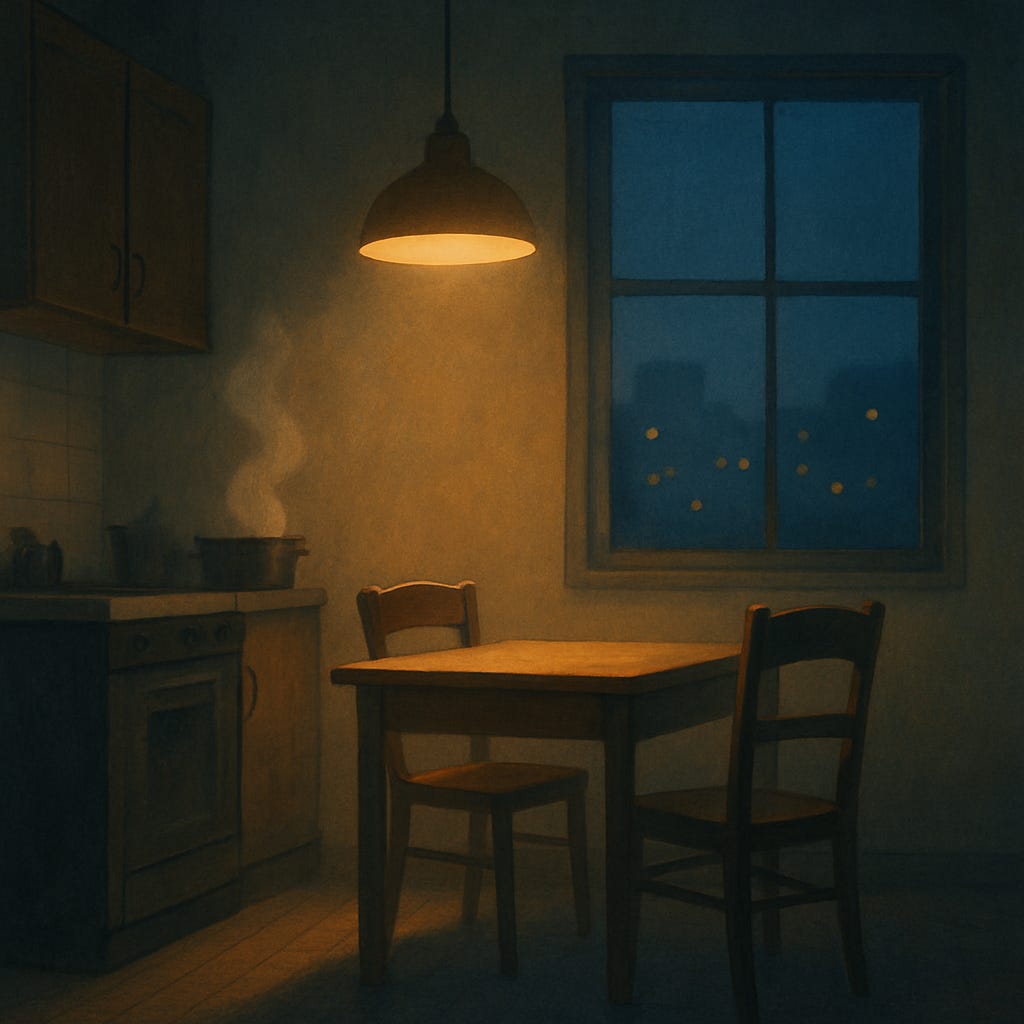
The uniform did not need to be burned. It was hung on a chair because the room no longer required a password. The cathedral of noise remained down the street—open when weather demanded it—but most evenings we practiced a smaller liturgy: keys on the table, water on to boil, a window cracked to let the day leave at its own pace. Freedom arrived not as a shout but as a schedule that loved tomorrow.
Elders did not reappear as monuments. They emerged as habits with faces. A man answered at midnight and did not make it a story. Another taught soup. A third kept the hour when no one came. Witnesses grew into keepers by repeating the quiet things until they held. The line, once broken, began to braid itself again—three strands at a time: attention, patience, repair.
Desire did not shrink. It learned a grammar.We stopped asking nights to do the work of years. We let “no” become ordinary so that “yes” could keep its voltage. We touched in sentences the body could remember without a camera. What we refused did not make us smaller; it made space.
There were still parties. There were even tank tops. But sameness lost its jurisdiction. We recognized men by their laugh in the dark, by the way they carried news that hurt, by whether they could sit in a room where nothing was performed and not mistake it for failure. The market called this uninteresting. We called it home.
Some evenings we missed the old spectacle. That was allowed. We named the ache and did not rent it out. Boredom visited like weather and left the place cleaner. On those nights, we read aloud—three pages, then quiet—or walked the same block and noticed what the season had revised. We learned the courage of repetition: the kind that builds a people.
If there is a benediction, it is small.May your rooms be legible.May your strength be useful.May your refusals be kind.May your promises fit on paper and be kept in fatigue.May your art return what it steals improved.May you find an elder to call and a younger man to feed.May the door you keep stay simple to find.
And when law interrupts, as law must, may the room keep its shape.When the music stops, may tenderness remain audible.When the grid forgets your name, may someone still know your Tuesdays.
This is the mercy of ordinary nights: not that nothing happens, but that what happens can be repeated without spectacle and survived without shame. If we earn that—kitchen by kitchen, choir by choir, hand by steady hand—the uniform becomes a coat, the cathedral a rehearsal, liberty a vow, witness a craft, and a life something more than visible: a place where language and love are born again.
—Elias WinterAuthor of Language Matters, a space for reflection on language, power, and decline.
Thanks for reading Language Matters! Subscribe for free to receive new posts and support my work.