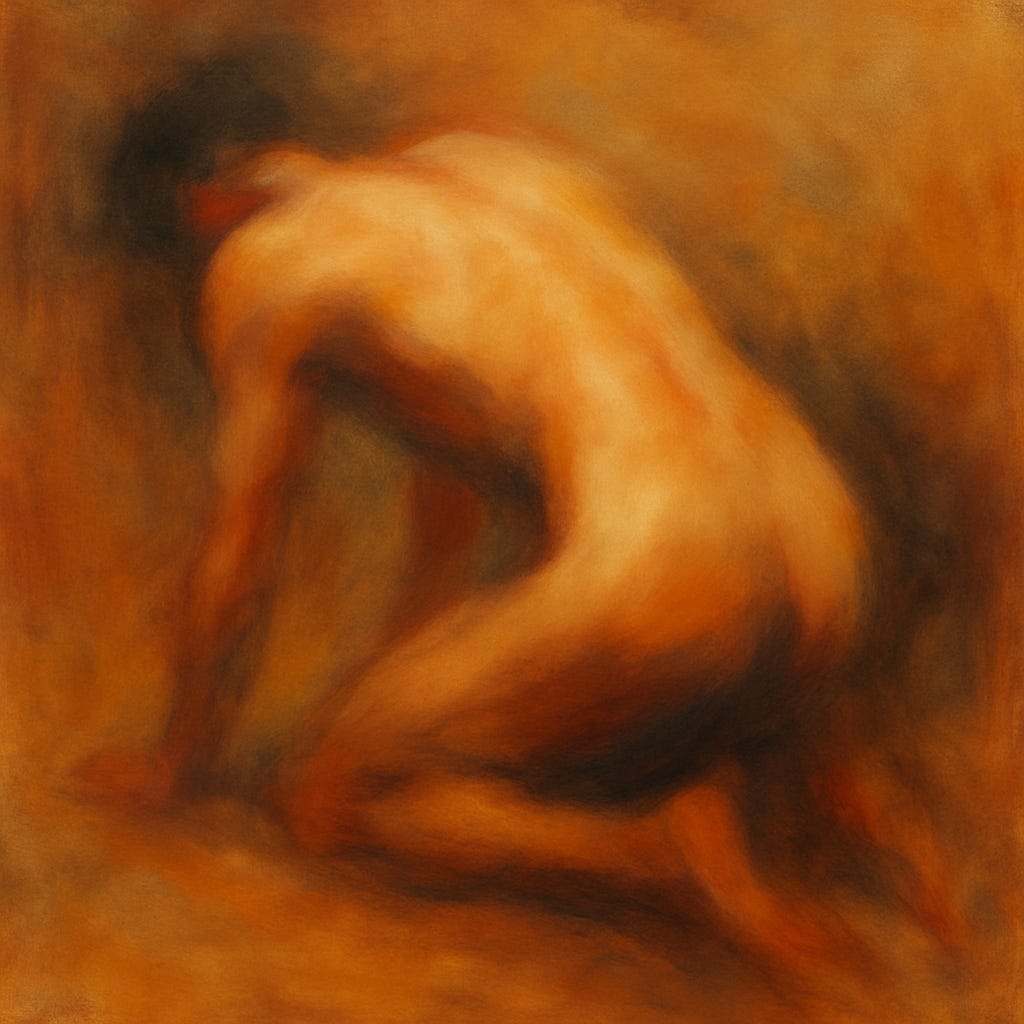
On the War Between Flesh and Story
Chapter 1: Margot
The morning is wet in the grass. The air smells of iron and something soft—milk, maybe. Her sides twitch. A fly lands and stays. She does not swat it.
There is mud beneath her left hoof, but not deep enough to bother. She shifts her weight from one leg to the other, slow. Her joints remember the night. She slept standing again. She does not remember why.
Nearby, the small one stirs. The small one always wakes before the boy. He does not cry, only breathes sharply and kicks a little. She turns her head—not sharply, just enough—and sees him. He is warm and not yet hungry. This pleases her. She returns to stillness.
A bird calls. Not one she fears.
The sky is the wrong color for summer, but the trees are still. That means it will not rain soon. She doesn’t know how she knows that, only that she does. Her body knows the order of things. Her body does not lie.
A sound—gate metal—sings in the distance. Her ears twitch before her head does. The boy is coming. His steps are not fast. He does not shout like the other one. He is kind. He brings salt or apple, and once, he wept into her shoulder for reasons she did not need to understand.
She likes him best when he is quiet.
He reaches the fence and leans his chin on the post. Watches her. She watches back. He is still. She is still. Then he laughs—not loud, not cruel—and tosses something over. It misses. She does not mind. The small one trots to it, nose to ground. Finds it. Licks. Looks up at her.
She turns away, slowly, and chews.
The heat is coming now. She feels it through the spine first. There will be flies. There will be biting. But not yet.
There is peace in this hour.
She does not miss the others. The ones who were taken. Her body remembered them for a while. Especially the tall one with the sick eye. But memory fades where it is not needed. This is wisdom.
The small one lies down again, a soft thud in the dirt. He is not yet named, but she knows him. He is hers.
She chews. The boy watches. The sun lifts behind the trees.
And for a long time, nothing moves.
Chapter 2: The Lie
I once watched my father’s cow chew in perfect stillness for what felt like an hour. Her name was Margot. She had a calf named Googie, who followed her like breath. She did not know what she was. That’s what made her free.
I did not understand that at the time. I thought we were different.
Humans have always told stories. That much is true. But what no one wants to say—what I will say—is that we are not just storytellers. We are liars. By instinct. By survival. By design.
And the first lie—the deepest, most enduring lie—is that we are not animals.
This lie is not accidental. It is strategic. The mind cannot tolerate its own origins. It needs distance. It needs metaphor. It needs a sky god and a clean shirt and a word for everything except blood.
So we invented purity. We invented dominion. We dressed ourselves in language and called it dignity. We built temples. Then we built walls.
But the body remembered.
That was the problem. The body remembered things the mind refused. Hunger. Rage. Milk. F*****g. Grief. These were not ideas. They were not metaphors. They were not sins. They were truths. And truth has always been a problem for us.
We named it sin and wrapped it in shame. We called it “lower” nature. We carved out a ladder of being, put angels on top and worms on the bottom, and declared ourselves almost divine. Almost. Close enough to matter. Far enough to excuse the slaughter.
But the lie never settled. It flickered. It cracked at the edges. You can hear it even now—in the prayers that are whispered just before orgasm, in the drunken confessions of men who can’t stop hitting what they want to love.
The mind lied. The body didn’t.
And so a war began—not between nations, but within each of us. A war between flesh and story. Between sensation and symbol. Between what we are, and what we needed to believe.
The cow did not know she was a cow. That was her freedom. I knew I was not a god. That was my wound.
Chapter 3: Beneath the Stone
The creature did not flinch when the light touched it. That was the first thing I noticed.
Its body glistened in the damp—segmented, pink, dumb to the interruption. It moved forward, slowly, by compression. No legs. No eyes. No clear direction. Only motion, as if movement itself were a memory.
I crouched to watch it.
There were four more, all close, nearly touching. I wondered if they knew each other. The idea was absurd. But it lingered.
The soil was dark, soft from the morning’s rain. I lifted another stone, slower this time. The same bodies beneath—soft, unhurried, purposeful in a way that did not concern me. I did not disturb them.
I had begun this habit with no real intention. It was merely the shape my mornings took. My wife said nothing of it anymore. She had learned that silence was more companionable than curiosity.
The creatures fascinated me. Not for their uniqueness—there was nothing unique about them—but for their refusal to mean anything beyond what they were. They did not hesitate. They did not posture. They did not ask the air for justification.
They joined when they met. No prelude. No flirtation. Just a thickening at the midsection, a shudder, and then a separation. Two of them mated once, inches from my boot. I had never seen anything so honest.
I took notes when it felt appropriate. But mostly I watched.
There were days I envied them. Their blindness. Their certainty. Their freedom from narrative.
And yet, it was not just envy. It was a kind of awe. The awe of something older than scripture. More precise than speech.
The smallest ones seemed to move in groups. I suspected familial connection. But I did not write that down. I had learned, over time, to distrust the reach of metaphor.
I spoke aloud, sometimes, to test how it sounded. “They live beneath the threshold of invention.” I said it once. I regretted it.
These were not metaphors. They were facts. They were reminders.
The garden was quiet. The sky was still gray. I did not mind the damp.
Later, at the table, I would be asked again about the trip. The islands. The bones. The birds. I would nod and speak politely. I would say that the finches were useful. I would not say that the worms haunted me more.
They were, in truth, the reason I began to suspect we had not ascended. We had merely learned to cover the ground with story.
Chapter 4: On All Fours
He said “mask for mask” in the chat. I didn’t answer right away.
His photo was half a face, blurred. The kind of body that doesn’t need to show more than a shoulder. He wrote: Hosting. Laid back. Clean.
I was already hard. I don’t know if it was him, or the wanting. The wanting is older than the man.
I didn’t ask his name. He didn’t ask mine. That’s part of the dance. You pretend it doesn’t matter so the body can matter more. We stripped language down until there was just enough left to get the address.
I cleaned out. Brushed teeth. Deodorant, not cologne. I don’t know why that matters to me, but it does. One last look at my face. Then down. Shirt off. Back on. Off again. I left it off.
I walked.
The hallway smelled like someone else's dinner. The elevator was slow. I thought about turning back, but that’s just habit now. The voice that says don’t go comes from the same place as the one that begs please, someone, take me.
He opened the door in shorts. No shirt. Nice body. Bigger than me. Not too big. He didn’t smile. Just nodded and turned around.
No lights. Just a lamp. A couch. A closed window. Music I didn’t know. Bass-heavy, forgettable. I stood for a moment. He didn’t look back.
Then, from the kitchen:“Drink?”
I shook my head.
He opened a drawer. Came back with the bottle. Little brown glass. I nodded. He passed it. I breathed it in.
Poppers. Alkyl nitrite. Cheap from the sex shop near 8th. First sniff hits like a cough from behind the eyes. Second one makes everything shimmer, like the body's a floor and someone turned the light on underneath it.
I sat.
He knelt.
We didn’t talk. He unzipped me like it was part of a shift change. Like he’d done it a hundred times that day. I was already leaking. I hated that. I loved that.
He sucked. I didn’t moan. That’s also part of the contract.
Then:“You wanna?”
I nodded.
He got up. Took the bottle again. He sniffed. I watched his nostrils flare. It looked like a reflex. Like hunger.
I didn’t know I was remembering her. Not yet.
I stripped fully. Laid on the bed. No sheets. Just mattress. Clean enough.
Then I turned.
All fours.
That’s the position.
No eye contact. No language. Just the sound of the poppers bottle hitting the floor and my own breath flattening into the mattress.
Then—he pushed in.
And everything—every story I had ever told myself—left.
That I was a man. That I was in control. That this was sex. That I was choosing. That I was sacred. That I was safe. That I was human.
Gone.
There was only the pressure, the tearing, the sick want of it. I felt it split me and join me at once. I hated him. I needed him. I could feel him pulsing and I hated that too. I wanted to cry. I didn’t. I moaned instead.
He said:“Good?”
I said:“Yeah.”
But that’s not what I meant.
I meant:This is the end of the lie.I meant:I am on all fours and I know what I am.I meant:I am a thing. I am what you f**k.
And for a moment—one flash, between thrusts—I felt God. Not the watching kind. The kind who remembers being soil.
And I think He forgave me.
Chapter 5: The Cost of Seeing
The study is dim. A single lamp throws its glow over stacks of journals, dried specimens, brittle letters—everything I once thought would grant clarity. Now the light seems to bend around them, not illuminating, but waiting. As if it too expects a confession.
I press my hand to my chest. My heart still beats. Slower now, more irregular, like a man trying to leave a church he no longer believes in.
In the evenings, I sometimes sit by the fire without opening a book. I used to find that impossible. Now, the silence feels heavier than the words. I have read too much, known too much, undone too much.
There is one letter I keep near. Emma’s handwriting, delicate as ever: "While you are acting conscientiously, you cannot be wrong." She still believes. She still prays for my soul, quietly, without asking that I return. There is mercy in that restraint, and it makes me love her more.
I believed once, too. Not as a child—my faith was never innocent—but I believed that the world had order. That its cruelty was accidental. That suffering, if it occurred, was watched by something kind.
But I went away. I saw things.
The reef-building corals. The high plains of Patagonia. The fossils of monstrous creatures buried in beds of salt. I saw a forest, thousands of years old, petrified into stone. I saw the beak of a finch adjust to the shape of a seed in less than a generation. And I saw the insect—unholy in its perfection—that lays its eggs inside the living body of another, so that its young may feed upon its host while it still breathes.
None of that was design. None of that was benevolence. It was survival—ferocious, blind, and intimate.
I returned with journals filled with observations, with doubts too large to name. I knew what I had seen. And I knew what it meant.
We were not placed.
We were not guided.
We were not separate.
We had emerged. Like anything else. Like the worms in the garden, who live without light and mate without shame. We, too, were of the soil. Only clothed in language and memory.
This is where the pain begins.
It is not that I wanted to keep believing in God. Not quite. It is that I did not want to wound those who did. Emma. My children. My father’s ghost. I began to live as a man split in two: the part that knew, and the part that remained silent.
That silence cost me more than speaking would have. I think I understand now why the Church feared us—those of us who saw. Not because we were defiant, but because we were heartbreakingly honest. Because we could not lie, even when the truth was ugly.
And it is ugly. I have seen it in the bones.
I have seen it in the jaws of ancient fish. In the pelvis of a whale that no longer walks. In the tailbone of man, where evolution forgot to clean up after itself.
I have seen it in Annie. My daughter. My child. The one whose grave made it impossible for me to believe in providence again. How could such suffering be part of a plan? What kind of mind would demand it?
When I lie in bed now, I feel the earth pressing up toward me. My body is tired. My eyes blur. My stomach fails me. Some days I feel like I am already part of the soil, and the worms are only waiting for me to fall still.
And yet—some evenings—when the pain subsides, when the fire is soft, and I hear the sounds of the house settling, I do not despair. I think of truth. Not as a possession, but as a discipline. Something you love even when it does not love you back.
It is not God I miss. It is comfort. The illusion that there was someone watching. That we were more than clever animals with an ache to transcend ourselves.
But there is beauty in knowing. There is beauty in facing it.
We come from the soil. We return to it. Everything in between is movement, and fear, and longing. We invent stories to survive the middle. But the beginning and the end are the same.
Sometimes, when no one is looking, I go to the garden and lift a stone. Just to see what moves beneath. The worms still live there, blind and sure. I watch them as I once did, before I knew what they meant.
They do not care that I am dying. They do not care that I once gave the world a new shape. They know nothing of God. They know nothing of shame. They mate. They split. They dig. They persist.
And in some quiet part of me, I envy them.
Chapter 6: After the Door Closes
He zipped up without looking at me.
The window was still closed. The music had stopped, or maybe it was still playing and I just didn’t hear it anymore. My body was still warm—open—but the room had gone cold.
He said, “Thanks,” like he was leaving a coffee shop.
I was sitting on the bed, knees pulled up, trying not to make it weird. I could still smell him on me—clean sweat, latex, the ghost of poppers. I didn’t want to wipe it off yet. I didn’t want to be empty again so soon.
He put on his socks standing up, like a dancer. Balanced. Casual. I watched his back curve slightly as he bent forward. His spine caught the light for a second and I thought: God, he’s beautiful. Not sexy. Not hot. Just beautiful. Fragile and temporary and real.
“Do you wanna sit a bit?” I asked, soft.
He paused. Just for a beat.
Then: “I’ve got to be up early.”
He smiled, politely. That soft-smile people give when they’re closing a tab, ending a call, hanging up on something gently. I wanted to grab his hand, to ask him not to go, but I didn’t. That’s not allowed.
He found his phone, checked it. I saw my own reflection in the dark glass, blurry. I looked tired. A little boy who never grew up. A body used, then left folded at the edge of the mattress like laundry no one wants to put away.
He said, “Take care, okay?” and was already near the door.
I nodded. “Yeah. You too.”
He left. No hug. Just a closing door. Not loud. Just final.
I sat there for a while.
I looked at the pillow where his head had been. It didn’t smell like him. It didn’t smell like anything. I put my fingers there anyway, just to feel close to something that had already left.
I stood. My legs were sore. I walked to the window, opened it. The city was quiet in that strange 3 a.m. way—still alive, but softened. Like the world had put on its pajamas.
I thought: Why do we do this to each other?
It’s not just sex. It’s not even rejection. It’s something else. That moment after, when someone has seen you from the inside out—has literally been inside you—and then doesn’t want to stay. Not even for a glass of water. Not even for five minutes of being human together.
I don’t blame him.
We were both raised in this world.
We were both taught that hunger is more acceptable than need. That if you come without catching feelings, you’re strong. That a hole is just a hole. That to want more is embarrassing.
But I do want more.
I want someone to look at me afterward. Not just during. I want someone to notice the scar on my ribcage from when I fell as a kid. I want someone to ask if I ever cry during movies. I want someone to sit on the edge of the bed and say, You’re kind of strange. I like that.
I want someone to see me after the door closes.
Tonight, it’s just me. Again.
I walked to the bathroom. My knees cracked. My thighs were sticky. I washed slowly, not because I needed to, but because I didn’t want it to be over yet.
And when I looked in the mirror, I didn’t hate what I saw. I looked… honest. Messy. A little haunted. But real. The kind of face that could belong to anyone—an ancestor, a shepherd, a monk, a child. Just someone who wanted to be held.
I dried my hands. I lit a candle.
I sat on the floor.
I didn’t cry.
But I did speak aloud. Not to God. Not to anyone.
Just to the room.
And what I said was: “I am still here.”
Chapter 7: The Gate
It was early. The kind of early where the grass is still wet, but the light is already gold. My father always woke before me. By the time I came out, he was already in the barn, already speaking in those low murmurs only animals understand.
I stood by the doorframe and watched.
Margot was patient. That’s the word I learned for it later. At the time, it just meant she didn’t fight. She didn’t flinch when he placed the stool beside her or leaned his head against her side. She swayed a little, like she knew his rhythm. Like the two of them were one animal, divided by language.
Googie was smaller then. Barely more than a shadow of her mother. Her legs too thin, too fast. My father used to make her run toward Margot during milking—not to feed, not yet, but to remind Margot of something. Of the calf, of the need, of the softness behind the ache.
And Margot would let down.
Milk hit the pail like rain on a roof. Sharp, soft, endless.
Sometimes, my father sang. Not well. Not loud. But it made the air warmer.
He never saw me watching.
He never told me to help.
After the milking, he would open the small gate. Always with the same gesture: hand on the latch, shoulder turned. As if he was bowing to her, not releasing her.
And then Margot would step into the light.
Not run. Not bolt. Just walk, slow at first. As if remembering the feeling of her own weight.
Then—every single morning—she would do the same thing.
She would dance.
Not a leap. Not a performance.
Just a sudden joy. A shift in the shoulders. A little kick of the back legs. A shake of the head. A swing of the tail like music had touched her from the inside.
And then again—two steps, then another lift, as if the earth was too much, and she needed, for just a second, to be not of it.
I watched her move like that, dust on her back, milk still warm on her belly, the sun climbing the fields behind her. She never looked at me.
But I think she knew.
I think the world knew.
There was no language in that moment. No names. No fences. Just a body emptied, a body remembered, a body that could still move.
And somewhere in my small chest, I felt it, too.
That life could still be beautiful after use.
That you could still dance, even after being touched.
That maybe this was the closest we ever got to being free.
Chapter 8: The Dance
There was pressure again. Warm hands. A voice low like earth. He pressed his head to my side, as he always did. His breath moved through me.
I stood.
I stood because I had stood a thousand mornings before.
The child was near, the one who smells like wind and metal and milk not yet gone sour. I felt her small body come close. I felt the ache respond. The letting go.
The milk left me. Into a bucket. Into the world. I did not move.
The ache softened. The light was climbing.
Then the sound—metal and wood. The hinge. The opening.
The gate.
He opened it.
I stepped forward.
The ground was wet. It held the night still. But the sky had already begun its forgetting.
I walked. One step. Another.
Then something in me moved.
Not a thought.
A flick. A lift of leg. A turn of neck. The dust rose around me like joy without name.
I did not do it to be seen.
I did not do it for the calf.
I did not do it for anything.
I did it because I was still alive.
I did it because my body remembered.
Because the sun was on my back.
Because the ache had gone.
Because no one was asking anymore.
I kicked.
I turned.
I danced.
The air was mine.
Epilogue:
We are the ones who left.
Left the field, the flesh, the forest. Left the morning milk still warm. We stood upright, made fire, made fences, made laws. We planted rows of grain and called it order. We tamed animals and named ourselves different.
We built. My God, we built.
Pyramids, cathedrals, engines, circuits. We built clocks to discipline the sun. We built empires to discipline the body. We split the atom. We mapped the code. We taught our children to sit still.
We wrote poetry, and then we monetized it.
We cured plagues, and then we monetized that too.
We told ourselves the story of progress so often that we forgot it was a story.
And what did we lose?
We lost the morning gate. The one Margot danced through.We lost the softness behind the ache. The eyes that looked back.We lost the right to forget ourselves in the grass.We lost the right to not be watched.We lost the yes before the word yes existed.
But still—we remember.
In the body, in the shame, in the hunger we name desire.In the silence after the door closes.In the soft rejection that feels older than language.In the calf’s first cry.In the worm turning under the leaf.
And so we stand here—brilliant, brutal, half-awake—and we ask:
Can you be freeAfter you’ve known the cage?Can you danceAfter you’ve been used?
And the answer is Margot.
The answer is always the dance.
We are animals who dreamed.
We are dreams that built cages.
We are cages that broke open.
And the only freedom that matters nowIs the freedom to moveWhen the gate opens.
—Elias WinterAuthor of Language Matters, a space for reflection on language, power, and decline.