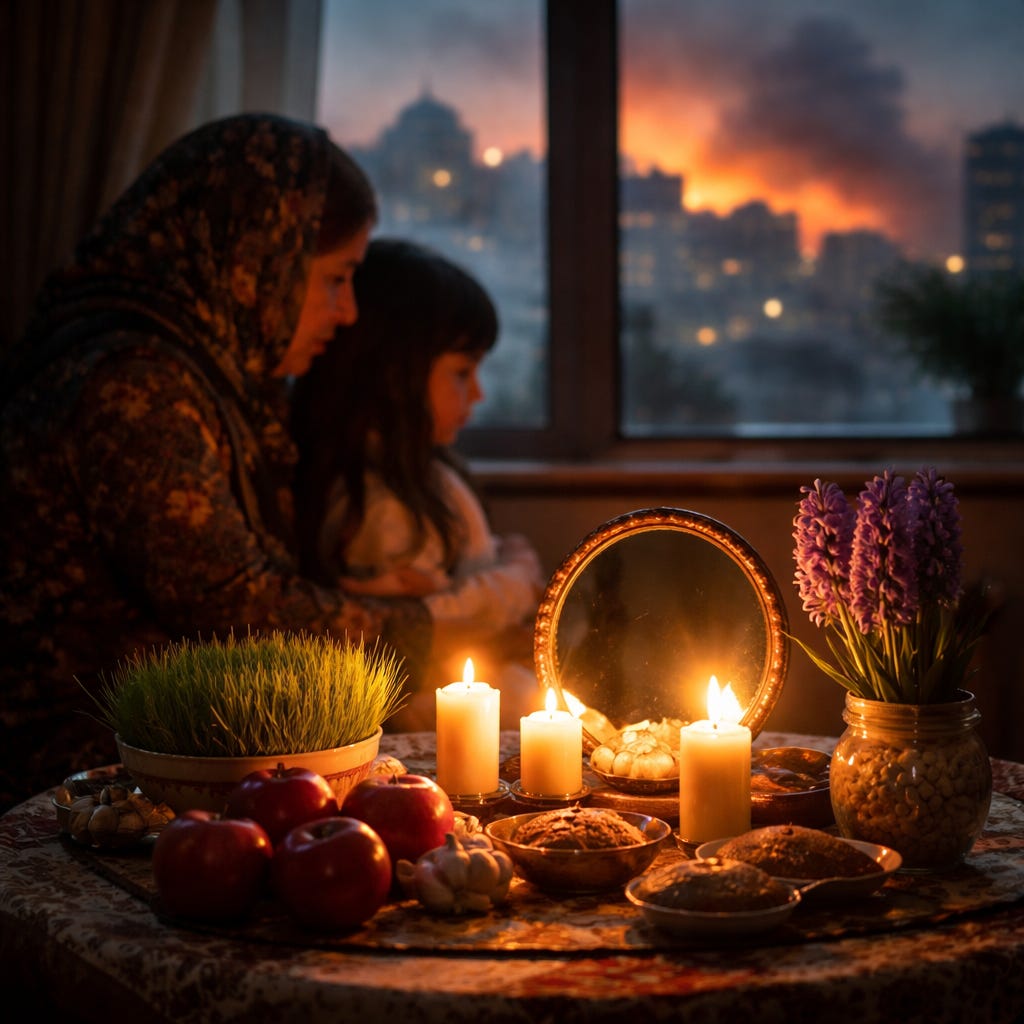
They set the table while the city shook.
Not because the city was safe. Not because the planes had turned back or the prisons had opened or the dead had been restored to their names. They set it because the year was turning, because spring had arrived according to a law older than the republic, older than the clerics, older than the sanctions, older than the states now discussing Iran as though it were a file and not a civilization.
In the Tehran apartment, the grandmother arranged the Haft-Seen with the concentration of a woman not decorating but repairing. The sabzeh leaned toward the window. The apples were polished until they held the room in miniature. Garlic in its white quiet. Vinegar in glass. Sumac, dark red. Samanu, sweet and dense, as if wheat itself had learned endurance. At the center, the mirror stood upright, waiting to return a face to itself.
Outside, a siren rose and broke against the apartment blocks.
Inside, the grandmother adjusted the hyacinth and told the child not to touch the candles.
The girl sat cross-legged on the carpet and watched with the solemn curiosity children reserve for adults who seem to know something about how the world is put together. She had already learned enough to be afraid of sounds. She knew the difference between the crack of celebration and the crack that sent parents reaching for phones. She knew that power could come from above and from within, and that both could call themselves necessary.
The grandmother placed the mirror at the center of the table.
“Why are we doing this?” the girl asked. “If everything is breaking?”
The old woman looked up. Her face had the calm severity of someone who had survived enough history to stop mistaking panic for thought.
“Because,” she said, “a people that forgets the new day has already agreed to die.”
The girl frowned, not because she disagreed, but because children know when they have been given an answer too large for the question they asked.
Outside, another sound, distant this time, something between thunder and metal.
The grandmother sat beside the table and drew the child closer.
“Listen to me,” she said. “There are governments. There are armies. There are men who think the world begins when they speak and ends when they strike the table. Let them think it. Iran was old when their grandfathers were still dust.”
The child touched the edge of the mirror.
“Did Iran begin at Nowruz?”
The grandmother smiled.
“No. Nowruz is how Iran remembers that beginnings do not happen only once.”
The parents had not yet returned. The mother was with a sick aunt. The father had gone in search of fuel, or bread, or news, which in a city under pressure begin to resemble one another. The grandmother had been left with the child and the table and the turning of the year.
For most of history, this has been enough: an elder, a child, a room, and a story wide enough to hold a nation until morning.
The child leaned against her shoulder.
“How was the world made?” she asked.
And because in that house, as in so many houses before it, the question of creation did not belong first to theologians or rulers but to grandmothers and frightened children, the old woman began.
Before there was a world, she said, there was not nothing.
Adults say “nothing” because they like clean beginnings. But the old stories are wiser. Before there were mountains and markets and apricot trees and little girls asking questions, there was order. Not written, not spoken, not carved into stone. More like the reason light knows how to be light, and water how to be water, and spring how to return when winter has done its worst.
“In Persian,” the grandmother said, “we have words for this. In older worlds, our ancestors had other words. But they all pointed toward the same thing: truth, order, the way things are meant to stand.”
“At first,” she said, “there was no king in the sky making lists. There was no judge building the world like a clerk building an office. There was order. There was form waiting to appear.”
Sky rose into place. Earth settled beneath it. Waters found their limits. Fire was placed among created things not to consume them but to reveal them.
The child’s eyes widened.
“So fire is alive?”
The grandmother laughed softly.
“Everything is alive if you listen long enough. But fire is special. Fire tells the truth. Fire does not let dirt pretend to be clean.”
Outside the window, evening had gone gray, then metallic. Somewhere in the building a faucet coughed. Somewhere down the street people shouted, then stopped. The grandmother continued.
“When the world was made, it was beautiful, but it was not finished. That is the first thing foolish people never understand. They think creation means completion. But the old Iranian wisdom knew better. A garden can be planted and still need tending. A child can be born and still need teaching. A country can have a history and still lose itself.”
“So who finishes it?”
“No one,” she said. “Or everyone.”
She touched the sabzeh.
“The world was made so that living beings could choose whether to help truth stand or help falsehood spread. That is why speech matters. That is why promises matter. A lie is not just a wrong sentence. It is a small betrayal of reality.”
“And every spring,” she said, “the world is given another chance. That is Nowruz. Not a party. Not a costume. Not an excuse for photographs while the city burns. It is the day the world says again: I am willing to live.”
The girl stared into the mirror, where the candles doubled themselves.
“Does that mean the world can die?”
The grandmother took a breath.
“It can be made ugly. It can be made cruel. It can be made forgetful. But as long as someone remembers the order beneath the ruin, it can begin again.”
The child was silent for a while. Then she asked the question that turns cosmology into history.
“Where did we come from?”
The grandmother leaned back.
“From far away and very close.”
“That is not an answer.”
“It is the only true one.”
She did not point to a map. Maps come late and always lie a little.
“Long before Iran was called Iran,” she said, “before Persia was called Persia, before kings built stone stairs for ambassadors to climb, there were people under very wide skies. Horse people. Fire people. Song people. They moved with their animals. They measured time in frost and thaw, in pasture and return. They did not carry the world in books. They carried it in memory.”
The child imagined them at once: riders under a hard sky, women tying bundles, children on carts, old people watching the horizon.
“They had priests,” the grandmother said, “but not like later priests. They had singers, keepers of old words. They had warriors, because beauty does not protect itself. They looked at the world and saw pattern. They saw that spring returns but never without winter first collecting its due. They learned that the world is lawful and fragile.”
“Were they Iranian?”
“Not yet. They were the ancestors of many peoples. Some would go west. Some would go toward India. Some came into this land and joined themselves to it so deeply that after a while you could no longer tell where rider ended and plateau began.”
The child traced an invisible route in the air.
“So we came from somewhere else.”
“We all do,” the grandmother said. “Only idiots and tyrants believe purity is a history. Every real civilization is made of meetings.”
Then she told her how those old peoples came into lands where others already lived. Not empty lands. Never empty. There were farmers there, builders, keepers of grain and water, people who had already learned how to coax life out of difficult soil.
“And did they fight?” the child asked.
“Sometimes. Of course. But fighting is never the whole story, no matter what men and textbooks prefer. They mixed. They married. They borrowed. They changed one another. The people of pasture met the people of field. The keepers of fire met the keepers of grain. And over time something new took shape.”
She paused.
“Iran.”
Not yet a state. Not yet a border. Something older and less fra…