Substack Notes is allegedly where writers hang out.
This is already funny.
Because what you mostly see there is not writing. It is slogan mist. Little moral burps. Tiny pellets of virtue. Sentences with the confidence of philosophy and the nutritional value of airport gum.
Most Notes are not arguments. They are badges.
They do not begin with a question. There is no method. No architecture. No attempt to think through a problem. No “here is the claim, here is the evidence, here is the tension, here is what would have to be true for this to hold.”
No. That would be insane. That would require reading.
Instead, the Note says: here is the morally approved feeling, compressed into a sentence, released into the feed for other people with the same feeling to applaud.
A slogan is not an argument. A slogan is a sticker. An argument is a bridge.
A slogan says: “Are you one of us?”
An argument says: “Can this survive contact with reality?”
The feed does not want the second one. The second one is rude. It interrupts the vibe.
What the feed wants is fast moral recognition. You scroll, you see the approved phrase, you nod, you like, you repost, you move on. Nobody has learned anything, but several people have been reassured that they are good.
This is apparently culture now.
And the prose is often bad. Not interestingly bad. Not wild, alive, Dostoevsky-on-three-hours-of-sleep bad. Just bad. Sloppy. Flat. Ungoverned. A sentence that looks like it was assembled during a minor allergic reaction.
But even the badness has become part of the costume.
Because now bad prose can signal authenticity. No AI here. No polish. No craft. Just raw humanity, bravely failing to use commas.
This is ridiculous.
AI is a tool. You can use it to cook a good meal or a crap meal. The problem is not the stove. The problem is the cook.
A bad sentence written entirely by a human finger is still a bad sentence. Congratulations on your artisanal mediocrity.
The deeper problem is not style. It is moral corruption.
A lot of these Notes come from the liberal class, the people who still think they own the language of justice, care, democracy, empathy, truth, and decency. But much of what they produce is not moral thought. It is emotional virtue signaling with a Wi-Fi connection.
And people can feel that.
They may not have the vocabulary for it, but they feel the fraud. They hear “justice” and smell branding. They hear “empathy” and suspect class performance. They hear “democracy” and wonder which HR department wrote the sentence.
Then MAGA walks in, demonic as ever, and says, “These people are fake.”
And the terrible thing is: the accusation lands.
Not because MAGA is good. It is not. MAGA is the worship of resentment. It takes grievance, kneels before it, and asks who must be punished.
But the liberal class has its own resentment too. It is just less red-hat and more workshop language. If you fall on the wrong side of the approved phrase, the kindness vanishes quickly. Suddenly the people of care, nuance, and compassion become very enthusiastic about social punishment.
So we get two forms of resentment.
MAGA says: “I hate you, and that makes me real.”
The liberal feed says: “I am morally correct, and that gives me permission to hate you properly.”
Very different fonts. Similar smell.
And this is what the next generation sees when they log in.
They learn that writing is not thinking. Writing is posting.
They learn that a sentence does not need a question behind it. It needs a signal. It needs to identify the villain, display the virtue, and arrive already pre-approved by the target audience.
Worst of all, there is no longer a clean distinction between reader and writer.
Everyone is a writer now. You need a phone and a finger. That is the whole apprenticeship.
But nobody is a reader.
Reading requires receiving something before reacting to it. It requires staying with another mind long enough to be changed, annoyed, challenged, or humbled by it.
The feed destroys that. On the feed, reading is just the brief pause before you produce your own little sentence. The text is not something you enter. It is something you use as a trampoline for your own performance.
So the system cannot fix itself.
The people writing the bad Notes are the people reading the bad Notes. The people reading the bad Notes reward the bad Notes. The rewarded bad Notes teach everyone what a Note should be.
It is a closed economy of low-quality moral exhaust.
There is no incentive to improve because the audience is the author and the author is the audience and everyone is applauding the same little slogans while pretending civilization is being advanced.
This is not a literary culture.
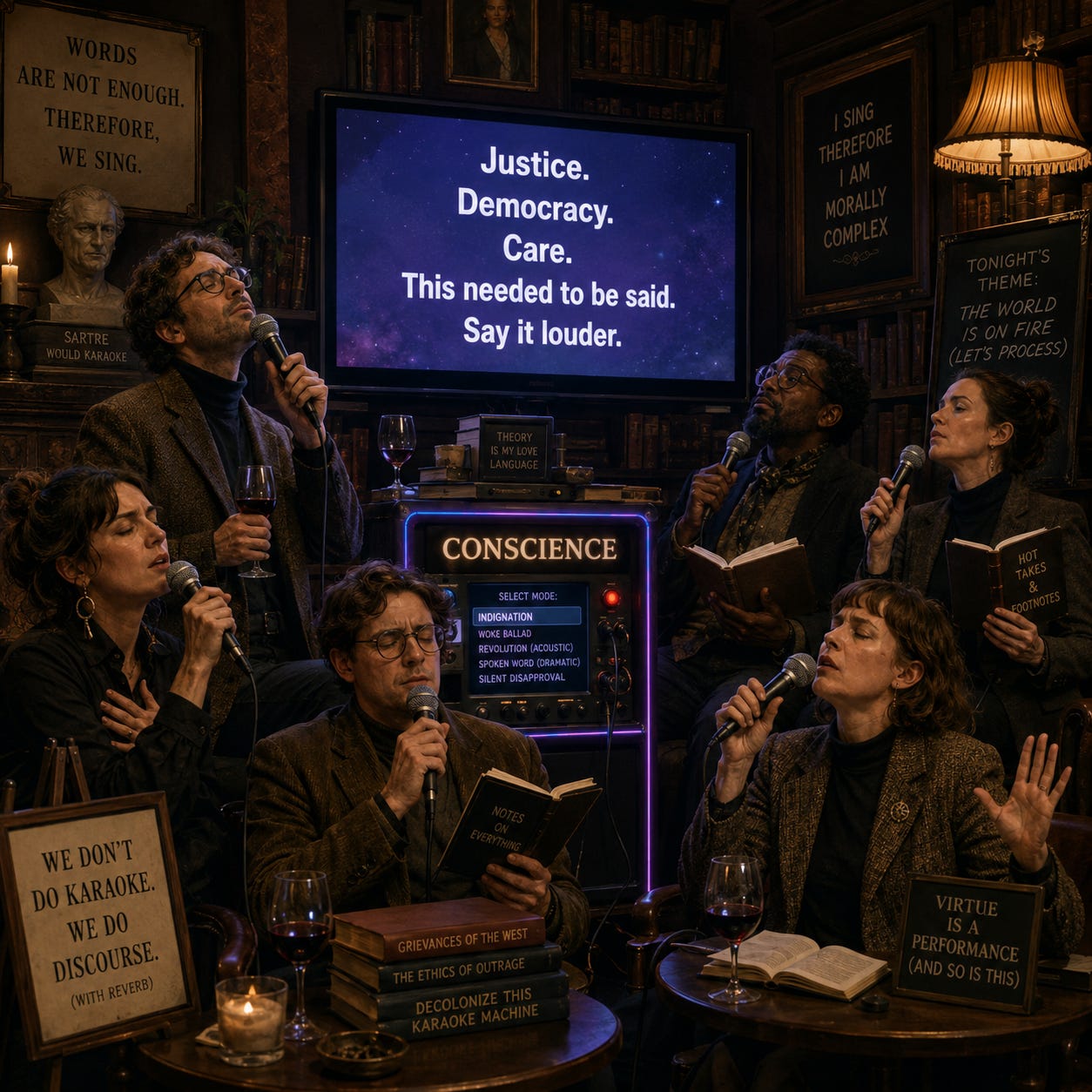
It is a karaoke machine for conscience.
And the saddest part is that everyone involved thinks they are singing.
—Elias WinterAuthor of Language Matters, a space for reflection on language, power, and decline