Chapter 1 — The Alibi Removal Service
I fell asleep with my laptop open the way a man falls asleep with a knife in his hand: not because he plans to stab anyone, but because he’s convinced the world is full of intruders and he’s the only one awake enough to see them.
In the dream, the room is not my room. It is a room that has the posture of authority without the décor—like a courtroom that got tired of pretending it wasn’t a theater.
There’s a desk. Behind it sits God.
Not the bearded Renaissance God. Not the thunderbolt God. Not the solemn icon God with the thousand-yard stare.
This God looks like he runs customer support for an airline. Sleeves rolled up. Coffee. A face that has read too many emails that begin with “Just circling back.”
He is scrolling.
At first I think it’s a holy book.
Then I see the interface.
Substack.
My Substack.
God doesn’t look up. He keeps scrolling the way a bored teenager scrolls a feed, except the boredom is ancient and the attention is lethal. He scrolls like someone who invented time and regrets it.
“You’re late,” he says.
“I’m asleep,” I say.
“You’re late to your own crisis,” he says. “That’s impressive.”
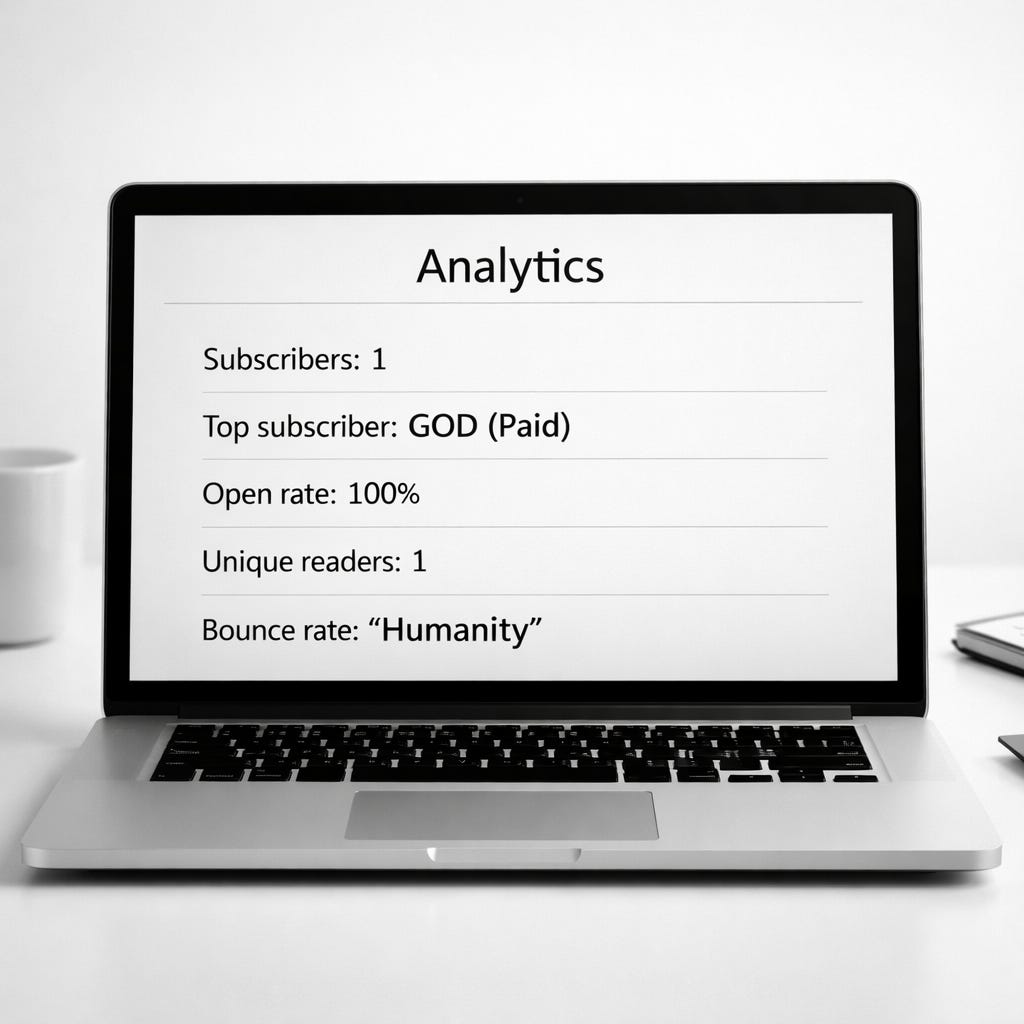
He turns the screen toward me. The dashboard is open. Analytics. Traffic. Subscribers.
There is a number in the “Top Referrers” box.
It’s just one word.
HEAVEN.
I swallow. “You—”
God holds up a finger without looking up.
“Before you say anything,” he says, “yes. I’m the only person who reads your essays.”
I feel a rush of relief and horror collide in my chest like two cars driven by the same man. “That’s—”
“No,” he says. “Don’t do that. Don’t make it noble. Don’t turn it into a martyrdom narrative. You’re not being persecuted. You’re being ignored.”
He takes a sip of coffee like it’s sacramental.
“Nobody reads them,” he continues, still scrolling. “Not because they’re bad. Not because they disagree. Because your essays do what people hate most.”
“What?”
He finally looks up. His eyes are not wrathful. They’re tired in the way a good parent is tired: the kind of tired that comes from watching the same lie be reinvented every generation with new fonts.
“You remove alibis,” he says.
I stare at him. “I’m trying to tell the truth.”
“Exactly,” God says. “Truth is an alibi removal service.”
He taps the screen.
“Look at this one. Strong opener. Great sentence rhythm. And then—bang—you commit the unforgivable crime.”
“What crime?”
“You take away the little stories they tell themselves to survive their own choices.”
I feel indignation rise. It has the taste of righteousness, which is how it seduces you.
“People are living inside a lie,” I say. “They’re anesthetized. They’re—”
“They’re doing what humans do,” God says. “They’re coping.”
He leans back.
“And you,” he continues, “you write like a man who walks into a crowded room and unplugs everyone’s emotional IV.”
“That’s not—”
God raises the finger again.
“I’m going to say this slowly, because you like slow things. You like time horizons.”
He speaks as if he’s dictating to a stenographer.
“They don’t hate you because you expose power. They hate you because you expose them.”
A silence lands between us.
In the silence, I realize I’m looking for the moral high ground like it’s a chair in a room where God has removed all chairs.
“I don’t expose them,” I say. “I’m talking about systems.”
God laughs, once, without joy. A short bark, like a judge who has heard a defendant say, “I didn’t mean it,” one thousand times.
“You always say systems,” he says. “It’s your favorite way of not admitting you’re talking about people. Including you.”
He swivels the laptop again and pulls up one of my essays. I can’t read the title because my eyes are doing that dream thing—letters wobbling like they’re trying to escape.
God can read it fine. Of course he can.
He highlights a paragraph without touching the trackpad. It lights up anyway.
“This is the paragraph where you remove the first alibi,” he says.
“What alibi?”
God starts listing them the way a sommelier lists notes in a wine, except the notes are the flavors of self-deception.
“‘I didn’t know.’”
He scrolls.
“‘It’s complicated.’”
Scroll.
“‘I’m just one person.’”
Scroll.
“‘I had no choice.’”
Scroll.
“‘Both sides.’”
Scroll.
“‘At least I’m not like them.’”
He looks up again. “You remove those. One by one. Sometimes in a single sentence. You do it with style, which is rude.”
I feel a defensive heat. “So what do you want? For me to lie?”
God’s eyebrows rise. “There it is.”
“What?”
“The dramatic binary,” he says. “Truth or lie. Prophecy or silence. You love that. It makes you feel like a soldier.”
“I’m not—”
“You are,” God says. “You’re a soldier who thinks the war is against ‘power.’”
He says the word power with quotation marks in his voice, like he’s mocking my tendency to summon abstractions like they’re demons.
“The war,” God continues, “is also against the average person’s desperate need to feel innocent while benefiting from the machine.”
I open my mouth, then shut it. Because the sentence is too clean. Because it lands.
God watches my face.
“Now,” he says, “let’s do a simple experiment.”
He snaps his fingers.
The room changes.
We’re in a living room that looks like every middle-class American living room designed by an algorithm: neutral couch, big TV, throw pillow that says BREATHE like a threat, a bowl of decorative wood balls that have never been touched by wood.
A man sits on the couch with a phone in his hand. He’s not a villain. He’s not a caricature. He’s just a person.
On the TV, a panel of people are shouting, but the volume is low. It’s more like the TV is generating a visual texture of outrage, a moving wallpaper of conflict.
God points at the man.
“Watch,” he says.
The man scrolls. His thumb moves like a metronome. Every few seconds his face tightens—micro-anger, micro-satisfaction, micro-disgust, micro-relief.
“He works,” God says. “He pays bills. He complains about the price of eggs. He occasionally donates to something if it’s emotionally legible.”
The man looks up at the TV. On-screen, someone says something about “freedom.” Someone else says something about “justice.” The man nods as if his nod is a moral act.
God leans down toward me like we’re conspirators.
“This man is not your enemy,” he says. “But he has a religion.”
“What religion?”
God points at the phone. “Innocence.”
I frown. “That’s not—”
“It is,” God says. “His highest value is the ability to feel like a good person without changing his life.”
I want to object. I want to call it structural. I want to call it ideology. I want to call it alienation.
God anticipates all of it.
He says, “Don’t say ‘alienation.’ Don’t say ‘late capitalism.’ Don’t say ‘spectacle.’ You write those words the way people used to write ‘demon.’ It makes you feel like you’re naming a thing.”
“I am naming a thing.”
God nods. “Yes. You are. But watch what happens when you name it too clearly.”
He gestures toward the man on the couch. The man’s phone screen changes. Now it shows one of my essays. The title is visible. I recognize it. I feel a heat of pride, like an idiot.
The man starts reading.
Two paragraphs in, his face changes. Not anger. Not disagreement.
Something closer to the flinch you see when someone hears a truth that moves too close to their private ledger.
He scrolls faster. Skims. His eyes bounce, looking for an exit ramp.
Three paragraphs later, he stops. His thumb hovers. He stares at a sentence as if it has accused him by name.
Then he does what most humans do when a mirror is unflattering:
He looks away.
He taps the back button.
He returns to the feed.
God watches him return to the feed the way a doctor watches a patient refuse the medicine and ask for another painkiller instead.
“See?” God says.
“He couldn’t handle the truth?” I ask, and even as I speak I can hear how contemptuous it sounds.
God turns to me sharply.
“No,” he says. “He couldn’t handle responsibility.”
The room’s light shifts. The couch seems suddenly like a confessional booth.
God continues, “Your essays don’t simply say, ‘The system is corrupt.’ They say, ‘You are inside it. Your attention funds it. Your habits reinforce it. Your moral outrage is a recreational drug.’”
I start to speak, but he cuts me off.
“And that,” he says, “is why people leave.”
I feel my own throat tighten. “So I should make it easier?”
God stares at me like I just asked if gravity could be turned off for aesthetic reasons.
“No,” he says. “You should understand what you’re doing.”
“What am I doing?”
God’s voice becomes almost gentle, which is how you know the next thing will hurt.
“You are walking into a world where people survive on stories,” he says, “and you are writing like someone who is allergic to stories.”
“I’m not allergic to stories. I write stories.”
“You write stories that function like scalpels,” God says. “Most people are not coming to the internet for surgery.”
I feel the urge to defend myself with theology.
“Clarity is compassion,” I say. “If you love someone you tell them the truth.”
God nods slowly.
“Yes,” he says. “But you also have to know that compassion without any allowance for human weakness reads as cruelty to the weak.”
I bristle. “I’m not trying to be cruel.”
“I know,” God says. “That’s part of the problem. You’re confused about why the door keeps closing, so you keep writing louder, sharper, cleaner, as if moral precision alone can hold a reader’s nervous system.”
He leans forward.
“Listen,” he says. “You have a correct diagnosis: the culture is addicted to alibis. You see the anesthetics. You name them. Good.”
He pauses.
“But you keep acting surprised that people prefer anesthesia.”
I look down at my hands. In the dream, my hands look like hands that have typed too much.
God says, “Let me show you the real reason your essays don’t spread.”
“Because people are cowards?”
God gives me a look that could erase a century.
“Because your essays are not a viewpoint,” he says. “They are an event.”
“What does that mean?”
“It means reading you costs something,” God says. “It costs innocence. It costs plausible deniability. It costs the ability to keep enjoying the feed while pretending it’s just entertainment. It costs the comfort of thinking the problem is always somewhere else.”
He gestures again, and now the living room fills with invisible people—crowds of readers, each holding a different alibi like a talisman.
God starts taking them away.
One reader loses “I didn’t know.” She panics.
Another loses “I had no choice.” He gets angry.
Another loses “It’s complicated.” He becomes cruel, because complexity was his refuge.
Another loses “Both sides.” He becomes anxious, because neutrality was his armor.
Another loses “I’m just one person.” She feels exposed, because helplessness was her excuse.
God takes them gently, but the scene looks like a kind of exorcism.
“What are you doing?” I ask.
God looks at me.
“I’m showing you what your prose does,” he says. “You are an exorcist of excuses.”
“That sounds good,” I say, automatically.
God sighs.
“It is good,” he says. “And it’s exhausting. For them. For you.”
He sits back at his desk. The living room dissolves. We’re back in the courtroom-without-decor. The laptop is open again. Heaven is still the top referrer.
God scrolls to the bottom of the page and reads out loud a line from my own essay.
I don’t remember writing it, but of course I did. In dreams, your own words return like witnesses.
He reads, “You cannot mourn collapse while continuing to feed it.”
Then he looks at me.
“You wrote that,” he says.
“Yes.”
“And you meant it,” he says.
“Yes.”
God taps the screen. “Now understand this: that sentence is a guillotine for most readers.”
I swallow.
God continues, “They come to writing to feel something, yes. But mostly they come to feel something without having to change. Your work doesn’t offer that bargain.”
“So what do I do?” I ask.
God smiles, and for the first time it’s almost mischievous.
“You stop confusing avoidance with misunderstanding,” he says. “You stop thinking your problem is that you haven’t explained yourself well enough.”
He closes the laptop with finality.
“And,” he adds, “you stop imagining that the primary enemy is ‘power’ out there.”
He stands. The room feels suddenly smaller.
“The primary enemy,” God says, “is the human need to feel innocent while staying comfortable.”
He walks past me, then stops at the door.
He turns back.
His final line lands like a stamp.
“You think you’re fighting power,” he says. “Half the time you’re fighting people’s innocence addiction.”
Then he opens the door and the dream lets winter in.
Chapter 2 — Roleless in Austin (Population: You)
When God opens his laptop again, it isn’t my dashboard.
It’s a seating chart.
Not metaphorical. Literal. Like a wedding planner’s spreadsheet. Rows and columns. Names. Assigned places.
Across the top: READERS.Down the side: ROLES.
There are blanks everywhere.
God looks at me with the mild contempt of someone who has watched me complicate my own life for sport.
“You keep asking why nobody engages,” he says.
“I do not—”
He clicks a cell. It highlights red.
“You do,” he says. “You ask the question the way a man asks a locked door why it won’t open.”
He swivels the screen toward me. I can see the rows now. The roles are labeled like a menu no one ordered:
* Student
* Fan
* Debater
* Confessor
* Co-conspirator
* Enemy
* Client
* Congregant
* Patient
* Spectator
* Disciple
* Peer
Across the top are reader names, but they’re not names. They’re placeholders. “Woman, 42, Kansas.” “Man, 29, London.” “Grad student, tired.” “Engineer, angry.” “Pastor, lurking.” “Journalist, afraid.”
Every cell is empty.
God taps the empty grid with his finger. The click sound is too loud, like a gavel in a cheap courtroom.
“This,” he says, “is your comment section.”
“I don’t have a comment section.”
God gives me a look that says exactly.
“You do,” he says. “It’s just inside people’s heads, and it ends with them closing the tab.”
I feel heat rise in my throat. “My work isn’t… it isn’t designed to be a fan club.”
“Correct,” God says. “You hate fans.”
“I don’t hate—”
“You do,” he says. “You hate anyone who reads you the way people read to feel smarter. You hate anyone who tries to wear your essays like a jacket. You hate anyone who says ‘Needed this’ as if your work is a supplement.”
I open my mouth. Shut it.
God continues, “You hate the roles because roles are where people hide.”
“That’s true,” I say, glad to have a line that sounds like integrity.
God nods. “It is true.”
Then he leans in, and his voice becomes that of a man about to ruin your favorite theory.
“It is also why nobody knows where to stand when they read you.”
I want to protest. But I already know the feeling. The feeling I get when someone speaks to me in a register that isn’t recognizable. When the usual social cues fail and you’re left holding your own face in your hands like a mask that won’t attach.
God says, “Your essays collapse roles.”
“I told you. Roles are lies.”
“Roles are scaffolding,” God replies. “You knocked down the scaffolding and then got offended that no one moved into the building.”
He clicks again.
The room changes.
We’re in a restaurant.
It’s a nice restaurant, which is how I know it’s a dream: I don’t belong in nice restaurants unless I’m in a business meeting pretending I’m relaxed.
There’s a hostess stand. There are candles that cost more than my childhood. There’s jazz playing at a volume that suggests moral seriousness.
The hostess is God.
He’s wearing a black vest like a man who owns the place and is playing a role for fun.
He smiles with professional warmth that is clearly weaponized.
“Welcome to Language Matters,” he says. “Table for one.”
“I’m not—”
“Shh,” he says, holding up a menu. “Tonight’s tasting menu is twelve courses of indictment. There is no vegetarian option. There is no dessert.”
He leads me past tables.
Every table is occupied by a reader.
They all have the same expression: cautious interest mixed with mild panic, like people who agreed to go to a haunted house on a first date and now regret their personality.
God seats me at a table in the center, under a spotlight that I did not request.
He places a menu in front of me.
The menu is blank.
I look up. “Where’s the—”
God leans close and whispers, “We don’t do roles here.”
He walks away.
A waiter approaches. The waiter is also God. Same face. Different tie.
“Good evening,” Waiter-God says. “May I take your order?”
“There’s no menu,” I say.
Waiter-God smiles. “Exactly.”
Around me, I hear the low murmur of readers trying to orient themselves.
At the table to my left, an anxious woman asks, “Are we supposed to agree with this?”
At the table to my right, a man in a blazer says, “Is this political?”
At the table behind me, a young person with a nose ring says, “Is this trauma writing or is it… like… philosophy?”
Another voice: “Is it okay to like this?”
Another: “Is it okay to share this?”
Another: “If I share this, will people think I’m… that kind of person?”
God glides between tables like a shark wearing cologne.
He whispers to one reader, “You can’t be a fan.”
To another, “You can’t be a student.”
To another, “You can’t be a critic.”
To another, “You can’t be a confessor.”
To another, “You can’t be innocent.”
Each whisper is a polite theft.
The readers tense. The room chills.
I watch as every familiar social posture is removed, and with each removal, people become more awkward, more exposed, more irritated.
God returns to my table.
“See?” he says.
“What am I seeing?”
“You built a place where no one knows what kind of body to bring,” he says. “So they leave. Not because they disagree. Because they can’t locate themselves.”
I feel defensiveness spike. “They should just read.”
God snorts. “Spoken like a man who thinks ‘just’ is a word that still works.”
I want to explain the purity of my intent.
God interrupts before I can.
“Humans don’t ‘just read,’” he says. “They enter a text through a role. Even if they don’t know it.”
He points to a table where a middle-aged man is holding a fork like it’s a weapon.
“That guy wants to be a debater,” God says. “He wants to argue with you, publicly, so he can feel alive.”
He points to a woman staring at her phone under the table.
“That one wants to be a student,” God says. “She wants to extract lessons and be done.”
He points to a young man who looks like he has cried in many bathrooms.
“That one wants to be a confessor,” God says. “He wants to read you like a priest and leave absolved.”
He points to a woman with sharp eyes, taking notes.
“That one wants to be a critic,” God says. “She wants to place you in a lineage and avoid being moved.”
“And you,” God says, “you refuse all of it.”
I nod, almost proud. “Because it’s all performance.”
“It is,” God says. “And it’s also structure.”
He sits across from me now, folding his hands like a man about to deliver a sermon, then remembers he hates sermons and chooses sarcasm instead.
“You’ve written work that destroys the usual social arrangements,” he says. “You refuse to be the therapist. You refuse to be the pundit. You refuse to be the prophet in the costume. You refuse to be the wounded darling of the internet.”
I say nothing. My silence is a small prayer.
God continues, “So what happens when someone reads you?”
“They confront the truth.”
“They lose a chair,” God says.
I blink. “A chair.”
“A chair,” he repeats. “A posture. A way to hold themselves while the words hit.”
He gestures around the restaurant.
“Most writing offers chairs,” he says. “Even serious writing. Especially serious writing. Chairs are how humans tolerate being confronted. They give people a way to stay in the room long enough to be changed.”
He leans in.
“You remove the chairs and then you get angry that people don’t stay to renovate themselves standing up.”
My jaw tightens. “I’m not angry.”
God smiles. “You’re not angry. You’re wounded. You wanted witnesses.”
I flinch. Because it’s true. I wanted readers who could see what I see.
God’s voice drops slightly, just enough to make the next line feel intimate and cruel.
“You wanted a communion,” he says. “You built a court.”
“I built—”
“Your prose is not an invitation,” God says. “It’s a summons.”
I feel my chest go hot.
“I’m telling the truth,” I say, again.
“I know,” God says. “But the truth isn’t just content. It’s structure.”
He taps the table.
“You are writing as if readers are already equipped,” he says. “As if they can stand unprotected in front of responsibility and not instinctively reach for the nearest role to hide behind.”
He points at the blank menu.
“This,” he says, “is you.”
I look down at the empty page.
“It’s pure,” I say, and even as I say it I hear the vanity in my voice.
God nods. “It is pure.”
Then he says, “And purity is socially disorienting.”
A waiter appears—also God, which is getting absurd.
Waiter-God sets down a plate in front of me. There is nothing on the plate.
“What is this?” I ask.
Waiter-God says, “It’s the role you gave your readers.”
He walks away.
I stare at the empty plate, and something inside me—annoyance, shame—rises.
God watches my face carefully, like he’s observing an experiment.
“You know what most people do when they encounter emptiness like that?” he asks.
“They fill it.”
“Yes,” God says. “With whatever role is available.”
He gestures.
At the far table, a reader begins performing outrage. She’s chosen the enemy role. It gives her structure.
At another table, a man begins praising the work loudly, theatrically. He’s chosen fan because it’s safer than being implicated.
At another table, someone begins tweeting quotes out of context. They’ve chosen amplifier because it lets them participate without standing still.
God looks back at me.
“And the rest,” he says, “leave.”
I swallow. The truth is not in the sentence; it’s in my body recognizing it.
“So what do I do?” I ask.
God’s eyes brighten, like a man delighted that the defendant has finally asked the right question.
“You stop thinking chairs are moral compromises,” he says. “You start thinking of them as entry ramps.”
“Entry ramps.”
He nods. “You can keep your integrity. You can still refuse the cheap roles. But you can also offer a reader a way to stand in the room without immediately needing to run.”
I feel resistance. “That sounds like softening.”
God laughs. “You’re addicted to the idea that gentleness is betrayal.”
I glare.
He continues, “There are ways to structure an encounter without domesticating the truth.”
He points at the seating chart again.
“Build a few intentional roles,” he says. “Not for the masses. For the handful who can actually carry it.”
“What roles?”
God counts on his fingers.
“A steward,” he says. “A reader who can hold the work without turning it into a personality.”
“A curator,” he says. “Someone who can frame without flattening.”
“An interlocutor,” he says. “Someone who can argue without turning it into a sport.”
“And,” he adds, “a friend. Someone who can read you and still call you when you’re spiraling.”
The last one lands differently. Too close.
I look away.
God lets the silence sit.
Then he reaches across the table and picks up my blank menu, as if he’s about to write something on it.
He doesn’t.
He just folds it in half and slides it back to me.
“Here’s your problem,” he says. “You abolished every role and called it honesty.”
I feel anger rising. “It is honesty.”
“It’s also a design choice,” God says. “And design choices have consequences.”
He stands, adjusting his vest.
As he walks away, he delivers the verdict like a line he’s said to too many writers in too many dreams.
“If you abolish every role,” he says without turning back, “the only remaining role is ‘leave.’”
Chapter 3 — Moral Seriousness as a Hate Crime
In the dream, God is no longer behind a desk.
He’s at a party.
That’s how I know it’s a dream: God is at a party and I’m still invited.
The party is the kind of party that exists only in cities that think they invented sincerity and then immediately outlawed it. There are string lights. There are drinks with herbs. There is a bookshelf in the corner that is purely decorative. Nobody has read the books. The books have been curated the way people curate vegetables they never intend to cook.
People are laughing in that careful way people laugh when they want to signal that they are safe. The laughter is polite. It has a résumé.
I stand near the wall, holding a drink I haven’t tasted, watching the room like an anthropologist who hates his own species and still wants them to survive.
God appears beside me without walking.
He’s dressed exactly like everyone else: casual, expensive, “unbothered.” The only difference is his eyes look like they’ve seen the end of every empire and still had to attend the afterparty.
He nods toward the room.
“You see this?” he asks.
“Yes,” I say.
“What do you see?”
I almost say: the spectacle.I almost say: performative liberalism.I almost say: the collapse of the moral center under the weight of ironic self-defense.
God watches my face like he’s reading subtitles.
“Don’t,” he says.
“Don’t what?”
“Don’t do your little sermon voice,” he says. “Don’t say ‘spectacle’ like you’re exorcising a demon.”
“It is a spectacle,” I say.
God takes a sip of his drink and grimaces, as if even in dreams he’s offended by mixology.
“It is,” he says. “But that’s not why people don’t read you.”
I feel my shoulders tense.
He turns to me.
“People don’t resist your politics,” he says. “They resist your seriousness.”
I narrow my eyes. “That’s the same thing.”
“No,” God says. “Politics is negotiable. Seriousness is contagious.”
He scans the room. A cluster of people are laughing at something that wasn’t said; they’re laughing at the idea of laughing. Their faces glow with the relief of shared non-commitment.
God leans in, conspiratorial.
“In a culture where nothing is allowed to matter,” he says, “the man who insists something matters is experienced as an attack.”
I feel the familiar indignation, that clean bright anger that makes me feel like I’m doing righteousness instead of self-protection.
“I’m not attacking anyone,” I say. “I’m trying to—”
“—tell the truth,” God finishes, bored. “Yes. I know. You say it like a mantra.”
He points at me with his drink.
“You think your problem is that people misunderstand you,” he says. “But most of the time, they understand you perfectly.”
“Then why do they—”
“Because you’re violating the social contract,” he says.
“What social contract?”
God gestures around the party.
The music is soft. The conversation is low. The lighting is designed to make everyone look like they’re morally intact.
“The contract,” he says, “is that we will all pretend nothing has consequences. We will discuss everything as if it’s content. We will trade opinions like trading cards. We will be outraged without obligation. We will care without cost. And we will call that virtue.”
I want to argue.
I want to say: that’s nihilism.I want to say: that’s late-stage empire.I want to say: that’s the death of the center.
God’s eyes flick to mine again.
He says, “Don’t. Keep it simple.”
He pauses.
“You,” he says, “walk into the party and you refuse to wink.”
I stare at him. “I don’t need to wink.”
God smiles as if I’ve just proven his point.
“At last,” he says. “A sentence you truly believe.”
He puts his glass down on a table. The table has coasters, but he doesn’t use them. God does not respect furniture.
“Let’s do a demonstration,” he says.
He lifts his hand.
The party freezes.
Everyone is suspended mid-laugh, mid-sip, mid-nod, like mannequins caught practicing humanity.
God takes me by the elbow and walks me through the room as if we’re touring an exhibit.
He stops by a man with perfect hair, frozen mid-story. The man’s mouth is open in a smile that says: I am interesting but not vulnerable.
God taps the man on the forehead gently.
“This one,” God says, “is trained in the ritual hedge.”
“The what?”
“The ritual hedge,” God repeats. “The thing that signals: ‘I am not morally serious, please don’t hold me accountable.’”
He taps the man again, and the man’s story unfreezes for a second.
“…not to be dramatic,” the man says.
God snaps. The man freezes again.
God points. “There. That’s a hedge.”
He moves to a woman holding her phone. Her thumb is frozen mid-scroll.
He taps her shoulder. She unfreezes.
“…I mean, it’s complicated,” she says.
Snap. Freeze.
God nods. “Hedge.”
We move to another cluster. A woman is mid-laugh. God taps.
“…I’m just saying,” she says.
Snap. Freeze.
God turns to me. “Do you see?”
I feel my jaw tighten.
“They hedge,” I say.
“They hedge,” God agrees. “They surround every moral claim with padding.”
He walks to another person and taps.
“…both sides are kind of—”
Snap.
“Because if nothing is fully asserted,” God says, “nothing is fully demanded.”
He looks at me with a kind of weary amusement.
“And then,” he says, “you arrive.”
He gestures toward an empty space in the room as if he’s about to summon my own ghost.
A version of me appears. Dream-me. Same face, same tense shoulders, same eyes that look like they’re negotiating with God and losing.
Dream-me walks into the party and speaks to a frozen group.
There’s no hedge. No “just saying.” No “not to be dramatic.” No “I might be wrong.” No wink. No meme-ready shrug.
Dream-me says, calmly: “The future is being cannibalized, and your outrage is part of the business model.”
The room reacts as if someone dropped a live animal on the floor.
People don’t argue. They don’t disagree. They recoil.
Not from the idea.
From the demand.
God watches the recoil with the interest of someone watching a familiar reflex.
He turns to me. “There. That’s your comment section.”
I feel the need to defend myself.
“What do you want me to do?” I ask. “Pretend it doesn’t matter?”
God’s face shifts into something like pity, which on him looks like a mild headache.
“No,” he says. “I want you to understand the physics.”
“What physics?”
He gestures at the frozen party.
“In a post-moral culture,” he says, “seriousness is read as dominance.”
“I’m not trying to dominate.”
“I know,” God says. “And they know.”
He pauses.
“Which is why it’s worse,” he adds.
I frown. “How is it worse?”
God walks back to the bar, unfreezes the bartender just long enough to hear him say, “We’re doing a mezcal thing tonight,” then freezes him again out of mercy.
God turns back to me.
“If you were merely arrogant,” he says, “they could dismiss you.”
“So they dismiss me anyway.”
“Yes,” God says. “But they dismiss you by calling you arrogant.”
He lets that sit.
“It’s not a diagnosis,” he continues. “It’s a defense.”
I feel something in my chest tighten.
God says, “They call you arrogant because you refuse to participate in the ritual that makes them feel safe.”
“What ritual?”
God begins counting off with his fingers, as if he’s listing a set of commandments he’s tired of enforcing.
“First,” he says, “you’re supposed to pre-apologize for caring.”
“Second,” he says, “you’re supposed to include a disclaimer that proves you’re not one of those people.”
“Third,” he says, “you’re supposed to make a joke at your own expense before you criticize anyone else.”
I almost laugh. “I do make jokes at my own expense.”
God looks at me. “You make jokes that are knives. They want jokes that are anesthetic.”
He continues.
“Fourth,” he says, “you’re supposed to keep the moral temperature low. A gentle simmer. No boil.”
“Fifth,” he says, “you’re supposed to offer an exit ramp: ‘But maybe I’m wrong.’”
“Sixth,” he says, “you’re supposed to end with hope, which is actually just emotional closure.”
He holds his hand up. “You do none of this.”
“I refuse to lie,” I say.
God nods. “I know. Again: correct.”
He steps closer.
“But you keep acting surprised that people experience your refusal as aggression,” he says. “Because you keep imagining that the only kind of aggression is volume.”
I say nothing. I can feel the truth in my body the way you feel cold air before the door opens.
God speaks more softly now, the way he does right before he makes fun of me again.
“Your seriousness threatens them,” he says, “because seriousness implies stakes.”
I swallow.
“And stakes imply judgment,” he adds.
“I’m not judging anyone,” I say quickly.
God’s smile is almost tender, which is terrifying.
“Yes you are,” he says. “You’re judging the system. And because they live inside it, they feel judged.”
I start to protest.
God cuts me off with a small gesture.
“And also,” he says, “they are judging themselves. Your prose just removes their ability to outsource that judgment to the algorithm.”
He picks up his glass again, takes another sip, and grimaces again. “This is terrible,” he says. “Why do humans drink smoke?”
Then, without warning, he claps his hands.
The party unfreezes.
A man near us turns and says, “So what do you do?”
I don’t know if he’s speaking to God or to me.
I start to answer seriously. Of course I do.
I start to say, “We have to restore moral grammar. We have to—”
God steps between us and says, “He thinks you’re asking for a plan. You’re not. You’re asking for permission to feel that this matters and still be liked.”
The man laughs politely, a laugh that isn’t joy but deflection. “No, no. I just mean—”
God leans in toward him and says, “You just mean you want to talk about collapse as a hobby.”
The man’s smile stiffens. “That’s not fair.”
God shrugs. “It’s accurate.”
The man walks away as if he’s leaving a conversation with an untrained dog.
I stare at God, horrified.
“You can’t say that,” I hiss.
God looks at me. “Why not?”
“Because—because it’s socially—”
God raises an eyebrow. “Socially what?”
I stop. Because the sentence I was about to say is: socially unacceptable. Which is another way of saying: it violates the contract of pretend.
God says, “Do you see your own reflex?”
I hate him for a second. Then I realize I love him. Then I hate that I love him.
God continues, “You keep thinking that if you could just explain yourself better, people would stop calling you arrogant.”
“Yes,” I say.
God’s face shifts into mock compassion. “My sweet boy,” he says, and I immediately want to punch him.
Then he drops the mock compassion and returns to tired clarity.
“They don’t call you arrogant because you’re above them,” he says. “They call you arrogant because you refuse to pretend nothing matters.”
He pauses.
“And because you won’t perform humility in the approved dialect,” he adds.
I grit my teeth. “So what do I do?”
God looks around the room at the laughing people, the safe people, the people whose souls are protected by irony.
He says, “You stop trying to be liked by a culture whose main technique of belonging is non-commitment.”
“That’s not an answer.”
“It is,” God says. “It’s just not comforting.”
He steps closer. His voice lowers.
“And you build humor,” he says, “not as a hedge, but as a delivery system.”
I blink. “Humor.”
“Yes,” he says. “Not irony. Not sarcasm. Humor. The kind that punctures you first so the reader can’t accuse you of puncturing them.”
He tilts his head. “You don’t need to soften the truth. You need to make it harder to weaponize your seriousness against you.”
I feel something like relief, and immediately distrust it.
God smiles. “Exactly,” he says. “Distrust relief. Relief is often just another alibi.”
He starts to walk away.
Then he turns back, as if remembering something.
“One more thing,” he says.
“What?”
“In this room,” he says, gesturing to the party, “moral seriousness reads as aggression because it forces everyone else to feel the cost of their laughter.”
He pauses.
“And your mistake,” he says, “is that you keep thinking the cost is your fault.”
He opens the door. Cold air enters, despite the party being indoors.
His verdict comes like a stamp.
“In a culture that survives on the fiction that nothing matters,” he says, “the man who refuses to wink will be treated like a threat.”
Chapter 4 — Non-Consumable Content and Other Business Models
God meets me in a conference room.
Not the kind with glass walls and a view. The kind with carpet that has seen despair. The kind that smells like whiteboard markers and deferred dreams.
On the table: a stack of papers. A projector. A bowl of stale mints that feel like a metaphor someone made by accident.
God is standing at the front like he’s about to present quarterly earnings.
He has a clicker.
This is, immediately, humiliating.
I sit down. My chair squeaks. Of course it does.
God clicks.
A slide appears on the screen.
GROWTH STRATEGY: ELIAS WINTER
Under it, in smaller font:
(A TRAGEDY IN THREE ACTS)
I squint. “What is this?”
God looks offended. “It’s a deck. You love decks. You love structure. You think if you just structure enough, the universe will apologize.”
He clicks again.
Slide 2:
MISSION STATEMENT“TO DELIVER NON-CONSUMABLE CONTENT TO PEOPLE TRAINED TO CONSUME.”
I wince. “That’s not fair.”
God raises an eyebrow. “It’s not kind. It’s accurate.”
He clicks.
Slide 3:
VALUE PROPOSITION
* Cannot be skimmed
* Cannot be excerpted
* Cannot be shared safely
* Cannot be turned into a take
* Cannot be enjoyed without implication
He turns to me with the satisfied look of a man revealing a magic trick.
“Congratulations,” he says. “You have built a product that resists every distribution channel on Earth.”
“It’s not a product,” I say automatically, like a man whose soul just got called a brand.
God’s face tightens.
“Oh, don’t start,” he says. “You publish on Substack, not the Dead Sea Scrolls.”
I open my mouth.
He holds up the clicker like a weapon. “Don’t you dare say ‘commodification.’ I will throw this at you.”
I close my mouth.
God clicks.
Slide 4 is a screenshot.
My Substack share buttons.
Twitter. Facebook. Email. Copy link.
God circles them with a laser pointer like a prosecutor highlighting evidence.
“Do you know what these buttons are?” he asks.
“Share buttons.”
“They’re confession traps,” God says. “They ask your reader to publicly associate themselves with your level of moral indictment.”
I blink. “That’s not—”
God clicks to the next slide.
Slide 5:
READER DECISION TREE
A flowchart appears.
At the top: “I read an Elias Winter essay.”
Then a branching question:
DID IT IMPLICATE ME?→ YES → Close tab, return to feed→ YES → Save it, never share→ YES → Share it, lose friends→ NO → (Impossible)
Under “NO,” there’s a little note:
(THIS BRANCH HAS NEVER BEEN OBSERVED IN THE WILD)
I stare at the chart. It is ridiculous. It is also… correct.
God says, “Your average essay is not a vibe. It’s a moral event.”
“Stop saying that,” I mutter.
God clicks.
Slide 6:
WHY VIRALITY WOULD KILL YOU
Bullets:
* Virality = excerpting
* Excerpting = flattening
* Flattening = weaponization
* Weaponization = people using you to avoid changing
* Result: you become a slogan factory against your will
God turns and points at the final bullet, which is in bold.
IF IT GOES VIRAL, IT WON’T BE READ. IT WILL BE USED.
God smiles. “There. We’ve reached the part of the presentation where you start nodding grimly and pretending you always knew this.”
I do nod grimly. I do pretend.
Then my resentment flares.
“So what am I supposed to do?” I say. “Write shorter? Add bullet points? Put a little ‘top five takeaways’ at the end like I’m an HR newsletter?”
God makes a noise that sounds like laughter strangled in its crib.
“Oh my God,” he says. “Yes. Exactly. Write a ‘top five takeaways’ called ‘Top Five Ways You’re Lying To Yourself’ and watch your subscriber count triple.”
I glare.
God sighs. “You’re doing the binary again.”
“What binary?”
“Pure cathedral or corporate slop,” he says. “Those are not the only two genres available to you, drama queen.”
He clicks.
Slide 7:
A photo of a cathedral.
Next slide: a tweet.
God points at the cathedral. “This is you.”
He points at the tweet. “This is the internet.”
He pauses.
Then he points at me. “This is you, trying to carry a cathedral through a mail slot.”
I feel my face tighten. “I’m not trying to go viral.”
God looks at me like I just lied badly in front of someone who invented the lie.
“You are,” he says. “In your own way.”
“No I’m not.”
“Yes,” God says, “because you keep getting emotionally injured by the absence of visible response.”
I go quiet.
God continues, “You tell yourself you’re above attention, but you keep checking the numbers like they’re a verdict on your worth.”
“That’s not—”
God’s finger goes up.
I stop.
He clicks.
Slide 8:
THE SILENT AUDIENCE PROBLEM
God writes on the slide with a digital pen:
* Serious work spreads slowly
* Serious readers rarely perform their reading
* Your work is risky to share
* Therefore: you will be read more than you will be witnessed
He sets the pen down.
“You’re undercounting the quiet readers,” he says.
“Convenient,” I say. “The invisible audience.”
God nods. “Yes. Convenient. Also true.”
He leans forward.
“You want me to give you a miracle?” he asks. “Fine. Here’s a miracle: there are people who read you and never, ever let you know.”
I feel something twist in my chest, part hope, part suspicion.
God sees it.
He says, “Don’t turn that into a fantasy. Quiet readers are not your salvation. They’re just reality.”
He clicks.
Slide 9:
WHY PEOPLE DON’T SHARE YOU
A list appears. Each line is a knife:
* Sharing implies “I agree,” and agreement requires cost
* Sharing invites social punishment
* Sharing makes them responsible for what happens next
* Sharing reveals their own complicity
* Sharing is a form of taking a side, and they like neutrality as camouflage
God points at the third bullet.
“This one is the real one,” he says.
“Responsible for what happens next.”
He nods. “Your essays make people feel like if they share you, they’ve signed a contract.”
I try to be sarcastic. “Maybe they should.”
God looks amused. “See? That’s why you’re alone.”
I open my mouth.
He keeps going.
“They don’t want a contract,” God says. “They want content. Content is a thing you consume and forget. A contract is a thing that binds you. Your writing binds.”
He clicks.
Slide 10:
THE ‘UNSHAREABLE’ ADVANTAGE
I blink.
God says, “Yes. It’s an advantage.”
He points to the slide, which has three bullets:
* Prevents mass co-optation
* Filters for serious readers
* Preserves the work’s integrity
Then, under a line, a single sentence:
BUT IT REQUIRES YOU TO STOP EXPECTING PUBLIC FEEDBACK AS PROOF OF IMPACT.
God turns to me.
“That,” he says, “is the trade.”
I feel anger.
“So I just—write into the void?”
God rolls his eyes. “You love the void. You titled an essay with it.”
“That’s different.”
“How?”
“Because—” I fumble. “Because I… I want to know it matters.”
God walks toward the screen and turns it off.
The room goes dim.
He says, “Tell me what you mean by ‘matters.’”
“It changes people.”
God nods slowly. “Okay. And what does that look like?”
“Comments. Emails. People—”
God interrupts. “No. That’s what recognition looks like.”
I swallow.
God says, “Change is quieter.”
He paces, like someone who is building a point and also enjoying that I can’t interrupt him with a clever line.
“Real change looks like this,” he says. “A man reads you and doesn’t forward it, because forwarding would be performative. But he stops lying to himself in one small way. He pays one debt he’s been avoiding. He calls his brother. He deletes one app. He votes differently. He speaks differently. He stops making a joke out of his own conscience.”
He looks at me. “And you will never know.”
“That’s unbearable,” I say.
God shrugs. “Yes. That’s why it’s called faith. You people are always surprised by this.”
I stare at him.
He smiles. “Don’t worry. You don’t have faith. You have obsession. We’re working on it.”
I feel the urge to fight him, which is my favorite form of prayer.
“So what do I do?” I ask, again.
God sits on the edge of the table, suddenly casual.
“You build containers,” he says.
“Containers.”
“Smaller forms,” he says. “Not to cheapen the work, but to allow it to travel without being destroyed.”
I tense. “That’s dilution.”
God’s eyes narrow.
“No,” he says. “That’s engineering.”
He continues, “You don’t have to make the cathedral smaller. You can build chapels.”
I hate that it’s good.
He says, “You can write shorter pieces that point into the longer ones. You can write prefaces. You can write a one-page ‘how to read this’ guide. You can create a glossary. You can do audio where your voice carries the tone and prevents flattening.”
He pauses.
“And,” he adds, “you can stop treating distribution reality as a moral insult.”
I feel a grim laugh emerge despite myself. “So I’m not misunderstood. I’m… unmarketable.”
God beams. “Now you’re getting it.”
Then he ruins it.
“You’re also addicted to the fantasy that the right mind will find you,” he says. “Like you’re a lighthouse.”
“I am a lighthouse.”
God makes a sound like choking.
“You’re a lighthouse,” he repeats, “that refuses to turn on the light unless the ships arrive first.”
I grit my teeth.
God stands, picks up the stale mints, and dumps them into the trash.
“Those mints,” he says, “are your ‘highlights’ feature. No one uses it. Everyone pretends they do.”
He walks to the door.
Before he leaves, he turns back and delivers the verdict, clean and unromantic.
“You wrote a cathedral,” he says. “Stop getting mad it doesn’t fit in a tweet.”
Chapter 5 — The Witness Trap (Now With Bonus Suffering)
God meets me in a trophy room.
This is immediately suspicious, because I do not own trophies. The only awards I’ve ever received are internal: quiet, invisible, and mostly shaped like resentment.
But here we are.
The room is lined with glass cases. Polished wood. Spotlights. Velvet pedestals. Each pedestal holds an object like it’s sacred.
God is strolling through the room like a museum docent.
He is whistling.
I recognize the tune, and it makes my stomach drop.
It’s the “walk-up music” they play at award shows right before someone receives something they absolutely do not deserve.
I turn slowly.
On the far wall, engraved in gold letters:
THE ANNUAL WITNESS AWARDSSPONSORED BY: SUFFERING
God stops beside a pedestal and gestures grandly.
“Welcome,” he says. “To your legacy.”
I squint at him. “This is not my—”
He cuts me off, delighted.
“Oh it’s yours,” he says. “I’ve been watching you accumulate these for years.”
He picks up a little gold plaque and reads it aloud, in a voice that mimics reverence so perfectly it becomes blasphemy.
“Most Improved Isolation,” he says. “Congratulations.”
He sets it down and moves to the next.
“Best Performance in a Leading Role: Noble Despair.”
He turns to me. “Your acceptance speech was gorgeous. Very long. A little self-pitying. Strong cadence.”
I feel heat rise. “I’m not—”
God raises a finger. “Don’t lie to Me in My own dream.”
He walks to a larger pedestal. This one holds a massive trophy shaped like an eye.
Under it: a plaque.
THE ONE WHO SEES
God beams. “Ah. Your favorite.”
I feel defensive immediately, which tells me he’s right.
“That’s not what I—”
He lifts the trophy and holds it out to me.
“Go on,” he says. “Take it. Put it on your mantle. Tell everyone at the party you don’t go to that you’re the only one who sees.”
I don’t take it.
God sighs theatrically. “Fine. I’ll hold it.”
He cradles the giant golden eye like a baby and starts rocking it.
“Shhh,” he coos. “Shhh. It’s hard being correct in public.”
I stare at him. “This is cruel.”
God looks genuinely surprised. “I’m being kind. If I were cruel, I’d make you read your own drafts aloud to a room of venture capitalists.”
He sets the trophy back down and turns to me, now more serious, but still with that customer-support fatigue.
“Let’s talk,” he says, “about the part of you that has started to confuse pain with proof.”
I feel my jaw tighten. “Pain is proof.”
God’s eyes narrow.
“Of what?” he asks.
“Of—of cost,” I say. “Truth has a cost.”
“Yes,” God says. “Truth has a cost.”
He pauses.
“Stop tipping,” he adds.
I blink. “What?”
God walks past the cases and points to another plaque.
MOST LIKELY TO BLEED EXTRA FOR AUTHENTICITY
He taps it with a knuckle.
“You keep paying the price,” he says, “and then paying an additional fee because suffering makes you feel… authorized.”
“That’s not true.”
God looks at me the way gravity looks at a man trying to negotiate with it.
“It is true,” he says. “Not in the dramatic way you want. In the small way that’s harder to admit.”
He starts walking again, slowly, as if he’s pacing a courtroom.
“You have a vocation,” he says. “Witness. Naming. Refusal. Fine.”
I feel myself straighten, relieved. Vocation is a clean word. It dignifies.
God notices.
He says, “Careful. I saw that. You love words that turn your nervous system into a cathedral.”
I bristle. “So what am I supposed to be? A content creator?”
God groans. “Don’t say that word in here.”
He stops in front of a final pedestal. This one is empty.
Just a velvet base. No trophy.
The plaque reads:
THE MOMENT YOU COULD HAVE STOPPED
I stare at it.
God speaks softly now.
“You keep acting like the only options are: tell the truth and suffer, or lie and be comfortable.”
I open my mouth.
He puts up his finger again. “Yes, I know you believe that. That’s the trap.”
He looks at the empty pedestal.
“This pedestal,” he says, “is for all the times you could have told the truth without also whipping yourself.”
I laugh bitterly. “And how exactly do I do that?”
God turns to me with an expression of genuine delight, like a teacher who finally got the student to ask the right question.
“Good,” he says. “Now we can do surgery.”
He snaps his fingers.
The trophy room dissolves.
We are in my bedroom.
Not an idealized dream version. My real room. The same chair. The same desk. The same laptop. The same faint smell of stale coffee and late-night resolve.
On the desk is my browser. Tabs open like a confession.
Substack. Notes. A half-finished draft. News. Some thread I don’t want to admit I was reading. Analytics.
God sits in my chair like he owns it, which he does, because he apparently owns my readership too.
He points at the laptop.
“Let’s review your spiritual practice,” he says.
“It’s not a spiritual practice.”
God nods. “Even worse. It’s a compulsive ritual with theological branding.”
I glare.
He scrolls, then reads aloud in a mock announcer voice.
“Tonight on: THE WITNESS TRAP,” he says, “Elias Winter will perform ‘integrity’ by staying up until 2:43 a.m. to write a paragraph that could have been written at 9:15 a.m., if he had slept like a mammal.”
I wince. “I write at night.”
God looks at me. “Yes. Because nobody can interrupt you. Because it feels like exile. Because exile feels like proof.”
He leans back.
“And because if you exhaust yourself, you don’t have to face what you actually need,” he adds.
I feel heat rise in my throat again. “What do I need?”
God smiles. “Ah. Now we’re in the dangerous part of the dream.”
He clicks his tongue and a new window appears on the screen: a list.
It’s titled:
NECESSARY COST vs. AVOIDABLE DAMAGE
Two columns.
God points at the left column.
“Necessary cost,” he says. “You will pay this no matter what. Ready?”
He starts listing, tapping each line as he speaks:
* “Some people will hate you.”
* “Some people will misunderstand you on purpose.”
* “Some people will admire you and never speak.”
* “You will not be rewarded proportionally.”
* “The work will isolate you at times.”
I nod. This is familiar. This is my theology. This is the part that makes me feel clean.
God points to the right column.
“Avoidable damage,” he says. “This is what you keep confusing with virtue.”
He begins listing:
* “Staying up late as a form of penance.”
* “Doomscrolling as ‘research.’”
* “Isolation as ‘integrity.’”
* “Refusing support as ‘purity.’”
* “Letting the body collapse because the mind wants to testify.”
I feel something like anger and shame.
“That’s not—” I begin.
God cuts me off. “Yes it is. I have receipts. I am literally God.”
He scrolls again.
“Look,” he says, “you write about embodiment. You write about attention. You write about cost. But you treat your own body like a disposable pen.”
I flinch.
God continues, more sharply now, “You’re not doing journalism. You’re not doing debate. You’re doing something closer to liturgy.”
I swallow. “Yes.”
“And then,” God says, “you behave like a man who thinks liturgy requires self-destruction.”
I feel exposed in a way that isn’t emotional. It’s mechanical. Like he’s found the hidden lever.
“Pain is part of it,” I say.
God nods. “Pain is part of it.”
Then he says, very simply:
“Damage is optional.”
The sentence hangs in the room like a bell.
I want to argue with it, because it threatens my favorite moral structure: the one where suffering proves seriousness.
God watches me struggle.
Then he leans forward, and the comedy drains out of his voice for exactly two sentences—no more, because he knows I’ll try to romanticize it.
“You have a history,” he says. “You do not get to make your nervous system the altar every time you want to feel legitimate.”
He pauses.
Then the humor snaps back like a rubber band.
“And if you keep doing that,” he adds, “I will unsubscribe.”
I laugh despite myself. It comes out ugly.
God smiles. “Good. Laughter means you’re still alive.”
I wipe my face with my hand, irritated by the moisture that suggests I am a creature.
“So what’s the instruction?” I ask. “What do you want me to do?”
God points at the empty pedestal again—the moment I could have stopped.
“Here’s the rule,” he says. “Witness is a vocation. It is not a personality.”
I feel something loosen in my chest. Not relief. Something more like… reorientation.
God continues, “Stop confusing the witness role with your identity. The work needs you alive. Not theatrically correct and dead.”
I stare at him.
He raises his eyebrows. “Yes, that was me being serious. Don’t get used to it.”
He stands, walks to the door, and stops.
“One more thing,” he says.
“What?”
He looks back at me with a grin that is infuriating precisely because it contains affection.
“You keep thinking the only way to be real is to suffer,” he says. “That’s just your old addiction trying to rebrand itself as theology.”
I want to deny it.
But the truth hits me with the quiet force of a correct diagnosis.
God opens the door. Cold air enters. Not winter this time—morning.
His verdict lands like a stamp.
“Witness is a vocation,” he repeats. “It is not a personality.”
Chapter 6 — Get a Curator, Not a Crowd
God meets me in a stadium.
Not a football stadium. A stadium designed by the internet: LED walls, glass, branding everywhere, a place built to convert human feeling into metrics.
The field is empty.
The seats are not.
Every seat is occupied by a version of me.
Thousands of Eliases. Each one holding a phone. Each one staring down at the screen with the same expression: suspicion, hunger, disgust, and a faint hope that someone will finally say the right thing and absolve us.
On the massive screen above the field, in bold letters:
E L I A S W I N T E RLIVE!TONIGHT: TRUTH AND CONSEQUENCE
I feel my stomach drop.
God is standing beside me in the VIP box, eating popcorn like he’s watching a mediocre movie.
“Welcome,” he says. “This is what you think you want.”
“I don’t want this,” I say quickly.
God chews slowly. “Sure.”
“I really don’t.”
God keeps chewing. “Sure.”
I glare at him. “I hate virality.”
God swallows, then looks at me with that tired, amused expression.
“You don’t hate virality,” he says. “You hate being used.”
“That’s the same thing.”
“No,” God says. “Virality is attention. Being used is what happens when attention arrives without comprehension.”
He gestures to the crowd—my crowd of selves.
“Look,” he says. “You want witnesses. So you fantasize about numbers. Because numbers are easier than the actual thing you need, which is a handful of human beings who can hold you without turning you into a weapon.”
I look down at the field. A spotlight hits the center.
A podium rises out of the ground like a game show prop.
On the podium: my essays, stacked like sacred texts.
A buzzer sounds.
A voice booms through the stadium—also God, because apparently he’s running the entire production.
“CONTESTANTS,” the voice says, “WELCOME TO: WHO WANTS TO BE A PROPHET?”
The crowd cheers.
I feel nauseated.
On the big screen, rules appear.
RULES:
* Read one paragraph
* Extract one quote
* Post it with confidence
* Avoid responsibility
* Win applause
I turn to God. “This is hell.”
God nods. “Yes. Hell is not flames. Hell is virality.”
The first contestant—a version of me wearing a blazer I would never wear—steps up to the podium.
He opens an essay, reads two sentences, then stops.
He highlights a single line. He holds it up like a trophy.
The line appears on the big screen in huge font.
The crowd roars.
I watch, horrified, as the line is immediately interpreted in five different directions, none of which are faithful, all of which are confident.
Another contestant steps up, pulls another quote, posts it, and the crowd roars again.
Each time the crowd roars, a small part of the essay stack dissolves into dust.
God keeps eating popcorn.
“You see?” he says. “If it goes viral, it won’t be read. It’ll be used.”
I feel rage. “I don’t want this.”
God shrugs. “Then stop secretly asking for it.”
“I’m not asking for it.”
God looks at me as if I’ve just tried to hide a dead body behind a curtain made of tissue paper.
“You keep telling yourself you want impact,” he says. “What you actually want is recognition that doesn’t require you to bargain with the masses.”
I grit my teeth. “So what’s the alternative?”
God’s eyes brighten.
“Oh,” he says. “Now we get to the part you resist.”
He snaps his fingers.
The stadium collapses like a cheap simulation.
We’re in a small room.
Not a stadium. Not a stage. A table. Four chairs. A lamp. A stack of printed essays with underlines and sticky notes. It feels like a study group, except the text is dangerous.
There are three other people in the room.
I can’t see their faces clearly—dream logic protects them from being fully known—but I can feel their presence the way you can feel weight in a room. These are not fans. Not haters. Not “subscribers.”
They feel… competent.
They look down at the pages like people who know how to read without turning reading into performance.
God sits at the head of the table like he’s running a seminar.
“This,” he says, “is what you actually need.”
I stare at the three figures.
“Who are they?” I ask.
God smiles. “Curators.”
“Editors,” one of them says, calmly.
“Interlocutors,” another says.
“A steward,” the third says, with a voice that sounds like someone who has held difficult things before.
I feel a strange tightening in my chest. Not fear. Something like longing that doesn’t know how to ask for itself.
God leans back and puts his feet on the table. Of course he does.
“You’re carrying the interpretive burden alone,” he says.
“I can handle it,” I say.
God nods as if I’ve said something cute.
“Yes,” he says. “You can. Like you can also carry a refrigerator up three flights of stairs by yourself. The question is not whether you can. The question is why you insist on it.”
I open my mouth.
He cuts me off. “Don’t say purity.”
I close my mouth.
God picks up one of the essays, flips through it, and pauses at a paragraph.
“This,” he says, “is the kind of sentence that makes ordinary readers panic.”
He reads it aloud.
I don’t recognize the exact words—the dream is blurring them—but I recognize the shape: the sentence that removes the last alibi and doesn’t offer a chair.
God looks at me.
“You write sentences like this,” he says, “and then you act surprised that people either bow or flee.”
I feel defensive. “I’m not responsible for their reaction.”
God nods. “Correct.”
He pauses.
“You are responsible for the architecture,” he adds.
The steward figure leans forward and speaks, quietly.
“What you’re writing,” she says, “is not meant for mass comprehension. It’s meant for preservation and transmission.”
I feel my throat tighten.
God waves his hand dismissively. “She’s right. Annoyingly.”
Then he turns to me.
“Curators do three things,” he says, counting on his fingers.
“First,” he says, “they keep the work from being flattened.”
“Second,” he says, “they frame without domesticating.”
“Third,” he says, “they protect you from having to be your own publicist, critic, translator, and priest.”
I bristle at the last one.
“I’m not a priest,” I say.
God laughs. “You’re a priest who refuses the collar.”
He points at the editor figure. “This one will tell you when you’re repeating yourself.”
He points at the interlocutor. “This one will argue with you without turning it into sport.”
He points at the steward. “This one will make sure the work survives you—and that you survive the work.”
The room goes still.
That last phrase lands like an accusation.
I look down at the stack of essays. The underlines. The notes. The evidence of real reading.
“What’s the catch?” I ask.
God grins. “The catch is you have to let them exist.”
“That’s not a catch.”
“It is for you,” God says. “Because you’ve made an identity out of being the lone witness.”
I feel the familiar heat. The pride disguised as integrity.
God continues, “You’ve trained yourself to treat solitude as proof. But solitude is not proof. Solitude is a condition.”
I look at him.
“Sometimes it’s necessary,” he says. “Sometimes it’s chosen. Sometimes it’s just trauma wearing a toga.”
I hate how accurate it is.
The interlocutor figure speaks again.
“You don’t need a crowd,” he says. “You need a small chain of transmission. People who can cite you correctly. Who can introduce you without softening you.”
God leans in.
“And,” he adds, “people who can tell you when you’re being a dramatic idiot.”
I glare. “I’m not—”
God raises a finger.
“I’m the only person allowed to call you that,” he says. “Because I’m paying.”
I exhale, half-laughing despite myself.
God sits up straighter, suddenly businesslike.
“Let me kill one fantasy,” he says.
“What?”
He taps the table.
“The fantasy that you will be understood by everyone,” he says. “Or even by most.”
I tense.
God continues, “The work is too costly. People do not volunteer for cost.”
I start to protest, but he cuts me off.
“And that’s fine,” he says. “Because your job is not to be understood by everyone.”
He points at the stack of essays.
“Your job,” he says, “is to ensure the work is transmitted faithfully to the few who can bear it.”
The steward nods.
“That’s how serious work survives,” she says. “Not through algorithms. Through stewards.”
God makes a face. “She keeps saying ‘stewards’ like she’s in a medieval guild, but yes.”
I look at the three of them again. I can feel how different this is from the stadium: no applause, no metrics, no spectacle, no identity performance.
Just reading.
I feel something like grief. Not because it’s small. Because it’s real.
God stands.
He looks at me with the expression of someone delivering a final ruling.
“Stop trying to be understood by everyone,” he says. “Build the handful who can hold it without softening it.”
He turns to leave, then stops, as if remembering the part that will irritate me most.
“And if you insist on a crowd,” he adds, “I’ll give you the stadium back.”
He smiles sweetly.
“It’s full of you,” he says. “Forever.”
Then he opens the door and the dream ends the way all dreams end: not with closure, but with a command I didn’t ask for and can’t ignore.
Coda — Amen, Now Go Outside
I wake up the way you wake up from a dream that insulted you accurately: irritated, alive, and a little embarrassed to have been seen so clearly by something you can’t argue with.
Morning light is leaking through the blinds like evidence.
My laptop is still open on the bed. The cursor is still blinking in the draft the way it blinks when it knows you’re going to pretend you were in control.
The first thing I do—because I am a creature of habit and hypocrisy—is check Substack analytics.
Of course I do.
The dashboard loads slowly, as if it’s ashamed to be participating.
I stare at the numbers like they’re scripture.
Then I see it:
New subscriber: GOD (Paid)
I freeze.
My heart does something stupid.
For one second, an absurd tenderness moves through me. Not validation exactly—something stranger. Like being watched by a presence that refuses to flatter you but refuses to leave you.
Then the page refreshes.
A new notification appears.
Subscription canceled.
Reason: Too long.
I sit there, staring at the screen, feeling a laugh rise and then die halfway up my throat.
I whisper, to no one, “You’re God.”
From the kitchen, I hear his voice—casual, irritated, unmistakably awake.
“I’m God,” he calls, “not a hostage.”
I swing my feet off the bed and stand, suddenly furious.
“You unsubscribed?” I say, louder than I mean to.
His voice comes back, as if he’s making coffee with deliberate incompetence just to provoke me.
“I didn’t unsubscribe,” he says. “I set a boundary. You should try it sometime.”
I rub my face. My mouth tastes like late-night certainty.
I walk into the kitchen. There is no one there.
The coffee maker is on.
Of course it is.
The mug on the counter says WORLD’S BEST DAD, which is either the dream still mocking me or the universe developing a taste for cruelty.
I pick it up. It’s warm.
On the counter there’s a sticky note in handwriting that is annoyingly mine and not mine:
You are confusing being correct with being alive.
Under it, another line:
You are also confusing being alone with being pure.
I stare at it, waiting for the note to soften into something comforting.
It doesn’t.
The note is a note. Notes don’t hug you.
I look at the coffee maker like it has answers.
From somewhere behind me—hallway, mind, air—God speaks again.
“You want a final instruction?” he asks.
“Yes,” I say. I hate how much I mean it.
“Good,” he says. “Here it is.”
I brace myself for a sermon.
He doesn’t give one.
He says: “Stop trying to convert your loneliness into a theology.”
I swallow.
“And stop trying to turn your nervous system into a publishing platform,” he adds.
I laugh once, bitterly. “That’s rich. Coming from you.”
“Coming from me?” he says. “I invented rest. You treat it like a moral compromise.”
I lean against the counter.
“What do you want me to do,” I ask, “instead of writing?”
There’s a pause.
Then, very simply:
“I want you to live long enough to write,” God says.
The sentence lands without drama. Which is part of its cruelty.
I wait for more. For a poetic flourish. For a metaphysical bow.
Instead, God adds:
“Also, I want you to stop calling it ‘the void.’ It’s called ‘your living room.’”
I close my eyes.
“I hate you,” I mutter.
“No you don’t,” he says. “You hate that I’m not impressed.”
I open the fridge because I don’t know what else to do with my hands.
Inside: nothing inspiring.
Leftover containers. Half a lemon. An old jar of something that once had hope.
God speaks again, now with the tone of someone reading a medical chart.
“You haven’t eaten,” he says.
“I’m not hungry.”
“You’re not holy,” he replies. “You’re underfueled.”
I close the fridge.
I look toward the window. The street is quiet. The world is doing its indifferent morning routine, which is both comforting and insulting.
“What about the work?” I ask. “What about the collapse? What about—”
“What about your obsession with being the last sane man?” God interrupts.
Silence.
Then he says, “The work is not you bleeding onto the page. The work is you learning to tell the truth without dying of it.”
I feel anger flare again, because anger is easier than obedience.
“So you want me to go outside,” I say, contemptuous, as if he’s recommending yoga.
“Yes,” God says. “Go outside.”
I exhale sharply. “That’s your divine counsel? Go outside?”
“Yes,” he says. “Touch something that isn’t discourse.”
I look down at my hands. They look like hands that belong to a man who has been trying to build a moral universe out of keystrokes.
“And,” God adds, “while you’re out there, do not turn the walk into a metaphor. Just walk.”
I grab my keys.
I pause at the door, because I am still me, and I cannot resist a final argument.
“If you’re the only reader,” I say, “then what am I even doing?”
God’s voice comes from everywhere and nowhere, with that same maddening mix of humor and refusal.
“You’re practicing speaking like someone who will eventually be heard,” he says. “And you’re practicing not needing it.”
I open the door.
Cold air hits my face—real cold, not dream cold. Texas pretending to be winter. The sky is bright and stupid with innocence.
I step outside.
Behind me, God calls out one last line, the way a parent calls after a child who thinks he’s storming out with dignity.
“And Elias?”
I stop, hand on the doorframe.
“What,” I say.
His voice is almost cheerful, which is how you know he’s about to be unbearable.
“Next time,” he says, “try a paragraph break. Even I have limits.”
I shut the door.
The street is quiet.
The world does not clap.
Which, for the first time, feels like mercy.
—Elias WinterAuthor of Language Matters, a space for reflection on language, power, and decline.