I should begin with an apology.
Some of you may have subscribed expecting essays. By essays, you probably meant the normal kind: a few observations, a book quotation, perhaps an opinion about democracy delivered before lunch. Instead, you received a prolonged inquiry into empire, narcotics, algorithms, theology, masculinity, professional dentistry, and whether civilization can survive the disappearance of men who know where the water shutoff valve is.
This was not the original plan.
The original plan, insofar as there was one, was to write clearly about the times. The times then responded by becoming unclear in seven separate categories at once. Every subject appeared to contain every other subject. A presidential speech led to a question about worship. A corporate layoff became an argument about covenant. A root canal developed a theory of class. A drug, which had already caused enough trouble, began offering insights into macroeconomics.
At some point I realized I was no longer writing topical essays. I was building a very anxious filing cabinet for the moral debris of the twenty-first century.
I tried categories.
There were political essays, except they kept becoming theological. There were theological essays, except God was often absent and the algorithm had taken His parking space. There were personal essays, except the personal life had been purchased in bulk by finance, technology, exile, history, and dopamine. There were essays about work, but work turned out to be a place where people exchanged pieces of their lives for health insurance and then received an email thanking them for their flexibility.
The categories leaked.
Empire behaved like addiction: it kept borrowing against tomorrow to avoid feeling the limits of today. Addiction behaved like empire: it occupied the body, renamed its violence, and insisted that surrender was freedom. Technology behaved like religion: it organized attention, promised transcendence, punished absence, and knew exactly when I was vulnerable enough to click.
I wanted separate folders. The essays wanted a conspiracy wall with red string.
Eventually a pattern began to appear.
Attention becomes appetite. Appetite outruns restraint. The present consumes the future. Language arrives to disguise the transaction. Something living is treated as expendable. Power calls the result necessary.
This sequence can happen inside a person, a marriage, a company, a nation, or an empire. The scales are not morally identical, but the machinery sometimes rhymes. The addict says one more night. The corporation says one more quarter. The government says one more emergency. The platform says one more scroll. Each purchases relief with a currency belonging partly to someone else: tomorrow’s body, tomorrow’s worker, tomorrow’s citizen, tomorrow’s child.
Then comes the euphemism.
We do not abandon people. We optimize. We do not consume the future. We unlock value. We do not surrender our attention. We engage. We do not betray a promise. We adapt to changing conditions.
I am not certain this is the master key to the century. I am increasingly concerned that it opens too many doors.
In The People Who Spent the Future, I tried to understand why entire ruling classes behave like a man bargaining with himself at three in the morning. The Hollow Empire asked what remains when a country still possesses instruments of power but no longer remembers what they are for. The Price of Bread and the Price of Mercy examined the curious arithmetic by which governments count every dollar except the one a hungry person does not have. Who Holds the Pen turned toward the imperial privilege of naming violence as procedure. The Age Without Elders asked why so many people have lived a long time and so few seem responsible for what comes after them.
These essays differ in subject, but they share a suspicion: the future has become an account we inherited, did not open, and have nevertheless been steadily withdrawing from.
The Sovereign of Attention began with the possibility that worship is whatever we repeatedly return to, which was spiritually inconvenient for anyone whose screen-time report arrives on Sunday. The Stage and the Void looked at a political culture that performs participation while delegating reality to producers. The Little Priests of Violence examined the custodians of moral language who denounce cruelty according to the seating chart. The Enemy Is the Last God asked whether hatred has become our most reliable source of shared meaning. The Republic of Contempt considered a society in which humiliating another person counts as evidence that one has understood them.
Taken together, these pieces suggest that secular life did not abolish religion. It improved the notification system.
Then there were the essays in which the civilization under examination refused to remain outside my apartment.
The Night the Animal Stayed Sober was about the difficult discovery that dignity may consist not in defeating the animal but in refusing to abandon it. The Song and the Mast considered whether freedom sometimes requires binding oneself before desire begins giving speeches. The White Man’s Root Canal asked why the decline of Western civilization seemed to involve an Iranian-born Frenchman being treated by an immigrant dentist while thinking inappropriate thoughts about America. The Prophet and the Server Bill confronted the economic tragedy that moral clarity does not automatically cover web hosting. The Man in the Corner stood near the dance floor and observed, with the usual mixture of insight and cowardice, what happens when other people enter the room more fully than you do.
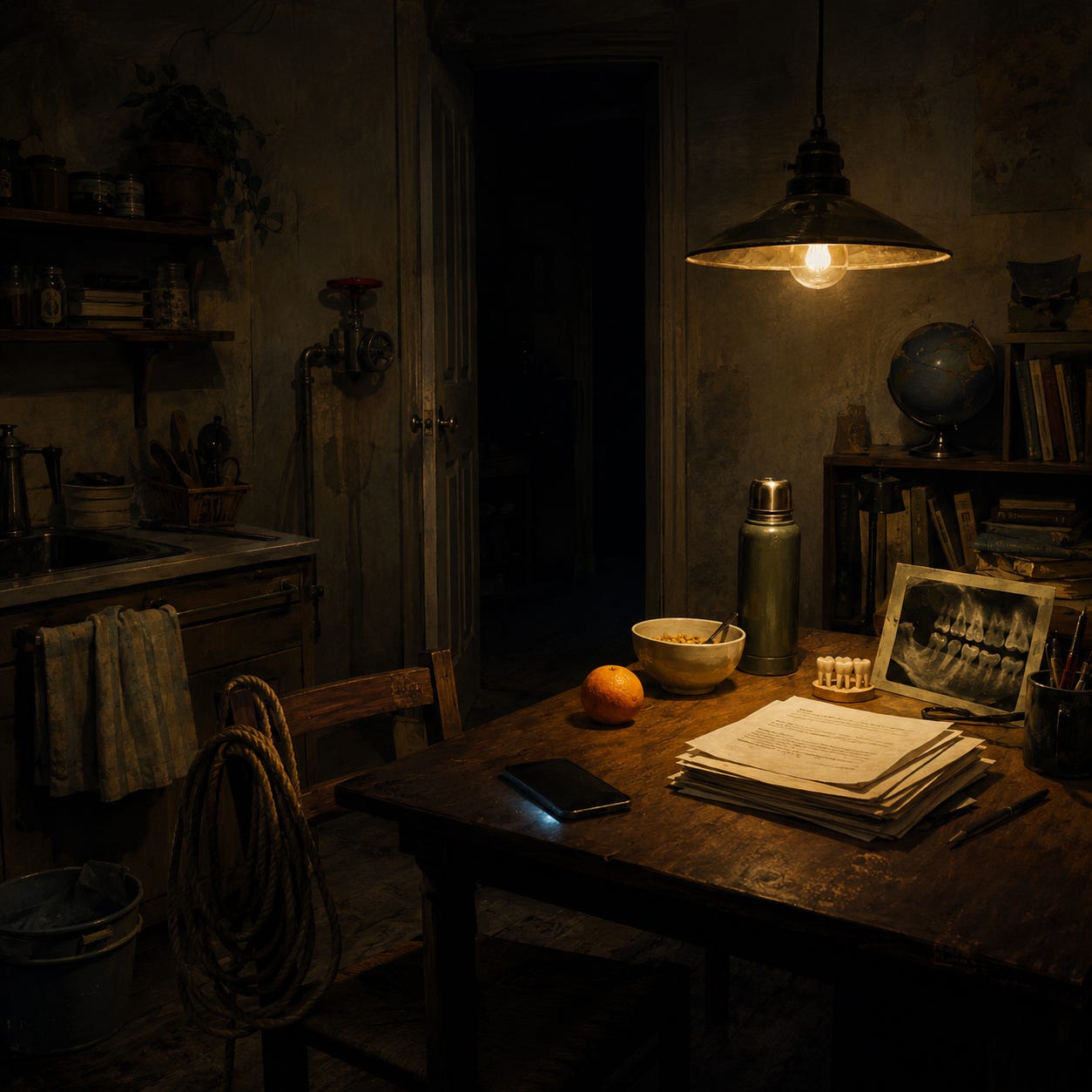
I went looking for the pathology of the age and found some of it eating cereal in my kitchen.
Not every essay was an indictment.
Solidarity Without Ownership tried to imagine care that does not seize control of the person being cared for. The Arrow and the Animal asked how language, worship, restraint, and domination may have been born together. The Covenant and the Cut considered what work becomes when institutions demand devotion but deny obligation. The One You Walk Past explored the small brutality of classifying another person before they have had time to become real. The Last Good Adult honored those mysterious citizens who appear with flashlights, jumper cables, soup, and no visible need to turn the event into content.
These essays began to suggest that civilization may survive less through declarations than through maintenance performed by people who do not consider themselves historical actors.
It is pleasant to diagnose civilization. Civilization rarely interrupts.
The self is less cooperative.
The more I wrote about extraction, appetite, denial, spectacle, and abandonment, the harder it became to pretend I had encountered these forces exclusively in cabinet rooms and corporate headquarters. I knew something about borrowing from the future for relief in the present. I knew how language could be made to serve the desire not to know. I knew how a person could call escape freedom and isolation independence.
This does not make my life a metaphor for history. History has suffered enough.
It means only that the structures outside us often recruit material already available inside us. Empire does not invent appetite. Platforms do not invent loneliness. Corporations do not invent fear. They industrialize them.
The essays became less credible whenever I wrote as though I were standing beyond the machinery. They became more credible when I admitted I had occasionally helped turn the gears, usually while explaining why I had no choice.
The word I kept circling was abandonment.
Abandonment as efficiency: the worker removed from the spreadsheet.
Abandonment as freedom: the person left alone with every appetite and no trustworthy limit.
Abandonment as innovation: the old obligation declared obsolete because the new system is faster.
Abandonment as fiscal discipline: suffering transferred downward until the budget appears …