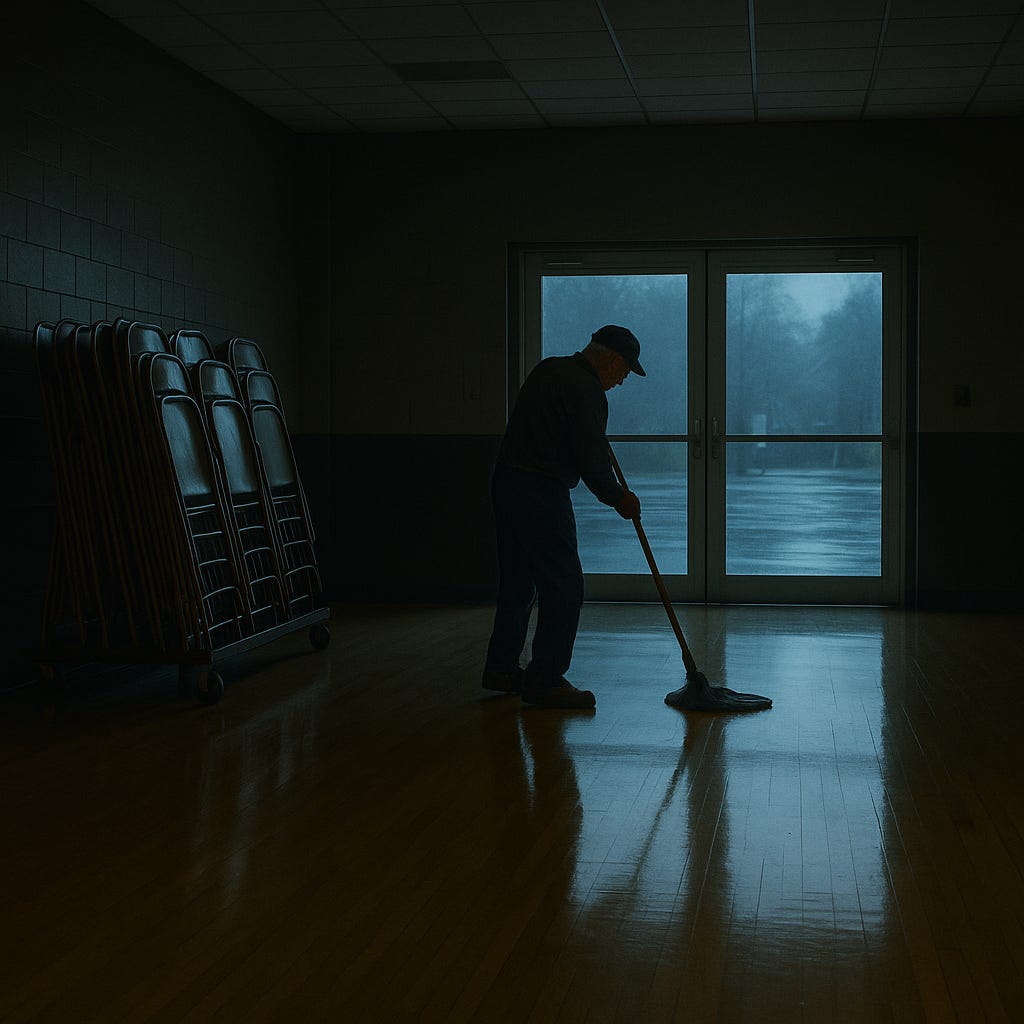
Section 1 — The Night of the Folding Chairs
The storm started before the meeting did. Rain worked the shingles like a tired drummer, steady and a little angry, while the high school auditorium swallowed everyone who had been told to show up and be counted. The janitor had rolled out rows of gray folding chairs, the kind that nip your fingers if you’re careless, and taped a sign to the door: TOWN FORUM, 7 PM. Beneath it, a plastic table with clipboards and two bowls of stickers—green for “Speak,” yellow for “Listen.” No one took yellow.
They came in clusters that pretended not to be clusters. Church friends who just happened to arrive together. Parents from a group chat who had never met but recognized each other by posture and baseball cap. The activist who kissed three cheeks in a row and called everyone “neighbor.” The veteran with a service cap pulled low like a visor against the fluorescent light. A woman from the cafeteria leaned on a mop and asked if this was going to be one of those nights. No one answered.
The issue on paper was a small thing—lines on a map, a budget that would tilt a little one way or the other—but the small thing was carrying cargo. You could see it in the home-printed signs that curled at the corners: OUR KIDS DESERVE SAFETY. STOP THE POLITICS. TAKE BACK THE SCHOOLS. WE LIVE HERE. Each declared neutrality the way a referee wears stripes, except every sign already chose a side.
A man at the sign-in table asked for names and towns and whether you wanted two minutes or three. People asked for five. The microphones hissed. The stage curtains refused to hide; their red was too clean for the night, a theater costume for a county with a real problem. A hand-drawn arrow pointed toward a stack of flyers explaining procedure. The flyers were not read. We were here to perform truth, not assemble it.
The first outburst was small, a cough shaped into a word—“Shame”—and then the word grew legs and wandered. From the back row: “We’ve been ignored.” From the front: “We’ve been ignored longer.” To the left: “We’re just parents.” To the right: “We’re just taxpayers.” Just, just, just—every claim varnished with the same polish: we are the real ordinary. The stage clock clicked forward, measuring not time but pressure.
When the moderator finally spoke, she used the voice you reserve for a skittish horse. “We are here as one town,” she said, and the room tested the sentence for weak spots. The mics clipped again. Someone raised a photo of their child; someone else raised a property tax bill like a document of citizenship. A young man read a list of names. An older woman read a list of dates. Each list was a key that fit only one lock.
I watched the stickers bloom—green dots on coats, backpacks, a stroller’s rain cover. They looked like traffic lights stuck on red, as if the town had decided there would be no moving tonight, only honking. A teenage usher tried to keep the aisles clear and gave up. The air smelled like wet wool and floor wax and a rumor that had finally found a microphone.
People took turns proving they did not belong to identity politics while speaking in the exact shape of it. “I don’t care about labels,” one man said, “but our community has been singled out.” “We don’t see race,” a woman said into the mic, “but our kids are not being respected.” “This is not about groups,” another declared, “this is about people like us.” The words stacked like sandbags, each one heavy with the flood they denied.
A gust of wind slammed the side door and every head turned as if expecting an arrival. Nothing came in but cold. The janitor shut it and twisted the latch with the care of someone who knows how small hardware can fail big evenings. Onstage, the moderator reminded us we were neighbors. On the floor, neighbors rehearsed their opening statements like prayers they had not yet decided to believe.
The storm kept its tempo. The microphones found it and translated the rain into static, which felt honest. I thought of old photographs in which men in their Sunday coats carried ladders after a fire, and how different the town looked when a problem required hands. Now we were all holding evidence instead: reports, screenshots, memories, grievances. We balanced them like trays we couldn’t set down.
A boy in the front row fell asleep on his mother’s shoulder. His breathing was the only thing that didn’t argue.
Somewhere between the third and fourth speaker, a fact tried to enter the room and was waved off for being impolite. The speakers were telling a different kind of truth, the kind that must be seen before it is weighed. “Look at us,” each said, in one form or another. “See what has happened to us.” Every sentence reached for a stamp that would make it official.
By the time the veteran stood, the room had learned the chorus. He didn’t sing it. He spoke softly about road closures during floods, how the volunteer crew used to throw sand in the back of pickups and drive wherever the water bossed them. “We didn’t ask who lived on which street,” he said. “We just went.” He sat down to polite applause that ended too quickly, like a door that didn’t catch the latch.
The next speaker called him privileged.
A woman in the aisle wiped her eyes and said she was tired of being told to wait her turn. A man shouted that his turn had never come. The ushers moved the microphones closer, as if proximity could heal translation.
At 8:12, the moderator tapped the gavel and the sound was smaller than the room. “We will proceed in order,” she said. It was an admirable sentence, and it did not change us.
What happened in that auditorium is happening everywhere that fluorescent lights gather the damp and the angry. The particulars differ, the choreography repeats. We come not to share a chore but to present a claim. We swear off tribes and then take attendance. We pretend the lines are new when the paper is old.
The rain thickened, and still we stacked our words like sandbags.
How did a country once organized by duties come to speak this new language of wounds, and when did the largest crowd decide it was fluent?
Section 2 — After the Wedding of Law
There was a day—several, in fact—when the law put on its best clothes and kept its promises. The Civil Rights Act, the Voting Rights Act, the Fair Housing Act: signatures exchanged like rings, photographs flashed, and for a breath the country believed it had married itself to its better self. The vows were plain: same rights, same doors, same line at the polling place. The victory was not an altar; it was a key. You turned it, and a locked room became a hallway anyone could walk.
What should have followed was the ordinary: school buses that weren’t color-coded by fate, courthouses that didn’t whisper, and ballots that didn’t ask the wrong questions. Many of the people who fought for that day wanted just that—entry without costume. The language was universal: keep faith with the Constitution, stop lying about who counts, let us join you at the table and finally talk about something else.
Politics heard the applause, then leaned in with a calculator. The new hallway had many doors; behind them were communities that had been muted and were now audible. Campaigns learned the neighborhoods by scent. The mailers changed. The field directors started their mornings with lists divided not only by precinct but by what had once been unmentionable: who you were counted as when the old country wrote the rules. None of this was criminal; some of it was compassionate. But the arithmetic built habits. If the map has tracts, the speech learns tracts too.
There had always been a preferred identity in American life. You could read it in immigration laws and jury rolls, in who could own and keep, in who wasn’t asked for papers because everyone assumed he had them. Majority identity was not a club you joined; it was the air. What changed after the wedding of law was visibility. Once the doors opened, the grammar that had long lived in silence stepped into daylight. Other groups organized, spoke, insisted. A country that had pretended to be unmarked now had a microphone for every mark. The stage looked fairer. It also looked busy.
I should be plain about terms, because the words have been bent until they squeak. By identity politics here I mean the practice of organizing public power around stable group categories, turning membership into a political credential and grievance into a policy engine. Not the march that demanded equal standing under law—that was justice and it was overdue—but the later habit of treating categories as permanent seats rather than temporary scaffolds to fix a damaged house. Assimilation, in this language, is an invitation to share one table and one set of chores; pluralism is the many-table arrangement in the same room; identitarianism is when the tables become fortresses with banners.
In the years after those signatures dried, you could watch the shift in small civic rituals. School-board campaigns where literature changed depending on the block. Council candidates who mastered two speeches for the same night. Federal programs that began as bridges and hardened into silos. Lawsuits that started as corrections and matured into categories with budgets and staff. On campuses, curricula opened to histories long ignored—rightly—but along the hallway, new offices sprouted with doors labeled by wound and origin. Some of this was repair. Some of it became a posture.
That posture did not arrive only in one hue. Women organized against exclusions that hid in plain sight: pay scales, door locks, the right to plan a future without permission. Gay men and lesbians mobilized in the teeth of a plague and then for the right to marry the person they already woke up next to. Each movement had a righteous core. Each won ground for all of us. But the country’s new political muscle was learning repetition, and repetition can turn medicine into diet. The badge for entering the room started to look less like citizenship and more like a certificate of injury.
Parties adapted because parties want to win. The Democrats learned to keep a coalition by speaking fluently to its parts; the Republicans learned to harvest resentments about the speaking. Redistricting took a highlighter to neighborhoods; primaries rewarded sharper tongues; consultants trained candidates to slice an issue so every slice could feel like the main course. It wasn’t a conspiracy. It was a market. Once you can sort people, you will. Once you can address them as segments, you will. If you can do both while claiming to hate the practice, you will do that too.
A critic will say what I’ve said is too neat, as if the country’s story were a line drawn on a clean desk. We both know the desk is scarred. White identity didn’t wait for the 1960s to exist; it built half the scaffolds the rest of us had to climb. But something did change when the law kept its vows: the symmetries became public. You could hear the cadence of group claims without leaning in. You could measure them by turnout, by mailers, by floor speeches. You could feel it in the way respectable people learned to say “community” when they meant “constituency with leverage.”
Back in the auditorium, the signs that declare “WE LIVE HERE” are the grandchildren of this period: honest and also recruited. The ordinary citizen—once told that equality meant a single doorway—has been taught to present as a member before a neighbor. The wedding gave us the key. The years after taught us to flash it at each other like a badge.
There is a difference I will not let go of. The march that asked for equal law does not belong in the dock. The strategies that came later—the permanent filing of humans into durable stacks for political convenience—do. You can honor the first without drinking the second. You can thank the movement that got you into the building and still refuse to spend the rest of your life living in the lobby.
This is the hinge on which the next turn will swing. Because once a country learns to speak in categories, the lesson does not stay put. Sooner or later, the largest crowd notices the game, finds its corner, and begins to chant in a voice it believes is just common sense.
Section 3 — The Credential of Wounds
Freshman week at the state university ran like a market. On the quad, a bright row of tents sagged under late-summer heat, each with a banner, each with a clipboard, each with a bowl of something—buttons, snacks, instructions. A student with a lanyard the color of stoplights waved me toward a table that read CLAIM YOUR STORY. She said it softly, as if the words might bruise.
At one booth, a volunteer placed a ribbon on a girl’s wrist and told her about study groups and emergency funds. At the next, a boy wrote his parents’ names under a column labeled “first-gen” and took a coupon for textbooks. Farther down, another table offered mentorship nights and a stack of pamphlets about safety, written in three languages. The help was real. So was the performance. You had to say who you were in a way that could be filed. Offer the right details and doors would open. The handout called it community. The line felt like triage.
This is how the medicine of a just era becomes a habit: tools built for repair turn into uniforms. We had needed categories to hunt discrimination in a city that lied about its habits; we had needed focused attention to reach those people the old order mislabeled as fog. It worked. People stepped into light that had never touched them. But over time, the forms remained after the fracture had mended, and the country learned to walk around holding them out like passes.
The credential of wounds traveled quickly because it solved more than one problem. It directed resources; it granted a name; it explained why the door had been heavy for so long. But it also began to answer a deeper ache no dean’s list could touch: the ache of belonging in a country that had quietly trimmed away the old obligations. The draft was gone; the lodges and halls that once gathered neighbors were hollowed or turned into wedding venues; the factory whistle no longer called a river of men into the same morning. We still needed to feel we were necessary to someone. The credential lighted up the scanner. It said: we see you; enter here; this line is yours.
I won’t pretend the early claims were anything but righteous. Women had walked through locked doors so often they knew the scratch pattern by heart. Gay men buried their friends and then carried a country into admitting their relationships were not a seasonal error. None of that was theater. It was stubborn, ordinary courage, and the victories changed daily life in ways that didn’t make headlines because they were finally normal. A nurse who could list her partner under “family.” A woman who didn’t need a man’s permission to steady her own future. These were repairs, not roles.
But roles arrived. They always do when an institution decides it can manage a human being by filing them. The grant applications wanted proof in thick paragraphs. The HR training needed boxes it could audit. The news segment needed a single face to stand for a million stories and then another to oppose it. And slowly, the country’s tongue adjusted. People learned to speak their injuries first, not because they wanted pity but because the system had taught them that was the fastest route to a room with chairs.
Go back to the auditorium and watch how a claim is made now. “As a—” is the doorway. What follows may be honest and hard-won, but the country has learned to react not to the evidence but to the credential attached to it. “As a” becomes an access code. The argument that used to begin with common terms now starts with a category and never quite walks out of it.
There’s a cruel economics to this. If categories open doors, categories will multiply. If attention pays, attention will be chased. Institutions begin to depend on the very tensions they promise to soothe; budgets, careers, and reputations grow sturdy roots in soil that must remain disturbed to justify the planting. And because it is embarrassing to admit that suffering can be professionally useful, we build a language that frames usefulness as purity. The classroom changes, the office changes, and the self changes—less a citizen navigating a shared task, more a claimant maintaining a license.
The credential spreads because it is portable. It can be worn at work, presented in court, attached to a résumé, pinned to a social feed, invoked at a podium. It can also be weaponized quietly: a way to end an argument without answering it. You see this when a meeting goes tense and someone reaches for the pass, not because the point was weak but because the pass is stronger than patience. This is not liberation. It is a shortcut learned in a crowded hallway.
None of this means the harms are over. They aren’t. The gaps in wealth, safety, and dignity didn’t vanish with a signature or a Supreme Court date. Anyone who lives with a target on their back does not need a lecture about posture; they need protection that shows up on time. But a nation can hold fast to justice and still refuse the permanence of a role built from pain. We lose something vital when we teach a generation to carry its injuries like passports. We train them for border crossings, not for home.
The truth that polite people avoid because it sounds mean is simpler than the theory: responsibility went missing and we filled the space with credentials. When a boy is never asked to spend a Saturday loading sandbags with strangers, he will find a different way to earn his belonging—a ribbon, a label, a story that can be scanned at check-in. When a woman is told the only way her voice will be counted is if it fits a slot in a spreadsheet, she will fit it. When a town learns that budgets respond better to grievances than to plans, it will practice the grievance. None of this makes us evil. It makes us trained.
On the quad, the sun dulled and the tents began to come down. The “CLAIM YOUR STORY” banner fluttered and then sagged into a cart. A janitor—maybe the same one who locks our auditorium—walked the grass, picking up pins and rubber bands and a single sheet of paper that just read WELCOME in fifteen fonts. The freshman with the ribbon on her wrist steered toward the dorms with a handful of flyers and a look that mixed relief and new pressure. She had a way in. She also had an assignment: keep the wristband on.
Sooner or later, the biggest crowd watches how this game is played and decides it was built for them too. They will come with their own wristbands and their own way of reading the rule book and call it ordinary. And when they say they hate identity politics, what they often mean is that they hate the fact that others got trained first. The country that forgot the chore list remembers how to line up. The credential becomes fluent in a new voice, deeper, louder, confident it is just describing the weather.
We think we are solving loneliness with recognition, and for a moment we are. The trouble is what happens next. Recognition becomes a badge, the badge becomes a habit, and the habit becomes a border that even friends must show a pass to cross. That is not a republic. That is a lobby where everyone carries paperwork and no one picks up a broom.
Section 4 — When the Largest Tribe Learns the Song
Saturday morning at the county fair, the radio truck set up early, mast raised, speakers aimed at the livestock barn. Country hits between callers. A booth near the kettle corn sold T-shirts with the county’s name wrapped around a silhouette of the state. Across the gravel path, a trestle table offered clipboards and ballpoint pens beneath a banner that said WE DON’T DO IDENTITY POLITICS. A man in a seed cap held court by the lemonade stand, thumb hooked in his belt, saying exactly who “we” were.
The song started like this: We are the normal ones. It had verses—we pay, we serve, we build, we bury our own, we mind our business until you make us stop minding it—and a chorus that could be learned by anyone in a minute: we are tired of being made into a category by people who don’t know us. They hated categories. They also loved the word “we.” It moved through the air like a tractor pulling more wagons than it should, rattling but steady, gathering faces as it passed.
A teenager in a letter jacket tried to hand me a flyer about a rally at the football field. “Just regular folks,” he said, not noticing how the phrase had become a gate. The radio host asked for callers who were “sick of labels,” and then screened for a certain story: the job lost when the plant left, the kneeling on television, the holiday that changed its name, the teacher who sent a note home about new words for old things. Each call fit a pattern. Each call asked for the same thing—recognition without the cost of saying which group was asking.
In the church hall later, folding tables held casseroles and petitions. A retired lineman explained the difference between what he once assumed and what he now announced. “We didn’t have to say it before,” he told me. “Everybody knew.” Knew what? He didn’t say, because the answer filled the room by itself: who belonged at the center of the picture. Majority had been a quiet season for so long it felt like climate. When forecasts arrived that the season was changing—new census math passed around like a rumor; maps on the evening news that colored suburbs in unfamiliar shades—the quiet broke. Weather became a story with characters and a soundtrack.
They did not invent the tune. But they amplified it with county-fair speakers, church-basement acoustics, school-board microphones, stadium chants. The method was borrowed and made local: testimonials, shared slogans, a traveling merch table, grievance with a logo. The certainties were homegrown. We are being replaced by a language that forgets us. We are being mocked by people who rely on the things we built. We don’t want special treatment; we want our place back. The word “back” carried more freight than any truck in the parking lot.
There is truth in the frame they hold up: factories closed, pills spread like frost over whole valleys, flags returned to families folded into triangles after wars that didn’t even get names people could find on a globe. You cannot preach away a headstone. You cannot call a man’s addiction an abstraction when he’s shaking in front of you. The losses are real, and the people who carry them have earned the right to say so out loud. But watch what the losses get turned into when a consultant takes a seat and opens a laptop. Pain becomes a banner you can march beneath. Neighborhood becomes constituency. The old pronoun “we” hardens into a fence.
By afternoon, the football field looked like a holiday that had been waiting for permission. Flags, hats, a stage on the flatbed of a truck. The sheriff waved from a tailgate. Pastors said a prayer. The local contractor donated the sound system and adjusted the levels himself. When the featured speaker arrived—one of our own, the introduction made sure to say—he read from note cards and then abandoned them when the crowd began to feed him his lines. That is how a chant is born, not as an order but as an echo.
Listen to the phrasing: We don’t see color; we see who works. We’re not a movement; we’re a community. We stand for everyone; we stand for us. The trick isn’t subtle, but it is effective. It takes the costume off while keeping the choreography. It calls itself ordinary as a way to claim the whole room. It uses the largest number the country has ever known and calls it nameless. It says it has no song and yet the bleachers are singing.
If you point this out, you will be accused of slander. The rebuttal is swift: We hate identity politics. Which is true in one sense: they hate the other identities for learning the microphone first. What they love is the comfort of thinking their “we” is just the weather again. What they practice is the biggest identity politics this country has ever seen—unapologetic when it is angry, invisible when it is asked to explain itself.
A neighbor from the fair told me he’d never joined anything before. “I’m not that kind of person,” he said, and then described the schedule for the next three meetings, the Telegram channel, the yard-sign strategy for the block with the cul-de-sac that always goes the wrong way. He said he didn’t like politics. He meant he didn’t like calling this politics. It felt to him like a family finally learning to speak in one voice.
Evening fell, and the field lights came on late so the sky could have its say. People lingered as if being together were proof. The radio truck packed the mast, the hats went back into the cab, the teenagers took selfies in the end zone. The sheriff did a slow lap with his hands behind his back, pride and worry both there in the walk. Somewhere beyond the bleachers the plant was still closed, the obituary page still too thick, the mailbox still held a mortgage bill and a postcard from a son who had moved two states away.
This is the part that matters for the country as a whole: the largest tribe decided it would stop pretending to be unnamed. It decided to sing the same kind of song it had mocked, only louder and with a better PA system. It called that honesty. It called that defense. It called that home. And when anyone noticed the likeness to the very thing they denounced, the answer was to turn the volume higher. If there is a doctrine here, it is this: We are not a category; we are the default you forgot. That sentence is a key. It unlocks almost anything and locks just as much.
The fairgrounds emptied. Paper plates skittered across the grass. A girl in a marching-band T-shirt practiced a drum cadence on the bleacher rail with two wooden spoons. The rhythm was simple and impossible not to follow with your foot. That is what the song sounds like when the largest crowd learns it: not complicated, not ashamed, catchy in a way that makes silence feel impolite. Tomorrow it will be at the diner. Next week at the council meeting. Soon on every porch.
They didn’t write the sheet music. But they bought the amplifiers, and they know every word.
Section 5 — The Steam That Vanished, The Stain That Stayed
By spring the slogans were lighter than the tote bags they were printed on. The town still had statements, just not the voices to carry them. You could tell by the office walls: laminated promises, a calendar with nine themed months, a QR code for the latest training, and a hallway bulletin board that had learned to speak in careful fonts. The heat that once made people argue at lunch had lifted. What remained was the residue—badges, templates, an inbox that sent you reminders if you forgot to click “I acknowledge.”
At the quarterly all-hands, the consultant advanced slides with two kinds of numbers: counts of faces and counts of courses completed. The room nodded in that polite way people nod when they have not slept enough. Someone asked if the training could be shorter. Someone else asked if there was a new badge for the email signature. A manager said the budget was tighter this year but the dashboard would continue because “measurement drives outcomes.” The word outcomes did not say what those were.
No one was angry; they were clocking in. The zeal had bled out of the experiment and left a compliance kit. Departments got new names that softened into each other—Engagement, Culture, Belonging—like paint swatches shown under warm light. The old fervor—the posts, the pilgrimages, the declarations at the microphone—had thinned to a tone you use when the auditor might wander by. People still practiced the theater of care, but the stagehands were running the show now: forms, renewals, evergreen committees.
On campus it had the same feel, like a parade seen a year after the band left—the route still taped, the horses long gone. Offices with doors labeled by harm stayed open ten to four; the pamphlets were current; the workshops repeated. Freshmen shuffled past, learning the passwords without learning why. A dean said the temperature had cooled, which was true, and that the work continued, which was also true if “work” meant the upkeep of a system that could outlive belief.
Meanwhile, in the places where belief had found a new home, the temperature was rising. The loudest critics of the old slogans had built their own. The school-board meetings turned into booking calendars for traveling speakers. Statehouses wrote bills with the same categorical certainty as the trainings they mocked—lists of what could be said, what could be taught, who could speak under which name. A porch that planted a sign reading WE DON’T DO POLITICS now planted three. The county fair learned to chant. The radio hosts did not need consultants; they had call-ins.
There was a geometry to it. Inside institutions, identity hardened into paperwork; outside, identity hardened into patrol. One side kept the binders. The other kept the bullhorns. Both insisted they were protecting the ordinary. Both used sorting as a tool. One had a diversity statement the lawyers had tuned. The other had a sheriff willing to pose for a photo in front of a banner that said what people were careful not to put on paper.
If you wanted to see the stain that stayed, you didn’t have to look for scandal. Look at the easiest habits. Procurement forms that ask you to declare what kind of company you are by who owns you, with boxes that determine bids. Scholarship committees trained to weigh the storyteller before the story. Editorial meetings where a pitch enters the room already wearing the outfit the homepage likes. None of it illegal. Much of it born from a good impulse. But the impulse calcified; the process replaced the point. The steam was gone; the ring it left on the table remained, a circle that told you where to set the next cup.
The culture warriors on the courthouse steps mocked the circle and then used it. “Our community,” they said, and pointed only at themselves. “Our values,” they said, and printed them on shirts. “Our kids,” and the plural meant a map you could draw with a Sharpie around three neighborhoods. They said they were fighting categories and then organized by the largest one they could find. The energy was simple and renewable because it fed on a promise that felt like a memory: that life had once been made for them and had been borrowed without permission.
Back in the office, someone updated the pronoun policy. In the statehouse, someone drafted a rule about bathrooms. In the school district, the superintendent revised the holiday email. At the county fair, a speaker told the bleachers that the country had been stolen by a vocabulary. What connected these scenes wasn’t virtue or vice. It was grammar. A way of sorting human beings that had escaped its just origins and found a procedural life. A way of arguing that no longer needed evidence if the right credential was presented, or the right crowd gathered.
It is tempting to say the fire went out on one side and the other lit a fresh blaze. That flatters both. The truth is clumsier. The blaze cooled into policy memos, and the new fire learned to feed itself by pointing at the paperwork and calling it an enemy. Each kept the other warm. In boardrooms you could hear phrases that sounded like a sleepy sermon; on call-in hours you could hear phrases that sounded like a shouted prayer. Neither required patience for the common case that could be tested and fixed.
The janitor again: in the building where the training happened, the projector was still warm when he came in to fold chairs and empty bins. He peeled a sticker off the carpet that someone had placed where the first row should stop to create a “safe space”—the glue came away in flakes that will gather dirt for months. Across town, after the rally, he locked the gym where volunteers had stacked extra water and two boxes of yard signs left over when enthusiasm outran the cul-de-sacs. He does not get a badge for any of this. He is the only person in both rooms.
A critic of this essay will object here and say I am minimizing harm by dwelling on residue. I am not. The harm is why the work began. Discrimination did not evaporate when the hashtags did. There are still doors that look open until you reach for them. There are still bodies stopped more often than others for reasons the officer can’t name without telling on himself. My argument is narrower and less fashionable: we built a habit that survives the heat and we forgot to question the habit when the fire moved on. We left the fixtures bolted to the wall and went home. The fixtures now speak for us.
What about the other side’s habit? It is not a habit; it is a mood that wants to become law. It says it is restoring neutrality. It is installing preference. It says it is defending the ordinary. It is patrolling a border around a story of who the ordinary are. It is not softening into binders because it prefers the feeling of a packed room to the patience of forms. It will, in time, build its own paperwork. For now it has found that live heat works better than compliance.
If you are hoping for a trick that will deactivate both—tear down the laminated posters and unplug the stadium speakers—you are still imagining a fight about decor. This isn’t about signs. It is about chores left unassigned for so long that we replaced them with announcements. When people do not share work, they share labels. When work returns, labels shrink to the size of name tags, which is about what they’re good for.
At the end of a long week, the office lights go out and the corridor posters stare at nothing. At the end of a long Saturday, the fairground is a line of trash cans and a smell of diesel. On Monday the superintendent will send another note. On Tuesday the radio host will cue the next caller. Both will say they are speaking for everyone. Neither will lift a sandbag.
The stain will not scrub itself. It isn’t proof that the steam was wicked; it’s proof that we let a hot moment lay down a ring and then arranged the furniture around it. The ring tells us where to put our cups. It also tells us where we lost the table to begin with.
The section that follows is not a fix; it is a memory: what it was like when a town shared a list of duties longer than its list of descriptions. If you want out of the grammar we’ve taught ourselves, the door isn’t in the posters or the rallies. It’s in the work that can’t be faked.
Section 6 — The Country Without a Chore Chart
At the volunteer firehouse on Maple Street there’s a corkboard so old the pushpins have fossilized. Above it hangs a plastic frame that once held a paper labeled DUTY ROSTER. The frame is empty now. Someone taped up a laminated “Facilities Policy” in its place—what to do if something goes wrong, who to call, which form to submit. No one wrote their name next to Tuesday.
That board is the shape of what went missing. Not slogans. Not ideals. The list of tasks. Who brings the hoses to be tested. Who checks the generator. Who cooks for the pancake breakfast that keeps the lights on. A town that used to assign itself chores now outsources them or lets them lapse, then congratulates itself for the sensitivity with which it speaks about the lapse.
You can track the loss without romance. First lever: the workday itself broke apart. The plant closed or automated; the union hall’s calendar planked over; the shift bell that synchronized mornings went silent. An Uber shift replaced a swing shift. A dozen flexible jobs replaced one hard one, and flexibility is not a schedule you can build a meeting around. Men who used to see each other at 6 a.m. saw each other on screens, if at all. When bodies stop sharing time, they stop sharing duty. It isn’t malice. It’s physics.
Second lever: the way we do politics rewarded segments over squares on a chalkboard. Primaries became the real elections; safe seats became safer; gerrymanders poured districts into containers that never spill. To win a primary you don’t need the town; you need the slice with the highest turnout and the sharpest appetite. Consultants learned to speak to slices and get paid either way. A candidate who once needed the firehouse breakfast now needs a viral clip and three major donors. The math changed; the manners followed.
Third lever: the information pipes were reworked so that attention behaved like water seeking the lowest notch. An algorithm cannot assign chores; it can only deliver what keeps a thumb from resting. The simplest fuel is grievance, and the cheapest version of grievance is category. A feed rewards the sentence that says who has failed you, not the spreadsheet that lists who will bring coffee to the sandbag pile at dawn. Chores are slow. Outrage is instant. We built a machine that hates appointments.
A quieter lever lives in the offices we call “risk.” Liability regimes, professionalization, credential creep: all of them made it harder for amateurs to keep a town running. The Boy Scouts’ canoe trip needs six forms and a lawyer; the church potluck wants a food-handler certificate; the river clean-up requires insurance a neighbor group can’t afford. Professionals are useful. They also crowd out the ordinary person who used to show up with a rake and a Thermos and feel, by dusk, that the day had counted.
What rushes into a vacuum like this will not be silence. The posture of grievance works because it does three jobs at once in a world that has unbolted the duty board. It gives meaning—a story that explains why the day felt thin and who took the thickness away. It offers belonging—you can join a chorus without waking up earlier or learning Robert’s Rules. And it delivers moral cover—if your role is to testify to harm, the burden of repair belongs to the named offender. The posture says, in effect: my part is to be the proof. It is efficient and, in the short term, intoxicating.
We should not kid ourselves about how easily this gets institutionalized. The office learns to reward the credential because it is legible. The campaign learns to reward the credential because it turns out voters. The newsroom learns to reward the credential because a category in a headline behaves like bait. A janitor learns to keep two sets of keys: one for the auditorium where people declare, and one for the bay where the old truck still waits with a quarter tank of gas and a battery that might not hold.
But the appetite that sent neighbors to the fair and parents to the auditorium did not come from nowhere. There is a hole where the chore chart used to be. Without tasks that require strangers to aim at the same stake in the ground, the country will keep writing descriptions of itself and mistaking those descriptions for a plan. We say community the way you say a password. We never ask for volunteers on Thursday.
If you doubt the power of assignments, watch a town in a flood. If the water is an inch from the back steps, the man who last week shouted through a microphone is happy to carry bags, and no one checks a credential at the pile. When the water recedes, we forget that feeling and go back to the theater. The question, then, is whether a republic can simulate the flood without the harm—build standing chores that make a habit of common work so the reflex survives when the sky is clear.
This is not nostalgia for the parts of the old order that deserved to die. It is a claim about the infrastructure of responsibility: calendars, rosters, kitchens with big pots, meetings that end with names next to tasks, budgets that pay for underloved things like generators and porta-johns and insurance for volunteers. It is also a claim about design. If you design a primary to reward the narrowest fervor, you will get a politics of slices. If you design a school to reward the loudest grievance, you will get students fluent in airing wounds and clumsy in forming crews. If you design a feed to reward friction, you will get a country that mistakes sparks for light.
A critic will say this is small-bore talk for a big problem. I say the big talk is what got us here—grand identities that scale nicely on T-shirts, policies that look like care from the CFO’s chair, speeches that fill a field and empty it just as fast. A chore chart looks humble until you realize what it replaces: not only boredom, but the need for a permanent politics of wounds. The person who knows she is due at the shelter kitchen at five does not need a new identity to feel real. She needs a ride and a hair tie and someone to pick up the onions.
Back at Maple Street, the captain of the volunteer house stands with a marker and no list. He is older than the truck and twice as stubborn. He starts to write names anyway—his own on three lines, two teenagers who might show up if their phones die, a plumber who owes him a favor. The board looks ridiculous, and it is the only serious thing in the room. He is rebuilding a language we once knew by heart: this is what I will do; this is what you will do; this is when we show up; this is how we’ll know we did it.
We do not need to agree about history to agree about Tuesday. We do not need to settle every claim to assign Thursday’s crew. The country learned to describe itself so well it forgot how to move its hands the same way. Bring back the roster and half the grammar we hate will atrophy from disuse. Not because anyone lost an argument, but because someone has to test the generator, and if they don’t, the lights go out and we are back to shouting in the dark.
Section 7 — Terms for a Ceasefire
They booked the middle school gym because it was the only room with a floor big enough for disagreement. No theme banners, no consultant, just a dry-erase board that still smelled like last winter’s basketball practice. The janitor unlocked the double doors and stayed by the bleachers, arms folded, as if he’d been asked to keep time. A teacher rolled in a cart with markers. The moderator—same one from the auditorium—tapped the cap against her palm.
“We’re not here to re-argue last year,” she said. “We’re here to decide what we’ll do next week.” Someone exhaled in a way that sounded like relief and challenge at once.
She drew a line down the center of the board and wrote TERMS in square letters. The room did not trust the word. It sounded like a treaty drawn by people who enjoyed treaties. But ink on white felt better than another evening of speeches that curdled by the door.
“Term One,” she said. “No claim without a chore.”
She wrote it, and for once no one groaned. If you want the microphone, bring a task with it: a shift you’ll cover, a dollar you’ll raise, a crew you’ll join, a duty you’ll adopt that anyone—friend or opponent—can verify by Thursday. Speak as whoever you are; that isn’t the point. The point is that sentences unaccompanied by labor have filled our calendar, and the calendar is not a stomach. The left side of the room nodded first. The right followed, suspiciously, but they followed.
“Term Two: retire the opener ‘As a—’ unless the detail changes the fix.”
You can tell your story; it matters. You can cite your category when harm is specific and remedy requires it. But we will not grade arguments by the badge on the lanyard anymore. We will grade them by whether they can be built, repaired, or enforced in daylight. If the plan is universal, speak it that way. If it’s targeted, show the target and the metric for when the target disappears so the policy can, too. The marker squeaked. The room adjusted in their chairs the way you do when clothes fit again.
“Term Three: sunset the fixtures.”
Every committee, office, initiative and training that was born for crisis now carries an expiration date unless it proves results you can touch. Not a vibe. Not a feeling of awareness. Results: fewer overdoses, fewer suspensions, more apprenticeships, more first-time business licenses on the neglected side of town, quicker response times, cleaner river after a Saturday crew. If it works, it stays. If it doesn’t, it ends, with thanks. No more immortal paperwork.
“Term Four: no restoration by erasure.”
The majority bloc that learned the anthem at the fair does not get to call itself neutral while writing rules that make other people vanish. No bans that exist to humiliate. No curriculum edits that pretend whole neighbors never lived here. If your policy requires pretending, it’s a nonstarter. If you want tradition, keep the door open while you hang it. If you want order, put your name on the roster that makes order humane. Say out loud what you are—largest, loudest—and stop calling it weather.
“Term Five: redesign the machines that reward slicing.”
Open primaries or ranked ballots or multi-member districts—choose the version that fits our state—but we will not keep structuring elections so the narrowest appetite wins the only race that matters. We’ll give map-drawing back to a citizen pool chosen by lot. We’ll allow more than one kind of neighbor to win a seat at the same time. We’re done letting consultants tell us our town is a set of silos that never meet except in yard signs.
“Term Six: trade credits for crews.”
Schools will keep teaching hard history and the dignity of every student; that stays. But prestige will flow toward crews that build something together, not toward performances of pain that never leave the seminar room. Every sophomore does a term of civic apprenticeship with people not from their lunch table: EMS, elder care, trail work, code tutoring, kitchen shifts, water testing. Thirty hours a term. Graded by completion, not confession.
“Term Seven: liability off-ramps for volunteer work.”
We will buy the insurance, loosen the rules that choke good faith, and pay small stipends where hours stack up. You should not need a certificate to ladle soup or a lawyer to clean a ditch. We’ll protect the town from the bad actor without strangling the decent one.
A hand went up near the back. The veteran. “What about language?” he asked. “We can do chores and still talk like we hate each other.”
The moderator nodded. “Term Eight: proof before epithet.”
Call a policy cruel only after you’ve shown the harm and proposed a fix. Call a person a bigot only after they’ve endorsed exclusion in daylight. Call a town racist only after you’ve measured the pattern and invited them into the repair. On the other side, stop saying you’re ‘just’ anything. No more hiding a block vote in the word normal. Speak plainly about who you are and what you want, and then agree to be bound by the same evidence you demand of your neighbor.
The teacher added a ninth without asking. “Term Nine: convert some offices.”
The HR or campus units that became signage departments will be repurposed into logistics for shared duty—ride boards, tool libraries, shift registries, small-grant desks for unglamorous needs. Their job is to make crews possible, not to monitor souls. Keep the anti-discrimination enforcement strong; let the rest become a switchboard for work.
A woman from the fairgrounds—the one who’d cried in the aisle—stood to speak. “My father died without anyone from the county helping him up the front steps,” she said. “I don’t want to be told my whole life is a grievance, but I also don’t want to be told to shut up and lift.” She looked tired of choosing between caricatures.
“Term Ten,” the moderator said softly. “Rights stay bright.”
No ceasefire swaps rights for duties. Anti-discrimination law holds. Equal access holds. The franchise holds. The ceasefire is about grammar, not the floor. The floor is non-negotiable.
By now the board was full of handwriting that drifted uphill as tired hands got hopeful. The sheriff, who had paced enough rallies to know a crowd’s temperature, leaned against the wall and did not roll his eyes once. The radio host, uninvited but unsurprised, sat two rows up and scribbled in a notebook like he might try a different program on Monday. The janitor checked his watch and stayed.
“Last term,” the moderator said. “We test this for ninety days. Flood drill without the flood.”
She wrote: Sandbag Saturday—first of the month—sign up by street, mixed crews. Kitchen shifts—every Wednesday—slots for eight. Tool day—bring, borrow, repair. River sweep—third Sunday. Childcare swap—during meetings. **Public ledger of hours—” She stopped, crossed out ledger, and wrote board. “Public board of hours. No shaming, no bragging. Just names and tasks.”
No one cheered. The sound was better: shoes on gym floor, pens on calendars, quiet negotiation over who could take which slot. Someone groused about liability; the town lawyer said, “I’ll write the rider by Friday.” Someone said they couldn’t do Saturdays; the group made a Tuesday crew. A kid in a hoodie asked if coding counted; the teacher said yes, if you teach a neighbor to fix the library’s laptops. The veteran put his name down three times. The woman from the aisle wrote once, then went back and added another.
A man in a seed cap stood, thumb in belt, the way he always stood before he told the story about being ignored. He didn’t tell it. “I can weld,” he said instead. “Where do I put that?” The teacher wrote WELDING next to March and drew a box.
These terms will not make saints. They might make neighbors again. We are not erasing difference or telling anyone to forget their scars. We are insisting that the price of a seat at the argument is a hand on the work. We are asking the largest crowd to stop pretending they are unnamed and to stop writing rules that shrink other people to a rumor. We are asking the coalitions that built offices out of pain to accept that offices must end when their job is done. We are asking campaigns and feeds and committees to stop making a living from the habit we all say we hate.
When the list was finished, the moderator uncapped and recapped the marker twice, as if giving the moment a lid. The janitor walked down from the bleachers, took a picture of the board with his phone, and said he’d make copies for the bulletin cases by morning. It was not a covenant. It was a schedule.
And if a schedule sounds too small for what ails us, remember what replaced it: a year of microphones, a parade of wristbands, a radio that learned our complaints by heart. We can keep the speeches. We can keep the ribbons when they’re needed. But the ceasefire we can actually enforce is inked in boxes with dates.
“See you Tuesday,” someone said.
“Bring gloves,” someone else answered.
Epilogue — After the Fever
The rain finally gave up. By the time the janitor swung the auditorium doors shut, the pavement was glazed and quiet, the kind of shine that makes a town look newly built. Inside, the floor was clean except for a few green stickers stuck like leaves where the front row had been. He knelt, scraped them up with a pocket knife, and dropped them into a coffee cup he used for lost screws.
On the bulletin case by the entrance, a fresh printout faced the glass: Sandbag Saturday, Tool Day, Kitchen Shift, River Sweep. Names already filled the first lines in crooked ink. Someone had drawn a small star next to WELDING.
The radio host tried a different show on Monday. Fewer calls, more visits. He took a mic to the repair day at the library and let a kid explain how to revive a dead laptop. The segment landed heavier than last week’s outrage. Not because it was profound, but because it finished.
At the gym, the marker squeaked again: shifts added, two crossed out, one reassigned because the plumber’s truck threw a belt. In the school hallway a boy taped a sign for childcare during meetings. He didn’t ask permission; he wrote a time and a room number and drew an arrow. Three toddlers showed up with snacks. Their parents stayed through the vote.
On Maple Street, the firehouse lights were on at dawn. The captain checked the generator and left the clipboard open on the table with three boxes ticked and one blank. The veteran signed the blank on his way to the river. He didn’t bring up the old speech. He brought a thermos and two pairs of gloves.
The woman from the aisle came with a tape measure and a notebook. Her father’s steps had been too steep. She traced a handrail on paper and asked the welder if he could build it. He could. They argued about height, settled on a number, and wrote it down like a promise you could hold with a wrench.
At the fairgrounds, a banner from last month sagged between two light poles. No one bothered to take it down. A crew from the park department unrolled new bases for the concession stand tables and asked whoever was standing around to carry them. They did. The stands looked ready for a season that hadn’t been scheduled yet.
There is no moral here that fits on a sticker. The town is still itself—sharp edges, long memories, quick tempers. The paperwork did not melt. The chants did not vanish. But some of the hours shifted from telling to doing, and that is a change you can weigh without a survey.
At night, the janitor made one last loop. He locked the auditorium, then the gym, then the door to the room where the board hung with next month’s boxes. He didn’t pray over it. He just checked the tape and pressed the corners flat.
A nation is not saved by speeches or slogans. It is kept by people who agree on where to be and when, and then show up. When we do, the temperature drops. The fever doesn’t end with an announcement. It breaks when the work begins.
—Elias WinterAuthor of Language Matters, a space for reflection on language, power, and decline.
Thanks for reading Language Matters! Subscribe for free to receive new posts and support my work.