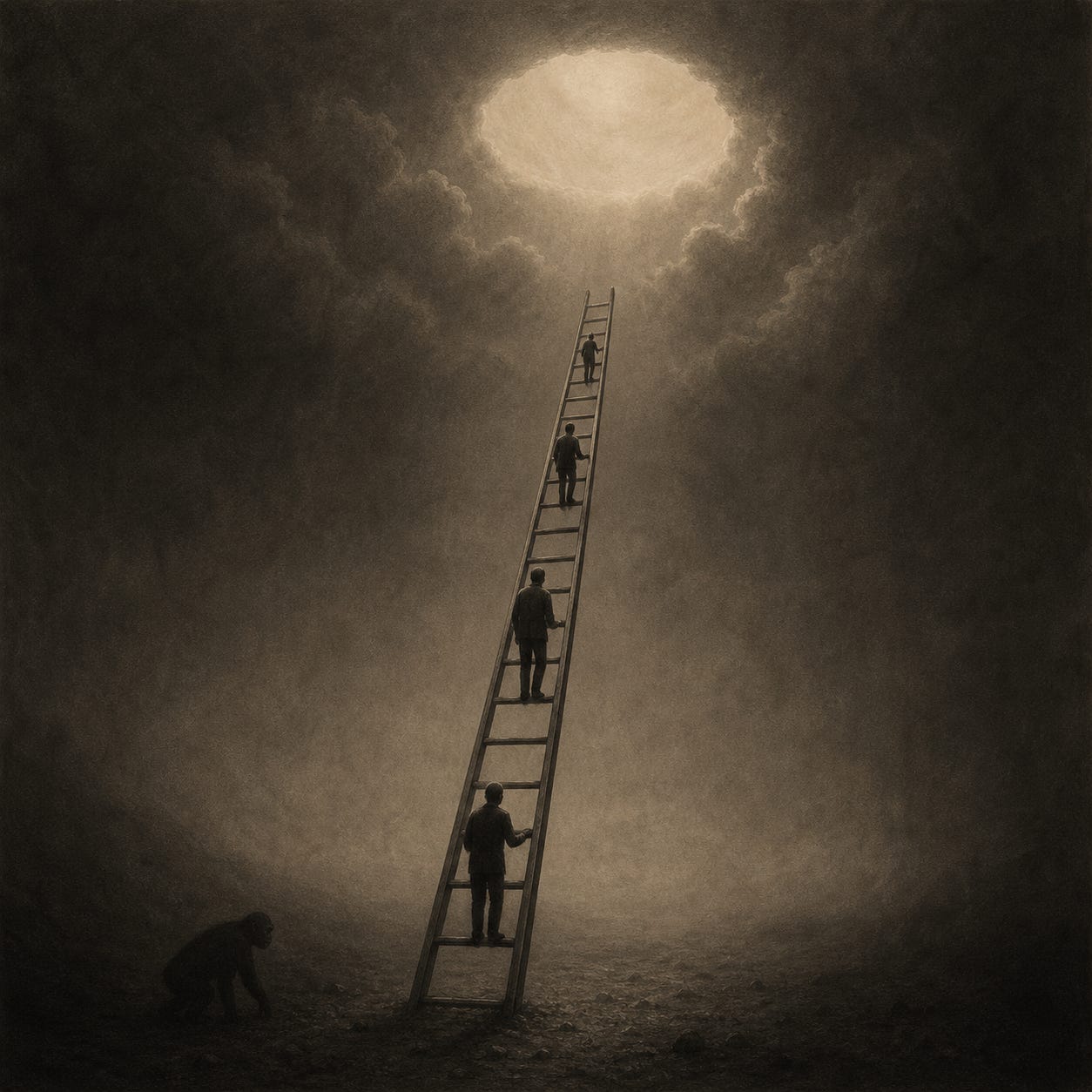
Before there were kings, there were bodies.
Before there were laws, there were teeth, shoulders, noise, fear, display. The first hierarchy arrived without a crown. It arrived as posture. One animal took more space. Another yielded. One male threatened. Another looked away. A troop learned who could strike, who had allies, who got food first, who had to wait.
The chimpanzee needs no management theory. He needs no constitution, no HR department, no executive coach, no quarterly OKRs, no LinkedIn post about servant leadership. He understands rank through force, alliance, grooming, intimidation, reconciliation, memory, and timing.
I find this both horrifying and reassuring.
Horrifying, because one realizes that the office meeting has deeper evolutionary roots than anyone in the office meeting wants to admit. Reassuring, because at least the chimpanzee is direct. He screams, bares his teeth, shakes a branch, and everyone understands the agenda. Humans made the matter more confusing. We replaced the branch with phrases like “just circling back,” “executive alignment,” and “let’s take this offline.”
Progress has its tragedies.
Hierarchy is old. Older than theology, older than philosophy, older than states, older than the little voice inside us that says, “Surely this person cannot be in charge.” Rank begins in animal life as pressure, nearness, threat, submission, alliance, advantage. Long before anyone could explain why they deserved authority, authority already existed as a bodily fact.
Then human beings made the situation more interesting, which is what human beings tend to do whenever nature gives us something terrible.
Early human groups had rank, skill, age, charisma, danger, memory, competence. Some people hunted better. Some spoke better. Some saw farther. Some frightened others. Some healed. Some knew where water was.
Yet early human groups also developed ways to resist domination. Ridicule, gossip, coalition, exile, shaming, refusal. The group could turn against the would-be tyrant. The dangerous man had to be watched. The boastful man had to be laughed at. The overreaching man had to learn that the group had teeth too.
This may be one of the beginnings of morality: the moment power had to answer to something beyond itself.
A chimp can dominate. A human must justify.
And justification changes everything.
Once power has to explain itself, it can be judged. Once the strong man has to say why his strength gives him the right to rule, a higher question has entered the room. At first, that higher question may take the form of custom, ancestor, spirit, taboo, story, myth, ritual. Later, it becomes law, truth, God.
I am speaking here of God both as faith and as moral architecture: the point above human rank before which no earthly hierarchy is final.
That distinction matters. Some readers hear the word God as truth. Some hear it as trauma. Some hear it as poetry. Some hear it as metaphysics. Some hear it as the name of the highest court. My concern here is the moral function of the idea: God as the point above the human swarm, the height from which every title shrinks.
The king stands under God. The father stands under God. The priest stands under God. The boss stands under God. The nation stands under God. The audience stands under God. The algorithm, despite its impressive confidence, also stands under God.
If all human beings stand under God, then no human being gets to be ultimate.
That is the strange genius of the idea. The highest hierarchy humbles every lower hierarchy.
The king and the beggar have different power, different clothing, different chances, different exposure to dental care. Yet from the divine height, both are creatures. The master and the servant occupy different social positions. Yet both are seen. The poor are more than failed competitors in a status game. The weak are more than evolutionary leftovers. The unseen are still seen.
This is why the prophetic imagination has always been dangerous. It looks at the ruler and says: your throne has a ceiling. It looks at the crowd and says: your consensus has limits. It looks at the successful and says: your elevation proves less than you think. It looks at the humiliated and says: your low place in the human order is far from your final name.
Of course, religion also became entangled with power. We know the record. Kings received divine blessing. Priests guarded access. Empires dressed conquest in sacred language. Women were disciplined. Servants were instructed to obey. Colonizers arrived with scripture in one hand and extraction in the other, often with impressive confidence in both hands.
Every sacred idea can be captured by the human ape.
That should humble believers and unbelievers alike.
God can judge hierarchy. God can also be invoked by hierarchy. The same word can liberate the crushed and decorate the throne. This is why spiritual language requires vigilance. The moment God becomes too convenient to power, one should check the room for incense, uniforms, and men with very serious hats.
Still, something powerful remains in the idea: a reference point above the social game.
Without such a point, hierarchy closes in on itself. Rank begins to feel like reality. Recognition begins to feel like truth. Visibility begins to feel like worth. People with status appear more substantial. People without status begin to feel erased.
This is one of the great pains of modern life.
We have many ladders and a damaged ceiling.
Corporate rank, cultural prestige, algorithmic attention, money, credentials, networks, audience size, institutional affiliation—these still organize our days. We still speak of dignity, justice, equality, authenticity, truth. Yet these words often circulate inside the very status contests they were supposed to judge.
Every faction has moral language now. Every institution has values. Every brand has a conscience. Every platform has a community standard. Every executive bio mentions empathy. The age is full of kindness vocabulary and astonishing levels of ambient fear.
Power has learned a softer voice.
It can say “alignment.” It can say “tone.” It can say “culture.” It can say “impact.” It can say “collaboration.” It can also say nothing at all.
Silence is one of modern hierarchy’s finest instruments.
A person can be corrected without being confronted. They can be ignored at exactly the moment recognition would have mattered. They can be left unsupported while everyone waits to see whether someone more established will endorse them first. In older hierarchies, someone might have shouted, “Know your place.” In ours, people simply fail to share the link.
This is where Foucault remains useful. Power lives in norms, institutions, categories, silences, habits of attention, professional vocabularies, disciplines, and forms of knowledge. It does more than prohibit. It produces. It creates the kinds of people who can be understood, rewarded, corrected, diagnosed, promoted, excluded, or ignored.
Power becomes atmospheric. It gets into the lighting.
People reproduce hierarchy through tiny acts of caution. They learn when to speak, whom to quote, whom to praise, whom to ignore, when to soften, when to laugh, when to become suddenly very busy. The system does not need constant orders if people learn to order themselves.
Then there is Machiavelli, who ruins everyone’s evening by explaining the weather.
He tells us that appearances matter. That rulers survive through perception. That virtue and effectiveness have an uneasy relationship. That people act from fear, ambition, loyalty, insecurity, appetite, memory. That the world rarely rewards goodness in its purest form. That truth does not automatically protect the truth-teller.
I confess something: I find this spiritually offensive.
There is a part of me that wants to place Machiavelli in a small bureaucratic hell where he has to sit through endless meetings led by people who have read only summaries of his work. He would deserve at least a few quarters of that.
Yet the irritat…