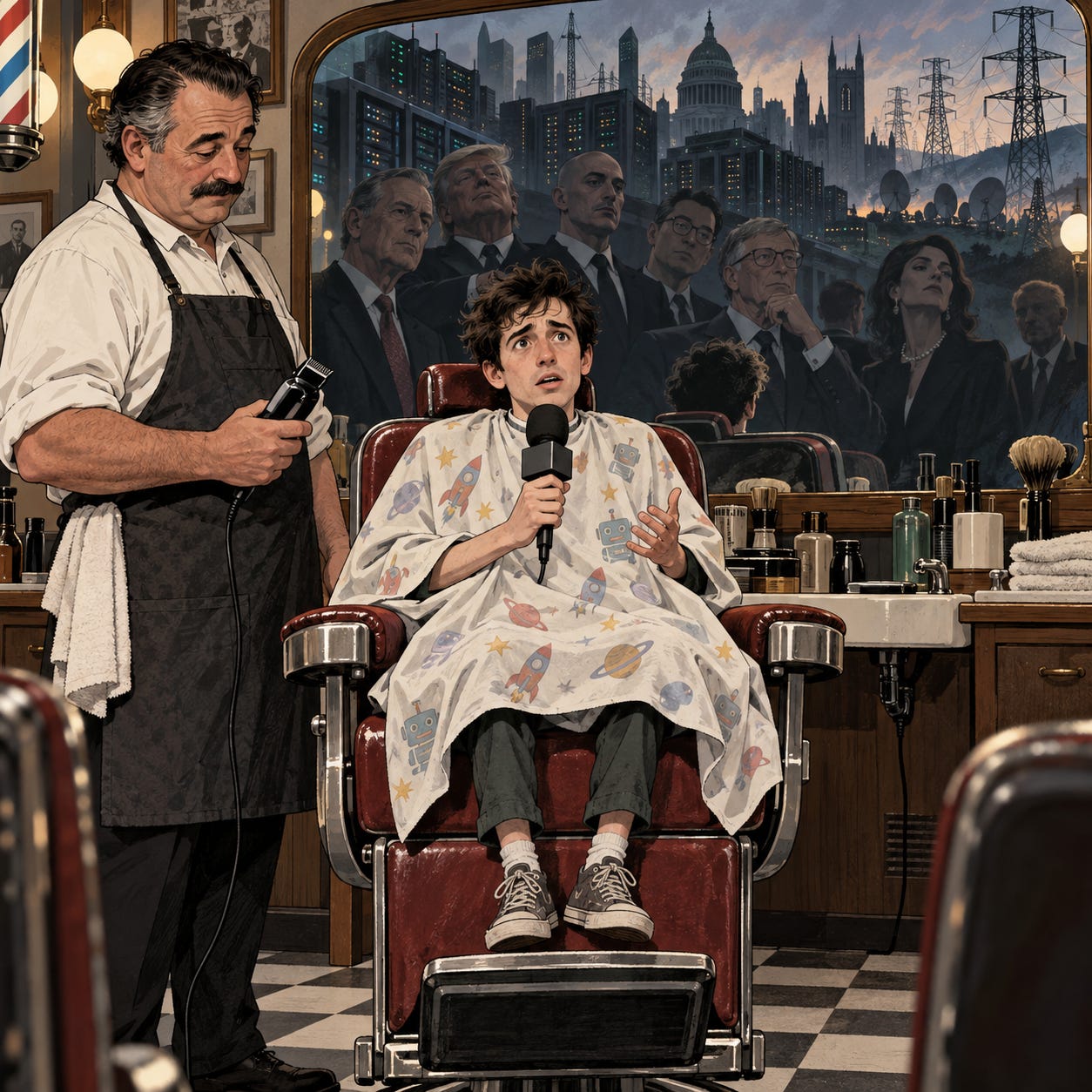
My barber Tommy was standing behind me with a pair of clippers when he asked whether I had seen the news about the artificial-intelligence researcher who thinks AI might kill everybody. This is apparently what barbershops are for now. There was a time when a man sat in a barber chair and was asked whether he wanted the sides tapered. Perhaps someone argued about baseball. Maybe an elderly man complained about taxes. Now you sit beneath fluorescent lights wearing a black polyester cape while a man holding a razor near your carotid artery asks whether you have emotionally prepared for the extermination of the human species by self-improving software.
“No,” I told him. “I try not to read the news anymore.” Tommy stopped for half a second. Not dramatically. Tommy is a barber. Barbers understand that civilizations rise and fall but the fade must remain symmetrical. I explained that the news had begun to seem less like information and more like a subscription service for problems over which I possessed no jurisdiction. Every morning, somewhere between coffee and brushing your teeth, you are invited to contemplate a new mechanism by which everything you love may disappear. War. Fascism. Climate collapse. Financial collapse. Pandemic. Artificial intelligence. Nuclear weapons. Microplastics. Apparently your cutting board is killing you too. The extraordinary thing is that after informing you of civilization’s imminent destruction, the article usually ends by asking whether you would like to enable push notifications.
Tommy laughed. Then I went home and, naturally, looked it up. This is one of the peculiarities of modern man. He says he has escaped the news and then spends forty minutes researching the apocalypse his barber mentioned.
There he was. Young. Brilliant. Cambridge. Serious eyes. The sort of face on which the beard has arrived before the authority has. A researcher from one of the most sophisticated artificial-intelligence laboratories in the world explaining, with unmistakable sincerity, that the machines being built by people like him might conceivably kill all of us. Not metaphorically. Not “destroy traditional retail.” Not “disrupt the advertising ecosystem.” Kill everybody. The species. Homo sapiens: 300,000 years, good run, unfortunate quarterly guidance.
And I stared at this young man and experienced an emotion I had not expected. It was not fear. It was irritation. I wanted to reach through the screen, straighten his collar, hand him a juice box and say: My dear boy, who exactly plugged the thing in?
Because something extraordinary has happened to the language surrounding artificial intelligence. The machine is spoken of as though it arrived from another galaxy. AI will become more intelligent than us. AI will take our jobs. AI will manipulate governments. AI may escape. AI may kill us. Listen carefully to the grammar. AI is always the subject. Human beings have disappeared from the sentence.
Apparently the machines financed themselves. They incorporated in Delaware. They raised billions of dollars. They negotiated the electricity contracts. They purchased warehouses full of GPUs. They hired the engineers. They built the cooling systems. They crawled out of the Pacific Ocean one moonless night carrying extension cords and said, Gentlemen, we require three gigawatts. At some point, one must admire the achievement. We have created the first industrial revolution whose architects narrate themselves as bystanders.
And this, I began to realize, was why the young man’s frightened face bothered me. Not because he was young. Not because he was frightened. He may have excellent reasons to be frightened. Perhaps he understands the danger much better than I do. The strange thing is that nobody older seems to be standing behind him.
Once, societies had people whose function was not merely to know things, but to have survived things. Every civilization arranged this differently. There were elders, priests, grandmothers, judges, village councils, teachers, rabbis, imams, tribal leaders, statesmen. Some were wise. Some were idiots. Some undoubtedly gave terrible advice while smelling faintly of onions. But the social function existed.
These people possessed something the young did not yet possess: time. They remembered the famine. They remembered the war. They remembered the winter when the river froze. They remembered which neighbor betrayed whom and which feud nearly destroyed the village. They knew that the world had ended before. Several times. And somehow breakfast had still been served the following morning.
Their authority therefore rested not merely on information but on memory. A frightened young person could come to them and say, What happens if the wolves come? And the elder did not open a PowerPoint presentation. He said: We build a fence. What happens if the harvest fails? We ration grain. What happens if the neighboring kingdom invades? We send word to the valley and prepare the walls.
Modern civilization has improved this process considerably. Today the child says, “What if the wolves come?” A twenty-seven-year-old computational researcher adjusts his microphone and says, “Our current models suggest a nontrivial probability of total village extinction.” This is what we now call expertise.
I am not mocking expertise. Expertise is indispensable. If my kidney fails, please do not summon the village elder. Take me to the nephrologist immediately. But expertise and wisdom are not the same faculty. Expertise tells you how frightened you should be. Wisdom tells you what fear requires of you. And somewhere along the road to becoming the most technically sophisticated civilization in human history, we misplaced the second half.
Everyone is frightened now. Nobody is the adult.
The strange thing is that the most powerful people are often the most helpless-sounding. The politician explains that the system gives him no choice. The executive explains that shareholders give her no choice. The investor explains that markets give him no choice. The general explains that security gives him no choice. The technologist explains that technological progress gives him no choice. The newspaper explains that the algorithm gives it no choice. The billionaire explains that competition gives him no choice. Everyone appears to command something. Nobody appears responsible for anything.
Power has learned to speak in the grammar of victimhood. This may be the defining rhetorical invention of our age. The wolf no longer says, I am hungry. The wolf says, You have no idea how difficult predation has been for me. The wolf has a podcast now. The wolf has trauma. The wolf has retained counsel. The wolf would very much appreciate some empathy while he eats the sheep.
And so the people funding the machines tell us the race cannot be stopped because somebody else might win. The people building the machines tell us the machines may become uncontrollable. The people governing the country tell us technology moves too quickly for government. The government tells us corporations have too much power. The corporations tell us markets are beyond their control. The markets, having wisely declined all interview requests, remain unavailable for comment.
This is how responsibility evaporates. Not through conspiracy. Through grammar.
The most consequential political sentence of the twenty-first century may turn out to be: “There is no alternative.” Whenever you hear it, check your wallet. Somebody is about to do something he very much prefers to describe as physics.
There is no alternative to globalization. There is no alternative to austerity. There is no alternative to war. There is no alternative to automation. There is no alternative to the AI race. There is no alternative because China. There is no alternative because markets. There is no alternative because innovation. There is no alternative because history.
History has become an extraordinarily convenient employee. She works twenty-four hours a day and…