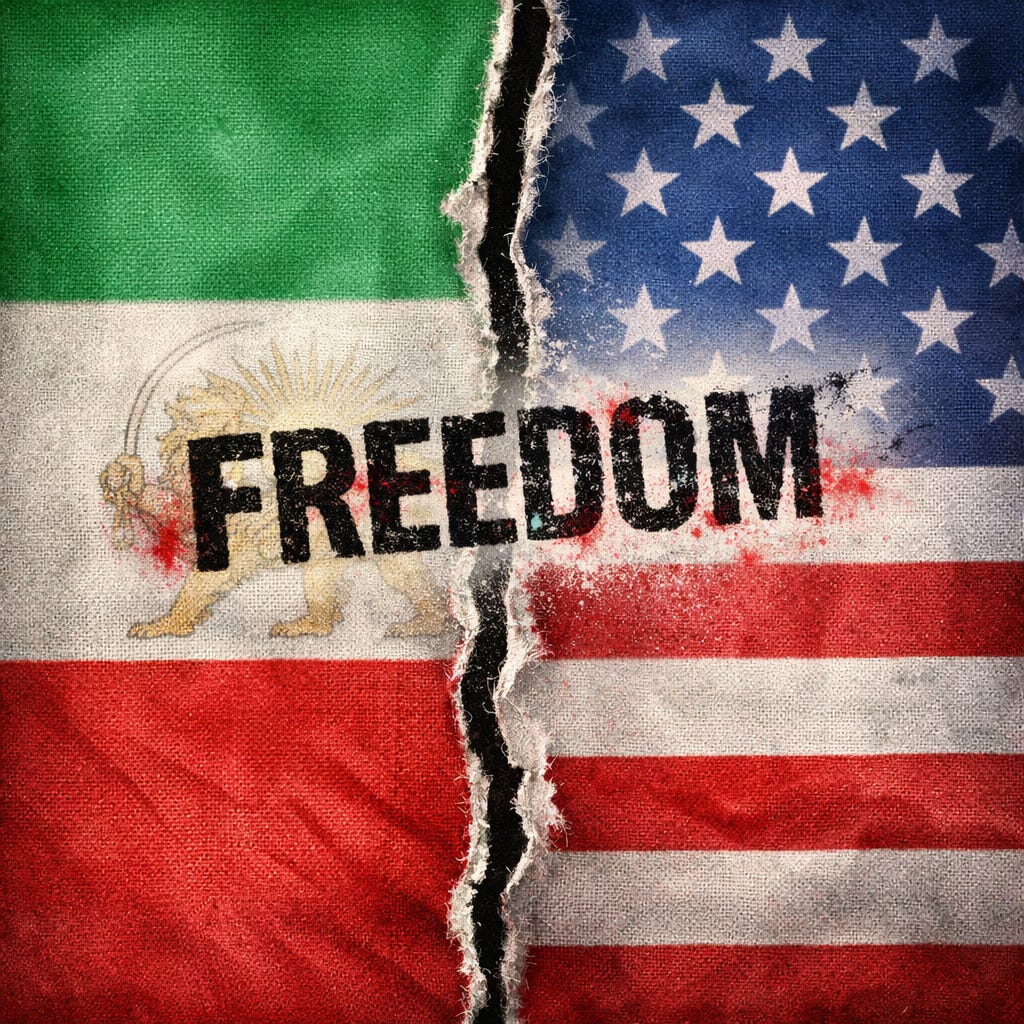
Chapter 1 — The Revolution That Became a Cage
At the beginning, it looked like sunrise.
Not the clean, mythic kind—the kind that poets sell to children—but the brutal dawn that arrives after a long night of fear, when the streets still smell like smoke and sweat and the last slogans haven’t faded from the walls. People remember the color of it. The density of bodies. The strange softness that briefly enters a nation when the state’s fist loosens and the air returns to the lungs.
In those first days, Iran was a country exhaling.
Men stood on cars and cried openly. Women laughed without checking who was watching. Strangers embraced as if they had survived the same shipwreck, which they had. The language on everyone’s tongue was not theology—it was dignity. The words were simple, human, and dangerously pure: enough. Enough humiliation, enough torture, enough secret police, enough foreign masters and domestic kings. A people who had been trained for decades to whisper now discovered what it felt like to speak at full volume.
History, in those weeks, seemed to bend toward mercy.
And this is the first truth you have to hold if you want to understand the catastrophe that followed: the Iranian Revolution did not begin as a religion seizing a nation. It began as a nation attempting to retrieve itself from theft.
But revolutions have a second phase, and it is almost never the phase that gets filmed.
The second phase begins when the tyrant leaves, when the euphoria spikes, when the crowd turns from refusal to construction—when a people asks the only question that matters after victory: Who will decide what happens next? And the answer, in most revolutions, is not “the people.” The answer is: the faction that can organize faster than grief, discipline faster than joy, and punish faster than hope.
Iran’s tragedy is not that it rebelled. Its tragedy is that it won—and then handed the aftermath to men who had been preparing for this moment with the patience of priests and the hunger of prosecutors.
A revolution is not merely a change of rulers. It is a change of grammar. It teaches a society what words mean. What “freedom” means. What “enemy” means. What “purity” means. What “woman” means. What “law” means. The Islamic Republic did not merely enforce rules; it rewrote the moral dictionary and made its definitions compulsory.
The new regime understood something the old one never fully grasped: if you want to rule a people, you do not only need guns. You need categories. You need a story so total that disagreement becomes blasphemy.
So the revolution that began as dignity was translated—step by step—into a governing religion.
Not faith in the private sense—faith as a chosen trembling, faith as the midnight whisper of a soul trying to stay human. Not that. The religion that took power was a political Islam: Islam drafted into bureaucracy, weaponized into legislation, converted into an administrative technology for obedience. A state that did not merely claim to represent God, but claimed the right to define Him. A state that did not merely ask for loyalty, but demanded submission as virtue.
And the most reliable way to produce submission is to seize the body.
That is why the cage closed first around women.
Not because women were an afterthought, but because women were the frontier. Every regime that dreams of total control eventually discovers the same truth: you can measure sovereignty by what you can force a woman to do in public. A government that can dictate how she dresses can dictate what she says. A government that can police hair can police thought. A government that can turn half the population into a walking compliance test can turn the entire nation into a classroom of fear.
So the veil became policy. Not merely cloth—policy. A uniform for public life. A daily ritual of submission required by the state and enforced by men who suddenly had a sacred excuse to invade the lives of strangers.
This was not an accident of culture. It was strategy. It was the quickest way to demonstrate that the revolution belonged to the new guardians, not to the coalition that had bled for it.
And it worked—not because the people welcomed it, but because the people were exhausted.
That word matters: exhaustion. After victory, people want normalcy. They want bread. They want safety. They want their children to stop flinching at footsteps in the hallway. And when a disciplined faction offers “order” in the name of holiness, the exhausted will sometimes accept the trade without realizing what they have sold.
This is how democracies die after revolutions: not when the dictator refuses to leave, but when the victors accept a new monopoly on truth because they are too tired to fight for pluralism.
In Iran, the new monopoly wore black and spoke in the language of martyrdom.
Martyrdom is one of the most dangerous currencies in politics because it cannot be audited. It silences argument by elevating pain into proof. It declares that suffering has already chosen the side of the righteous. Once martyrdom becomes a state ideology, the state no longer needs to persuade. It only needs to accuse.
And accusation became the regime’s primary instrument.
If you opposed the new order, you were not merely wrong—you were impure. A traitor. An agent. A servant of foreign corruption. A contaminant in the body of the nation. The revolution’s moral energy—the legitimate rage at the Shah’s brutality, at foreign theft, at decades of humiliation—was redirected away from the new rulers and toward an ever-expanding enemy category.
Every authoritarian project needs an enemy that never disappears. The enemy is how the regime justifies emergency. The enemy is how it consolidates power without admitting it is consolidating power. The enemy is how it turns dissent into treason and treason into a crime worthy of disappearance.
For the Islamic Republic, America was not merely a geopolitical adversary. America was the indispensable devil: the external image onto which all internal failures could be projected.
This is the second cage Iran entered: the cage of permanent enmity.
Hostility toward the United States became more than foreign policy. It became a moral theater that allowed the regime to present itself as the guardian of dignity even as it crushed dignity at home. It could beat women in the street and call it protection from Western decadence. It could silence journalists and call it defense against imperial propaganda. It could fill prisons with dissidents and call it resistance.
And once a regime fuses its legitimacy to opposition against an external enemy, it gains a terrifying freedom: it can do almost anything domestically and still claim to be fighting for national pride.
The revolution had started as an attempt to retrieve sovereignty. It was now being used to manufacture a sovereignty-performance, staged daily on television, shouted in slogans, paraded in rituals—while real sovereignty, the kind that would allow the people to shape their own lives without fear, was quietly confiscated.
It is here that the regime discovered a second alibi, even more powerful than America: Palestine.
Let me say this with precision, because sloppiness here becomes cruelty.
The Palestinian cause is real. The suffering is real. The dispossession is real. The grief is real. The moral claim is not invented. But the Islamic Republic did not treat Palestine primarily as a human tragedy to be addressed with humility and solidarity. It treated Palestine as a lever—an instrument of legitimacy, a permanent emergency that sanctified militarization, disciplined dissent, and made sacrifice compulsory.
A regime that wants to rule without accountability loves an endless conflict. Endless conflict allows endless mobilization. Endless mobilization allows endless surveillance. Endless surveillance allows endless control.
Palestine, in the hands of the Islamic Republic, became more than a cause—it became a permission structure. It allowed the state to say: we are at war; therefore you must endure. It allowed the state to say: we are resisting; therefore you must be silent. It allowed the state to say: the nation is under threat; therefore your freedoms are luxuries.
And so Iran was asked to live in austerity not merely because of mismanagement or sanctions or corruption, but because the state had sanctified perpetual confrontation as identity. It had turned foreign policy into theology. It had built a political self that required enemies the way a fire requires oxygen.
This is what my mother means when she calls the country a hostage.
A hostage is not merely someone trapped. A hostage is someone whose life has been subordinated to demands that are not theirs. A hostage eats and sleeps and grows old under conditions decided by negotiators elsewhere. A hostage can see their own home, but cannot inhabit it freely.
Iran became a hostage in at least three directions at once: hostage to its own rulers, hostage to the narrative of permanent war, hostage to the global powers that respond to that narrative with punishment that often lands on the wrong bodies. And the citizen is crushed between these forces—between regime corruption and foreign hostility—while being told, with a straight face, that this is what dignity looks like.
But the deepest hostage-taking was spiritual.
Because when a state claims God as its sponsor, it poisons the sacred.
The Islamic Republic did something that will take centuries to heal: it made millions of people associate the name of God with humiliation. It turned prayer into performance. It turned morality into policing. It turned sermons into threats. It turned the language of transcendence into the vocabulary of surveillance.
This is why political Islam is not merely a political disagreement for people who lived under it. It is a violation of the soul.
Political Islam—in its Iranian state form—does not merely govern behavior. It governs meaning. It attempts to monopolize the relationship between the individual and the divine. It tells a woman that her hair is a public offense. It tells a young man that his desire is a crime. It tells artists that beauty is suspicion. It tells citizens that speech is an infection.
And then it calls this “freedom.”
Freedom—from Western decadence. Freedom—from corruption. Freedom—from the enemy. Freedom—from the chaos of pluralism.
But what it actually means is freedom for the regime: freedom to legislate intimacy, freedom to criminalize dissent, freedom to cultivate fear while preaching righteousness.
That is the essence of the cage: a government that uses the language of virtue to make virtue impossible.
Because virtue requires choice. It requires conscience. It requires interiority. It cannot exist under compulsion.
The revolution promised the restoration of dignity. The Islamic Republic built a system in which dignity became conditional: conditional on obedience, conditional on performance, conditional on the correct costume, conditional on silence.
And then—inevitably—it produced the most corrosive consequence of all: mass duplicity.
A society forced to perform holiness becomes a society trained in lying.
Public piety; private contempt. Public slogans; private despair. Public mourning; private laughter. People learn to split themselves in two. They learn to survive by developing a second tongue, a second face, a second life. That split is not merely psychological; it is political. It is the regime’s masterpiece: a population so practiced in self-censorship that the state can rule with fewer bullets, because fear has moved inside the body.
This is why the revolution’s aftermath matters more than the revolution’s victory. The aftermath is where a people either builds institutions that protect disagreement—or builds institutions that punish it. Iran built institutions that punished it.
And the world watched, as the West often does, in a state of moral simplification. Iran became a symbol on the screen: a turbaned villain, a veiled woman, an angry crowd. Western liberals reduced Iran to oppression; Western conservatives reduced Iran to threat. Both missed the deeper fact: Iran’s tragedy was not exotic. It was a classic political tragedy—a revolution that began as a demand for sovereignty and ended as a machine for obedience.
The warning is not that Iranians were uniquely naïve. The warning is that human beings, under pressure, will trade complexity for certainty. They will trade pluralism for purity. They will accept a new tyranny if it arrives wrapped in moral language and promises to punish the old tyrant’s collaborators.
And the most dangerous moment is always the moment right after victory, when the crowd still believes it cannot lose again.
Iran lost again.
Not because the people were weak, but because the faction that seized the aftermath understood power at the level of nerves. It understood fear. It understood the utility of enemies. It understood the political value of women’s bodies as border control. It understood how to convert faith into administration. It understood how to turn Palestine into a permanent emergency. It understood how to make America into a devil so useful that the nation could be disciplined forever in the name of resistance.
So the revolution that began as an exhale became a training program in suffocation.
And now, decades later, an old woman walks uncovered, her mouth bloodied, and says she has nothing left to lose.
When someone says that, they are not speaking in the language of politics. They are speaking in the language of a hostage who has finally stopped negotiating. They are speaking for everyone who has lived for years inside a cage built from righteousness.
She is not an argument. She is a verdict.
And the verdict is simple:
A regime that calls obedience freedom will eventually meet a people who would rather bleed than pretend.
Chapter 2 — The Rhyme in the Republic
There are moments when a country changes its face without announcing it.
Not with a coup. Not with tanks. Not with a dictator standing at a microphone declaring the constitution dead. It changes the way a body changes when it starts to fail: quietly at first, through symptoms people learn to explain away. A fever called “passion.” A tremor called “patriotism.” A bruise called “necessary.” And because the flag is still there, and the courts still open, and the anchors still speak in their practiced tones, people tell themselves it cannot be what it feels like.
But some of us have seen this before.
I remember watching America in 2025 the way you watch a man you love begin to lie to himself. Not once. Not dramatically. Habitually. The lie becomes a posture. The posture becomes a culture. And then, one day, you realize you are not arguing about policy anymore. You are arguing about reality—about whether the law exists, whether truth exists, whether losing is a legitimate outcome, whether power has boundaries.
And when those arguments start, the republic is already bleeding.
It was not one event. It was an atmosphere.
A man says he is the people. The crowd repeats it until it becomes metaphysics. A movement discovers the sweetest drug in politics: the permission to be cruel while calling it honesty. Another discovers the oldest trick in political theology: to transform “freedom” from a universal demand into a tribal password. Freedom for us. Silence for them. Rights for the righteous. Punishment for the impure.
This is how a democracy begins to rehearse its own destruction without admitting it is rehearsing anything.
The American version did not arrive wearing turbans. It arrived wearing suits, podcasts, flags, memes, baseball caps—consumer nationalism. It did not quote scripture as law; it quoted grievance as revelation. It did not announce a theocracy; it announced a restoration. It promised to return the country to an imagined past that never existed in the way it was remembered.
And it asked for one thing in exchange: loyalty.
Not loyalty as civic responsibility—loyalty as surrender of judgment. Loyalty as the replacement of conscience with belonging. Loyalty as the demand that every institution, every reporter, every judge, every teacher, every civil servant, every scientist, every neighbor, either kneel or be marked.
I felt something in 2025 that I have felt before in the histories of other countries: the republic becoming emotionally impossible.
Because democracies depend on a fragile virtue that people rarely name: the ability to accept that your opponent might win and still be legitimate. The ability to accept loss as law, not humiliation. The ability to accept that power is temporary, that the state belongs to no single tribe, that elections are not sacrificial rituals where the losers must confess sin.
When that virtue dies, democracy doesn’t end instantly. It becomes theater. A stage where the rituals remain but the faith is gone.
And in 2025, the faith was dying in public.
You could see it in the way institutions began to flinch. In the way journalists began to pre-anticipate the mob. In the way universities began to speak like corporations trying not to anger investors. In the way public officials began to calculate every sentence not for truth but for survivability. In the way people who knew better—people who could still see the line—began to treat the line as negotiable.
The line is always negotiable right before it disappears.
This is the rhyme I cannot unhear: the transformation of politics into purity.
Every authoritarian movement—religious or nationalist, left or right—needs purity because purity is what makes violence feel like virtue. Purity is what allows a crowd to treat dissent not as disagreement but as contamination. Once contamination becomes the frame, repression becomes hygiene. Deportation becomes sanitation. Surveillance becomes protection. Censorship becomes defense. The law becomes a broom.
Iran’s revolution, after its victory, turned purity into theology. America’s movement in 2025 turned purity into identity and grievance. Different language. Same function.
The first move is always the same: create an enemy whose existence is intolerable.
Not an adversary, not a competitor—an enemy. Someone to blame for the nation’s humiliation. Someone to accuse of poisoning children, stealing jobs, corrupting culture, eroding masculinity, replacing the people, destroying the sacred. Someone who must be stopped not because they are wrong but because they are evil.
Once you have evil, you no longer need debate.
And once you no longer need debate, you no longer need democracy.
Then comes the second move: transfer legitimacy from the constitution to the leader.
It is the oldest heresy of the republic: the replacement of law with charisma. The leader becomes the source of truth; the crowd becomes the evidence. Institutions become obstacles. Courts become enemies. Elections become acceptable only if they confirm the leader’s destiny.
In Iran, this transfer was sanctified through religious narrative: the leader as guardian of the revolution, the interpreter of God’s will, the custodian of authenticity. In America, it was sanctified through spectacle: the leader as the only one brave enough to speak, the only one who can fix, the only one who tells it like it is, the only one who fights.
And fighting becomes the measure of virtue. Not truth. Not restraint. Not fairness. Fighting.
A democracy that worships fighting is already halfway to becoming a state that worships force.
The third move is where the slow death becomes tangible: exceptionalism.
“Emergency” is the regime’s favorite word because emergency suspends ethics. Emergency dissolves process. Emergency turns power into necessity. Under emergency, the law becomes flexible. Under emergency, the press becomes suspicious. Under emergency, protest becomes threat. Under emergency, dissent becomes sabotage. Under emergency, you can do what you want and call it protection.
In Iran, the emergency was external and theological: the enemy abroad, the devil of America, the war, the betrayal, the sacred duty of resistance. In America in 2025, the emergency was civilizational and internal: “invasion,” “crime,” “corruption,” “stolen elections,” “woke collapse,” “degeneracy,” “the end of the real country.”
The content differs. The structure is identical: the permanent emergency that never ends because it is the engine of power.
A people in a permanent emergency is easy to govern. Fear makes them grateful for control. Exhaustion makes them accept brutality. Anger makes them hungry for punishment. And punishment, once sanctified, becomes policy.
But the deepest rhyme—the one I could not stop seeing in 2025—is not simply institutional. It is spiritual.
Because authoritarianism is not primarily a set of laws. It is a mood trained into a population.
It is the training of contempt.
Contempt for truth. Contempt for expertise. Contempt for complexity. Contempt for the slow work of civic life. Contempt for restraint. Contempt for those who speak carefully. Contempt for anyone who tries to hold the line when the crowd wants to storm it.
Contempt is not just an emotion; it is a political technology. It makes cruelty feel like clarity. It makes lies feel like courage. It makes humiliation feel like justice.
And in 2025, contempt was a public ceremony.
You could hear it in the laughter when someone’s life was reduced to a slogan. You could feel it in the way cruelty became entertainment. You could see it in the way people began to treat the suffering of others as proof that the world was being restored to its proper order.
This is where the republic becomes unrecognizable to those who once loved it: when the crowd learns to enjoy degradation.
It is here that the “dead internet” becomes relevant, not as a side topic but as infrastructure. Because the modern republic dies in two places at once: in law and in attention.
A democracy is not only ballots. It is the shared capacity to perceive reality together. When perception collapses, elections become superstitions. Institutions become props. The nation becomes a set of private hallucinations held together by vibes.
In 2025, America was not merely divided; it was being trained into incompatible realities. Not by accident. Not by “polarization” as a natural weather system. By incentives. By platforms that reward rage and irony. By media ecosystems that sell humiliation as entertainment. By political operators who understand that outrage is cheaper than governance and more addictive than policy.
This is how you can destroy democracy without banning speech: you flood the public square with noise until truth becomes socially expensive.
People stop speaking because speaking is punished—not by law, but by atmosphere.
They stop writing because writing is mocked.
They stop arguing because argument is pointless when the other side does not share the same world.
They stop hoping because hope requires a future, and a future requires a minimum agreement about what is real.
So the republic becomes a stage where everyone is shouting, and no one is hearing, and the only thing that travels cleanly is contempt.
I found myself grieving America in 2025 not as a citizen reading headlines but as someone who has already watched another country lose the ability to speak.
There is a particular sensation you feel when a society begins to punish seriousness: a tightening in the chest, as if the air itself has been privatized by cynicism. You learn to measure your words for survivability. You learn to anticipate bad faith. You begin to speak less, not because you have nothing to say, but because the cost of saying it begins to exceed the value of being heard.
That is how freedom disappears: not when you are silenced, but when you are trained to silence yourself.
And this is why I cannot treat the American debate in 2025 as normal politics. It is not simply “conservatives vs liberals,” not merely the rhythm of partisan cycles. It is a struggle over the moral prerequisites of democracy: truth, restraint, legitimacy, and the acceptance that your opponent is still a citizen.
Once a movement begins to revoke citizenship emotionally—once it begins to treat whole populations as illegitimate—democracy becomes an illusion maintained by paperwork.
Paperwork is not enough.
What made this unbearable for me, as someone born elsewhere, is the double wound: to watch the country that once promised refuge begin to flirt with the same techniques of moral domination that have haunted the places I came from.
I did not come to America because I believed it was morally pure. I came because it had a system that, at its best, could withstand human impurity. It could hold disagreement without demanding blood. It could survive ugliness without turning ugliness into doctrine. It could produce change without requiring revolution.
In 2025, I watched that system being treated not as a treasure but as an obstacle.
This is not nostalgia. It is not romanticism. It is a recognition of how rare restraint is in human history, and how easily it is thrown away by people who confuse strength with domination.
And then, as if to complete the circle of obscenity, the same voices corroding freedom at home discovered the word “freedom” when they looked abroad.
Suddenly they cared about Iranian women. Suddenly they spoke about censorship. Suddenly they used the language of liberation. Suddenly they claimed solidarity with protesters in the streets of a country they could not locate on a map without a teleprompter.
Not because they had become defenders of universal freedom.
But because Iran is convenient.
Because the enemy of their enemy is useful. Because the suffering of a foreign people can be drafted into a domestic narrative. Because “freedom” abroad can be weaponized without requiring freedom at home.
This is the oldest imperial trick: to dress strategy as conscience.
It is also the most insulting form of solidarity: the kind that treats the oppressed as instruments.
In 2025, watching this unfold, I felt the same sickness I feel when I watch a regime sanctify its violence: the sacred word “freedom” being converted into a prop.
Freedom as a slogan. Freedom as a marketing line. Freedom as a cudgel.
Freedom with no commitment to pluralism, no respect for elections, no patience for law, no empathy for the vulnerable, no restraint in the use of power.
Freedom reduced to a tribal hymn.
This is where the American story meets the Iranian story, not in doctrine but in technique: the hijacking of moral language by those building cages.
And that is the bridge into what must be said next.
Because I can bless the people of Iran without giving my voice away to those who would use their uprising as a weapon. I can support a revolt against political Islam without becoming a servant to a different form of authoritarianism. I can despise the machine that turned God into a police officer without allowing empire to turn Iranian blood into a talking point.
That is not fence-sitting. That is the only form of solidarity that does not become annexation.
And it begins with an ethic: support without ownership.
That is the next chapter.
Chapter 3 — Solidarity Without Ownership
I bless the protesters.
Not as a slogan. Not as a performance. Not as a convenient pose. I bless them because a people being beaten for wanting air deserves more than my analysis. They deserve my allegiance. They deserve the plain moral sentence that too many refuse to say with their full chest: the Islamic Republic has forfeited legitimacy. A government that rules by humiliation, that polices hair and words and desire, that holds a nation hostage to its ideology, that turns prisons into ministries and confession into theater—such a government is not merely “authoritarian.” It is a desecration of life.
And the people who stand against it—whether they chant, whether they strike, whether they simply walk unveiled through the streets and refuse to apologize for existing—are not just political actors. They are witnesses. They are saying, with their bodies, that there is a limit to what a human being can be forced to pretend.
This is what I bless: the refusal.
But blessing the refusal does not mean surrendering the story.
Because there is another theft that arrives whenever a nation rises in pain: the theft of the uprising by outsiders who want to own its meaning.
Some of those outsiders wear suits. Some wear flags. Some wear algorithms. Some wear the language of “freedom” like a perfume they apply when cameras appear. They speak about liberation abroad while corroding it at home. They celebrate protesters in Tehran while criminalizing them in Texas. They call themselves defenders of speech while building systems that punish seriousness with ridicule and exhaust truth beneath noise.
They are not allies. They are opportunists.
And the first task of an ethical witness—especially an exile, especially a diaspora voice, especially someone writing in the heat while the bodies are still falling—is to learn the difference between solidarity and annexation.
Annexation is what empires do with land. Solidarity-annexation is what they do with suffering. It is the same move in a gentler costume: to take what is not yours, to reframe it as your destiny, to extract value from another people’s wound, to fold their dead into your narrative and call it compassion.
You can recognize annexation by one sign: the oppressed are required to become legible to the powerful in order to be worthy of support.
Speak in our language. Name a leader we can talk to. Offer a program we can negotiate. Promise an outcome we can manage. Condemn the enemies we hate. Praise the allies we trust. Be simple. Be coherent. Be a story we can sell.
In other words: become usable.
This is where “support” becomes a trap. Because the moment an uprising is required to be usable, it is no longer free. It has been domesticated into an export product. It becomes a commodity circulating in foreign media ecosystems and policy rooms—an image to justify sanctions, an image to justify strikes, an image to justify a savior, an image to justify an agenda that was waiting for an excuse.
The worst thing you can do to a suffering people is to steal their agency after they have already been denied it.
This is why I will not appoint Iran’s future from exile. I will not crown anyone in the middle of the fire. I will not demand a constitution from people being shot. I will not turn their grief into a referendum on my own ideological preferences. I will not translate their pain into Western culture-war dialect, where Iran becomes merely another screen for American self-hatred.
A nation does not rise in order to validate outsiders.
A nation rises because it can no longer breathe.
There is a psychological hunger in every crisis: the hunger for a face. For a spokesperson. For a single voice to answer the terrifying question that every onlooker asks: What happens next? It is a natural hunger. It is also a dangerous one.
Because “a leader” is not just a person. A leader is an interface. And power loves interfaces. Power wants a point of contact. Power wants one number to call. One person to invite to conferences. One figure to declare “reasonable.” One figure to treat as the movement’s signature.
This is how foreign interests tame an uprising without defeating it: they select the face that makes them comfortable and call comfort legitimacy.
I understand why some Iranians invoke the Crown Prince. I understand the longing. I understand the clarity. I understand the desire to hold something in the mind other than the cleric’s boot. When a people is suffocating, even a symbol can feel like oxygen. Sometimes a name is not a program; it is a refusal made visible. It is the shouting of an alternative into a sky that has been occupied.
I will not insult that longing.
But symbols are not constitutions. Names are not consent. Visibility is not legitimacy. And the demand that Iran must produce a single, legible leader in order to be supported is not support—it is management.
It is the logic of 1953 in a modern suit: sovereignty made conditional on foreign comfort.
This is why I reject instrumental compassion. This is why I reject “enemy-of-my-enemy freedom.” This is why I reject the obscene theater in which men who corrode democracy at home suddenly discover the language of liberation abroad.
Because freedom used as a weapon is not freedom. It is strategy with a halo.
The principle is simple: you cannot claim to love liberty while building cages. You cannot call yourself pro-freedom in Iran while rehearsing authoritarianism in America. You cannot celebrate women being beaten by morality police while praising the criminalization of protest at home. You cannot mourn censorship abroad while running platforms that teach people to punish seriousness and reward cruelty.
And you cannot call this hypocrisy an accident.
It is a method.
Freedom, in the mouths of these men, is not a universal moral demand. It is a tool—a word that means “our side wins.” It is used when it harms an enemy. It is discarded when it threatens control. It is deployed abroad because the cost is low and the optics are high. It is denied at home because the home is where power must actually be shared.
This is the key to their contradiction: they do not love freedom. They love sovereignty for themselves.
They love domination without the shame of admitting it.
So they borrow the word “freedom” the way a thief borrows a uniform: to enter places they have no right to enter and to be treated as legitimate while committing a crime.
Solidarity without ownership means refusing this theft.
It means refusing to let Iran’s uprising become a stage for other men’s morality plays.
It means refusing to turn Iranian bodies into content.
It means refusing to turn Iranian courage into permission for foreign violence.
It means refusing to turn Iranian grief into a fundraising pitch or a partisan meme.
And it means, above all, refusing to demand that Iranians become simplified in order to be supported.
Because real solidarity does not begin with demands. It begins with accompaniment.
Accompaniment is not loud. It is not heroic. It does not announce itself as virtue. It does not require the oppressed to perform gratitude. It does not ask for ideological purity. It does not appoint leaders. It does not bargain over the dead.
It does the quiet things:
It amplifies primary voices instead of replacing them.
It protects communication channels without insisting on political ownership of the outcome.
It documents crimes so the regime cannot rewrite memory.
It supports strike funds and medical aid and legal defense.
It refuses to spread rumors that endanger people.
It refuses to romanticize violence.
It refuses to treat an uprising as entertainment.
It understands that the first duty of the outsider is not to narrate but to listen.
And when it speaks, it speaks with restraint. Not the restraint of cowardice—the restraint of respect. The restraint of knowing that a nation’s future is not your property.
This is why my support has boundaries. Boundaries are not indifference. Boundaries are the only way to keep solidarity from becoming annexation.
My boundary is this: Iran must belong to Iranians, not to their rulers, not to foreign powers, not to diaspora fantasies, not to media appetites, not to strategists, not to billionaires who sell “freedom” as bandwidth while turning the public square into a humiliation machine.
Iran must belong to the people who bleed in its streets.
I can say that without appointing the shape of the next regime. I can say that without giving anyone a crown. I can say that without demanding a program in advance. I can say that while still naming, without apology, what must end: political Islam as state power; God drafted into policing; holiness used as a baton; a nation turned into a hostage of “resistance” theater while its own citizens are priced out of their lives and exiled from their own futures.
I bless the protesters because they are returning something to Iran that no sanction, no speech, no foreign policy, no exile can restore from the outside: the right to refuse.
But I will not let their refusal be stolen.
Not by clerics.
Not by empires.
Not by saviors.
Not by opportunists who chant “freedom” abroad while practicing domination at home.
This is what it means to support without ownership.
It is the only kind of support that does not become another form of rule.
Chapter 4 — The Woman With Blood in Her Mouth
There are moments when a single face ends an argument.
Not because it is persuasive in the way pundits mean persuasion, not because it performs the right ideology, not because it recites the correct program—but because it carries the irreducible authority of lived consequence. A body that has been struck by the state speaks a language that no spokesperson can counterfeit. Blood does not argue. Blood testifies.
I saw her and understood immediately why revolutions do not begin in theory.
An old woman, uncovered, walking in the street as if she had crossed some invisible border that the rest of us still fear. Her mouth was bloodied. The blood was not symbolic; it was fresh. She walked like someone who had already made the only decision that matters under tyranny: that fear would no longer be the price of remaining alive.
And she said something to the effect of: she has nothing left to lose.
That sentence is not a slogan. It is a diagnostic.
When a person says “I have nothing to lose,” it does not mean they are reckless. It means the regime has already taken everything that makes life feel like life: safety, dignity, predictability, the ability to imagine a future. It means the state has overplayed its hand so completely that survival has become indistinguishable from submission—and submission has become unbearable.
It means the hostage has stopped negotiating.
For decades, the Islamic Republic has governed by forcing people to negotiate with their own humiliation. It makes you bargain with your own conscience: how much of yourself will you amputate today to pass through the world without being punished? How much of your daughter’s freedom will you surrender to keep her safe? How much truth will you swallow to keep a job? How much beauty will you silence to avoid attention? How many sentences will you delete from your own mind?
The regime doesn’t only punish. It trains.
It trains the flinch into the nervous system. It trains obedience into the morning routine. It trains duplicity into adulthood. And then it calls this “stability,” as if a nation living in constant self-editing is merely “normal life with traditions.”
But her face—her uncovered head, her bloodied mouth—was what happens when training fails.
Not because she became fearless in some heroic myth, but because the regime’s basic exchange rate collapsed. It offered fear as a currency, and she no longer believed fear could buy her anything worth living for.
This is what I want people outside Iran to understand, because it is the only ground from which ethical solidarity can grow: these protesters are not asking for attention. They are demanding the minimum conditions of human life. The right to walk without apology. The right to speak without rehearsing their own disappearance. The right to exist without being treated as a suspect in the eyes of a state that calls itself holy.
Her blood is not an invitation for outsiders to write their own story over her. It is a rebuke to every outsider who treats Iran as a chessboard.
And yet that is exactly what happens, almost instantly, whenever Iran erupts.
A clip surfaces. A face goes viral. Politicians issue statements. Commentators posture. Think tanks publish talking points. Billionaires float “solutions.” The word “freedom” enters the mouths of men who treat freedom as a prop. The uprising becomes content, and the dead are turned into persuasion material.
This is the mechanism of modern theft: even suffering is quickly processed into someone else’s narrative supply chain.
I refuse it.
Not because I am above politics, but because I have become suspicious of all speech that arrives too quickly with a plan. Plans are the favorite disguise of ownership. Plans are how outsiders smuggle control into compassion. Plans are how foreign powers convert a people’s revolt into a manageable future.
The woman with blood in her mouth has not asked anyone to manage her. She has asked the regime to stop.
That is the shape of the demand: negative before positive. End the beating. End the suffocation. End the hostage life. End the god-police state. End the permanent emergency. End the theater of righteousness that justifies misery.
And if you want to know what “hostage life” actually means, don’t ask a strategist. Ask a mother.
My mother has said it plainly: they have turned the country into a hostage.
Prices climb. Currency collapses. Life gets narrower. Every ordinary aspiration becomes a negotiation with crisis. Everything—from medicine to housing to the ability to plan a wedding—feels provisional. The future becomes a rumor, something other nations are allowed to possess.
And then there is the exile inside exile: the borders.
She has applied for a visa for years. Years. The paperwork becomes a second prison, administered by a foreign country but produced by the regime’s choices: endless hostility, endless provocation, endless sanctified confrontation. The Islamic Republic turns foreign policy into identity, and the citizens inherit the consequences as if they personally signed the slogans painted on state television.
So my mother cannot visit me.
Not because she is dangerous. Not because she has committed a crime. Not because she is a threat. But because a government that claims to defend dignity has made normal human movement—mother to son—into collateral damage.
This is what it means to turn a nation into a hostage: even love becomes geopolitics.
She wants the regime gone for reasons that have nothing to do with ideology and everything to do with life: because she is tired, because she is aging, because she wants to breathe, because she wants to see her child, because she wants a country that is not perpetually at war with reality.
And she also wants the relationship between Iran and the United States to improve—not because she worships America, not because she believes in American purity, but because she wants the world to stop being used as a battlefield by men who do not pay the costs of their own aggression.
This is where the story becomes morally complicated, and where lazy political writing collapses into slogans.
Because yes: the Islamic Republic is the primary author of Iran’s hostage life. It built the cell. It designed the key. It institutionalized the humiliation. It chose the theology of permanent confrontation as a governing identity. It decided that the body of a woman would be a battleground. It decided that “resistance” would be the excuse for everything, including the slow starvation of ordinary joy.
But it is also true that great powers—especially the United States—have often responded to Iran not with a consistent ethic of human freedom but with their own imperatives: interests, fear, punishment, leverage. They have imposed policies that claim to target regimes and frequently crush civilians. They have spoken the language of rights while engaging in alliances and interventions that make the language ring hollow.
Both things can be true without confusion of responsibility.
The regime built the cage. The world often tightens the outer ring. The prisoner is still the prisoner.
And now, in the middle of this uprising, the obscenity sharpens: the same American forces corroding democratic restraint at home suddenly present themselves as patrons of freedom in Iran. They speak as if they have always cared. They posture as if they are guardians of liberty. They discover the word “women” abroad in the same breath that they punish dissent, criminalize protest, and flirt with authoritarianism at home.
This is not support. It is opportunism.
It is enemy-of-my-enemy morality: the oldest cheap substitute for conscience.
It produces a specific kind of false solidarity: loud, performative, and fundamentally proprietorial. It treats Iran’s uprising as a weapon to be aimed at a rival, rather than as a human revolt that deserves dignity on its own terms.
It is the kind of solidarity that carries an invoice.
The woman with blood in her mouth is the antidote to this hypocrisy because she cannot be used without being betrayed.
If you use her pain as a prop, you are no longer supporting her. You are consuming her.
If you invoke her suffering as a justification for your own authoritarian tendencies at home, you are not pro-freedom; you are pro-power.
If you claim to “stand with Iran” while building cages for your own citizens, you are not an ally of liberty; you are a merchant of it.
So what can I say, in the face of her blood and my mother’s longing, that does not become another form of theft?
I can say this:
I want the Islamic Republic to fall.
Not because I am addicted to regime-change fantasies, not because I believe the aftermath will be clean, not because I think history ends when a tyrant leaves, but because a government that rules through humiliation has no moral claim to govern. Because political Islam, as a state project, has poisoned the sacred and degraded the human. Because a nation cannot be asked to live forever inside a permanent emergency sanctified as virtue.
I want the people to win their air back.
And I also want the world—especially America—to stop treating Iran as a stage for its own drama.
I want solidarity that does not seize ownership.
I want support that does not appoint leaders, does not demand legibility, does not translate the uprising into someone else’s ideology, does not turn the dead into content, does not use Iranian blood as a talking point in domestic factional wars.
I want those who claim to be pro-freedom to prove it where it costs them: at home. In their own institutions. In their own restraint. In their willingness to accept pluralism, legality, and the legitimacy of opponents as citizens.
Because the easiest freedom to praise is the freedom of strangers.
The hardest freedom to honor is the freedom of people you are tempted to dominate.
The woman with blood in her mouth is not asking for my cleverness. She is asking for the end of a regime that has turned her old age into a battlefield. My mother is not asking for my ideology. She is asking for the simple human right to visit her child, to live in a country where prices do not rise like a curse, where the state does not turn every ordinary act into a political crime.
And perhaps this is the only honest way to end:
Not with a manifesto. Not with a crowned savior. Not with a policy list.
With a wish so modest it indicts every empire and every theocracy at once:
May Iran become a country where an old woman can walk without bleeding.
May it become a country where a mother can cross a border without begging for years.
May it become a country where God is no longer a policeman.
May it become a country where “freedom” is not a word used by rulers, but the air people take for granted.
That is not utopia.
That is the minimum.
And it is worth everything the protesters are risking to claim it.
—Elias WinterAuthor of Language Matters, a space for reflection on language, power, and decline.