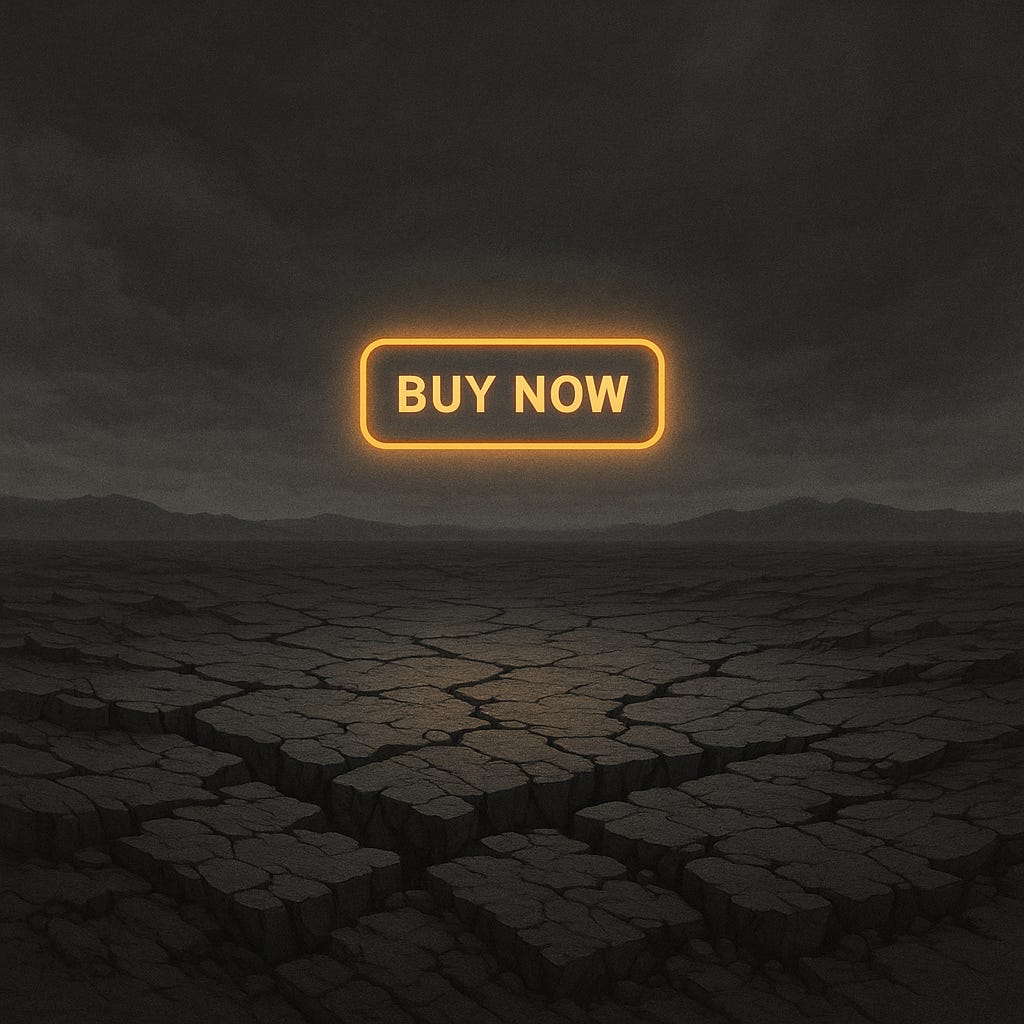
Section 1. Autoplay at the End of the World
It’s 1:17 a.m. Your laptop screen is a lighthouse for moths, and you are the moth with a credit card. You meant to watch one video about bond yields; now a wall of thumbnails is yelling in 72-point font: HYPERINFLATION TONIGHT, AI JUST LEARNED REVENGE, OCEAN ON FIRE (AGAIN), END OF DEMOCRACY (PROBABLY). The algorithm smiles like a night concierge who keeps offering you rooms with names like “Panic Deluxe” and “Executive Suite of Dread.”
You click the finance guy first, because he’s wearing a suit that suggests he has personally argued with a spreadsheet and won. The video opens with a siren sting from a royalty-free apocalypse pack. “Folks,” he says, pointing at a chart that looks like an EKG after six espressos, “if you’re not moving into real assets right now, you’re volunteering to be a piñata at the next rate hike.” He pauses. Sponsored message. “By the way, this collapse is brought to you by NordOcelot VPN. When your banking app breaks up with you, you’ll want privacy.” Promo code: ENDGAME.
You check the comments. It’s a rave at the end of the world: “I’ve been stacking silver since ’09.” “I’m only in cash and beans.” “Sir, you saved my portfolio AND my marriage.” Someone drops a link to freeze-dried stroganoff with a shelf life of three papacies.
Autoplay leaps to an AI channel hosted by a man who looks like a barista who tried philosophy once and never recovered. Title: GPT-Omega Has a Plan (And It’s Not Taxes). The host whispers urgently, which is how you know it’s bad. “We simulated nine scenarios and in seven of them we were paperclips.” B-roll of robot arms assembling other robot arms, the patriarchy of elbows. “I’m not saying unplug the data centers,” he says, eyes glistening, “I’m saying… keep a wrench handy.” Sponsored message: NebulaMattress. “If synthetic minds erase your job, at least you’ll sleep like a funded lab.”
You let the mattress float by like a cloud with affiliate links. Next: climate. Drone footage of a coastline pretending to be soup. Subtitle: Wet Planet Blues: Part 4,001. The host is wearing a parka that looks like it has a PhD. “We have 12 seconds,” she says, “give or take a decade.” There’s a map with colors not seen since grape popsicles. Sponsorship: HydraStraw—a tube you can drink a puddle with. “When the taps go quiet, you’ll be the person everyone texts.” (Assuming the cell towers are also drinking from a puddle.)
You glance at the recommended sidebar. It’s like a deli menu at a panic convention:
* Crypto Will Save You From Banks (Unless It Doesn’t)
* Civil War, But Make It Midterm
* Ten Canned Goods That Say “I Love You” When the Grid Quits
* The Dollar Is a Pumpkin: A Seasonal Analysis
* AI Writes Better Eulogies Than Priests?
* Interview: Man Who Married His Generator
The evening stretches. YouTube becomes a haunted museum where every painting follows you with its eyes. Substack newsletters start arriving in your inbox like owls with academic debt. You skim a headline: Thirteen Reasons the Bond Market Is Whispering Your Name. Another one: AI Ate My Homework: Notes from a Friendly Extinction. You click “free preview” and get three electric paragraphs ending right at the moment the author promises to reveal “The Clue Nobody Wants.” You are invited to subscribe for the price of four avocado toasts, which is $19 in newsletter math.
You switch back to YouTube. Another financial video, different blazer. “Inverted yield curve,” he says, “which is Latin for ‘Call Your Mother.’” You almost do. Instead you click over to a climate clip where an influencer kayaks to the grocery store. “Community is the new currency,” she says, paddling past the peanut butter aisle. Sponsor: Floaty, a wearable raft for people whose hobbies are lakes and denial.
Autoplay proposes a compilation: Top 10 Things That Will Definitely Happen Someday, Probably Soon, Unless They Don’t. It is impossible not to click. You click. The countdown is narrated by a voice that could sell haunted real estate. The number one item is always vague enough to pass a lie detector: “Systemic Something.” Your laptop fan begins to sound like a sermon. You consider buying a tiny solar panel to charge your phone during the collapse, which will be handy for streaming the instructional collapses.
Here is the part where the platform asks if you’re still watching. As if it doesn’t know you’re practicing for eternity. You wonder what it would recommend if you said no. Possibly a hike. Possibly sleep. Instead you say yes, and the algorithm sighs like a cat that’s gotten its way.
You close the tab. The silence has weight. Your inbox pings with a newsletter promising “a pragmatic guide to thriving in the interregnum,” which is a fancy word for the time between doom videos. You smile in the dark at how creative we are at naming the void. You don’t hate any of these people. They’re talented broadcasters of a shared human tremor. But it does occur to you—somewhere between the VPN and the bullion cougar—that this whole experience felt less like learning and more like renting a sense of control by the hour.
You set the laptop aside. The room keeps glowing anyway; that’s how late screens work. You think of the list of things you were supposed to do today that didn’t involve a coupon for powdered eggs. Then, like someone sneaking out of an overlong party, you let yourself imagine tomorrow without the nightly tour of endings. It’s a small thought, but it stretches its legs.
The algorithm will wait. It has all night. It has all of us, one more video at a time, sold with a grin and a countdown. Tonight, for once, you let it count down alone.
Section 2. Receipts from the Abyss: A Short History of Paid Apocalypse
Prophecy has rarely traveled alone; it walks with a cashier. The forms change—alms, indulgences, pennies for pamphlets, theater tickets, ad buys, affiliate codes, monthly renewals—but the contract is familiar: stand near the warning, and leave something of value behind. Follow the money and you can watch the end of the world professionalize, scale, and finally auto-renew.
In the medieval square, catastrophe wasn’t a content genre; it was Tuesday. Plague trimmed the census, harvests failed, borders moved like weather. The priest, the monk, the street preacher didn’t merely predict—they mediated. One hand named judgment; the other offered a path: coins for masses, gifts toward relics, pledges for remission. Doom arrived with a liturgy and left with a ledger. You didn’t purchase safety; you purchased proximity to mercy. The economy of warning learned its first price points in the shadow of altars.
Then the press arrived and taught fear to travel. A comet scratched the night and, by morning, the stalls were stacked with woodcuts and broadsides: diagrams of tails and omens, tables that counted years to fire. The Reformation poured accelerant on the form. Each camp hired prophecy like a lawyer, naming the other Antichrist and itemizing proofs in fresh ink. Suddenly disaster had distribution. Fear left the pulpit and found a print run. What had been a sermon became a run of five thousand with margins and a second edition. The market learned that anxiety, properly typeset, sells briskly.
Industrial modernity moved the apocalypse onto graph paper. Demons ceded the stage to variables. Malthus tallied mouths and acres; Marx tracked capital through booms and busts; pamphleteers mapped social decay with the confidence of surveyors. Judgment turned secular and wore numbers. The traveling lecture circuit made doom a ticketed event—posters on brick walls, a rented hall, a velvet hat for coins at the door. Meanwhile, revival tents and millennial movements kept the sacred flame alive, sometimes with dates circled in red. When those dates passed, the crowd learned the first rule of the trade: revise, don’t retire. The show must go on.
The twentieth century discovered ratings. Radio pulled apocalypse into kitchens; television gave it wardrobe and a makeup chair. Nuclear dread professionalized the countdown—civil defense films, sirens tested at noon, experts who could pronounce annihilation with immaculate diction. Televangelists translated Revelation into geopolitics and sold it between choir numbers; environmental writers drew curves that ended in cliffs and watched their books climb lists. Panic migrated from the square to the schedule. The catastrophe tease became a dependable lead-in to the commercial break. If you stayed through the mushroom cloud diagram, you would hear about soap.
Then the calendar turned to 1999, and we discovered the joy of paying consultants to outlive a semicolon. Y2K monetized a date. Companies bought audits; households bought generators; broadcasters bought countdown graphics. The lights mostly stayed on, but the model did not power down. After 2001, the threat became a season, not an episode. Color-coded alerts, rolling headlines, a decade of surveillance budgets passed through congresses like a metronome. The security state and the 24-hour news cycle learned to dance without stepping on each other’s shoes.
Finance joined with a vengeance. After 2008, a new class of collapse entrepreneur appeared—charts like cardiograms, spirits like evangelists, convictions priced by the ounce. On late-night cable, gold gleamed between segments warning of sovereign implosion. The old relic economy returned in bullion form: portable, shiny, and pitched as absolution from fiat sin. Meanwhile, blogs with mascots of ruin aggregated tremors into destinies and sold the thrill of foresight to a generation that had just learned how quickly the floor could move.
Platforms finished the job. The feed personalized prophecy, then invoiced it. YouTube optimized the thumbnail; Substack sold the epiphany behind a paywall; Patreon swapped tithe boxes for member tiers with emojis and backstage passes. A thousand micro-prophets went direct-to-consumer with the same essential product: a frame for your dread and a plan for your wallet. Ads covered the topsoil; affiliate links seeded the undergrowth; sponsorships watered the roots. The apocalypse discovered merchandise tables: VPNs for when the lights go out, bullion for when the dollars forget themselves, filters for the air you may soon be renting by the sip. Climate threads, AI eschatology, electoral crack-ups, microbes with ambition—every storyline could be templated, serialized, and cross-promoted. The model rewarded the tone that kept you from closing the tab.
What changed across these centuries wasn’t the appetite; it was the machinery. The altar offered absolution; the press offered circulation; the lecture offered charisma; the broadcast offered scale; the platform offers intimacy. Each step tightened the coupling between fear and purchase until the gap nearly vanished. You no longer buy a book about the end; you live inside a loop that rents you a feeling of readiness by the month. The receipt is digital, the charge recurring, the content infinite, the horizon elastic.
We like to tell ourselves we are buying information. Often we are buying a position: the angle from which the storm looks legible. The medieval donor purchased intercession; the pamphlet buyer purchased a diagram; the radio audience purchased companionship in the siren hour; the subscriber purchases a voice that says, I can teach you to live inside the tremor without looking surprised. And somewhere in that transaction, a quiet trade takes place: we hand over the right to say “enough” in exchange for the right to say “almost” forever.
The lineage is not a conspiracy; it is a curriculum. Every era teaches the next how to package uncertainty, how to drape it in authority, how to make its edge feel like rescue. If you want to see the lesson plan, read the receipts. They are less about money than about permission—permission to remain on the threshold, staring at a door labeled Soon.
Section 3. The Furnace of Certainty: Why Fear Feels Like Facts
Fear is not simply an emotion; it is architecture. The mind builds scaffolds out of threats because threat is the shortest path from confusion to decision. Hope offers a thousand routes; danger offers one. Our animal circuitry privileges the single arrow over the labyrinth. That is why a sentence shaped like a siren feels truer than a paragraph shaped like weather. The body does not wait for peer review to move its feet.
Certainty, in this arrangement, becomes a drug—the clean burn that quiets the static. We do not buy doom for the pleasure of despair; we buy it for the relief of a settled map. The forecast that says inevitable is a sedative disguised as rigor. “I told you so” is not information; it is anesthesia. It stills the shame of not knowing what to do next. It turns trembling into posture. When a voice offers a single line through the fog, we do not ask how the line was drawn; we grip it like a rail and call the metal truth.
There is also the matter of status. Forewarning is a subtle crown. To be the one who saw it coming is to be absolved in advance: of gullibility, of complicity, of sleep. In barren times, moral prestige clusters around the lookout tower. Communities form around the watchman’s lamp. Vocabulary follows: awake, based, initiated, unblinded. The currency of belonging becomes foreknowledge. You do not just share opinions—you share a future in which you were not fooled. That promise is adhesive; it keeps people anchored to a voice long after the timelines shift and the numbers change their minds.
But beneath the crown there is a courtroom. Modern life is heavy with unprocessed guilt—ecological, imperial, technological. We feel implicated in machinery too large for confession and too impersonal for absolution. Judgment lingers without a judge. Doom supplies one. Collapse becomes the trial where everyone finally speaks plainly: we stole from the soil, we gorged on speed, we turned neighbors into markets, we knew better. The sentence comforts because it closes the case. This is why apocalypse can feel like justice even to the innocent. It is the fantasy of a world that at last says what it means.
Then comes the marketplace. Platforms do not tell prophets what to say; they tell them what survives. The economy of attention discovers that panic has a higher click-through than patience, that straight lines outperform spirals, that a chart with a cliff is a better salesman than a chart with a slope. Incentives sand the edges off truth until it fits the slot where the ad goes. It is not that anyone lies on purpose; it is that nuance keeps missing its quota. Over time, style hardens into doctrine: shorter windows, sharper verbs, more decisive verbs, a tone calibrated to keep your hand from closing the tab. What we call “viral” is often just the residue of a thousand silent edits made in service of survival.
Objects arrive to seal the story. Coins, filters, cans, courses—tangible proofs that fear can be converted into readiness. They are not trivial. They are liturgy. The act of buying becomes the ritual that resolves cognitive dissonance between dread and passivity. You cannot redirect the jet stream, but you can stack water. You cannot negotiate with an algorithm, but you can change your password and call it sovereignty. In a world where power is distant, talismans feel like self-respect. They are sometimes prudent. They are also, often, souvenirs from a museum of imagined futures.
And language, always language: the cadence of authority, the black-and-white palette of urgency, the numbers carried like incense. Statistics become rosaries—handled, recited, soothing in their count. We forget that numbers acquire their holiness from framing, and framing is a moral act. A graph can be a sacrament or a weapon depending on the hand that lifts it. The furnace of certainty glows hottest where the rhetoric of care meets the arithmetic of fear. We stand near it for warmth and call the heat enlightenment.
None of this requires conspiracy. It only requires a species built to crave orientation, a culture trained to monetize arousal, and an age that swapped priests for feeds without remembering to keep a place for absolution. Put those three together and you get the feeling you know too well: the exhale that follows a definitive headline, the spine straightening at a forecast that lets you rehearse the end in peace. Fear feels like facts because it promises an exit from humiliation. It tells you what team you are on and why the other team will lose. It offers a key to a door that will never open, and the key itself begins to feel like home.
We are not wicked for wanting this. We are tired. But a life organized around alarms becomes antechamber—forever about to enter, forever not yet in the room where action happens. That is the cost the furnace does not print on the label. In the next turn we will consider that room, the price of living in its doorway, and what it takes to step across without mistaking courage for noise.
Section 4. The Price of Permanent Almost
A life organized around alarms becomes a lobby with no doors. The furniture is practical, the lighting is harsh, the clock is always five minutes to something. You call it vigilance. After a while it feels like address.
The first cost is imagination. Catastrophe narrows the aperture until only silhouettes pass through. Music sounds like weather reports, fiction like memos from the future, friendship like a mutual aid pact with small print. Risk—once the raw material of invention—gets misfiled as sin. You don’t try forms; you stockpile outcomes. The mind stops asking “What could we make?” and learns to ask only “What could go wrong?” Whole talents go quiet in that posture. An era can die of that.
The second cost is time, which leaves without slamming the door. Hours disappear into rehearsal. We practice arguments we will never have, rehearse evacuations for neighborhoods we may never leave, pre-suffer the headline. Preparation crowds out participation. Readiness becomes a hobby that eats its owner. You can measure it: projects delayed, calls not returned, seeds never planted because the season might be wrong. Real seasons come and go while we check the forecast for the name of our fear.
The third cost is money—not only in what’s bought, but in what it replaces. There is prudence, and then there is turning thrift into a shrine. We build pantries and neglect patronage; we buy insurance and starve institutions; we fund purifiers and defund the public. A dollar leaving your hand can be a vote for the world you intend to inhabit, or a bet against the possibility of one. Permanent almost tilts spending toward exits—portable, private, subtractive. The commons thins by arithmetic.
The fourth cost is politics. Citizens become spectators in a permanent scrimmage. Policy is eclipsed by prophecy; every bill is judged by its potential to avert or accelerate the myth. We mistake volume for vigilance and choreography for courage. Movements harden into militias of interpretation, each convinced they’re the last firewall. The center does not hold because we have trained ourselves to despise rooms where nobody gets to be right all the time. Deliberation—slow, drafty, inconvenient—cannot compete with the theater of imminent. Democracies do not die of disagreement; they die of impatience.
The fifth cost is trust. “I told you so” metabolizes into diet and then into bone. Couples debrief the news like a custody battle. Neighborhood threads curdle; every siren breeds theories; every outage is sabotage, never a tree limb. Institutions, already wobbly, take the rest of the blame. Expertise becomes a suspect accent. We forget that trust is not belief; it is a muscle built from repeated repair. Permanent almost never allows repair. Everything is pre-failure and therefore unforgivable.
The sixth cost is the body. Sleep fractures; shoulders climb; breath turns shallow and stays there. Hypervigilance keeps odd hours; digestion keeps score. You carry contingency like extra weight. Some mornings you wake with the sensation of having been briefed all night by a committee that cannot adjourn. No siren need sound; the nervous system runs a private drill and sends you the bill.
The seventh cost is humor. Not jokes—those still multiply—but the deeper playfulness that lets communities survive themselves. Permanent almost breeds wit with a clenched jaw: cutting, accurate, incapable of loosening the knot. Eventually even laughter reports to duty. Parties become press conferences. Children learn our cadence and inherit our flinch.
The eighth cost is truth. Urgency corrodes nuance; repeated forecasts sand down edges until only slogans remain. We become loyal to our predictions and suspicious of our observations. Evidence is reassigned to morale. When reality refuses a script, we edit reality. That edit may feel like resolve. It is simply the fear of walking back from a stage we built too quickly.
There is a final cost that is hard to say without sounding sentimental: we lose the ability to be surprised by goodness. The plumbing works, and we call it a lull. The elections are boring, and we call it a cover. The ocean throws us a reprieve, and we call it misdirection. Relief itself becomes suspicious. It is difficult to love a world that must justify its calm.
None of these costs arrive all at once. They accrue like dust on a lens. You notice it when the view seems faintly gray and you cannot remember when colors quieted. You notice it when a friend starts a sentence with “after everything collapses, I’ll…” and means it. You notice it when your calendar is full of future tense and your hands are empty.
Permanent almost is not a prophecy; it is a habit. Habits can be broken. But first they must be priced. Count what the rehearsals have cost—not to scold yourself, but to recognize the exchange you have been making: sovereignty traded for suspense, neighbors traded for exit strategies, craft traded for commentary, breath traded for briefing. Once you see the bill, you will want to argue with it. Good. That impulse is the beginning of a different economy.
Section 5. Leaving the Siren Market: Practices for Courage Without Spectacle
Quitting the doom economy does not mean whistling past the fire alarm; it means learning to hear it without moving into the hallway. The work is plain and unsentimental: change how attention is budgeted, how knowledge is made, how courage is rehearsed. Begin with the smallest sovereign territory you control—your day. Put a border around your news. Twenty minutes has more oxygen than two hours. Choose windows with a latch: morning or evening, never both. Read pieces that can be underlined instead of clips that can be replayed. When a headline shouts, ask for its neighbors. The mind is less gullible when it is full.
Uncertainty is not a failure state; it is a muscle that atrophies when we outsource it. Train it. Keep a notebook of things you do not know and resist the reflex to fill it in an hour. Give some questions a week. Let enough time pass that the first draft of the world can be corrected by the second. This practice is not passivity; it is discipline against the speed that makes mistakes look heroic. When you do reach for a forecast, insist on an epistemic receipt: what would count as being wrong, by when, and will you say it out loud? Apply this standard to yourself. Prediction without terms is theater; with terms it becomes a wager you can actually learn from.
Build convivial knowledge. Replace the airless monologue of feeds with three people you can argue with and still want to see tomorrow. Start a standing table—coffee, soup, a walk—in which each brings one claim and one doubt. Rotate who speaks first. Take minutes, briefly. Hold a friendly ritual of “revision”—not a punishment, a habit. Communities taught themselves to sew, to can, to code; teach yourselves to adjust. The aim is not consensus but shared repair, which is the oxygen of trust. The algorithm personalizes panic; friends normalize proportion.
Make proof-of-calm. Not denial—demonstrations that you can act without ceremony. Fix one municipal thing: a dangerous crosswalk, a broken light, a cooling center that needs volunteers during the next heat wave. Draft the email, file the request, show up. The point is not the glamour of victory; it is the muscle memory of address. Spectacle offers the sensation of scale without the dignity of consequence. Small, local acts do the opposite; they quiet the part of the brain that performs apocalypse as personality.
Give fear its weather and forbid it a throne. If something truly matters—climate, weapons, institutions—choose one arena where your action has lanes, and commit. The rest you will follow, not curate. Nothing de-escalates performative dread like real work done weekly. Pick measurable tasks with boring names. Boredom is often the sound progress makes when it stops auditioning.
Your devices will not assist this conversion unless you conscript them. Add intentional friction to the home screen. Hide autoplay behind an extra tap. Set the default share to “are you certain?” and the default send to “tomorrow morning.” Turn off the notifications that arrive dressed as emergencies. Post less often and with a trailing draft: sleep on the words you intend for a thousand strangers. If the message withers overnight, let it. Courage that expires in eight hours was an energy drink.
A word for humor. Keep it, but change its jurisdiction. Use jokes as solvents, not accelerants. Laugh first at your own appetite for certainty; it will make you kinder to the panic of others. Treat the comic as a crowbar that opens stuck doors, not as a hammer that explains why a door is beneath you. The internet manufactures one-liners faster than we can bury our dead. Decline the factory shift.
What can systems do? They can stop pretending neutrality. Platforms already edit reality—only the rule set is profit. If we must have feeds, let their physics reward claims that carry warranties. Make forecasts accumulate a public record by default: hits, misses, walking-backs in one place, stamped with dates. Boost content that names disconfirmations. Slow virality with humane brakes: “You’ve seen five versions of this in an hour—would you like to expand the window?” Replace the shiny “share” with a small, decent friction: two sentences of why you endorse this, in your own words, before the button appears. Force the copy-paste of conscience.
Newsrooms know how to do this and are starved for permission. Pay for slower reporting with longer shelf life. Subsidize beat expertise the way we subsidize infrastructure; it is infrastructure. Build public-interest recommendation rails, insulated from ad markets, as we do for water and power. Require that panic graphics carry provenance the way nutrition labels carry ingredients. When storms come—and they will—let emergency channels be boring, exact, and free of merchandise. In politics, legislate pauses into the calendar; a republic needs hours where nothing is asked of our cortisol.
Institutions can practice uncertainty in public. Leaders who say “We have ninety days of confidence” are not weak; they are sober. When a claim changes, do not spin; archive the old claim next to the new one, with reasons. Ritualize correction; give it ceremony. The admission of revision should confer status, not stigma. The public will learn whatever model of adulthood we display most often.
Back at the scale of a life, do not aim to be unafraid. Aim to be proportionate. Let risk keep its teeth and take away its microphone. Track your inputs like a diet: how many minutes of heat, how many of light, how many of things no one would pay you to be outraged about. If the numbers skew, do not invent a philosophy; change the ratio tomorrow. Keep one day each week deliberately under-informed and over-involved—gardens count, libraries count, the stubborn hinge on your neighbor’s gate counts. Place your hands on objects that do not care what is trending.
When the next siren sounds, as it surely will, treat it like weather: close the windows that should be closed, check on the vulnerable, cancel what must be canceled, and then resume the day that remains. Heroics are rare; stewardship is a rhythm. If you keep it, the mind learns a new comfort: not the chemical smoothness of being certain, but the steadier warmth of being reliably in motion toward what you can actually touch.
We are not quitting alarm because the world is safe. We are refusing to rent our courage by the hour. We will pay the harder price: attention spent on things that outlast the headline, loyalty pledged to futures that never trend, and patience for the kind of progress that does not generate blooper reels. This, too, is a market, but the exchange rate is different. It offers no applause and fewer sponsors. It does, however, return your nights, and sometimes—unexpectedly—your mornings.
Epilogue: After the Siren
When the noise quits, it leaves a silhouette. Your room remembers the shape of it—the way a chair remembers the person who sat too long. You notice the quiet not as an absence but as a texture. It has grain. It takes a minute to learn which way to smooth it.
There is a morning after alarm that never makes the news. Street sweepers drag their small comets down the curb. A bakery door lifts; the first loaves exhale. Someone unlocks a park gate and checks the hinges with a shoulder. In the apartment across the alley, a lamp goes on, then off, as if someone weighed the day and decided to carry it. None of this argues with catastrophe. It simply refuses to rehearse it.
You move through the kitchen without the pocket theater of headlines. The phone is sleeping in another room, like a dog that finally understands the word stay. Water fills a kettle. The burner ticks and becomes a ring. There is nothing heroic here, which is the point. Heroics belong to fires. Most lives are plumbing: lines that must be kept clear so that something needed can pass.
We will be warned again. Of course we will. Some warnings will be right, some wrong, many mixed. The work is not to harden into disbelief or loosen into credulity; it is to keep the joints of attention oiled. To say: I will hear you, and then I will ask for terms. I will act where my hands can reach and lend toward what my hands cannot. I will not live in the lobby, no matter how polished the floor.
If you need a ritual, let it be small and public. Learn the names of the people who run the places you rely on—the clinic, the library, the shop that fixes things. Put their numbers where a panic once went. Vote, and then check on somebody who didn’t. When the storm’s first hour arrives, carry water; when the ninth hour arrives, carry patience. Afterward, carry a broom. None of this satisfies the craving for a clean ending. It does something sturdier: it moves the ending farther away.
There will be days when the old appetite returns: the itch for the hot certainty, the wish to be first to say the line that feels like verdict. When it comes, let it pass through you like a bright animal, admired and unhoused. You do not have to keep what visits. You are not a museum for alarms.
We are allowed to be glad when nothing happens. We are allowed to keep plans. We are allowed to treat calm not as camouflage but as a civic achievement, maintained by a thousand unphotographed labors. If relief feels suspicious, let it earn your trust the way trust has always been earned: repetition, repair, receipts you can point to in daylight.
Later, perhaps tonight, a platform may ask if you are still watching. Let something else answer. The kettle clicks off. The hinge you oiled no longer complains. You pour two cups instead of one because you remembered the neighbor with the stubborn gate. Outside, the sweepers finish their orbit. Inside, the lamp goes on—and this time it stays.
—Elias WinterAuthor of Language Matters, a space for reflection on language, power, and decline.