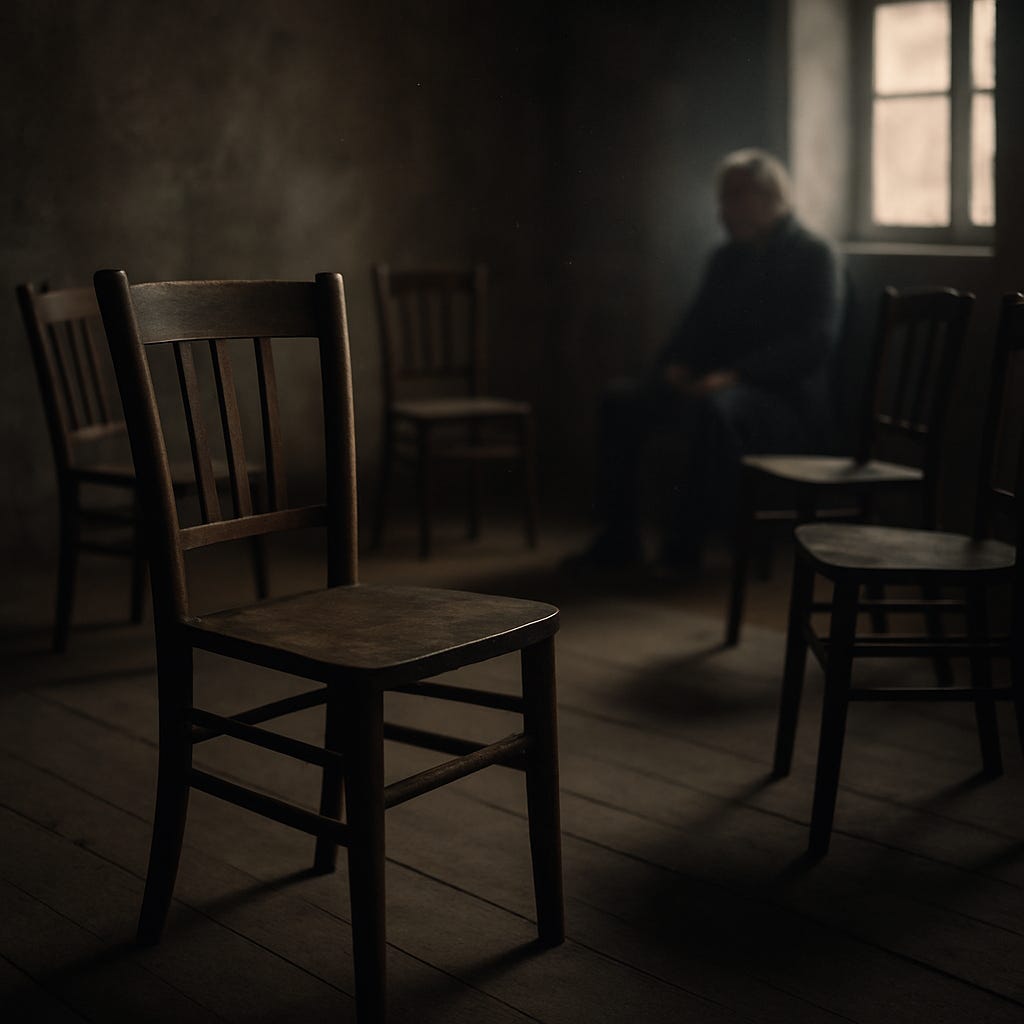
There is an absence at the heart of our time. You can feel it, even if you have no words for it. A kind of spiritual weightlessness — as though no one is holding the ground anymore.
We have information. We have spectacle. We have performance. But we do not have elders.
I do not mean old people. We have many of those — aged bodies in nursing homes, retirement villages, luxury condos. We have old politicians clinging to office. We have CEOs in their seventies steering machines they no longer understand.
But this is not elderhood. It is residue — the after-image of age, stripped of role, stripped of reverence, stripped of transmission.
An elder is something else. An elder is not simply one who has lived long. It is one who has undergone transformation — from striving to stewardship, from accumulation to transmission, from self to community.
An elder carries memory. An elder teaches by presence, not just by word. An elder tells the young: I have seen, I have suffered, I have endured — and still, there is wisdom here. Come, receive it.
Once, the chain was whole. The old taught the young. The young honored the old. Memory moved from hand to hand, voice to voice, generation to generation.
When this chain held, a civilization could endure crisis. Could endure exile, famine, conquest, even collapse — because something deeper was being carried: meaning.
Today, that chain is broken.
The young are spiritually orphaned — cobbling together a self from algorithms, fragments, and noise. The old are isolated or infantilized — treated as burdens, as inconveniences, as obsolete.
And between them lies a silence. A missing transmission. An absence we rarely name — because to name it would expose the poverty beneath our progress.
I do not write this from nostalgia. I do not long for the false pieties of the past. But I know this: without elders, a culture decays in ways no technology can repair.
Without elders, wisdom is lost to data. Virtue is lost to branding. Rites of passage dissolve. Maturity is delayed indefinitely. Old age becomes a medical problem instead of a moral vocation. The young drift — brilliant, connected, anxious, alone. And the old diminish — wealthy, perhaps, but without the dignity of honored memory.
This is not sustainable. It is not human.
And the fact that we do not speak of it — that we have no public discourse on the loss of elders — is itself a symptom of the rupture.
In what follows, I will trace this break. I will show what elderhood once was — in ancient cultures, in pre-modern life. I will name how modernity dismantled it — through urbanization, rationalism, technological acceleration, and the flattening of time. I will draw on the warnings of those who saw this coming: Arendt, Illich, Lasch, Han, MacIntyre.
And finally — I will ask: Is elderhood recoverable? In this collapsing empire of noise and spectacle, can we still rebuild the chain?
I do not know. But I know this: to abandon the question is to abandon the future.
A civilization that cannot generate elders is a civilization that cannot endure.
I. What Elderhood Once Was
Before we can understand what we have lost, we must remember what elderhood once was. This is not a matter of nostalgia, but of civilizational memory. In every culture that endured beyond a single generation, elderhood was not an accident — it was an institution of the soul. Only in the modern West, and now its global imitators, could a generation imagine it no longer needs elders. It is a dangerous amnesia.
In pre-modern life, elders were not ornamental. They were necessary. Without them, a tribe, a village, a nation would not survive. Elders were bearers of memory — transmitting history, lineage, and the sacred. They mediated conflict because they had nothing left to prove. They interpreted the cosmos: priests, sages, shamans, philosophers — those who had contemplated what lies beyond survival. They mentored the young, initiating them into adulthood, virtue, and responsibility. In short, elders anchored the moral and narrative order of a people.
This was not a luxury. It was survival. In Indigenous cultures, Australian Aboriginal songlines mapped vast territories — without them, young men could not cross the desert and live. In Native American tribes, knowledge of seasons, plants, migrations — held by the old — meant life or starvation. In African clans, elders preserved lineage memory through war and displacement. In ancient Israel, elders held the fragile unity of the tribes, the covenant memory that bound the people even as kings rose and fell. In Sparta, the Gerousia balanced the aggression of younger warriors, protecting the state from self-destruction. On the Mongol steppe, the kurultai of elders legitimized leadership; without them, the tribes would have fractured. In Japanese villages, elders preserved agricultural rhythms, flood wisdom, and ritual life — the slow knowledge without which no community endures.
Across these cultures, a pattern emerges. Elders transmitted memory, mediated conflict, gave meaning in suffering, and mentored the young. Elderhood was adaptive. It existed because it was needed. Societies without elders fragmented; those with them endured.
And crucially — elderhood was earned. You did not simply grow old. You became an elder through passage, through transformation. As the young were initiated, so too were the old, moving from accumulator to transmitter. Elders learned to speak with restraint, to guide without domination, to embody presence. They were not mere sources of facts; they were custodians of meaning.
At the heart of elderhood was this principle: life is not given to us only for ourselves. It must be handed on. An elder’s life was a gift to the future. Their authority came not from power, but from their willingness to serve memory and the young. This is why they were honored — not for age alone, but for their orientation toward transmission.
Now we have the skeleton of longevity, without the soul of elderhood. We have more old people than ever, but few are recognized, formed, or honored as elders. We have children exposed to global information, but uninitiated, unmentored, unprotected. We have middle-aged adults caught in performance, with no model of what it means to mature into stewardship. And so the chain is broken.
When a culture loses its elders, it loses deep memory. It loses the ability to suffer well. It loses the capacity for moral transmission. It loses the vision of human maturation. The culture becomes liquid, fragmented, prone to panic — unable to endure crisis. And in an age of civilizational instability, this is not a small loss. It is an existential one.
This is what elderhood once was. This is what we dismantled. In the next section, I will trace how modernity — first slowly, then suddenly — broke the chain.
II. The Unraveling Begins
The chain did not break all at once. The rupture we now inhabit began slowly, under the banner of progress. Like many civilizational losses, it came first as an erosion of need, not an act of conscious destruction.
With the rise of the Enlightenment, a new gospel took hold: the supremacy of reason. It was no trivial shift. In traditional life, wisdom was embodied — passed through persons, not abstract systems. To know was to be initiated, entrusted with memory.
The philosophers of the Enlightenment proclaimed a different path: autonomous reason. Truth was no longer to be received, but derived. Inherited wisdom became suspect. The past became a weight to be overcome. Descartes, Voltaire, Kant — each in their way unseated the elder. If reason is universal and innate, what need for the mediating presence of the old? The consequences were subtle at first. But once wisdom was decoupled from embodied transmission, elderhood began to erode.
Rationalism bred progressivism — the conviction that history moves forward, that the new is inherently superior to the old. In this view, the past was not grounding, but error. The French Revolution declared a Year One, erasing the ancestral calendar. Jefferson proclaimed, “The earth belongs to the living.” In such a frame, elders embodied the past — and the past became suspect. Where once age conferred authority, it now invited suspicion.
At the same time, a quieter revolution unfolded: the rise of print. Before the book, memory was embodied. If you wished to know the law, the seasons, the sacred, you sat with the elder. With the spread of books, knowledge became externalized — unbound from personhood. The apprenticeship model gave way to literacy. Young men could access almanacs, encyclopedias, philosophical tracts without elder mediation. Franklin’s Poor Richard’s Almanack is a telling example: maxims once shared in communal speech were now consumed in print.
Then came the wrenching force of industrialization. The multi-generational household gave way to the nuclear family. Young men poured into factories, leaving elders behind. Cities became youth-heavy, transient spaces — unsuited for elder transmission. In the village, the elder was an anchor. In the industrial city, the elder was an inconvenience. Manchester, Paris, Berlin — these new urban landscapes bred youth autonomy, but also spiritual orphanhood.
Into this volatile brew came Rousseau. In Emile, he proposed that childhood was pure, and society — with its inherited customs — the source of corruption. It was a radical inversion. Where traditional cultures saw maturity as the telos of human life, Rousseau enthroned youth as the moral ideal. The Romantics absorbed this vision. Wordsworth wrote, “Heaven lies about us in our infancy.” And so the veneration of age gave way to the cult of youth.
Step by step, the ancient architecture of elderhood was dismantled. None of this was driven by malice. No philosopher set out to destroy elderhood. But the cumulative result was a civilizational shift. The young no longer needed elders for knowledge. The old no longer occupied central roles. The moral prestige of maturity began to decline. And with each generation, the chain of transmission weakened. The ground was now prepared for the deeper rupture of the twentieth century — when the chain would not merely fray, but break.
III. The Great Rupture
The erosion of elderhood began with modernity. But it was in the twentieth century that the chain itself was broken. Here, the loss was no longer subtle. It became a civilizational wound.
Hannah Arendt named it clearly: the rupture of tradition. The disasters of the twentieth century — two world wars, the Holocaust, totalitarian regimes — shattered the moral legitimacy of inherited wisdom. The old order had produced death camps and gulags. The old order had failed to prevent slaughter on an industrial scale. In postwar Europe and America, the young no longer trusted the old. Arendt wrote: “With the loss of tradition, we have lost the thread that connected past and future.” In this rupture, the elder was no longer seen as custodian of moral meaning. They were seen as suspect — or irrelevant.
At the same time, a new force rose: mass media. Radio, cinema, and then television became the new transmitters of culture. Where once the young sat with elders to hear stories, they now consumed mass-produced narratives, designed for profit, not formation. The elder was bypassed. The narrative authority of the old was displaced by the entertainment industry. A teenager in 1950s America might know more about Hollywood stars than their own grandparents’ stories. A German youth might be shaped more by radio broadcasts than by ancestral wisdom. The chain of face-to-face transmission weakened further.
Then came the explosion. In the 1960s, youth culture did not merely drift from elders — it rebelled against them. In Berkeley: “Don’t trust anyone over 30.” In Paris, the May ’68 student revolts denounced the patriarchal bourgeois order. In Germany, postwar youth rejected their parents’ generation as tainted by fascism. For the first time in recorded history, an entire generation celebrated generational rupture as virtue. It was not merely that elders were no longer needed — they were seen as obstacles to be overcome.
Meanwhile, the old who remained in power — especially in political and corporate life — did not embody wisdom. They embodied bureaucratic stagnation. In the Soviet Union, the aging Politburo under Brezhnev was mocked as a government of the dead. In America, the old Senate elite was seen as corrupted and compromised. The ideal of elder leadership lost its dignity. Age became associated not with stewardship, but with inertia.
And then came the final inversion. Consumer capitalism discovered that youth sells. Teenagers became a market segment. Fashion, music, beauty products glorified perpetual youth. Aging was framed as a problem to be concealed, not a vocation to be honored. The new cultural hero was no longer the elder, but the forever-young consumer.
By century’s end, the architecture of elderhood lay in ruins. The thread of tradition was cut. The narrative authority of elders was bypassed. The moral trust in the old was shattered by history. The cultural economy glorified youth and concealed aging. A civilization that had once honored initiation into elderhood now fled from it. And so the chain broke.
In this new world, the young came of age with no clear rites of passage, no trusted guides. The old lived longer than ever, but were culturally marginalized, medically managed, and economically sidelined. The vertical transmission of wisdom — the slow handing down of memory — was severed. And into this vacuum would soon pour the accelerations of the digital age.
IV. The Digital Severing
The twentieth century weakened the chain of elderhood. The digital age severs it.
Here, the rupture is no longer moral or cultural alone — it is neurological. It reaches into attention, memory, cognition, even the architecture of the self. We now inhabit an era where the formation of consciousness has been captured by forces with no elderhood, no memory, no telos.
We are drowning in information. The velocity of digital data — its speed, volume, and fragmentation — exceeds the human capacity for integration. Lyotard foresaw this: the postmodern condition is one of collapsed grand narratives. Without shared stories, information becomes noise — unanchored facts, adrift in the void. Byung-Chul Han deepens this insight: time itself is flattened. The long rhythms of reflection and maturation dissolve in the eternal present of the feed. In such a world, the ancient function of the elder — to contextualize knowledge, to guide discernment — is bypassed. Why seek a living guide when one can Google endlessly? Why sit with one who speaks slowly when one can consume a thousand fragments in an hour? But wisdom is not data. Wisdom is not acceleration. It requires time, presence, and moral patience — all that the digital order devalues.
Social media completes the inversion. Prestige, once linked to life experience and moral formation, is now conferred by algorithmic virality. A twenty-year-old influencer may command more cultural authority than any elder. A child can become a moral “voice” without undergoing the disciplines of life. In this regime, age becomes a liability. Experience is no longer the currency of trust. Algorithmic charisma replaces embodied presence. The old are not merely marginalized — they are displaced from the role of guiding the young.
Deeper still, the very structure of cognition in the young is now shaped by machines. Historically, minds were formed through dialogue with elders — through speech, silence, and shared life. Now, minds are trained by algorithmic feeds. Attention spans are fragmented. Emotional regulation is bypassed. Moral imagination is shaped by trending content. A thirteen-year-old’s vision of the world may be constructed more by TikTok’s For You page than by family, faith, or elders. And this is not neutral. Algorithms do not transmit wisdom. They optimize for engagement, for stimulation, for consumption. The soul of the young is being trained for market imperatives, not for moral formation.
Meanwhile, lifespans extend — but elderhood does not return. We have more old people than ever before. But they are not elders. They are patients. Consumers. Retirees. There is no public role for elderhood in the modern West, no path of visible ascent from adulthood to moral eldership. Aging is framed as a problem to be managed, a process to be concealed — not as the ripening of the soul. The old are left to consume entertainment or medical care, while the young stumble forward without initiation.
And so we arrive at the present. The young are spiritually orphaned — awash in hyper-information, but unshepherded. Their moral frameworks are unstable. Their psyches fragmented. Their longing for meaning unmet. The old are infantilized — treated as obsolete, their potential as elders unrecognized. Between them lies a vacuum of transmission. The chain is broken. It is not even mourned, for many have forgotten it ever existed.
Without elders, the young improvise selves from fragments. The old suffer invisibility. The middle-aged are trapped in performance, with no model of maturation beyond optimization. A culture that cannot form elders is a culture that cannot sustain meaning. And no amount of digital progress can replace what is lost.
V. Witnesses of the Rupture
We do not lack witnesses. In the long twilight of the twentieth century — and now the twenty-first — there have been those who saw what was being lost, even as the culture raced ahead. Their voices were not heeded by the architects of progress. But they endure, for those with ears to hear.
Here I draw upon five such voices, each naming a different strand of the broken chain.
Hannah Arendt named the central fracture: the rupture of tradition. In Between Past and Future, she wrote: “The thread of tradition is broken. What has been handed down no longer binds us.” Tradition, for Arendt, was not nostalgia. It was the connective tissue between past and future — the means by which a culture transmits meaning. When that thread is cut, the young are disoriented, the old are stripped of role. In such a world, elders lose moral authority, for there is no longer a shared narrative for them to embody. And so the chain weakens.
Ivan Illich, in Deschooling Society, saw another dimension: the institutional capture of initiation. Where once elders initiated the young through organic rites, apprenticeship, and communal life, modern institutions — especially schools — have bureaucratized the process. A generation is now processed by systems, not formed by living guides. Illich wrote: “School is the advertising agency which makes you believe that you need the society as it is.” Initiation becomes consumption. Formation becomes credentialing. The elder’s role as initiator is displaced by the machine. The chain frays further.
Christopher Lasch, in The Culture of Narcissism, showed how modern consumer culture breeds narcissism — a fixation on youth, appearance, and performance. In such a culture, aging is shamed. Maturity is deferred. The old are not honored — they are erased. Lasch wrote: “People today hunger not for personal salvation, but for the feeling, the momentary illusion, of personal well-being.” In this therapeutic age, the very idea of becoming an elder — of undergoing the sacrifices and transformations required — is alien. Everyone is urged to remain young forever: physically, psychologically, economically. And so the chain is not merely broken — it is denied.
Byung-Chul Han, in The Disappearance of Rituals, shows how the flattening of time destroys the conditions for elderhood. Rituals structure human time — marking transitions, honoring thresholds, creating space for transformation. Without ritual, life becomes a continuous present, an endless cycle of optimization and consumption. Han writes: “Rituals stabilize life by creating a firm order of things. They stabilize time, which today is dissolving into a continuous present.” In such a flattened time, there are no rites of passage into elderhood. No recognition of moral ascent. No communal honoring of those who have undergone life’s deeper transformations. The chain dissolves.
Alasdair MacIntyre, in After Virtue, diagnoses perhaps the deepest root: the fragmentation of moral language. Without a coherent moral tradition — a shared telos of human life — there can be no recognized path to elderhood. An elder is not merely old; they embody virtue matured by time. But in a culture where virtue itself is fragmented, where moral narratives have collapsed into individual preference, what is there for an elder to transmit? MacIntyre writes: “We live in a culture which has long since discarded the notion of a human telos.” Without a shared sense of what it means to live well, the role of the elder becomes unintelligible. And so the chain is forgotten.
Arendt names the rupture of tradition. Illich names the bureaucratization of initiation. Lasch names the narcissism that shames aging. Han names the loss of ritual time. MacIntyre names the collapse of moral coherence. Together, they reveal a culture where elderhood cannot arise, cannot be seen, cannot be honored. Not because the old have nothing to give — but because the structures that once made transmission possible have collapsed. And so the chain lies in ruins.
VI. The Three Wounds
We speak of progress, of information, of longevity. But beneath these metrics lie deeper wounds — unspoken, systemic fractures in the moral architecture of our time. These are not technical problems to be optimized. They are the signs of a civilization that can no longer transmit itself.
First, we face a surfeit of information without wisdom. We have more data than any generation in history. What once required years of apprenticeship is now instantly accessible. But information is not wisdom. Wisdom requires time, context, and the presence of elders — those who speak not from novelty, but from depth. In a flattened digital culture, wisdom drowns beneath the noise. Attention fragments. Memory is outsourced. Discernment collapses. The young swim in an ocean of information, yet with no embodied guides to help them orient. And so they drift. A culture that cannot contextualize knowledge cannot sustain wisdom — and without wisdom, it cannot endure.
Second, we face a world of aged bodies without elders. We live longer than our ancestors dreamed. We extend life through medicine and technology. Yet we do not honor elderhood. We do not form elders. We have aged bodies, but few true elders. We build retirement homes, but no public rites of passage into elderhood. We invest in anti-aging industries, but no moral architecture for aging well. We cultivate wealthy old elites, but few who serve as stewards for the young. In such a culture, aging becomes a problem to manage, not a vocation to fulfill. The old are diminished — treated as patients or consumers, not as custodians of memory. And the chain breaks further.
Third, we face a generation of spiritually orphaned young and isolated old. The young come of age without clear rites of passage, without trustworthy elders, without a coherent moral telos. Their minds are shaped by algorithmic feeds, not by the slow presence of wise guides. Their selfhood fragments — performative, anxious, unmoored. Meanwhile, the old, though often economically secure, are culturally invisible. Their potential as elders is neither recognized nor called forth. Between young and old lies a widening vacuum — no bridge, no transmission. The vertical chain collapses.
Together, these wounds name the condition of the Age Without Elders. A culture that cannot transmit wisdom drifts toward nihilism. A culture that cannot honor age remains trapped in perpetual adolescence. A culture that severs the chain between generations will lose its memory — and then its future. We have reached the precipice. The question now is not how to optimize this system, but whether we have the courage to remember what we have lost. For a civilization that cannot generate elders cannot generate endurance. And without endurance, collapse is only a matter of time.
VII. What Comes Next?
Can elderhood be recovered? Or is the chain too broken, the rupture too deep? I do not offer easy answers. There are losses a civilization may not undo in a single generation. There are structures that, once dismantled, cannot be rebuilt by will alone.
But this much is clear: if elderhood is not intentionally restored — even in remnant form — we will drift further into a condition of permanent orphanhood. The task before us is not technical. It is civilizational. It is spiritual. It will not be accomplished by policy, nor by platform, nor by program. It will require acts of quiet courage — counter-cultural acts, in the deepest sense.
First, we must recover rites of passage. Without communal markers of transition, human beings remain suspended — trapped in prolonged adolescence or performance-driven adulthood. We must mark the coming of age, the entry into mature adulthood, the ascent into elderhood — not as nostalgic replicas of the past, but as necessary forms of structured transformation. Without such rites, life becomes liquid. The vertical chain cannot hold.
Second, we need those willing to become elders, even when the culture does not confer the title. This is a choice — a moral stance. It means refusing the cult of youth. Refusing the flattening of time. Embracing disciplines the machine does not value: radical presence in an age of acceleration, stewardship of memory in an age of erasure, moral imagination in an age of cynicism, courage to transmit hard-won truths in an age of performance. Those who take this path must do so without expectation of recognition. They will often stand unseen — like monks in the ruins of empire. Yet their presence matters. It matters for the young, who beneath their digital fluency are starving for real initiation. It matters for a culture that may yet remember what it means to generate depth.
Third, we must build spaces where elders and young can meet — beyond the noise of algorithmic life. Such spaces are rare. They must be protected. They will not arise in the default structures of the market. They must be cultivated — in recovery communities, in ritual circles, in apprenticeship guilds, in faith communities, in small, intentional circles of transmission. Without such spaces, young and old will remain isolated in their respective silos — starved of the human encounter that binds generations.
The obstacles are immense. The attention economy will resist any move toward elderhood — for elderhood is unmonetizable. The flattening of time discourages the patience required for elder formation. The loss of moral coherence leaves many unsure what an elder would transmit. The narcissistic culture shames aging itself. To choose the path of elderhood now is an act of spiritual rebellion.
And yet without this rebellion, we drift toward collapse. A civilization that cannot form elders is a civilization that cannot endure crisis. It will panic. It will fragment. It will feed its young to the machine and warehouse its old in silence.
The task before us is not to restore the old order. That is neither possible nor desirable. The task is to forge new forms — new vessels for transmission — so that some part of the human chain remains unbroken.
If you would undertake this, know that it is not a role of prestige. It is a role of witness. It is to stand, often unseen, in defense of memory. It is to choose depth over performance. It is to hold space for the young — not as a performer, but as one who has suffered, endured, and learned.
And if enough do this — even in fragments — the Age Without Elders need not be the end of the story. It may yet be the silence before the rebuilding.
Closing
There are losses a civilization can measure. And there are losses it barely dares to name. This is one of the latter.
The loss of elderhood is not an academic concern. It is not a niche cultural debate. It is a fracture at the heart of the human story. When the old no longer guide the young, the future becomes a void. When the chain of transmission breaks, a people forgets how to endure. And when wisdom disappears beneath the flood of information, the soul starves — though the feeds keep scrolling.
I write this not as one who stands apart, but as one who lives within the ruin. I do not imagine that a few essays, a few voices, will restore what has been lost. We live in an age of deep acceleration, of cultural amnesia, of disfigured time. But even in such an age, memory matters. Witness matters. To name the loss is to refuse its finality.
To those who feel this absence — who sense beneath the spectacle a hunger for what the culture no longer provides — know this: you are not wrong. You are not alone.
And if you feel called to become an elder — even without title, without recognition, without institutional place — know this also: you will be needed.
The young are already seeking, though they do not yet know where to look. And in the years to come — as the illusions of endless optimization begin to crack — they will seek more urgently.
If even a few stand ready — in presence, in patience, in moral clarity — the chain will not be utterly lost.
We do not need new content. We do not need new brands of wisdom. We do not need more platforms. We need elders.
We need men and women who will stand — rooted in memory, bearing witness across time. Who will speak when the spectacle fails. Who will remain when the noise collapses into silence.
Who will say to the young, when they finally come asking: You are not alone. You were never meant to be alone. Come. There is still something worth inheriting. And I will help you remember.
The Age Without Elders is not a final sentence. It is a condition. It can be named. It can be resisted. And in that refusal lies the first act of rebuilding.
—Elias WinterAuthor of Language Matters, a space for reflection on language, power, and decline.